
Politics Always Wins
Episode 3 | 55m 47sVideo has Closed Captions
The arrival of the International Space Station promises a new era of cooperation in space.
The Mir’s reign in space comes to an end with the arrival of the International Space Station. A new dawn of co-operation awaits, offering hope for a divided world.
Problems playing video? | Closed Captioning Feedback
Problems playing video? | Closed Captioning Feedback
Politics Always Wins
Episode 3 | 55m 47sVideo has Closed Captions
The Mir’s reign in space comes to an end with the arrival of the International Space Station. A new dawn of co-operation awaits, offering hope for a divided world.
Problems playing video? | Closed Captioning Feedback
Where to Watch Once Upon a Time in Space
Once Upon a Time in Space is available to stream on pbs.org and the PBS app.

Share Inspiring Moments From The Film
Explore the PBS Giphy collection for Once Upon a Time in SpaceProviding Support for PBS.org
Learn Moreabout PBS online sponsorship[gentle music] GINGER KERRICK: When I was five years old, I used to go to the library with my parents every Friday, and I remember being really excited about this book, and it was titled Astronomy and Astronauts.
There was something that just spoke to me.
It was very strange.
I remember reading a passage just about what it felt like when the astronauts stepped outside, and how they looked at the Earth.
And I thought, oh my gosh, I, I want to be a part of that.
I want to see that.
And it stayed.
It wasn't one of those, oh, I like dinosaurs or I like this other thing.
It wasn't a phase.
It really spoke to something in my soul.
[explosion] So in May of '95, I applied to be an astronaut.
I thought, okay, well, I'll probably get a rejection letter.
I'm only 26 years old, but I'll frame it and be proud that I finally applied.
But instead I got a call.
3000 people had applied, and I was one of 120 that they wanted to interview, and I lost it.
And I called everybody.
I called my mom, I called my sisters.
I was really, really excited.
But during the medical tests, turns out I had kidney stones.
Back then, if your body shows the ability to form even a single stone, it's a lifetime disqualification.
INTERVIEWER: Lifetime disqualified for being an astronaut.
Yeah.
So I... I remember being home at that weekend and just crying.
And then Monday afternoon, Duane calls me, the head of the selection office, and he just said, are you okay?
And I'm like, no, I'm not okay.
[uncomfortable laugh] Would you be okay?
My life is over.
and I just let it out.
And it was at that moment when I... It's like I could hear myself, and... And I thought, no, no, no, no, no, no.
This is not me.
I am strong, I am fierce, I can handle anything.
And he said, Ginger, have you ever considered working in mission operations, maybe as an astronaut trainer?
You know, for the International Space Station.
MALE SPEAKER: The first stage of the International Space Station is marking the beginning of a new era of international collaboration to embark on what's been described as humankind's most ambitious endeavor to date.
So I just kind of had to take some deep breaths and... reconsider.
I can never go into space.
I can never visit the space station.
But if I started teaching the astronauts, even though I can't go, each one of them can like take a piece of me with them.
Something I've taught them, something I brought to them, and I thought, okay, I can, I can buy that.
I can sell that to myself.
[slow guitar strumming] [applause] MALE SPEAKER: In 1984, President Reagan proposed building a permanently manned space station.
Since then, the cost estimate has ballooned to nearly $100 billion.
MALE SPEAKER 2: In the early days during the space race, it would have been unthinkable.
Now, in an effort to save money and show his support for Boris Yeltsin, President Clinton has proposed that NASA work with the Russians in building a space station.
MALE SPEAKER 3: I t's the most complex engineering project ever undertaken.
The first section has been built by the Russians, but the project is led by NASA.
It's a pleasure to welcome the astronaut class of 1996.
We are very soon going to begin the assembly of the International Space Station.
And I can't wait to have them on board.
Good afternoon, I'm Dan Tani.
My hometown is Lombard, Illinois, a suburb of Chicago, where I worked in an aerospace company.
I couldn't be more excited and proud to be here.
And hi, Mom.
Good job.
Saying saying hi to Mom.
[laughs] So, you know, I was eight years old when Neil and Buzz landed on the moon.
And I remember everybody was space and astronaut crazy at that time.
But I certainly had no interest in space or... or exploration.
Baseball player was absolutely what I wanted to be.
Then, actually, I wanted to be a stand up comedian because one of my idols was George Carlin.
Two minutes before you die, you receive an audible warning.
Two minutes, get your [bleep] together.
[laughter and applause] But my real interest was how people use machines.
I like the human interface of how a ballpoint pen works, or how a shampoo dispenser works.
I love that stuff.
But one of the games you play as a senior is, hey, where can I interviewed for free?
And so I look at the... all the companies that are interviewing.
And one of them was a space company out in California.
I thought, well, let me go talk to them, because if I can get a free trip to Los Angeles, that'd be kind of fun.
MALE SPEAKER: Located in El Segundo, California, Hughes Space and Communications Group is one of the largest satellite manufacturers in the world.
DAN TANI: It was during my spring break, so it was snowing in Boston, and it was 75 degrees in Los Angeles.
And I went to the beach and watched people roller skating up and down and playing volleyball.
[upbeat music] And I thought, it'd be silly to turn this down.
I mean, from a lifestyle point of view, this is going to be a ton of fun.
So I moved to California, bought my convertible, and living near the beach and just goofing around in the design department of this aerospace company.
And that's where I ran across, you know, my my buddy Gus.
We were young.
We had money.
No commitments.
As nerds... [laughs] It was amazing.
When we met at Hughes.
DT was the young buck.
He was smarter than all of us.
[camera clicks] But let's be very clear here.
He didn't give a rat's ass about space.
It was just an excuse to come live on the West Coast.
And if he denies that and says, oh, no, it's because I wanted to be an astronaut, he is lying.
Carlos is... He's a lot of personality, right?
And so when you're bringing a new friend in or introducing Gus to somebody, you have to sort of set the framework.
He's going to be a lot at the beginning, but you stick with it, because once you can get past that, there's a lot of sincerity and a lot of... a lot of big heart going on behind it.
Space was a dodge for him, okay.
Space was like, eh, I'm doing this for the paycheck.
I don't care about any of this stuff.
Whereas someone like me, it's everything.
My mother claims when I was but a young toddler, and I'd been fussing and carrying on and making trouble all day, and then they put on this launch.
MISSION CONTROL: Three, two, one, zero.
Ignition.
And apparently it was night and day.
I went from troublemaking screaming, yelling, crying to [whoosh!]
locked on the TV.
Just locked on.
To her last breath, my mother claimed that's when she knew.
That my destiny was determined.
Get good grades.
Work hard.
You're going to space, son.
RADIO: Okay, I'm on.
GUS GARDELLINI: And for me, the shortest distance there was studying to be a rocket scientist.
So, of course, I applied to the astronaut corps.
That rejection letter that I got... You know, that was NASA essentially laughing at me.
Now, again, I'm being overly melodramatic.
I had no shot at this.
Didn't even make the first cut.
And then I moved to Houston, and I applied two more times and of course, failed there, too.
So I applied a total of three times to be an astronaut.
Failed at every one.
INTERVIEWER: What is it do you think that successful candidates had that you didn't?
They have the right stuff.
I don't.
They had the right stuff.
I don't.
DAN TANI: After I left Hughes, I got offered a job with a small aerospace company outside of Washington, D.C.
And somebody said, yeah, there's a notice up that they're taking applications for the new astronaut class.
INTERVIEWER: What made you apply?
Do you think?
Why wouldn't you?
Like, why wouldn't you send your application in?
I had no hope of becoming an astronaut.
I just wanted to play the game and participate.
You know, I say it's like you buy a lottery ticket and you put in your back pocket and you forget about it, and, you know, all of a sudden, you find out that your number has got called.
It's the shock of your life.
And then that's when the imagination started going crazy.
I was like, holy cow, I'm actually going to go to space.
The desire to be an astronaut started that moment.
I didn't have the desire till it became a real possibility.
GUS GARDELLINI: I've dreamed about this.
I've worked for it.
I've striven for it my whole life.
And he walks into it and they hand him the keys to the kingdom.
But there wasn't jealousy on my end.
I was just awestruck that he got in.
This is incredible, Dan.
Where do we go from here?
Wow.
Maybe kind of lose respect for NASA.
[laughing] That's mostly kidding.
We're here at NASA's Johnson Space Center in Houston, Texas, where this mockup is used for training.
The real thing was built in Russia, and so it's called the Zvezda, which is Russian for "star".
When completed, the station will be as large as about two football fields and will be able to be seen with the naked eye.
Those are just your regular ISS... DAN TANI: When I was selected in '96, we had not flown any element of the International Space Station yet, but we were testing the first modules on the ground.
You know, there was 35 of us.
That's a huge number of new astronauts.
They needed a big class because they anticipate a lot of flights and a lot of spacewalks and all that was just music to our ears.
All right.
We're starting off a little late.
Wanted to give people a chance to come in from the rain and grab a cup of coffee.
There are a number of different assemblies and components we're going to talk about today.
GINGER KERRICK: When I became an instructor for the astronauts, my first crew was Expedition 1.
[indistinct dialogue] And that was the first crew that was training to fly on board the International Space Station.
Yuri Gidzenko, Sergei Krikalev, and Bill Shepherd.
So you're like 26, 27 when you were given Expedition 1 to take care of.
Yeah.
Oh, yeah.
I was young.
Feisty but young.
[chuckles] We were a little Expedition 1 family, and we did everything together.
And I quickly realized that I needed to live in Russia, because if I was going to be wherever the crew was, they were in Russia 70% of the time.
So I put everything in storage, and I moved out there.
I loved it.
Oh, I loved it so much.
This is my room.
I just cleaned it.
See?
Computer's always on.
These are wonderful people with rich history of human spaceflight that we have a lot to learn from.
We have not really worked on long duration space flight missions.
Russian counterparts had the Mir space station, so they understood it.
And they'd been doing this a long time.
[indistinct Russian dialogue] So space provided a common goal where we could show the world that the U.S.
and Russia can actually work together and create something that people have never seen.
[upbeat electronic music] FEMALE SPEAKER: The International Space Station is taking a big step from dream to reality.
The crew of the shuttle endeavor has put together the project's first two major components.
They linked a U.S.
built passageway to a Russian built module.
DAN TANI: NASA utilized the Mir space station as a bridge to the ISS.
It gave us a lot of experience training for and going to live on a space station.
So American astronauts have been spending six months there.
All of the reports we were getting back is that's a real slog.
Of course, they had the fire and the collision and depressurization.
And so we knew that it had survived a couple of catastrophic events.
You knew it was kind of old.
You knew the technology was a little outdated and that, like your car, you know, at some point it just makes sense to buy a new car than to keep fixing the stuff that's breaking.
It's... you want to drive the Lexus or you want to drive the Lada?
The enormous international plan to build a permanent scientific station in space is not only behind schedule, it may cost the United States much more than the U.S.
had planned.
MALE SPEAKER: Russia has fallen almost a year behind building this critical section called the service module.
Many U.S.
officials say cooperation is still worth it, even if it is expensive.
It keeps the Russians friendly, and it helps bolster the U.S.
presence in space.
For the first time in more than ten years, no human is orbiting the Earth.
That's because Russia's Mir space station is now empty.
Mir mission director Vladimir Solovyov still hopes some extra money will be found to keep it in space, but knows time has run out.
[phone rings] I was at home and the phone rings and it's Mr.
Walt Anderson, and he literally opens the conversation by saying, I'm thinking about buying the space station.
I'd like you to help me.
What?
[laughs] INTERVIEWER: And it's a guy called Walt.
- Walt Anderson.
Correct.
- Friend of yours?
At that point, I've done just over a decade.
Carlos was totally and absolutely certain about the development of space, that that was the right thing for mankind to do, and it was important.
And I agreed with it.
So we got along pretty well.
I think if there's something important enough in your life that you think about it more than anything else, that's an obsession.
INTERVIEWER: And are you obsessed?
Oh, yes.
[laughing] Oh, yes.
GUS GARDELLINI: The public belief was only NASA can do space.
So if I can short circuit that by joining other like-minded individuals, then I'm going to do it.
You jump ship.
Where's my jetpack?
Where's my lunar colony?
Where's my flying car?
In the 90s, many of us were very frustrated and we decided to take matters into our own hands.
Hi, I'm Gus.
I'm the one taking these shots.
Hi, Mom.
We called it New Space, and we were a community preaching that it's not just governments that can do space.
It's not just NASA that can do space.
We got these crazy, insane entrepreneurs with these crazy, insane ideas, and they band together to show the world that private companies could do great things in space.
[cheering] The problem was, who's got money that wants to put it in commercial space?
There was only one game in town, Walt Anderson, you know, one of the most successful entrepreneurs I've ever known.
INTERVIEWER: And do you know how he made his money?
Telecoms.
At a time when telecoms were exploding in growth, he rode that wave, man.
[phone rings] So you make your money in telecoms, and then you throw all of it away in space.
WALT ANDERSON: To me, the idea that we would save the Mir and use it for commercial and scientific purposes was an interesting idea.
I mean, who wouldn't want to own a space station?
GUS GARDELLINI: And we quickly agreed.
Well, we got to go out and meet the Russians.
[jet engine hums] WALT ANDERSON: We wanted to impress them.
We wanted to show them we were real and had some resources.
So we thought taking the private jet was a good move.
GUS GARDELLINI: The brief in Russia is very simple.
Can they work with a Western partner?
Are they thinking that we can do this deal together?
Or they're going to throw us out on our ass.
WALT ANDERSON: They sent a car for us, drove us out to their headquarters, which a few years before would have been a closed place that no Westerner could ever think about going in.
MAN 1: Okay, I hope you're ready.
MAN 2: We are ready.
GUS GARDELLINI: As soon as that door opens, we're under tremendous pressure, and we know that we're being studied.
We know that they're looking for any weakness.
[indistinct conversation] WALT ANDERSON: It started out very tense.
I mean, obviously, the geopolitical relationship between Russia and America has always been fraught.
And it was a difficult time in terms of the trust.
We'd worry about that later.
So we could form a company.
That company could... We could set up this relationship between us.
WALT ANDERSON: But we weren't there as Americans.
We were there as developers of space for all mankind.
And that's that's the approach we took.
I understand you have some need for both the commitment, number one, but actually to see some real money because commitments... You had some problems with commitments before from some other people.
This agreement has to be pretty well worked out.
And I think that's going to take a while.
WALT ANDERSON: Surprisingly, the positions we staked out turned out to be compatible.
You know, we had very similar goals.
They wanted to save the Mir.
[indistinct conversation] GUS GARDELLINI: Walt Anderson.
His desire is to dare mighty things, and to dare mighty things would be to set up with your private banker in advance that there will be a code phrase.
And when that code phrase is proffered... Bam!
Speed of light.
Seven million U.S.
dollars, pst!
Transfers from Walt to the Russians.
INTERVIEWER: What was the code word?
I don't remember.
Carlos probably does.
"Mir for peace."
Mir for peace.
- [indistinct] - WOMAN: To success.
MAN: Yes, to success.
MALE SPEAKER: The Russian space program, once a crown jewel of communism, has gone completely capitalist.
This morning, an American entrepreneur signed a contract to lease Mir from the Russians.
WALT ANDERSON: There are customers that want to do pharmaceutical manufacturing.
There are people who want to travel to the Mir as space tourists.
All those things are possible.
ANNOUNCER: Ordinary Americans will compete for one chance of a lifetime.
A trip into space.
Destination: Mir on NBC.
I remember hearing about MirCorp and his involvement and his new passion.
We're going to do it.
We're going to do it.
DT, we're going to do it.
I remember being skeptical.
But, you know, you never underestimate Gus, right?
He's a big dreamer.
And some of those dreams can come true.
INTERVIEWER: Had anything like this being proposed before?
I mean, is this new territory?
At that point?
No, I had never heard of anything like that before.
Especially the commercialization aspect.
You know, buying something that the government owns and then running it as a for-profit company.
That was a completely new.
MALE SPEAKER: The possibilities have long been apparent for the cash-strapped Russian space program -- cosmonauts and commercials, product placement and mission control.
Put your logo on a Russian rocket.
This is just one small step for mankind, but a giant leap for Pizza Hut.
But wait.
Isn't Mir that creaky old space station the Russians were going to ditch?
It is, but engineers say it's worst problems are fixable.
GUS GARDELLINI: Whenever you buy a building.
The site survey is critical, right?
You send out someone to evaluate the building, the foundation, the structure, the electrical and then you make the go, no-go decision.
We needed to see if it's worth saving.
Hence the first flight.
INTERVIEWER: Who went?
Two privately hired cosmonauts.
Paid for by a private company, MirCorp.
FEMALE SPEAKER: A few months ago, it looked like the Mir's days were numbered, but cosmonauts Sergei Zalyotin and Aleksandr Kaleri are under orders to patch it up and keep it orbiting.
FEMALE SPEAKER: Early this morning, two cosmonauts suited up for a mission few people thought would happen again, a manned flight to Mir.
Thanks to MirCorp, Russia's national space program is back in business.
FEMALE SPEAKER 2: The cosmonauts know they're heading for a crumbling 14-year-old space station which has been plagued by accidents and breakdowns.
[Russian radio chatter] [fanfare] [indistinct chatter] So of course, they found a lot of problems.
We expected that.
But there was no showstopper.
There's nothing here that would prevent us from doing MirCorp.
The building will stand.
It was that simple.
MALE SPEAKER: Today, MirCorp marks a first: manned space flights are being made available to private citizens through a business-oriented non-governmental company.
GUS GARDELLINI: This is the moment we dreamed of our whole lives.
A regular person going to space.
This is business plan 101.
First customer.
FEMALE SPEAKER: 59-year-old Dennis Tito, a California millionaire businessman, is in training to be a cosmonaut, Russian style.
WALT ANDERSON: We negotiated a deal with him to be the first tourist on the Mir.
He signed an agreement and we are feeling positive.
I always followed space.
I always loved space.
I always imagined what it would be like to look at the Earth from space.
WALT ANDERSON: We were getting newspapers all over the world.
There is no bad news.
Everyone thought it was very cool to have a private space station.
And in fact, even the NASA employees thought it was kind of cool.
When you got higher into the political side of NASA and the White House, it was different.
[applause] Thank you.
WALT ANDERSON: It really surprised me later to learn how unhappy they were about our business.
[indistinct chatter] GINGER KERRICK: For years, supporting the crew as they trained for the International Space Station.
It seemed launch was always right around the corner.
But something would usually happen and our launch would get delayed.
Everyone knew they were going to launch at some point, but it really wasn't real yet.
GINGER KERRICK: But when we got in that plane to go from Star City to Baikonur, Kazakhstan, that meant it is real.
It was so emotional.
You know, all these years, everything was... There's no time for emotions.
I got to get these guys ready.
But now I'm like, oh my gosh, those are my babies.
And they're going off into space.
And how am I going to, you know, what's going to happen?
MALE SPEAKER: Yuri Gidzenko in the middle and Bill Shepherd heading to the launch pad.
It's part of the journey to begin the permanent occupancy of the International Space Station.
GINGER KERRICK: And I'm like, getting nervous and, it's going to be okay, it's going to be okay.
And then they go up the stairs and they disappear.
They went inside the hatch and they closed the hatch.
MALE SPEAKER: It's actually the very launch pad that has been used for every crewed launch from Baikonur, including that of the first human to be sent into space Yuri Gagarin almost 40 years ago.
And there was something inside me that kind of lost it a little bit, and I started hyperventilating [chuckles] because I couldn't see them.
And there was a gentleman that came up and he's like, oh, it's okay.
Come with me, come with me.
So he starts parting the crowd, and it was really tightly packed.
And he said [speaking Russian], which means it's the mother of the crew, it's the mother of the crew.
[laughs] And he finally fights my way up front and there's a smaller TV screen and he's [speaking Russian] Look at them.
Everything's okay.
And I could see them now inside the capsule.
And then all of a sudden I'm like, okay.
[exhales] But it was... I feel like an idiot.
It was the silliest thing because I knew they were safe.
I know that they're trained and I know that they're ready, but I wasn't ready.
I'd spent so much time focusing on them that I didn't realize what this whole experience was going to do to me.
And... I was terrified.
MISSION CONTROL: Minus ten seconds.
Nine, eight, seven, six.
We have engine start.
Four, three, two, one.
We have ignition.
We have ignition and liftoff.
Liftoff of the Soyuz rocket, beginning the first expedition to the International Space Station.
And setting the stage for permanent human presence in space.
MALE SPEAKER: The Soyuz launch from Kazakhstan symbolizes a way of life in space that could last for a while.
The crewmen aboard will be the first resident crew of the International Space Station, and will stay there for four months.
After they dock in two days, they will be the first in a series of crews that will occupy the station for more than ten years.
[ethereal music] MALE SPEAKER 2: Commander Shepherd has the prerogative of being the first to enter the station, but he has deferred in an offer of conciliation and respect out of the partnership to allow his Russian crew member to enter the station first.
BILL SHEPHERD: Let's look upon this as the real opening of the international space frontier, not just for a country, but for Russia, America, Europe, Japan, Canada, and all that will follow.
GINGER KERRICK: The moment they open that hatch and set foot in that module, we set a clock.
We are living on the International Space Station, and there won't be a time where we don't have people living in space.
That was our intention when we designed the space station, to always have people onboard.
I knew that I was taking part in history.
Very few people get the opportunity to to do that.
We are here and we are here to stay.
FEMALE SPEAKER: Last year, the Russians announced they would scrap their old space station Mir and focus resources on the new International Space Station.
Instead, they're now repairing Mir.
MALE SPEAKER: Russia's revival of Mir is a slap in the face at NASA.
This debacle has already delayed the International Space Station for over two years, and cost is several billions of dollars.
NASA were pissed.
They were like, here's this mosquito buzzing around us.
Somebody swat it.
NASA was given a priority by the president of the United States.
The International Space Station is the way we're going to go forward in partnership with the Russians to maintain peace in the world.
We have a unique opportunity to cast aside the suspicions and doubts that used to plague our nations.
Russia is not the enemy of the United States.
GUS GARDELLINI: And for that to happen, we need Mir to go into the ocean.
Swap these [bleep].
The most powerful entity on Earth, the US government.
is going to put a cross on your face, and they're not going to miss, babe.
They're not going to miss.
If we found that the Russians were going to fund Mir and continue its operation and not fund the International Space Station, there would be very serious levels of concern on our part.
And I remember I was in a cafe just reading the Times, and holy cow, what is this?
"American mega millionaire gets Russki space heap, sells joyrides to fellow tycoons!
NASA fumes!"
There's Uncle Sam crying and there's Wacky Walt doing the deal with the Russians.
That was the first.
And then came all the other ones, [exhales sharply, imitates explosion] Here.
Watch this.
This is actual official NASA footage of the space station Mir.
And we're supposed to feel good about this?
You know what I'm talking about?
This is what this is.
It's a Hyundai.
[laughter and applause] GUS GARDELLINI: Politics always wins.
Politics always wins.
INTERVIEWER: Why not just sort of use the Mir?
I mean, you could have, but where's the national pride in that?
Where is the sense of accomplishment in that, having our own space station would be our way of demonstrating that we are the leaders in human spaceflight.
We couldn't have done that by just using the Mir space station, because we couldn't control what the the overall purpose was or the overall vision for the Mir space station.
So we needed to create our own.
And it's the beginning of the end for the Russian space station Mir.
This morning, a Russian rocket took off, sending the final unmanned cargo ship to the Mir.
The ship is carrying fuel that will be used to nudge the Mir out of orbit.
And according to plan, into the Pacific Ocean.
MALE SPEAKER: The operation seems to be going without a hitch.
The live pictures on the screen behind me are the last that will ever be seen from Mir.
[plaintive music] [indistinct Russian dialogue] [static] [deep sigh] People ask me, would I do it again?
And I say yes, I would do it again.
I mean we hadn't achieved everything we wanted to do, but we did get the first citizen explorer to space.
Dennis Tito finished his training, but the Mir wasn't there for him.
So he got to go to the Russian side of the ISS.
Now, NASA was very pissy about that and difficult.
But the Russians had built much of the station, so had every right to bring a passenger up.
That was something.
It was a tiny bit of positivity in a overall negative situation.
MALE SPEAKER: 245 miles up, a Soyuz spacecraft docks with the International Space Station today, which opens its hatch to the tourist NASA doesn't want.
Dennis Tito, smiling broadly, after convincing the Russians he had the right stuff -- $20 million of his own money.
[indistinct Russian radio chatter] Look, it played out the way it had to play out.
It was a great, audacious dream.
It wasn't meant to be from the very, very, very beginning.
25 years later, I think there's a strong argument that can be made.
We're now where MirCorp was 25 years ago, except it's working.
Richard Branson is sending people to space.
Jeff Bezos is sending people to space.
Elon Musk is sending people to space.
The dam has burst.
There's no looking back.
[cheering and clapping] That's why, you know, when you asked me, you know, how disappointed were you you didn't become an astronaut?
How disappointed were you that this company failed?
How disappointed were you with the MirCorp?
Why did you step away?
It is essentially my life history that most of the things that I participate in are going to fail.
And that's okay.
You know, there are some places in your life that you never expect to be.
And standing here at this mic is one of them.
And I'm really obviously excited to be here.
Thank you all for coming out.
This is an absolute dream come true.
And believe me, it's as exciting and fun as you think it is.
[bright electronic music] Wild horses couldn't have kept me from seeing my best buddy DT launch in space.
Or as we put it, Dan goes on a business trip.
We're on our way.
We're almost to the Cape now.
We're pumped.
We're ready.
We were giddy.
We were nervous.
We were expecting the greatest show of our lives.
And we got it, man.
Can't describe it, man.
Got to be there.
We're at three miles.
Closest any human is.
DT is just being latched in right as we speak.
20, 30 minutes, roughly.
- Countdown time.
Right?
- Yeah.
There is a certain feeling of, well, if I can't go, I'm glad a buddy I know gets to go.
We felt, in our own naive way, like, you know, we're kind of part of the entourage.
ANNOUNCER: Ten, nine... [indistinct] Six, five... - This is it, I feel it.
- You got it.
We're on.
ANNOUNCER: ...two, one.
[crowd cheers] [rocket rumbles] MAN: Oh my God!
[crowd applauds and cheers] [triumphant music] We did it!
We watched.
That was cool.
Look, it's up there.
Check it out.
[indistinct excited chatter] Oh!
[man whoops] [music crescendos, then stops] I'm, uh... You can't see me because the tanks here.
But I'm at the tip of this big fireball.
Probably now is the time I'm thinking, holy cow, I'm sitting in a freaking space shuttle.
[rocket roars and flares] [laughs] All of a sudden, you're in space.
Looking at my home planet, you get this pride of ownership of I can't believe I'm from there.
I'm so happy to be a citizen of that planet.
[mellow music] And there's what looks like a bright star on the horizon.
And... and hey, that's the station.
We're 50 kilometers away.
We talk about it when we practice it, simulate it.
But once you see it for real, wow, that's that's really cool.
Here we come.
Pretty soon you can see the solar rays, and then you get closer and closer.
And then at some point you're thinking, we're really close to this thing.
It's taking up the whole window and you're going to touch it, you're going to dock to it.
It's like you're going to Oz, you know.
[laughs] It's glimmering, it's beautiful.
It's an incredible thing that we humans have made in an incredibly hostile environment.
It's quite, quite something.
It's really fantastic.
MAN: 21-2.
21-2.
There's eight inches.
Four inches.
Flight control power off.
MISSION CONTROL: Great job.
- Good job.
- Yeah!
[whooping] Good job!
[indistinct dialogue fades out] [mellow music continues] INTERVIEWER: Which station is better?
GINGER KERRICK: The space station was designed so that neither the US nor Russia could operate the vehicle independent of one another.
It was intended to be able to withstand any political turmoil that might exist between our countries at any given time.
The power system, those huge solar arrays that you see that power the entire space station is controlled by the U.S side.
The propulsion system, however, is managed on the Russian side of the vehicle.
So the U.S.
keeps the power running and our Russian counterparts make sure that we can stay in orbit with the right propulsion.
Ultimately, it was designed to function only if we're cooperating.
Well done, whoever thought of that.
Because it's helped us survive a couple of bumps in the road.
I love that part about it.
But there are things that we didn't predict.
Things we weren't prepared for.
JAMES MARKS: Russia is poised with its military forces to conduct an invasion.
As we went over the eastern part of Ukraine, all of a sudden there were little red flashes and we were watching bombs go off.
We were literally watching people being killed from space.
MALE SPEAKER: There is a creeping realization that 30 years of progress may be about to end.
GINGER KERRICK: Are we no longer going to be able to work together?
Is this going to destroy what we created?
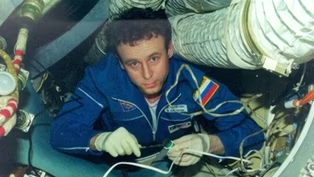
“Vodka did not go down well in space.”
Video has Closed Captions
Clip: Ep3 | 1m 28s | Sergei Zalyotin offers invaluable advice about what alcohol to drink in space. (1m 28s)
Providing Support for PBS.org
Learn Moreabout PBS online sponsorship New Episode
- Science and Nature

Explore scientific discoveries on television's most acclaimed science documentary series.
 New Episode
- Science and Nature

Capturing the splendor of the natural world, from the African plains to the Antarctic ice.

 New Episode







Support for PBS provided by: