
Pontiac/Mi Roundtable
Season 48 Episode 51 | 26m 46sVideo has Closed Captions
Pontiac/Mi Roundtable | Episode 4851
The mayor of pontiac talks about the economic changes in her city and the cutting edge technology that’s keeping residents informed during the pandemic. Plus, the Michigan Roundtable for diversity and inclusion expands its efforts to combat racism. Episode 4851
Problems playing video? | Closed Captioning Feedback
Problems playing video? | Closed Captioning Feedback
American Black Journal is a local public television program presented by Detroit PBS
Pontiac/Mi Roundtable
Season 48 Episode 51 | 26m 46sVideo has Closed Captions
The mayor of pontiac talks about the economic changes in her city and the cutting edge technology that’s keeping residents informed during the pandemic. Plus, the Michigan Roundtable for diversity and inclusion expands its efforts to combat racism. Episode 4851
Problems playing video? | Closed Captioning Feedback
How to Watch American Black Journal
American Black Journal is available to stream on pbs.org and the free PBS App, available on iPhone, Apple TV, Android TV, Android smartphones, Amazon Fire TV, Amazon Fire Tablet, Roku, Samsung Smart TV, LG TV, and Vizio.
Providing Support for PBS.org
Learn Moreabout PBS online sponsorship♪♪ Coming up next on "American Black Journal," the mayor of Pontiac talks about the economic changes in her city, and the cutting-edge technology that's keeping residents informed during the pandemic.
Plus, the Michigan Roundtable for Diversity and Inclusion expands its efforts to combat racism, and we'll have a special performance by the Detroit Youth Choir.
Don't go away, "American Black Journal" starts right now.
Announcer 1: From Delta faucets, to Behr paint, Masco Corporation is proud to deliver products that enhance the way consumers all over the world experience and enjoy their living spaces.
Masco, serving Michigan communities since 1929.
Announcer 2: Support also provided by the Cynthia & Edsel Ford Fund for Journalism at Detroit Public TV.
Announcer 1: The DTE Foundation proudly supports 50 years of "American Black Journal," in covering African-American history, culture, and politics.
The DTE Foundation and "American Black Journal," partners in presenting African-American perspectives about our communities and in our world.
Announcer 2: Also brought to you by Nissan Foundation, Ally, UAW, solidarity forever, Impact at Home, and viewers like you.
Thank you.
♪♪ Welcome to "American Black Journal."
I'm Stephen Henderson.
The city of Pontiac is using new technology to keep its residents informed during the COVID-19 pandemic.
The city has launched a free mobile app called PontiaConnect that provides information such as COVID hotspots, testing locations, pandemic guidelines, and other news.
I spoke with Mayor Deirdre Waterman about this new tool, and how the city is doing on the economic front.
So you have a lot going on in Pontiac, and I wanna get to a lot of it during this interview.
But let's start with this new app PontiaConnect.
Tell us what that is, and how it's helping city residents.
Pontiac is the pilot site for something called a mobile engagement app, and that's an app, as you said, called PontiaConnect, and it was devised as another platform for social networking and distribution of information.
You know, communication is one of the currencies of our modern age, being able to communicate.
And so, particularly that was important for a couple reasons at this particular time.
Number one, with the advent of the COVID-19 and this pandemic we're having, it was important for us for the health and safety and information of our population to be able to get out good information.
And so, the app has particular designation as being able to get out resources, where testing sites are, questions people have, and in the era in which there's a lot of faulty information, we wanted to have a reliable source of good information for the safety and welfare.
And we know how much this has impacted communities, and it's disrupted everybody's life in one way or the other, but it's reality.
We're now beginning to finally see the end of the tunnel, now that we're being able to talk about people being vaccinated, because that's the way in which we can put 2020, and all the challenges of this year, in our rear view mirror very soon, as we're now gonna be talking about how we get this vaccination out into the general population.
So the PontiaConnect has all those features.
We were picked, as I said, as the pilot city to do this by a company called Kyyba, and they are a software company that specializes in global technology issues.
And so, they came to us, and said would we be willing to develop this with them, and we did.
So we have launched it, and this is an app that's available free.
People can download it from both the Google Play and the Apple Store.
So that is a way we're getting out information, as well as it has some COVID-19-related information including the more people who sign on, we have the heat maps, and it's actually a way that we'd introduce for contact tracing.
Yeah.
In addition to the fact that there are also platforms to just get out real information.
So we're able to communicate breaking news items, of which there are a number happening, also advisories and warnings, and just to kind of distill the current information of which people are being barraged by information from all sources, and we're able to get that, some of that out that's been tried, and trued, and tested, and comes out as a reliable resource.
So it's called PontiaConnect with one C in the middle.
That's available right now, and lots of people are signing on, and we're feeding it with good information, and reliable resources, and just good news.
Yeah.
In this era, in which good news is sometimes hard to come by.
It's been a tough year for good news, no question about it.
(Deirdre laughs) Let's talk about how Pontiac has fared during the pandemic.
We've talked a lot on our show about Detroit, and Southeast Michigan.
We've haven't heard specifically from you, or anyone else about what this has just been like, taking care of people, trying to keep people safe during the pandemic.
What have the last eight or nine months been like there?
Just like all other municipalities by the country, we have been under the siege of this pandemic.
So as an elected official, as the mayor of this proud city, which is an honor to serve, I realized my first responsibility is the safety and welfare and health of the population.
That's our first and foremost responsibility.
So while we had to keep the city rolling, and there's lots of stuff going on, so we didn't skip a beat on that, but we had to make sure that we took every occasion and opportunity to make sure that the health and safety was a priority.
So we did all the things we needed to do in terms of alerting people to how important testing was, set up test sites here in the city, in fact, we had some free test sites available just this last weekend, made sure people were aware of all the guidelines, gave out good information for that, made the safety of our staff, and we had declared an emergency of the city as far back as early March, in which we closed on our senior centers and our youth rec center.
I have since given guidelines, and changed the way we operate internally as the city to be able to continue to function, because we had so much going on, we couldn't miss a beat.
We still had to give all those services to our citizens.
We still had to make sure the streetlights were fixed, still had to make sure the streets were swept, and all those sorts of things.
So we had to have our staff still continue to operate for everything that citizens expected with the same quality, but under the new guidelines, and just observing all the principles we had to under this new COVID-19 mandate that we're under.
Yeah.
So, we have done that and kind of dancing forward, and still, it's like patting our heads and chewing gum at the same time.
And so, there was a certain art and technique and challenge to doing that, but I'm so happy to say that we've got a really dedicated staff of experienced professionals that I've recruited to come serve the city, and they had done that all well.
Even before this started, you know, Pontiac was changing pretty rapidly, I feel like, and there was a lot of economic investment that was starting to take hold, and really prevent, present opportunity to the residents there.
Catch us up on where you are with all of those things.
So yes, Pontiac is creating a new narrative about ourselves here, and people remembered Pontiac from the days in which we were pretty much a General Motors town.
So when General Motors kind of downsized and changed, so did Pontiac, as well as a number of other industrial cities, manufacturing cities along that I-75 Corridor.
So we likewise were affected by that, but you know, Pontiac people are resilient people.
We're very proud of our automotive heritage, but we also have moved forward into that post-industrial age with a strategic plan and a consensus-formed strategy of how we move forward and continue to build our economic development base.
And we have done that, and created a whole new narrative about the city of Pontiac.
One of those new narratives that people are becoming more familiar with as we talk about that is the fact that we are now claiming our rightful place as the county seat of Oakland County, one of the most prosperous counties in the nation, and whereas Pontiac used to be known as the hole in the donut, we're nobody's hole anymore.
We're very much a thriving metropolis, and we have certain unique capabilities, such as our downtown.
We're the only, one of the only cities in Oakland County that has a downtown that's thriving.
We have recently come up with a really good solution for a problem that I inherited from an attorney, the emergency manager, and that was our Phoenix Center, our amphitheater complex, which we, just now, the ink isn't even dry on the deal yet.
You know, we're still working out the final terms of that, but that, we're really happy to resolve that, because that's going to be a catalyst for investment and that whole opportunity zone that we've established in the center of the city is gonna open up that investment in our downtown, which is already drawing a lot of attention from investors.
So we're drawing kind of businesses to the city that Pontiac had never been the site of before, and they are thriving, and there have been testimony to what's going on with economic development in Pontiac.
So whereas some other cities, you know, will be impacted, as we all were, by somewhat of COVID-19, Pontiac now has a sort of cushion and insurance, in the fact that we've had companies that come in now, have seen that Pontiac is a good place to do business, and I'll name some that are kind of well-known around the dinner table, Amazon, for example, where we used to have the Silverdome, they took over that whole Silverdome site.
And they now have committed to doing a distribution center, which is already done.
It's known as The Hub, as well as they're in the process, in the area of completing a fulfillment center, and this is the first time anywhere in the United States that Amazon has put both a distribution center and a fulfillment center on the same site.
That's how much they liked being in Pontiac.
(Stephen laughs) In addition to that, we have a number of companies that have come to Pontiac and have thrived, we've, kind of come to Pontiac from their other places, such as United Shore, which is known because it's now going to NASDAQ.
It came to Pontiac with 2,500 employees, has now climbed to number one in the wholesale mortgage business, now going to NASDAQ, and from the 2,500 employees that they brought two years ago, they're now at 7,000, would have been at 10,000, had it not been for the pandemic.
But I hear from the owners and president just a few weeks ago that they foresee that they will be at 15,000 employees at the end of next year.
Wow.
So that's a sixfold increase in growth, and they've bought up additional properties, because Pontiac has been a good place for them to grow and thrive, and this is a good time to do business.
Right now in Pontiac, we have 40 new building projects.
Wow.
This is the most new building economic development we've had, I understand, since the early days of General Motors, so that's saying something.
So pandemic or not, Pontiac is still growing, and thriving, and creating a new narrative, and the people who've discovered that this is a good place to do business, a good place to invest, a good place to buy a home.
For example, our housing stock, we're working on increasing our housing stock.
The average time it takes to sell a home in Pontiac is, in most neighborhoods, is three days.
Wow, wow- Three days, okay?
So the word's getting out about Pontiac, and we're creating a new narrative.
I'm excited about that.
We turn now to the work of the Michigan Roundtable for Diversity and Inclusion.
Thanks to a grant from The Kresge Foundation, the organization is expanding its anti-racism work in the city of Detroit.
I talked about the roundtable's plans with its new Deputy Director of Strategy and Innovation Yusef Shakur.
Let's talk about this new position of yours with the Michigan Roundtable for Diversity and Inclusion.
How did this come about?
I've been working for the organization 4 1/2 years, but prior to that, I had community connections in terms of them supporting some of our community initiatives, and I think in terms, you know, being able to push the organization to go deeper in terms of racial and social justice, and being able to earn my keep as I continue to develop as a leader within the city, and personally through pursuits of continuing to get better through transformation as well as pursuing higher education, the opportunity presented itself.
And Steve and the board saw the potential, and we seized the moment.
Yeah, go deeper, that's a great phrase to describe what I imagine you're trying to do here with this position.
People who know you around the city know you're a guy who's about action, and not just talking.
Yes.
And I suspect that that's part of what you're up to here.
Oh, absolutely.
A theme, in particular, well, before the era that we're currently in, is challenging ourselves to take a position of racial and social justice.
Again, particularly with black folks, we've inherited a lot of inequities, and as a result, we fought against it, and a lot of other people, you know, in the current time, this work is not, is led by non-profit.
But again, what we know as black people, whether we get paid for it or not, we have to face these inequities, and we have to figure out how to do it.
So you know, trying to bring that type of mentality, whether you get paid for this or not, we have to change this, and this is bigger than what we can get paid for.
It's just fortunate enough that some of us get it, you know, get paid for it.
And so, being able to find that common thread in there, but also, you know, Detroit is a predominantly black city.
The suburbs are predominantly white, and that heightens a lot of the contradictions that goes on.
And so, being able to put ourselves in the ring to challenge those contradictions.
Yeah, talk about some of the things in the short-term you would wanna focus on in this new role.
So currently, what we're doing is, one, pushing ourselves to take whatever role that we engage in is we're taking a position, a racial and social justice position.
That is non-negotiable.
And also, using critical race theory as a guide to how do we do the work, overstating that diversity doesn't mean that you're anti-racist, that we're showing up being anti-racist, that we're showing up dealing with the hard issues of poverty and so forth, overstating that we're, that we represent the most marginalized, and the most marginalized, particularly in this region, are black people, but also creating the opportunity to develop and build them up in terms of shifting what we perceive as power, as the stakeholders.
So seeing the people, those who are oppressed, as the stakeholders, that their lives matter, that the equity of, you know, being here three to four generations of Detroiters matters.
And so, the position that through the community house that we built, and also we're in the process of doing another one, so digging deeper within the hearts of the neighborhood, and creating an opportunity to uplift those voices.
Yeah, this is of course a moment where I feel like there's more people paying attention to these issues than before now, and now I'm talking about non-black people.
And of course you have these constant reminders of how hard all of this is, now that people can capture with their cellphones the kind of experiences that black people have all the time.
How do you lean into that moment in this new work?
What opportunity does that give you?
So what we did was, and I had the great honor of graduating from University of Michigan School of Social Work in 2019, and there, they've incorporated what is called PODS, Privilege, Oppression, and social... Diversity, and Social justice, and when you hear it, it really, it clicks, it clicks in terms of, 'cause what we know is people say they wanna have tough conversations, but in reality, they wanna have softness, soft conversation.
And so, to get to the change, we have to create discomfort, and a lot of times the discomfort is for non-black people, and helping them understand that we have to examine the power and privilege and how it impacts oppression and to get to authentic diversity, we have to land on racial and social justice.
So overstating that journey, overstating those roles, you know, there's different expressways, but they interconnect.
So even like you and I, you know, we're two black men, but we probably come from two different experiences.
So getting into the roots of what those different experiences to allow us to really value who we are, 'cause in reality, when we step out, no one's going to look at our difference.
They just gonna see two black men.
But also they accept us differently, and so, this is within the work.
You know, ignorance is something that we all uphold, but ignorance has become a way of life.
And so, being able to uproot that ignorance as well as uprooting racism is the objective.
Yeah.
I wonder what you think of the opportunity to not just take this message to young people, but to adults.
I feel like it's often more difficult to get these messages across to people who've been stuck in their ways for a really long time, and maybe don't think there's anything wrong.
I think what impacts people across racial, gender, and socioeconomics is being authentic, you know, just being very real, and also, or substituting the word real for being vulnerable, 'cause that, 'cause we think you're being real, you're being vulnerable, and it's not.
And so, the ability to be vulnerable is more education on anything, and I'll just share two brief stories with you.
I remember going up to Manistique, Michigan, you know, which was, you know, it's snowing today.
It was, it's completely white up there, right?
And I'm talking about the experience of growing up with abusive, where my mother was being abused by her boyfriend, and there was a little white kid in the back of the room, had to be no more than about 13, 14, and when everybody dispersed, he was in the back row crying.
So I'm like, "What's going on, what's wrong?"
He was like, "Man, you know, when I grew up, "my mother was experiencing the same thing."
So that, what that told me, again, what we're taught, abuse only happens in black families, drug addicts only happen in black families, or when I talk about my father being in prison, you know, and me meeting my father, there was a young man who was 17, 18, so he wanted to come back to my hotel.
He wanted to talk to me, like, man, my father never told me who, "My mother never told me who my father was, "but I think it should be, you know, matter."
So again, I mean these social issues that we face they face too.
But until we're able to be able to be vulnerable with ourselves and realize this is, it's a black and white issue, but it's bigger than a black and white issue.
And who created the opportunity for us not to see the human connection, 'cause the ills that we're facing, not only are are they threats to you and I as black people, but they're threat to humanity.
And if we have truly called ourselves human beings, then we need to transform ourselves to create a better space for those who are the most impacted and where we don't also find ourselves on that road.
And so, again, I think being authentic allows us to get to that position.
Yeah.
So where do you start?
It's a new role, but as you point out, you've been there for some time.
What's first on your agenda?
So first on my agenda, again, was going inside the organization and being able revamp how we're gonna approach things, establishing, you know, the PODS, you know, looking at privilege, looking at oppression.
Also, again, openly saying that we're, as an organization, we're anti-poverty, we're anti-racist, you know?
I mean, again, we know a lot of white folks talk that, but you know, when it's time to show up, you know, because of their discomfort, they show up differently.
And so, being able to, if we're going to model change, we need to be the change, and not just a slogan.
So being able to internally hold ourselves accountable, and also placing ourselves on the side of those who are the most oppressed, and allowing them to lead us by engaging them in areas that help transform them.
You know, that internal focus is something that too many organizations aren't really willing to do.
What is it about the Michigan Roundtable that you think leads them to say, hey, look, we understand we've got to look at ourselves?
So I'm blessed to be able to work with coworkers that already have been doing that work.
Stacy Stevens, prior to me getting there, actually, the reason I am here is because of her abilities as a white woman, and looking at the privilege that she holds in that space and saying, "Hey, we need another black person.
"We need another black woman or another black man.
"We need to break down these silos."
Even though we're doing the right stuff, we're doing it wrong, 'cause internally, it's not reflective of what our theories are.
And so, being able to have that, and then also, you know, Steve who's my boss, you know, putting, continuing to challenge him, and put him in discomfort conversations, and this kind of work, and him not taking it personal.
I was saying this is bigger than anything that, again, that he can get paid for.
And so, and trust, and as you know, doing this work, we got to trust each other, and trusting each other is building real sustainable relationships in the barracks, in the barracks that, where we're, we're showing our ugly selves, 'cause again, this work has existed before I was born, and the goal is for it not to exist after I pass, but we have to get to a point we're having the confidence and faith, so the confidence and faith they have in me, I have in them, and also, just to be honest with you, if you had told me growing up this is where I would be, and I was like, "Man, you crazy," this is, 'cause my, this wasn't the reality.
But you know, it shows you the power of God.
It shows you the power of transformation, education, and commitment to continue to do better.
And I think most of them, I mean, some people don't agree with me, but I think what most people do agree with is that I'm consistent, that I'm passionate, and that I am very sincere and authentic.
That's gonna do it for us.
Thanks for watching.
We hope you'll take a few minutes to tell us what you think about "American Black Journal" at dptv.org/abjsurvey.
We leave you now with music from the Detroit Youth Choir.
It's their version of Katy Perry's "Roar" performed at the Marygrove Theater.
Enjoy, and we'll see you next time.
♪♪ ♪ I used to bite my tongue and hold my breath ♪ ♪ Scared to rock the boat and make a mess ♪ ♪ So I sit quietly ♪ Agree politely ♪ I guess that I forgot I had a choice ♪ ♪ I let you push me past the breaking point ♪ ♪ I stood for nothing ♪ So I fell for everything ♪ You held me down, but I got up ♪ ♪ Already brushing off the dust ♪ ♪ You hear my voice, you hear that sound ♪ ♪ Like thunder's gonna shake the ground ♪ ♪ You held me down, but I got up ♪ ♪ Get ready, 'cause I've had enough ♪ ♪ I see it all, I see it now ♪ I got the eye of the tiger ♪ A fighter ♪ Dancing through the fire ♪ 'Cause I am a champion ♪ And you're gonna hear me roar ♪ ♪ Louder, louder than a lion ♪ 'Cause I am a champion ♪ And you're gonna hear me roar ♪ ♪ Oh, oh, oh, oh, ooh ♪ Oh, oh, oh, oh, ooh ♪ Oh, oh, oh, oh, ooh ♪ You're gonna hear me roar ♪ Now I'm floating like a butterfly ♪ ♪ Stinging like a bee I earned my stripes ♪ ♪ I fell from zero ♪ To my own hero ♪ You held me down, but I got up ♪ ♪ Yeah ♪ Already brushing off the dust ♪ ♪ You hear my voice, you hear that sound ♪ ♪ Like thunder ♪ Like thunder's gonna ♪ shake the ground ♪ Ooh ♪ You held me down ♪ But I got up ♪ Get ready 'cause I've had enough ♪ ♪ I've had enough ♪ I see it all ♪ I see it now ♪ I've got the eye ♪ I've got the eye of the tiger ♪ ♪ A fighter ♪ Dancing through the fire ♪ Dancing through the fire ♪ 'Cause I am Announcer 1: From Delta faucets, to Behr Paint, Masco Corporation is proud to deliver products that enhance the way consumers all over the world experience and enjoy their living spaces.
Masco, serving Michigan communities since 1929.
Announcer 2: Support also provided by the Cynthia & Edsel Ford Fund for Journalism at Detroit Public TV.
Announcer 1: The DTE Foundation proudly supports 50 years of "American Black Journal" in covering African-American history, culture, and politics.
The DTE Foundation and "American Black Journal," partners in presenting African-American perspectives about our communities and in our world.
Announcer 2: Also brought to you by Nissan Foundation, Ally, UAW, solidarity forever, Impact at Home, and viewers like you.
Thank you.
♪♪
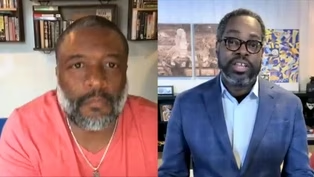
Video has Closed Captions
Clip: S48 Ep51 | 10m 8s | Mi Roundtable | Episode 4851/Segment 2 (10m 8s)
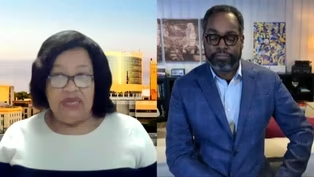
Video has Closed Captions
Clip: S48 Ep51 | 10m 37s | Pontiac | Episode 4851/Segment 1 (10m 37s)
Providing Support for PBS.org
Learn Moreabout PBS online sponsorship New Episode
- News and Public Affairs

Top journalists deliver compelling original analysis of the hour's headlines.

- News and Public Affairs

Today's top journalists discuss Washington's current political events and public affairs.




 New Episode




 New Season
Support for PBS provided by:
American Black Journal is a local public television program presented by Detroit PBS