
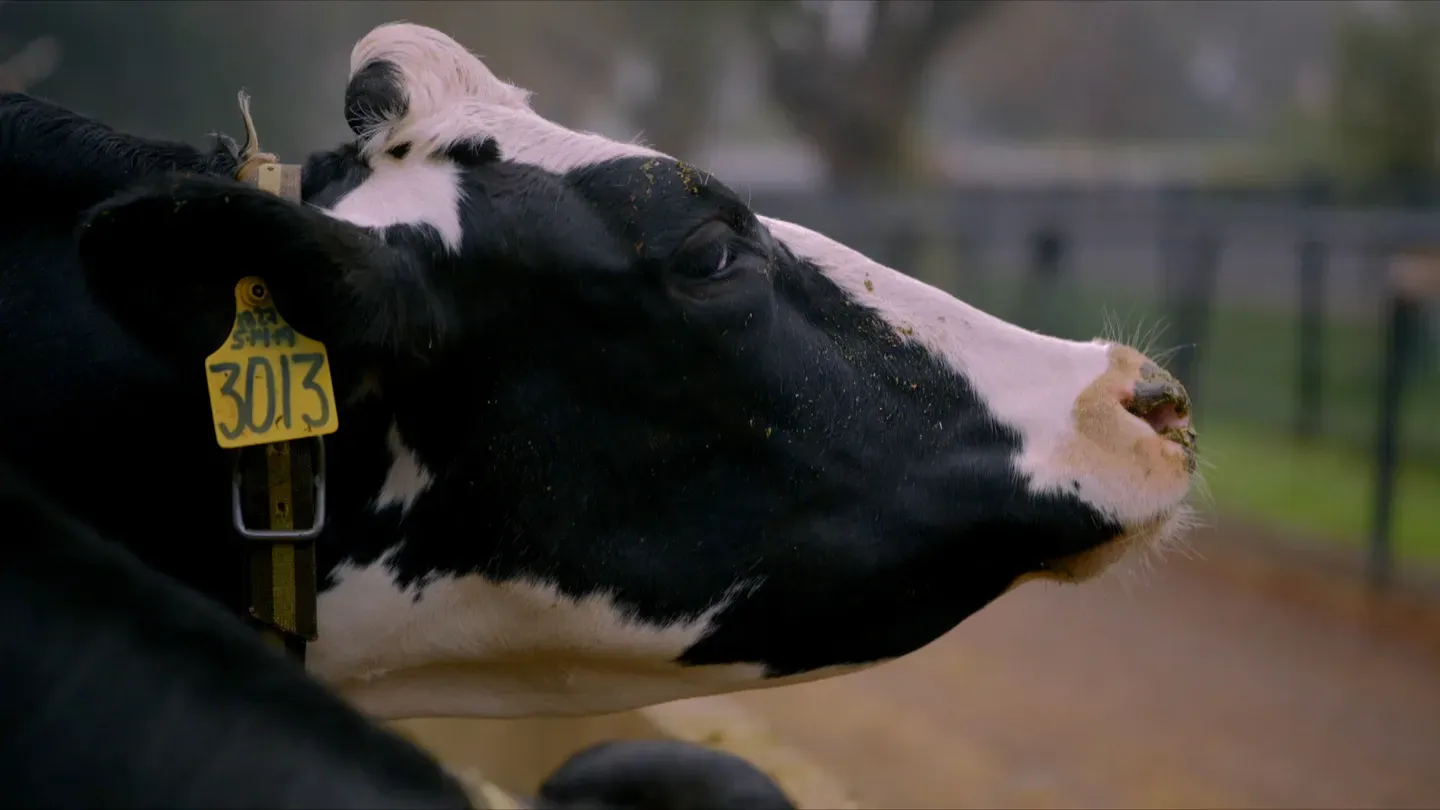
Fighting Cow Methane With Seaweed
Episode 1 | 28m 23sVideo has Audio Description
Cow burps are heating the planet, and one dairy farmer’s seaweed fix might help cool it down.
It’s a wispy red seaweed that can cut cattle methane by 50, 80, even 98%. Miles O’Brien travels from a Marin County, California, dairy to seaweed farms in Mexico, a UC Davis research barn, and an Australian burger joint to trace how one entrepreneur’s gut instinct and a handful of scientists are racing to scale a climate fix that fits in a cow’s lunch.
See all videos with Audio DescriptionADProblems playing video? | Closed Captioning Feedback
Problems playing video? | Closed Captioning Feedback
Made possible in part by support provided by Sue Hart-Wadley and Searle Wadley with additional support from Jerry Cox.
Fighting Cow Methane With Seaweed
Episode 1 | 28m 23sVideo has Audio Description
It’s a wispy red seaweed that can cut cattle methane by 50, 80, even 98%. Miles O’Brien travels from a Marin County, California, dairy to seaweed farms in Mexico, a UC Davis research barn, and an Australian burger joint to trace how one entrepreneur’s gut instinct and a handful of scientists are racing to scale a climate fix that fits in a cow’s lunch.
See all videos with Audio DescriptionADProblems playing video? | Closed Captioning Feedback
Where to Watch Resolve to Solve with Miles O'Brien
Resolve to Solve with Miles O'Brien is available to stream on pbs.org and the PBS app.
♪ ♪ ♪ ♪ (cows lowing) ♪ ♪ (cow lows) MILES O'BRIEN: It's 0 dark 30 at the Straus Dairy Farm in Marin County, California.
The cows stand patiently in line, ready for the morning milking.
At the helm is Albert Straus, dairy farmer and lifelong environmentalist.
(cow lows) STRAUS: I want to make a farming system that's a positive impact on the environment, and cows have an essential role in reversing climate change.
♪ ♪ O'BRIEN: Really?
Cows?
(cow lows) Yes, they do.
In addition to milk and beef, they produce methane.
A lot of it.
Not from flatulence.
Mostly, it's burps.
(cow lows) Seems harmless, but methane is a potent greenhouse gas.
It is shorter-lived in the atmosphere than CO2, but it causes about 80 times more warming over a 20-year time frame.
Globally, livestock methane emissions rival those from the fossil fuel industry.
It's clear there is no climate solution without a methane solution.
That means we either all stop eating beef, drinking milk, and eating ice cream, or we must find a solution, in the name of French vanilla and Dutch chocolate.
♪ ♪ That's why, in 2021, Albert Straus jumped at the chance to become the first commercial dairy in the U.S.
to test a novel methane mitigation solution: seaweed in the feed.
He enrolled two dozen cows in a two-month trial.
STRAUS: The things that we were testing for is, it didn't have any effects on, on the animal health or human health, and that, um, there was no off-flavors or effects on the quality of the milk or the quantity of the milk.
O'BRIEN: The additive comes from a red seaweed called Asparagopsis taxiformis.
It was just half a percent of the cows' diet, but the results were dramatic.
STRAUS: Average of 52% reduction, with some cows over 80% and then one cow over 90%.
-Hm.
(cow lows) O'BRIEN: Impressive results, but they won't amount to a hill of cowpies if a big problem can't be solved: scaling up-- way up.
After all, there are one-and-a-half billion cattle in the world.
♪ ♪ That big challenge is what they're working on here, in the tiny coastal community of Ejido Eréndira, Mexico.
It's a seaweed farm.
These massive vats brim with Asparagopsis.
The company is called Blue Ocean Barns.
Its co-founder and board director is Joan Salwen.
SALWEN: Cattle have been eating seaweed for thousands of years-- coastal herds.
-So, does this seaweed appear here naturally?
-Oh, yes.
-It does?
-It does, yes.
-It's out there right now?
SALWEN: It's out there right now.
O'BRIEN: Hm.
SALWEN: Yeah.
O'BRIEN: But while the seaweed grows naturally offshore, Joan says it makes more sense to cultivate it on land, though that comes with its own set of challenges.
It became clear that this kind of finicky seaweed was not just going to, um, become domesticated without a little bit of a fight.
(laughs) And so we had to really learn.
O'BRIEN: Blue Ocean Barns marine biologist Hannah Resetarits gave me a tour.
(equipment hissing) It begins indoors, in a carefully controlled environment.
So this is called a sun tube.
O'BRIEN: Although they look like giant lava lamps to me.
RESETARITS: All of our cultures start in this room and then scale outside all the way up through our different vessel sizes.
O'BRIEN: Outdoors, they scale up in 17,000-gallon vessels.
Once thriving, the seaweed is harvested in cycles.
Leaving enough to keep the thing going.
RESETARITS: Yeah, think of, like, a sourdough starter.
So in that we will harvest what we need, we leave enough behind to keep growing, and get to repeat that indefinitely.
O'BRIEN: You're trying to scale up and still understand some basic science at the same time, which is a challenge, right?
-Oh, a hundred percent, yeah.
We're applying our learnings as we're still asking the next question.
So, not only are we doing the research, but we're applying it every single day, and we're seeing the results of it already.
O'BRIEN: Which brings us back to Joan.
BOTH: Mwah!
O'BRIEN: Full disclosure here... We have so much to catch up on!
O'BRIEN: ...I've known her for nearly 30 years.
She's not a scientist, but she is a world-class problem solver.
When I met her, she was a hard-charging, self-made business leader.
ANNOUNCER: And only the strongest business models survive.
O'BRIEN: A partner at Andersen Consulting who grew up in an Iowa farm family.
SALWEN: Most Sundays, we went to my grandparents' farm, picked cherries, uh, played in the corn crib, drove the tractor if, uh, Grandpa let us, kind of a great place to be a kid, went away to college, and never came back.
O'BRIEN: Then came 2001.
Andersen Consulting went public, rebranding as Accenture in a nearly $1.7 billion I.P.O.
Overnight, Joan became a multimillionaire.
She was 42 years old.
You could have retired right then and there, right?
-Could have, could have.
-Yeah.
I work, and I am a workmanlike person in everything I do.
I like work.
♪ ♪ I really thought back to my grandfather, and his father, and his father, who were stewards of livestock, their land.
They would have wanted an innovation that helps make livestock agriculture sustainable.
Is this where you decided to become an expert on this?
I would not say that at that moment I started my journey, but I resolved that I would have that journey.
O'BRIEN She dove headfirst into peer-reviewed journals, struggling to teach herself the science of cattle, climate, methane, and mitigation.
SALWEN: I could barely read the abstracts at the top.
-Yeah, I bet.
-I could barely read the discussion at the end.
-Yeah.
The methods in the middle were, like, no way, not even close.
O'BRIEN: Yeah.
SALWEN: I would click and go to another and another, and, you know, hours would go by, kind of like Candy Crush.
-(chuckles) -And there it was.
O'BRIEN: The research came from Australia.
The discovery?
A red seaweed called Asparagopsis taxiformis blocks the chemical process that creates methane in cows.
I was, like, "Oh, really?"
You know, most people are looking at cat videos.
(laughing): And you were going deep into the scientific journals.
-Yeah.
-Learning as you go.
And so I then had, actually, a lot more questions.
And I'm glad that I had the right place to go.
And that place was U.C.
Davis and Ermias Kebreab.
She knocked on the door, and I said, "Come in."
And then she sat, sat right there, and, um, then we start talking about methane.
O'BRIEN: Animal scientist Ermias Kebreab is a world-renowned scholar on this subject at the University of California Davis.
-Then we start talking about methane, and she asked me, "Have you seen this paper on, uh, Asparagopsis that was done in Australia?"
And I said, "Yeah, I, I've seen it."
O'BRIEN: He was skeptical and responded with a reality check.
You know, "Oh, Joan, Joan, Joan.
"Some substances have this potential "and it lasts for a day, or for a week.
But," you know, "don't get too excited."
She said, you know, "Would you be interested in doing some work?"
And I said, "I would be, but I don't have any resources.
I don't have any funding."
Why were you so convinced you were on to something?
-In my gut, I thought it was worth more look.
And I raised nearly a million dollars to kind of get some, um, publicly, you know, funded research going and see, see what it looked like.
Let's learn.
O'BRIEN: Going with your gut.
-Yeah.
-How apropos for this story, right?
Yeah.
-How apropos, yeah.
♪ ♪ O'BRIEN: Ermias gave me a tour of the U.C.
Davis Dairy Teaching and Research Facility.
So these cows are doing their part for science, right?
-Yes, they're, they're helping us really investigate and try to reduce methane.
O'BRIEN: Ermias is leading a study with two dozen cows to measure how effective the active ingredient in Asparagopsis seaweed is at blocking methane.
He introduced me to some of his test subjects.
(chuckles, coos): Hello!
-Oh, yeah, they're very, very curious.
-Hello, how are you?
-They're a very curious bunch, yes.
-How are you?
Yeah.
-(laughs) -Holy cow, holy cow, I'd say, huh?
-Yeah, they like.
(chuckles) ♪ ♪ KEBREAB: This is our cold facility for weaned animals.
O'BRIEN: Ermias and postdoctoral fellow Paulo de Meo Filho showed me their research methods.
To gather data on how much methane a cow might be exhaling, they use a device called GreenFeed.
(cow licking) As the cows lick, chew, breathe, and belch, the gases they exhale are sucked into a tube for real-time analysis.
KEBREAB: So it will analyze the contents of the, uh, of the breath.
O'BRIEN (chuckling): Well, so much for that-- that's okay.
Don't worry about it, we'll just, we'll keep going here.
♪ ♪ O'BRIEN: They are recording impressive results.
Cows that consume just one quarter of one percent seaweed in their diet emit 30% less methane.
What do you think the upward limit is?
KEBREAB: In the literature, there is a report that 98% reduction.
-98?
-98% reduction.
Ourselves, we've seen about 80%.
O'BRIEN And that's with only one-half of one percent seaweed additive.
Cows perform a kind of biological alchemy, turning grass into milk and meat.
So, why does that generate so much methane?
♪ ♪ To understand that, we need to ruminate on the rumen, the first of four compartments in a cow's stomach.
Here, microbes start the whole process of turning grass into energy.
But this fermentation also releases carbon dioxide, CO2, and hydrogen, H2.
An enzyme called MCR converts those molecules into methane, CH4, and it is exhaled.
But this process can be disrupted by an ingredient in seaweed called bromoform, CHBr3.
It disables the MCR, preventing the CO2 and H2 from forming methane.
And the hydrogen is now available to create more energy for the cow.
♪ ♪ Ermias and his team routinely extract and analyze the DNA of rumen microbe samples.
DE MEO FILHO: So I'm doing very little pressure.
He's doing all the work.
(device beeps) KEBREAB: Okay.
(murmurs) (de Meo Filho speaking off mic) O'BRIEN: He didn't seem to mind very much at all, did he?
KEBREAB: No, no, this is... -Didn't bother him a bit.
-No, no.
O'BRIEN: Yeah.
KEBREAB: This, this is what they do every week.
When we have inhibition of methane, we want to know what are the microbes that have been affected by reduced methane.
O'BRIEN: This is how they're identifying the genes that control methanogenesis, the microbial process that produces methane in the rumen.
It's a holy grail discovery.
If they can edit the DNA of these microbes, they could stop methane production permanently.
KEBREAB: So we will have, like, a probiotic.
O'BRIEN: So you could take a capsule.
-You take a-- exactly.
You can take a capsule.
-The gut biome gets edited.
-Yes, exactly.
-And for the rest of their lives... -That's it.
-...no more methane.
-No more methane, that's, you know... That's what they'll be hoping.
O'BRIEN: It's the long-term solution.
Hunting for these crucial genes is a laborious process that will take some time.
Seaweed in the cow feed can happen a lot sooner.
KEBREAB: It's a tool by itself.
O'BRIEN: Uh-huh.
-But it's also a tool to get us into a different way of, uh, of, uh, coming with a solution, as well.
♪ ♪ O'BRIEN: Ermias Kebreab is a proud immigrant from Eritrea, in Northeastern Africa.
I invited him to dinner at a Sacramento restaurant serving the cuisine of his homeland.
♪ ♪ More power to you, wherever you go.
Congratulations on your success.
KEBREAB: Thank you.
O'BRIEN: He grew up in Asmara, the capital of Eritrea, but spent much of his childhood in the countryside tending to livestock, mostly cows.
It's really boring stuff, you know, you just sit down, sit and watch, you know?
-Uh-huh.
But then you, you know, some... Like, just watching this animal just eating, grazing-- just grass, nothing else.
There's nothing else, it's just grass.
And then the next day, in the morning, you have this wonderful meal.
(both laugh) ZION TADDESE: Ready?
KEBREAB: Oh, yes.
Oh, my gosh, speaking of wonderful meals.
TADDESE: There it is.
KEBREAB: This is great.
O'BRIEN: Wow.
KEBREAB: This is great.
TADDESE: Look at that.
O'BRIEN: Beautiful!
That is beautiful.
KEBREAB: Wow, wow.
O'BRIEN: Growing up in Eritrea, climate change wasn't a concern for most people.
Survival was.
KEBREAB: Originally, my focus was on productivity.
O'BRIEN: Mm-hmm.
So I wanted to have better productivity so that more people can get this high-quality food.
I had particular liking the milk.
I really enjoyed drinking milk.
So it got me thinking, like, you know, why can't we have this on, on a daily basis?
O'BRIEN: His roots give him an unusually diverse perspective on the climate crisis.
There's this, you know, north-south divide we talk about a lot.
KEBREAB: Yeah.
You've lived on both sides of the divide.
KEBREAB: Yes.
What's it like on that other side?
And what, what do, how do people view the climate and attempts to address it?
The issues in the, in the south is food security.
You know, we need to be able to feed our, our people.
Can we have it all?
Can we have our, have our steak and eat it, too, so to speak, allow nine billion people to select meat, beef as protein, if they want... -Yeah.
...and still not ruin the climate?
You think we can do this?
-It's gonna be a challenge.
Until recently, there was no tool.
I mean, you, you could go a 20% reduction.
But you can't go any, any further because we don't have the tools.
But now, now we can do it.
O'BRIEN: Which brings us to a picturesque lab on the cliffs of La Jolla, California.
This is the Scripps Institution of Oceanography at U.C.
San Diego.
Here, marine biologist Jen Smith is hard at work trying to better understand how a wispy, finicky red seaweed might be refined into a robust tool to help slow down global warming.
SMITH: Each stack has three cells in it.
And each cell has one of these dark spots.
Those dark spots are where the bromoform is stored.
O'BRIEN: Remember, bromoform stops methane production in a cow's stomach.
♪ ♪ Researchers here are testing Asparagopsis samples from Australia, Hawaii, and California to determine which strains grow fastest and produce the most bromoform.
SMITH: You can alter temperature, you can alter nutrients, you can alter the light to see what makes the Asparagopsis the happiest in terms of its ability to produce more bromoform.
O'BRIEN: Most Asparagopsis is only about half a percent to one percent bromoform by dry weight.
But they found one strain that contains 13%-- off the charts.
SMITH: That means the amount of Asparagopsis that you'd have to feed cows to get the same effect is a lot smaller.
♪ ♪ O'BRIEN: Scripps has a long legacy of love for seaweed.
In the late 19th century, founder Ellen Browning Scripps often walked the beaches of La Jolla, gathering the algae.
She would press her samples into heavy blotter paper to display their aesthetic beauty and to preserve them for future research.
There are 5,000 of them in the Scripps Collection.
SMITH: Even the pressings contain DNA, and you can get DNA out of, um, pressings that are over a hundred years old.
O'BRIEN: She showed me how it's done.
-You can select your seaweeds of choice and just kind of gently arrange it on the paper.
O'BRIEN: Really beautiful.
Obviously, you have scientific reasons to how you divide things, but do you factor in the aesthetics, too, while you're doing it?
A little bit?
-Yeah, I mean, I always do, because when I get the time to press seaweeds, I want them to be able to show off their beauty as best as possible.
-Right.
O'BRIEN: All of this was making me hungry.
Really.
I wanted to sample some seaweed.
Jen obliged.
I'm guessing it's going to be salty.
SMITH: It's very delicate.
It's very delicate.
-Oh, nice.
-Almost like a... -I feel like I've probably eaten that in Japan with some sushi or something... -Maybe, yeah, mm-hmm.
-Delicious.
This one is called pepper dulse... -Uh-huh.
-...or, or truffle dulse.
-Ooh, truffles, yeah.
-Um, it's a, a delicacy... -All right, uh-huh.
-...in, in Scotland, um... -Mm!
-Ooh, that's very truffle-y.
-I really get the truffle there.
-Mm!
-That's amazing.
O'BRIEN: Delicious and nutritious.
SMITH: Seaweeds have an order of magnitude more vitamins and minerals than any vegetable we can grow on land, so... Order of magnitude, really?
-Order of magnitude.
So when you think about kind of engineering the perfect superfood, seaweeds really have all of those characteristics.
♪ ♪ O'BRIEN: Seaweeds sequester millions of tons of carbon dioxide and can also be used as a substitute for plastics made from petrochemicals-- another way these algae might be enlisted to fight the climate emergency.
Is it too good to be true?
(Smith laughs) I mean, or do you keep thinking, wow, this is just, uh, something we've overlooked for too long?
Um, I think it's just... You know, maybe it's a marketing issue.
Seaweed?
Who wants to eat a weed?
It sounds, you know, unappealing.
O'BRIEN: She's right-- seaweed needs a rebrand.
♪ ♪ After work, she and her team met for beers at the beach.
The first thing we need to do is figure a better name for seaweed.
(others exclaiming) Don't you think?
O'BRIEN: That's when an idea popped into my head.
See, every, everybody loves avocados, right?
How about oceanacados?
(others laughing) Right?
And we could have oceanacado toast.
I mean, it would start a whole thing, right?
You know?
SMITH: Okay, yeah.
-Right?
Are we on to something?
-Seacados?
Seacados?
-Seacados!
All right, were you rolling on that?
I think we just... O'BRIEN: Of course we were!
Seacados it is-- you heard it here first.
♪ ♪ On a more serious note, Jen told me she began her scientific career studying coral, which live in a delicate balance with seaweed-- I mean seacados.
She saw a scientific opportunity.
Kind of historically, there have been a lot fewer scientists that are experts in the field of seaweed science.
-Hm.
-So, um, I would say, um, we're rapidly trying to catch up, because all of a sudden right now, seaweeds are having a day.
There's, there's a lot of attention being put on seaweeds right now.
O'BRIEN: Seaweed may be having a day, but there's still a big stumbling block standing between it and mass consumption by cows, much to the chagrin of Joan Salwen.
SALWEN: For the most part, regulators don't know what to do with products like ours.
They can determine that something is a probiotic or whatever, but they don't have a anti-methane department.
O'BRIEN: The U.S.
Food and Drug Administration doesn't have a regulatory pathway designed specifically for climate solutions.
Feed additives like this are evaluated for safety, not their impact on greenhouse gases.
That leaves compounds like bromoform in a gray area.
They can be classified either as a feed ingredient or as a veterinary drug.
If it falls into the drug category, approval can take years, sometimes close to a decade.
SALWEN: The FDA wanted the U.S.
Congress to pass laws that authorize them to create new pathways for products like ours.
And in both the House and the Senate, it was in committee, got out of committee, but never was taken to the floor for a vote.
So, we're a little stuck in the United States.
O'BRIEN: Bromoform comes with some caveats.
In high doses, it's considered a probable carcinogen.
But the amounts used in cattle feed are tiny, and it's quickly broken down in the cow's stomach, with little evidence of it ending up in milk or meat.
Human exposure is minimal.
It's also a volatile compound that can affect the ozone layer, but it breaks down quickly in the atmosphere, and only small amounts are released.
With proper safeguards, scientists say the risks are low, while the climate benefits from cutting methane are substantial.
♪ ♪ It was enough to convince regulators in Australia.
Ah, Sam!
Good to see you.
Hey, Miles, great to meet you, too.
-All right.
Right, Australian of the Year, right?
-Yeah.
-All right.
-That's a big deal, huh?
-We're going to figure out why you earned it by, uh, trying the burger.
-Okay.
-All right.
O'BRIEN: While in Sydney for another story, I met Sam Elsom, the co-founder and C.E.O.
of Sea Forest, a company running a large-scale seaweed farming operation in Tasmania.
ELSOM: It's been an exciting business to build over the past six years.
O'BRIEN: I bought him lunch at a popular burger chain that sells low-methane burgers... ♪ ♪ ...beef from cows that have been fed Sea Forest's seaweed supplement.
I'm gonna have a Simply Grill'd with cheese, please.
ELSOM: Yeah, two of those, thank you.
O'BRIEN: Sea Forest is also testing bromoform-infused pellets for sheep, creating low-methane wool.
ELSOM: Animal supply chains touch so many businesses.
-Right.
-From the clothes we wear to... You know, the food we eat, pharmaceutical industry.
You know, there's just, just... There's so, so many sort of stakeholders, if you like.
Pardon the pun, but... -Yeah.
(both chuckle) O'BRIEN: The Australian equivalent of the U.S.
FDA does not recognize bromoform as veterinary medicine.
ELSOM: Everything that happens to affect the methane is targeted within the rumen itself.
So it doesn't have a physiological effect on the animal and therefore doesn't fall under the definition of, of veterinary medicine.
So, it, it's also required, you know, we have to demonstrate that it's safe, and so we have all of that research, as well.
Um, and then, and we also have done extensive studies on flavor profile and quality of the meat and milk products coming from the animals.
Um, and so, for those reasons, we've been able to commercialize in Australia.
O'BRIEN: Ah, ah!
Look what we got!
SERVER: Two Simply Grill'd with cheese.
O'BRIEN: Excellent.
ELSOM: Wow, thank you so much.
O'BRIEN: Thank you so much.
Appreciate that.
What a fabulous-looking burger.
All right, so, um, my first taste.
-Okay, here we go.
-This is very exciting.
-(laughs) -Mm, that's good-- that's a good burger.
Not a hint of seaweed, for sure, right?
(both chuckle) Put it this way.
This, this is the biggest, fattest, low-hanging fruit in my view, is this one, methane.
But, you know, like, it should happen in the U.S., for sure.
It should happen, you know, be all around the, all around the world.
♪ ♪ O'BRIEN: Joan Salwen isn't waiting for U.S.
regulations to catch up.
The company is in talks with major multinational food producers who are scrambling for ways to meet carbon-neutrality targets.
SALWEN: And if they continue to feel pressure to make good on their promise, I feel very, very bullish.
O'BRIEN: Bullish-- I love it!
But she admits a less-determined entrepreneur might have been cowed by the obstacles.
SALWEN: I often wonder, if I had it to do again, would I do it?
Because it's been really arduous and very consumptive of my time and my energy, my dreams.
And the answer is, I would do it again.
We now have a clear sightline to achievement that will redefine my life, you know?
It's something of great importance and great impact.
And I'm not going to deny myself that.
I'm sticking with it.
♪ ♪ O'BRIEN: Scientists say we must cut global greenhouse gas emissions in half by 2030 to limit global warming to 2.7 degrees Fahrenheit.
But we're headed in the opposite direction.
Emissions are still rising.
As it turns out, a big solution might be bite-sized.
♪ ♪ ♪ ♪ ♪ ♪
Video has Closed Captions
Clip: Ep1 | 4m 42s | Cow burps are heating the planet. One dairy farmer’s seaweed fix might cool it down. (4m 42s)
Providing Support for PBS.org
Learn Moreabout PBS online sponsorship New Episode
- Science and Nature

Explore scientific discoveries on television's most acclaimed science documentary series.












Support for PBS provided by:
Made possible in part by support provided by Sue Hart-Wadley and Searle Wadley with additional support from Jerry Cox.