
Protecting California’s Coast
Season 8 Episode 3 | 24m 21sVideo has Closed Captions
The fight to save California beaches, coastal infrastructure and marine habitats.
California’s more than 800 miles of coastline is under siege from coastal erosion, rising sea levels and threats to marine habitats. We meet the people fighting to save Golden State’s coastline for future generations.
Problems playing video? | Closed Captioning Feedback
Problems playing video? | Closed Captioning Feedback
Earth Focus is a local public television program presented by PBS SoCal
Protecting California’s Coast
Season 8 Episode 3 | 24m 21sVideo has Closed Captions
California’s more than 800 miles of coastline is under siege from coastal erosion, rising sea levels and threats to marine habitats. We meet the people fighting to save Golden State’s coastline for future generations.
Problems playing video? | Closed Captioning Feedback
How to Watch Earth Focus
Earth Focus is available to stream on pbs.org and the free PBS App, available on iPhone, Apple TV, Android TV, Android smartphones, Amazon Fire TV, Amazon Fire Tablet, Roku, Samsung Smart TV, LG TV, and Vizio.
Providing Support for PBS.org
Learn Moreabout PBS online sponsorshipNarrator: Maybe nothing defines California's identity more than its hundreds of miles of coastline and beaches.
Beyond its beauty, the coast is where so many of us go for community and recreation, peace and solitude.
The essential ingredients: sun, sea, and sand.
But because of climate change, our coast is changing.
[camera button clicks] Announcer: This program was made possible in part by a grant from Anne Ray Foundation, a Margaret A. Cargill Philanthropy.
Narrator: Ocean levels are creeping upward, erasing borders between land and water.
And once wide beaches are shrinking, losing the sand that once replenished them naturally because of coastal erosion.
Scientists warn that if these trends continue, California's coast could look dramatically different by the end of this century and some beaches could vanish entirely beneath the waves.
This has created a reckoning for coastal communities, forcing them to make difficult choices about how to respond.
Man: The beaches in Oceanside are super important to the individuals that live here.
It's a part of their culture.
Most people have been in the water, and a lot of them surf on a daily to weekly basis.
They're also raising their kids in that same style to enjoy the ocean.
And it's our most beloved piece of Oceanside.
Jayme Timberlake: A lot of people assume that beaches are natural, but especially in Southern California, we are trying to control the beaches, maintain them, keep them around.
If you've lived here your whole life, you've seen very lush, wide beaches, but in 1 or 2 generations, we've seen a dramatic change in the beaches, a dramatic loss.
We haven't been able to keep pace with the rate of erosion.
Climate change, sea level rise are a definite threat to the community of Oceanside.
That's why the city has been investing in trying to adapt the coastline and get it ready for these conditions.
Instructor: It's kind of hard to walk here because these rocks are brand-new to the area.
You know, five years ago, we never had rocks like this on the beach.
I have to come from a point of always safety.
Has the ocean remained safe to teach surfing?
Yes.
Now has changes in the sand and how far the tide comes up, how far the tide goes out, have those looked different over time?
Absolutely.
Jayme: So in Southern California, we have this loss of sediment that's getting to our coastline.
So that really has a big effect on the natural sand restoration that happens on beaches.
So in Santa Ana River Watershed, for instance, in Orange County, that's all been flood controlled.
It's all concrete lines.
So that means your river system is not eroding anymore.
It's not gathering sediment and eroding on the banks.
So basically what's happening is there's not enough sediment traveling through the watercourse out into the littoral cell or the currents that flow around in the ocean.
And that's not allowing for sandbar development, which diminishes surfing and a lot of other things, but it also diminishes that capability for, naturally, beaches to restore themselves.
Interviewer: What would the shoreline look like without a beach?
Jayme: If you'd like to see what it looks like, you can go down to South Oceanside.
So without a beach, what we have is a fixed shoreline that is lots of revetment, essentially riprap revetment, which is like, large boulders that are placed.
The whole purpose is just to protect the home or the infrastructure behind it.
So the more and more erosion that we see, the more we see those types of ad-hoc protection mechanisms, you know, throwing riprap against a piece of infrastructure to protect it.
And that's really not what we're trying to do.
We're trying to be more proactive and thoughtful about it.
Instructor: If you even, like, flail off to the side or just jump in, it's all a part of the process.
Student: People want sand, people want the sand.
And I think it is--it's that, you know, the softness, the "welcome mat" aspect of it.
You know, the fact that it's sand and you're at a beach and you kind of expect sand, that's huge, um, just to not, you know, have access to all of this and to not have part of the world closed off to you that's right in your backyard.
Jayme: In Oceanside, we're trying to use many different coastal management tools to restore all the beaches on our 3.75 miles of coastline that we own.
To the north of the pier, where we have sustained beaches, we're trying to utilize the sand that we still have, and we're trying to build up the back beach with sand dunes.
In Southern California, sand dunes are not like the East Coast dunes.
They're about 2 to 3 feet high.
But what's interesting about the use of sand dunes in coastal resilience is that they can rise faster than the seas are rising.
And so it's a really simple, cost-effective, nature-based solution to sea level rise, to combating climate change.
What Oceanside is doing right now is the Coastal Sand Dune restoration project, and we're doing about ten different plots, totaling one acre of coastal dune restoration, using simply, just sand fencing and some native vegetation that's native to sand dunes.
So it's a really low-budget, natural solution to building resilience on the coastline rather than a big engineering project.
Worker: If we use that little bit that they're bending over the pole.
Frederico Scarelli: These are some seeds of native plants that we are putting here.
We have three species that the common name for these plants is sand verbena and the beach burr that are the important species for sandy grove.
So when the vegetation starts to grow, they help accumulate sand and then they grow together.
Interviewer: But essentially, nature takes its course after this.
Frederico: Exactly.
It's because that's called nature-based solutions.
So we are passively helping rebuild the dunes or restart the dunes that were here, like, in the 1920s, 1930s.
Man: My concern partly is the beauty of it.
I don't think they're very attractive, but also I don't know how effective it's going to be.
My other concern is I think there might be people around that are going to just destroy these fences at night.
Having this place for 30 years and being a taxpayer here, I just don't think it's a good use of money as far as protecting the sand.
Instructor: The number-one thing I would like to happen with the issue of sand retention and the difference in the tidal waters is everyone coming together to understand that we have different opinions, but we all love the ocean, so we're all on the same team then.
Jayme: What Oceanside is now trying to do is this project called RE:BEACH, which includes sand nourishment, but it also includes the construction of an artificial reef that will dampen that wave energy in that location and allow some of those erosive forces to stay away from the shoreline, where we're trying to put the sand back to.
The waves break on the outside reef on the rock, and then they come into the shoreline with a little less wave energy.
So a little less energy, a little less of that erosive force.
We expect there to be more sand retention with the placement of this artificial reef.
And what that'll do is give Oceansiders at least 30 years of sandy spaces here in areas where it's really desired to have a sandy beach.
Narrator: California's coast is also an extension of our wider society and built environment, the place where over generations we've built homes, power plants, roads, and other critical infrastructure on the ocean's edge.
But as the water advances and beaches thin, what are we willing to do to protect what we've built in the path of the ocean?
Woman: I moved here about 7 years ago, and I immediately noticed that the beaches were in trouble, that they were starting to narrow.
And as the beaches get narrower and narrower, what happens is the railroad becomes worried about the security of their tracks, and they start throwing out more and more of these really large boulders that you see here, the riprap.
And I started talking to the city and city officials about this problem and how they needed to put more sand down and address this problem, or else we're going to end up with beaches that are just filled with boulders.
[Bell ringing] Man: The rock is meant to protect the integrity of the rail line.
The armoring provides a level of predictability to anchor and protect the rail line.
The sand, while it is a very good source for buffering between the Pacific Ocean and the rail line, there is a lack of predictability in terms of the ability for the sand to stay resident for a long period of time such that there isn't direct ocean wave intrusion against the rail line.
Interviewer: What is ocean wave intrusion?
Dan Phu: That would be in simple terms the wave pounding against the rail line.
So Mother Nature is a very strong force, and we have seen in--over the last handful of years where there's been situations where there's literally no beach and what's separating the rail line is really just the protection of the rocks that's there and the Pacific Ocean.
So that's why it's needed to protect the rail line.
OCTA, as the county transportation agency, owns 42 miles of the rail line in Orange County, of which 7 miles of the rail line is actually through a very critical southern Orange County portion.
And it goes through the cities of San Clemente as well as Dana Point and San Juan Capistrano.
[Bell clanging] For the Amtrak service, it's actually the second busiest in the nation from a standpoint of passenger throughput.
It is really the only alternative via the coast, Interstate 5.
So it is a critical rail line that carries both passenger as well as freight for our neighbors to the south.
This particular rail line has been in operation for over 130 years, and for the first 120-plus years, we have seen closures that happen, I would say, pretty sporadically, but something happened along the way starting around fall of 2021, where we have seen a series of rail closures that's led to passenger rail service disruptions.
It's a function of both coastal erosion on the beach side and inland bluff failures on the inland side.
So it's a very challenging situation for the rail line to be nestled between the Pacific Ocean to the west and then the inland bluffs to the east.
It's, yeah, definitely a straitjacket for the rail line.
There's absolutely not a lot of room to maneuver.
Suzie Whitelaw: The amount of rock they have here, we believe, is an appropriate amount to structurally support their tracks.
What they want to do is put rock all the way out to there and across the entire San Clemente State Beach.
The boulders do, at least temporarily, protect the structure of the railroad tracks, but what they do is actually increase the erosion and make the beaches erode even faster.
We used to get some erosion from the bluffs, and that would feed some of the beaches.
But the railroad is elevated and that blocks that sand.
So every year, we lose a little bit of sand offshore or downcoast, and if it's not replaced by natural sources, the beach just gets narrower and narrower.
Man: Tonight I want to focus on what will shape our coastline in the near term and why it represents the greatest immediate threat to our beaches.
We have a critical choice in San Clemente: We can protect the rail line and our world-class beaches together or we can allow our beaches to disappear behind a failing approach paid for with our tax dollars.
This is where you can help: support leaders that are advocating sand replenishment over hard armoring.
Suzie: My organization is advocating for a sand-only or a sand-first approach.
We think that sand is the best way to protect the tracks, and it's also the best way to protect this wonderful public resource we have, because the rocks themselves won't keep the water out.
The only thing that's going to keep the water out is the sandy beach.
[Machine reversing warning beep] You can truck in sand.
We've done that on smaller projects, but the trucking involves a lot of other undesirable environmental consequences.
There's air quality, there's traffic.
It's just more expensive.
And so for a larger project, you really need to go offshore, and you dredge up-- what you actually are dredging up is ancient beach deposits.
During the last ice ages, the coastline was miles offshore.
And that's where the beaches were.
And as the glaciers melted, it covered up those beaches.
And so we're going back out and seeking those ancient beach deposits.
And you dredge it up and place it back on the beach.
Dan: What we're finding with respect to sand is while sand is a great mechanism and instrument as a buffer for the rail line, it takes a very large volume of sand to actually provide that sufficient buffer.
You're talking about potentially half a million or greater cubic yards of sand.
And in terms of that quantity, it would take many, many years to actually be able to bring that amount of sand in from a sand source.
And the permitting process is very complex when it comes to sand.
With the prediction that we're seeing with sea level rise and climate change over the next 50 years, any development-- namely, the tracks in South Orange County with respect to this critical rail line--will be vulnerable to both sea level rise and climate change over the next several decades.
So that is something that we're mindful of, and we're looking to basically come up with solutions to protect it in place while we're looking at longer-term solutions.
Suzie: There's been talk of moving the rails inland.
They started talking about it three years ago.
They got money for a study.
They spent the money on other things.
And now they have said that Caltrans is going to study the relocation.
The issue is there's no land.
The only land where they could do it would be to tunnel under the I-5 freeway.
That's going to take at least five years to study whether it can be done and another 20 or 30 years to construct it.
That's a whole generation.
And I'm not willing for a generation to miss out on our beaches.
And that rock, once it's on our beach, isn't going to go away.
So it's a forever loss for all of our generations.
Narrator: California's coast is also a wilderness with its ecosystems, both on and offshore, home to marine plants and animals found nowhere else on the planet.
So how do we best protect those critical habitats while also safeguarding the people whose livelihoods depend on the sea's bounty?
Woman: Our plan for the day is we're going to motor out of the harbor, up the coast.
Conditions today look pretty good.
We're sneaking in before a storm system that's building through the weekend.
They actually say that if you learn to sail and boat in the Santa Barbara Channel, you're pretty set for boating in a lot of places in the world, just because the weather can change so quickly.
But we're very fortunate to have a very seaworthy vessel here that can handle the channel and its potential for wind or swell.
Harbor patrol.
That's their new boat.
It goes a lot faster than our boat.
We're heading out today to conduct some boat-based surveys of our MPAs-- our marine-protected areas.
And specifically, we're just looking at what kinds of human activity are taking place in the areas adjacent to our MPAs and in the MPAs themselves.
Interviewer: What is an MPA?
Penny Owens: A Marine Protected Area is an area where we limit any extractive activities, so that includes take of any organisms--algae, fish, invertebrates, and the idea is that you let the whole ecosystem recover.
And in California, we're really fortunate.
We have a network of protected areas, 124 MPAs along the coast.
And the idea is that a lot of these organisms do something called broadcast spawning.
And if we have areas set aside where they are not removed, they can get bigger and produce more offspring and help populate areas both inside the MPA and also outside.
Man: Santa Barbara Channelkeeper is a local nonprofit.
We work to protect and restore the Santa Barbara Channel and its watersheds.
We work from Point Conception all the way down to the Ventura River, and we work from the ridges of the Santa Ynez Mountains all the way out to the Northern Channel Islands.
Penny: So here we are.
We've entered into the eastern side of the Campus Point MPA.
There's a lot of fishing effort right up to the border of the MPA.
And so that's our local lobster fishermen taking advantage of the movement of the lobsters.
Veronica Moran: I saw a man onshore.
It looked like he might have been fishing.
So we got closer to shore to check out and see what he's doing.
And he is fishing, so we're gonna take note of that in our survey form.
Interviewer: How do you know you're in an MPA?
Are there buoys?
Or there's no floating signs or anything.
How do you know you've entered it?
Penny: I know.
That's a great question.
As the boater or the fisherperson, it's up to you to know the regulations where you're fishing.
And so we have this lovely chart plotter, like Google Maps in your cars.
It shows the MPAs.
If you're a fisherman, there's apps I have on my phone that can show you where you are in relation to the MPA, and then the regulations for that MPA.
Ted Morton: On the land, we're very familiar with, like, national parks.
So, you know, Yellowstone was established in the 1870s.
For protecting the ocean environment, we're behind.
We really started working on that in, like, the 1970s.
And particularly for the Santa Barbara area, we're seeing some really positive results of the Marine Protected Areas that have been set in place.
We're not looking to sort of shut down the entire Santa Barbara Channel for fisheries.
We're looking for ways to create balance that lets them still be able to continue their livelihood.
[Sea gulls calling] Man: We're in Santa Barbara Harbor, so right at the pier.
This is a Saturday at Fishermen's Market.
We sell locally, sustainably-sourced fish right here from the Channel Islands and beyond, a whole bunch of sustainable and delicious and nutritious seafood supplies.
All about the local seafood economy, supporting, like, the blue economy here in Santa Barbara, and really showcasing the resources that are found and caught right off the coast, so to bring a delicious meal to you.
Woman: How do you clean it?
Man: So you can either gut it or you can just cut the head off and then fillet it real quick.
You can have them fillet it for you, but I wouldn't pay $3.00 a fish for that.
Woman: Yeah, I know.
Man: So it's all local hook and line rockfish.
We've got different species of the rockfish, and then we've got some rock sole.
Sold out of mackerel first thing--one of our most popular items here at the market.
We distribute from San Francisco to Los Angeles all out of this harbor.
We're keeping the local, you know, fishing alive.
You know, we're battling farm-raised fish.
We're battling fish from overseas.
We're battling fish from Mexico.
Everyone's trying to push out the little guys.
But here we are, and we're keeping that dream alive.
Man: This kind maybe?
Interviewer: How are the MPAs working out for you?
I say "MPA," you think what?
David Siordia: For me, they don't bother me.
You know, most fishermen have a different opinion.
I think that it's keeping the fisheries alive.
I actually think that they are helping in the sense that we're giving the fish a break and we're getting the spillover.
I really do believe that we're getting spillover out of them... Interviewer: Spillover, meaning the fish reproduce in the MPA.
David: Yeah, absolutely.
Interviewer: Leave the MPAs, and you're good to catch them.
David: Absolutely.
I'm not against them.
Now, Keep expanding, keep growing, and you make half the island close, I might have a different opinion.
Man: Would you like two?
They're mixed emotions about that, you know.
MPAs, they were designed to close areas for a few years, do some study on it, and reopen it and maybe close another area.
As far as the MPAs now, they just, they've shut them down and there hasn't been fishing there since the MPA started.
Interviewer: Does that affect you?
Robert Cathcart: In different fisheries, in different fisheries.
You know, the nearshore stuff, it definitely affects all the fishermen.
There's an abundance of sea life there that's not tapped into where it's been closed for so long.
Man: The number of fishermen in this state when I first started fishing was over 20,000 licensed commercial fishermen.
Now it's less than 6,000.
I'm saying that conservation of the marine environment's a good idea, but it can be done in conjunction with well-regulated, sustainably-managed fisheries.
So the two aren't incompatible.
We have an internationally award-winning network of MPAs in California, and they contribute to the abundance of fish between MPAs because they end up being repositories of spawning potential.
And so there should be a recognition of that reality.
We are durably regulated, and there's no need for California of all places, to dramatically expand the amount of protected areas when the areas that we fish in are well-protected.
Ted: I think that there's also been a bit of a tradition of thinking about oceans as vast: "We can't do any kind of damage to them."
So it's taken a while, and it's taken a lot of really great people to sort of, you know, explore the ocean and start educating.
The oceans are deserving of protection, too.
And particularly when we think about the importance of oceans for human populations is something that does deserve greater attention.
Narrator: California's coast is more than a place.
It's a promise of beauty and a Golden State way of life.
But as our planet changes and threats to our coast grow, that promise is being tested, and none of the challenges have simple or cost-free solutions.
What's clear is that the decisions being made now by policymakers, engineers, environmental activists, and residents will decide what the coast looks like for future generations.
The coast has long shaped Californians.
Its future is in their hands.
[Music] Announcer: This program was made possible in part by a grant from Anne Ray Foundation, a Margaret A. Cargill Philanthropy.
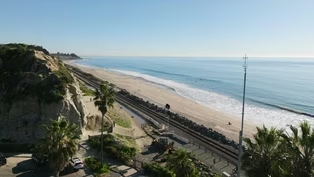
Protecting California’s Coast (Preview)
Preview: S8 Ep3 | 30s | The fight to save California beaches, coastal infrastructure and marine habitats. (30s)
Providing Support for PBS.org
Learn Moreabout PBS online sponsorship
 New Episode
- News and Public Affairs

Top journalists deliver compelling original analysis of the hour's headlines.












Support for PBS provided by:
Earth Focus is a local public television program presented by PBS SoCal