OnQ
Rachel Carson's Legacy
Clip | 7m 4sVideo has Closed Captions
Hosted by Michael Bartley, this episode explores Rachel Carson’s life, legacy, and impact.
Hosted by Michael Bartley, this episode features “Rachel Carson's Homestead,” produced and reported by Dave Crawley, exploring Carson’s life and legacy, with Homestead directors Patricia DeMarco and Amanda Trapp on how her childhood shaped her work. Interviews and archival footage, including CBS clips, a 1963 Carson interview, and a 2000 speech by Al Gore, highlight her international impact.
Problems playing video? | Closed Captioning Feedback
Problems playing video? | Closed Captioning Feedback
OnQ is a local public television program presented by WQED
OnQ
Rachel Carson's Legacy
Clip | 7m 4sVideo has Closed Captions
Hosted by Michael Bartley, this episode features “Rachel Carson's Homestead,” produced and reported by Dave Crawley, exploring Carson’s life and legacy, with Homestead directors Patricia DeMarco and Amanda Trapp on how her childhood shaped her work. Interviews and archival footage, including CBS clips, a 1963 Carson interview, and a 2000 speech by Al Gore, highlight her international impact.
Problems playing video? | Closed Captioning Feedback
Where to Watch OnQ
OnQ is available to stream on pbs.org and the PBS app.
Providing Support for PBS.org
Learn Moreabout PBS online sponsorshipThis unassuming farmhouse in Springdale, northeast of Pittsburgh, was the home of a little gir who fell in love with the fields and woodlands that surrounded her.
Her name was Rachel Carson.
Years later.
She wrote a book that changed the world.
The spring Hous gardens are probably closest to what was her when Rachel's family lived here.
Patricia DeMarco father gave her a copy of Silent Spring as a high school graduation gift.
Now she serves as executive director of the homestead, where her childhood idol was born a century ago.
Up here, there was the orchard and the property of the Carsons went all the wa to where the high school stands.
Young Rachel once had a clear view of the Allegheny River from her bedroom window.
Her family's 65 acre farm extended to the shoreline, and she went into the woods, in the fields and learned abou what she saw, what she found.
I was very observant as a child and enjoyed, taking lessons from the birds and insects and the plants.
As her sort of normal surroundings.
So we're going to head off into the nature trail of this way.
Behind the house, Education Director Amanda Trap leads a nature hike through a quarter mile of woodland that once extended far beyond this hillside.
This is the jewelweed starting to pop up right here.
These visitors are members of the International Women's Association of Pittsburgh, a testament to the worldwide influence of America' most famous environmentalist.
I lived here in 1949 to 1952 when we built the house across the street.
Ralph Shoop was then a young man, newly married, with no inkling of the soon to be important footsteps he was following.
Although my father in law was superintendent of schools here, and he did have a hidden class.
Without a doubt, one of the most literate kids that he'd had in school.
Rachel often joined her older brother and sister down on the riverbank.
Her books about the ocean, including The Sea Around Us, were influenced by those early years watching the river flow.
She wondered where it went, what kind of creature were there, where they came from and had, curiosity about the water and the interface between the water and the land from a very young age.
But the interface between man and nature produced her greatest work of all.
Insecticides and other chemical poisons were celebrated as a panacea against agricultural pests in the years following World War two.
But Rachel Carson didn't see i that way.
Chemicals are the sinister and little recognized partners of radiation in changing the very nature of the world, the very nature of its life.
Since the mid 1940s, over 200 basic chemicals have been created for use in killing insects, weeds, rodents and other organisms described in the modern vernacular as pests.
She wrote Silent Spring at the request of a friend who owned a nature preserve.
Her property was adjacent to an agricultural field, which was sprayed with DDT, and the cloud drifted over her nature, preserving.
Many of the birds died, and she wrote to Rachel, pleading for some help and attention.
And, that was at about 1958, and Rachel began researching for that book.
At that time and she began publishing Silent Spring as a serial in The New Yorker magazine.
So by the time it went to press in 1962, she already had attracted considerable amount of attention from people like President Kennedy.
I think particularly, of course since Miss.
Carson's book.
But, they are examining the matter.
But her bestselling book also received ringing condemnation from chemical companies and their supporters.
A leading critic was industry spokesman doctor Robert White Stevens, who made his feelings clear in a 1963 documentary produced by CBS.
The Major claims in Miss Rache Carsons book Silent Spring.
Gros distortions of the actual facts, the real threat, then, to the survival of man is not chemical, but biological, in the shape of hordes of insects that continued.
Our forests sweep over our croplands, ravage our food supply, and leave in their wake a trai of destitution and hunger.
To these people apparently the balance of nature was something that was, repealed.
Or as soon as man came on the scene when you might just as well assume that you could repeal the the law of gravity.
The balance of nature is built of a series of interrelationships between living things and between living things and their environment.
You can't just step in with some brute force and change one thing without changing of the many others.
If you're trying to control on insect to use something that isn't necessarily goin to wipe out everything in sight.
Yet the public was being asked to accept these chemicals, was being asked to acquiesce in their use, and did not have the whole picture.
So I said about to remed the balance there.
That she did.
Her testimony on Capitol Hill led to chemical controls and the ban of DDT.
The environmental lure of Rachel Carson's homestead attracted presidential candidat Al Gore in 2000.
And the main lesson that I took away from it was that there are problems that we can cause for the environment that are not immediately obvious to the naked eye.
This is a four room farmhouse.
Typical of this period.
Visitors to the homestead marve at the original four rooms in which the Carson family lived.
At the top of this narrow staircase in this room.
A little girl began to formulate ideas that would bloom in the winter of her life.
Rachel Carson died of breast cancer two years after Silent Spring was published, but her legacy was already secure, with a warning cry that echoes to this day.
I think we were challenged, as mankind has never been challenged before, to prove our maturity and our mastery, not of nature but of ourselves.
Visiting a homestead where past and future meet.
I'm Dave Crawley.
Society for Contemporary Crafts Clip
Video has Closed Captions
This clip of OnQ highlights The Society for Contemporary Crafts in the Strip District. (8m 17s)
Video has Closed Captions
This clip highlights Pittsburgh’s City Theatre and their production of Hedwig and the Angry Inch. (7m 52s)
Latino Pittsburgh! - Clip from OnQ6122
Video has Closed Captions
An OnQ segment about the growing Latino population in Pittsburgh. (8m 59s)
OnQ - Reflection of Papal Reconciliation PSO Concert
Video has Closed Captions
A reflection of the Pittsburgh Symphony's concert for Pope John Paul II after his death. (14m 19s)
OnQ - 2003 PSO European Tour Report Part 3
Video has Closed Captions
Part 3 of Jim Cunningham's PSO 2003 European Tour Coverage in Amsterdam and London. (9m 14s)
OnQ - 2003 PSO European Tour Report Part 2
Video has Closed Captions
Part 2 of Jim Cunningham's PSO 2003 European Tour Coverage in Vienna, Austria. (9m 16s)
OnQ - 2003 PSO European Tour Report Part 1
Video has Closed Captions
Part 1 of Jim Cunningham's PSO 2003 European Tour Coverage in Valencia, Spain. (9m 20s)
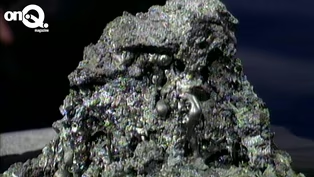
Video has Closed Captions
Ambridge resident Bob Justiss shares a large piece of space junk that fell in his mother's backyard. (8m 2s)
Video has Closed Captions
This clip features Carnegie Mellon University's new robot that is headed for Mars. (6m 44s)
Video has Closed Captions
Director of the Buhl Planetarium, John Radzilowicz, talks about the gathering of the planets. (6m 4s)
The War That Made America OnQ Clip - Braddock History
Video has Closed Captions
OnQ segment exploring Braddock’s revitalization through its War history and Carnegie Library. (15m 33s)
The War That Made America OnQ Clip - Behind the Scenes
Video has Closed Captions
OnQ segment previews a behind-the-scenes look at the PBS documentary The War That Made America. (8m 40s)
The War That Made America OnQ Clip - Robert Griffing
Video has Closed Captions
OnQ segment features Robert Griffing’s French and Indian War paintings and artistic inspirations. (12m 46s)
The War That Made America OnQ Clip - Preview Party
Video has Closed Captions
OnQ segment previews The War That Made America with interviews, behind-the-scenes stories, and art. (26m 22s)
The War That Made America OnQ Clip - Local Street Names
Video has Closed Captions
OnQ segment explores Pittsburgh street names, General Braddock, and Steelers sideline photographers. (19m 45s)
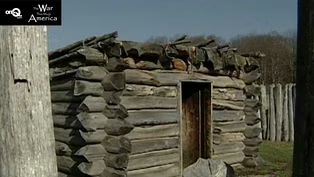
The War That Made America OnQ Clip - Fort Necessity
Video has Closed Captions
OnQ segment explores Fort Necessity, the French and Indian War, and The War That Made America. (8m 32s)
The War That Made America OnQ Clip - Casting and Models
Video has Closed Captions
OnQ segment explores casting George Washington and creating lifelike models for a historic exhibit. (17m 20s)
The War That Made American Launch OnQ
Video has Closed Captions
OnQ explores early test footage, interviews, battle recreations, and insights on TWTMA production. (9m 30s)
Early American History OnQ Clip - Andy Masich
Video has Closed Captions
This OnQ segment explores Pittsburgh history from the French and Indian War to the modern city. (3m 33s)
Joe Negri Performs Sleigh Ride
This clip from OnQ features Joe Negri performing Sleigh Ride from December, 16 2003. (4m 12s)
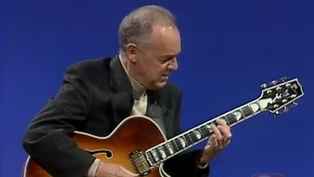
Joe Negri Performs Minha Saudade
This clip from OnQ showcases Joe Negri performing Minha Saudade. (3m 19s)
Video has Closed Captions
This clip of an OnQ episode explores debate in Pittsburgh over same sex unions in the church. (8m 28s)
Video has Closed Captions
This clip of an OnQ episode is about National Coming Out Day and LGBTQ+ lives in Pittsburgh. (18m 32s)
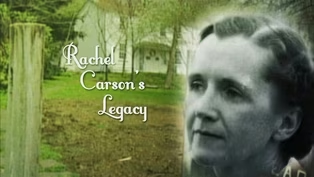 Now Playing
Video has Closed Captions
Hosted by Michael Bartley, this episode explores Rachel Carson’s life, legacy, and impact. (7m 4s)

Video has Closed Captions
12 senior citizens posed for a racy calendar to raise money for their hometown. (10m 43s)
Providing Support for PBS.org
Learn Moreabout PBS online sponsorship New Episode
- News and Public Affairs

Top journalists deliver compelling original analysis of the hour's headlines.

- News and Public Affairs

Today's top journalists discuss Washington's current political events and public affairs.
 New Season


 New Episode

 New Episode



Support for PBS provided by:
OnQ is a local public television program presented by WQED