Oregon Field Guide
Rail Speeders, First Nations Vet, River Recovery After Fire
Season 37 Episode 3 | 27m 5sVideo has Closed Captions
A scenic coast rail speeder journey. Rez dogs get vet care. How rivers recover after fire.
Enthusiasts drive vintage railcars along the Oregon Coast for the annual Teddy Bear Toy Express. Pets in need on the Warm Springs Reservation are visited by a mobile veterinary clinic. Five years after Oregon's Labor Day fires, what have scientists learned about how stream ecosystems recover?
Problems playing video? | Closed Captioning Feedback
Problems playing video? | Closed Captioning Feedback
Oregon Field Guide is a local public television program presented by OPB
Oregon Field Guide
Rail Speeders, First Nations Vet, River Recovery After Fire
Season 37 Episode 3 | 27m 5sVideo has Closed Captions
Enthusiasts drive vintage railcars along the Oregon Coast for the annual Teddy Bear Toy Express. Pets in need on the Warm Springs Reservation are visited by a mobile veterinary clinic. Five years after Oregon's Labor Day fires, what have scientists learned about how stream ecosystems recover?
Problems playing video? | Closed Captioning Feedback
How to Watch Oregon Field Guide
Oregon Field Guide is available to stream on pbs.org and the free PBS App, available on iPhone, Apple TV, Android TV, Android smartphones, Amazon Fire TV, Amazon Fire Tablet, Roku, Samsung Smart TV, and Vizio.
Providing Support for PBS.org
Learn Moreabout PBS online sponsorshipMajor support for Oregon Field Guide is provided by... [ ♪♪♪ ] WOMAN: Come on!
There he is, there he is, there he is.
[ exclaims ] Get him out of there, buddy!
Good boy!
[ laughing ] WOMAN: Whoo, high five!
Yeah!
THOMAS: Next, on Oregon Field Guide: For a long time, people thought forest fires were bad for streams and fish.
MAN: Right here.
But what if that wasn't true?
Fish in your net.
WOMAN: Everything we thought we knew about fire, we've kind of turned it on its head.
Then, a mobile vet clinic cares for dogs and cats on reservations... with some help.
We get volunteers that come from all over the United States.
They call it a spay-cation.
But first, vintage rail speeders spread cheer along the Oregon coast.
It's a brisk and sunny fall morning at a sawmill west of Eugene, near the tiny town of Noti, and people from as far away as Texas, Colorado, and even Pennsylvania have converged here to be part of Oregon's longest and largest rail speeder run.
Thank you.
You bet.
What's a rail speeder?
Well, these are rail speeders... [ ♪♪♪ ] ...also known as a section car, motor car, putt-putt, track maintenance car, crew car, or inspection car.
They're basically metal boxes with motors that go down railroad lines.
They were once used on railroads by track inspectors and work crews to move quickly from work sites.
Now they're a hobby.
It's just-- It's different.
There are not that many people get to run the rails or have cars like these.
There are speeder runs all across the U.S.
and Canada, and these folks have gone on many of them, but this run is a favorite, and many say it's the best.
Yeah, I mean, for me, it's definitely the top.
I mean, it's number one by far.
For the club members, this run is a special treat.
It plunges through tunnels and crosses over 100-year-old trestles, passing covered bridges, misty valleys, and old sawmills, offering a perspective of Oregon that feels, well... quintessentially Oregon.
Its reputation spreads and people talk about it: "Oh, you've got to do that."
RALPH: We're running rails that Amtrak doesn't run on.
These are not passenger rails.
These are freight rails.
And we get to see country you can see no other way.
[ train whistle blows in distance ] The run starts at the foothills of the Willamette Valley, cuts through the mountains toward the coast.
Near Florence, it swings south, crossing through Reedsport and Coos Bay, all the way to Coquille, then retraces the route back, 250 miles in all.
This run is not only the longest in Oregon, but it has a special purpose.
MAN: We have three stops to pick up presents.
This is our once-a-year Teddy Bear Toy Express.
RALPH: This is the first year we've had Santa Claus.
WOMAN: They asked if we would be elves, so we're Santa's elves.
And it's for the kids.
Of course, to do the run, the hobbyists need rails to run on.
So club leaders Bill and Nancy keep a relationship with the railroad company.
The speeders follow behind a railroad employee driving what is known as a "Hi-Rail."
NICK: They have the little steel wheels that go down, and you can just take a full-size truck and run up and down the railroad trucks.
Before they had those, they had these little boxes on wheels.
RALPH: In the mid '80s, they went to the pickups and started using those, and so all these became surplus and that's how they all came for us to use them and do these kinds of things, the hobby.
And that's what's kind of kept these things alive and out of the scrapper.
[ whistle blows ] They've got forward and reverse.
And then they just got two gears.
They're pretty straightforward.
And then of course with steel on steel, especially in the fall, these tracks get wet and you go to hit the brakes... I mean, it's not like your car.
These things will just keep moving.
You're not skidding, you're sliding.
[ laughs ] The first stop is the town of Mapleton, population 493.
WOMAN: It's Mr.
and Mrs.
Clause!
RALPH: Hello.
Hi.
So good to see you.
RALPH: It's good to be here!
The local school has set up a donation booth.
MAN: Kids are gonna love this.
[ overlapping chatter ] [ woman laughs ] Ooh!
Okay, the lead motor car is heading out.
Ho-ho-ho!
Setting off from Mapleton, the procession parallels the Siuslaw River.
Here, the river slows and widens.
The weather sets in to a gray sogginess.
The coast is near.
The tracks had been pointing west, but at Cushman they make a sharp turn to the south, crossing over the Siuslaw.
They skim over a marshy slough for the next several miles, then roll over the many inlet fingers of Siltcoos and Tahkenitch Lakes.
None of this can be seen from the road.
RALPH: I've lived here all of my life.
I've been all these places many times, but I've never seen them from these views.
You get to see the scenery nobody else sees.
RALPH: When you got the tracks rolling out in front of you and you're just seeing the scenery and everything, it is very relaxing.
And the "clank-clank-clank" of the rails, it's got a rhythmic part to it that is very soothing.
NANCY: Our first run, we knew we loved it.
There's a feeling and sensation about it that we just enjoy.
[ train whistle blows ] From Tahkenitch Lake, the rails cross over the Umpqua River and roll into the town of Reedsport.
[ horns honking ] RALPH: You get lots of people honking and waving when you are paralleling the highway, and people will pull over and they'll take off and get way ahead of us and find a place to pull over where the tracks are and watch us come by.
After Reedsport comes the small town of Lakeside.
The locals have turned out with toys to donate to the cause.
It means a lot to the citizens here.
We're a small community, as you realize.
I don't think I can climb up there.
DOROTHY: I don't know if I can either.
Thank you.
We won't make you do it today.
Here, honey, you do it.
Okay, I'm getting it in there.
Thank you very much.
RALPH: There's lots of kids that will show up with parents to give these toys away to other kids that are less fortunate than them.
BILL: That's really touching to us to get the young kids involved with it, and that's what it's all about.
Now we're getting full.
Thank you so much.
NANCY: That just struck me.
I thought that was just the real essence of giving.
You know?
Here I'm going to tear up.
All of this, these people give so much to us, make us feel so good over the years that it's good to give back.
After Lakeside, the rails continue southward, past the Oregon dunes.
Then the famous McCullough Bridge of Coos Bay appears.
This is historically a working town, the economic muscle of the coast.
The motorcars stop for the night before continuing south up the Isthmus Slough.
It's a good thing for my wife and I to do together.
NANCY: My husband and I have been in this hobby for many, many years, 32 years.
Dorothy here, she's my partner in the car and in my life.
And... Yep, and you've put up with me.
Yeah, and we put up with each other.
Yes, we do.
It doesn't get better than that.
RAIL OPERATOR: We're down at the end.
So once you get out, everybody turn your cars.
The speeders reach the farthest point on their trip: the town of Coquille.
It's time to turn around and retrace the route.
But turning a rail speeder around is not like turning a car.
[ warning alert beeping ] You might wonder how a railcar does a 180-degree turn on the tracks.
Well, that's exactly what they do: a 180-degree turn.
After getting all 45 cars turned around, the procession rolls back to Coos Bay for the finale of their toy run.
We made it!
Let's unload these toys.
Come on, elves!
[ overlapping chatter ] I like having all the motorcar operators and passengers involved.
They brought many toys with them, and these people, some of 'em don't even know each other.
And we all worked together.
We just did it together as a unit.
I like that.
[ woman exclaims ] The donated toys are handed off to the Coos Bay Fire Department to be later gifted to local kids during the holidays.
NANCY: Thank you, guys.
This year's toy drive, another success.
[ ♪♪♪ ] The only thing left to do is head back.
Bill and I will probably have to retire.
We keep saying that.
We're 86 and we say we're going to retire, but we don't.
So we'll go as long as we can, yeah.
And when we do leave, we'll pass it on to somebody else.
[ ♪♪♪ ] This tree here near the McKenzie River burned during the Holiday Farm Fire.
It's one of dozens of Labor Day fires that burned through Oregon and Washington five years ago this fall.
The fires changed forest ecosystems, but they also affected the streams and rivers that run through those forests.
And scientists are here in the woods trying to understand those changes.
MAN: Get ready.
This is going to get exciting.
Fishy, fishy-- Oh, I saw one.
Sometimes, to understand what's happening in a stream, scientists have to go fishing.
There it is.
Yeah, I see it.
In your net.
Sweet!
Electrofishing is temporarily stunning the fish in the water and then snatching them up as fast as you can in the net.
Yep, it's right here.
Right here.
There's fish in your net-- Out of your net.
Going down.
It jumped right in your net and then jumped out.
ALLISON: The fish are doing their best to hide from us.
Oh, there it is!
Under here.
MAN: Next time.
The fish are pretty crafty at avoiding the nets, but most will eventually get scooped up.
Little fish.
They'll help these scientists understand how streams changed following the most extreme fire event in Oregon's recent history.
I remember it very distinctly.
Labor Day 2020.
COVID.
Everything was closed.
We were in the river that day.
It was quite hot.
[ ♪♪♪ ] It was a glorious day until it wasn't.
DISPATCHER: 9-1-1, what is your emergency?
WOMAN: We need help in Gates.
There's a fire coming up in the neighborhood.
It's huge!
Oh, my God.
That day, a massive wind storm moved across the Pacific Northwest, fueling more than 20 fires.
They would eventually burn more than a million acres.
When the fires were finally out, nearly a dozen people were dead and thousands of homes and businesses were destroyed.
The landscape and rivers, the sources of drinking water for millions of Oregonians, changed significantly.
We knew it was bad and we knew that it needed to be studied.
The team of biologists and ecologists sprung into action... Be careful on that rock.
...searching for streams that had burned at varying severities across tree plantations, older natural forests, areas where the burned trees were logged after the fire, and some unburned streams to serve as a baseline.
This study is unique in that we have 30 streams, you know, across three big mega-fires in Western Oregon.
I just gotta measure the depth.
Every summer since the fires, the crews have tested water quality... 260.
...and how the animals in the streams have fared.
Cedar Creek burned in the Beachie Creek Fire.
What was once a shady creek is now exposed to the heat of the sun for much of the day.
Yep, yep, yep, yep, yep, yep!
There it is right there.
I think that was a rainbow trout.
Nice.
Many of these species depend on good water quality and cold water to thrive.
And after five years of counts, the team has started seeing some trends.
ALLISON: Despite stream temperatures getting really warm in these systems after the fire, the fish populations are remaining just as high or higher than the unburned sites are.
The streams are warmer, but more sun means more algae, which feeds the food web.
Also without trees and vegetation sucking up water on the surrounding hillsides, there's more left for the rivers.
With the extra rains that are coming straight down and into the stream with that runoff, you're getting additional fringe habitats along the streams.
But while the fish have gotten the post-fire bump, the story isn't as clear for amphibians.
Three, two, one, out.
Streams in the West Cascades are home to coastal giant salamanders and tailed frogs.
Sallie?
There it is!
The sallies are tough to catch.
It's gone.
They're potentially the squirmiest.
It's waving.
Hello!
Oh, no, no, no, no!
Oh, no!
MAN: Okay, I got three of them.
Okay, there's a young-of-the-year by your feet.
Oh, we got them all.
Frog and tadpole numbers, in particular, have dropped in some streams.
But the preliminary data are showing fires aren't the cause.
Instead, the declines happened in areas where logging crews harvested burned trees most heavily after the fires.
For the longest time, stream ecosystems were thought to suffer because of wildfire.
But in the five years since the Labor Day fires, these scientists are seeing signs that they're actually thriving.
Sculpin.
Everything we thought we knew about fire, we've kind of turned it on its head here on the west side of Oregon.
And the research shows that the tragedy of the Labor Day fires has turned into an opportunity, a chance to figure out the best way to manage our forests after wildfire to protect our streams and all the life they contain.
The reality is that wildfires are increasing on the landscape in severity and size.
And so in terms of understanding how we manage our forests and these ecosystems, we need to know what's happening because we're really just kind of at the start of what we're going to begin to see in the future.
[ ♪♪♪ ] In some indigenous communities, it can be incredibly difficult to find accessible, affordable veterinary care.
But luckily, some organizations are finding a very creative way to fill the need.
MAN: Dogs are part of my family.
Good doggies.
Good.
Good boy.
MAN: When I was growing up, we always had not only one dog, you know, a number of dogs.
When we went to the swimming hole, the dogs were with us.
When we would go gather foods, the dogs were, you know, our companions.
This one reminds me of a golden retriever.
Dogs are part of a way of life.
Cosmo, you dare hit your own-- Aah!
James, my son, he's always had a dog.
It's okay.
[ dog whimpers ] If we see a dog on the road, we'll pick him up and we'll nurse him back together.
Try to tell him, "Hey, time to go home, dog," but guess what, they don't want to go home, so then they're our dogs.
They don't have a collar on or registered to anybody, we'll bring 'em in and we'll feed 'em.
I'm not going to say protect them, because they protect us.
Like, all these dogs might be my favorite.
And then, of course, "Well, that's my dog," you know.
Then they put the claims on that-- that rez dog.
That's how the majority of my dogs came to me.
If we don't take care of them, who will?
Here on the Warm Springs Reservation and like so many other reservations, there's lack of access to veterinary care.
And so what we like to do is to come up here and do a hundred spay/neuters, which translates into about 300 births prevented.
So that means 300 less dogs roaming around this reservation specifically.
Thank you guys so much for being here and for making these clinics happen.
They could not happen without you and without your commitment.
I have an aunt that speaks very well, she's an Elder, about how our people always took care of the four-leggeds.
It's been special, it's been handed down in our generations.
And she speaks very eloquently about how important it is that we look after the animals.
It just makes my heart feel so full to be here, so I don't know what that word is, but that's how I feel when I'm here and it truly is an honor, so thank you so much.
We call it tmná.
Tmná.
Tmná, that's a heart.
And that heart is... Yeah, that's how I feel.
[ all laugh, chattering ] Hi.
Good morning.
So he'll get neutered today.
You're going to get vaccine records, it looks like.
Hi, buddy.
Okay, I'm going to put this around him.
[ indistinct chattering ] He's just very, very scared.
It's okay.
You're okay.
There we go.
Good boy.
Okay, good boy.
GINA: I deeply believe in spay/neuter, and really specifically, high-volume spay/neuter.
Ultimately, if we can reduce the overall population, then we reduce animal suffering.
So we reduce the number of animals that go into animal shelters and to rescues.
And specifically on reservations, we can reduce the number of free-roaming dogs.
WENDELL: When we didn't have the vets coming in, you would see more animals that were injured, torn apart-- they had gashes in their side.
What's your last name?
GINA: This year, we are doing a clinic on Warm Springs, and then next month we'll do one on the Umatilla Reservation.
We also will do a clinic up on the Hopi Nation.
We get volunteers that come from all over the United States.
They call it a spay-cation.
[ cat meowing ] Two babies.
It's okay.
I got you.
Thank you.
I'm a board member of First Nations Vet because I actually took my cat here two years ago.
Uh... four.
Yeah.
She saw that I was a Warm Springs community member.
From there, she's like, "I think it's good to have somebody in the community on our board."
Being on a reservation, it's kind of hard to get vet care, because for one, we don't have any veterinarians that are on the reservation.
And then once they are able to get an appointment, it's just super, super expensive.
[ indistinct conversation ] We not only spay/neuter them, but we also vaccinate them, provide a microchip for them, we give 12 months' worth of flea and tick medication.
And so we deliver those services totally free to the community.
If it's the only appointment that we're going to get, we just want to give them everything we've got.
Can we get a runner?
[ machine beeping ] [ indistinct chattering ] So occasionally, we have clients who, maybe their pets have an accidental litter and the puppies need to find homes.
These eight super cute little chonky puppies, their owner had called us and said, "I have this mama dog that just keeps having puppies and I have got to get her fixed."
And, you know, I'm looking at our lists, we were already full.
And so I had texted Ali and I was like, "Put this one at the top of the waitlist."
We're gonna vaccinate the puppies, we're gonna fix mama dog, and then those puppies are gonna go into rescue with Street Dog Hero and get adopted.
I'll just carry the second two in.
Okay.
Do you know where we're putting them, because I thought they were right there?
I would just set... or here, yeah.
You see a little baby?
Before the vets started coming here, there were a lot more free-roaming dogs.
Female dogs weren't fixed in the community, and so when they would, they would have lots of puppies and then some people wouldn't be able to have homes for them or sometimes, you know, they just get left.
[ indistinct conversations ] Think that one's a boy.
I just came to get cats.
But, I mean, what's one more dog?
Make it an even six, huh?
Yeah.
[ all laugh ] You gonna take it home?
Yes.
Yeah, this is yours?
Yay!
This one's mine.
He won't be Bear, though.
Fry bread partner!
Yes!
[ dogs whimpering ] Cozy Jim.
It's your turn.
Are you ready to come with me?
Come on, sweet pea.
Hi, sweet little pooch.
Good.
Perfect pup.
All right, meloxicam's given.
Recheck her temp in about five minutes.
Resp rate 30.
WENDELL: Is he droopy?
Huh?
Yeah, he is.
WENDELL: We are grateful that the vets come to the reservation.
[ dogs barking, whimpering ] Professionals provide shots for things that we don't really think about.
Why, do you want Indian tacos?
Oh, yeah, we do.
Look, he's happy now.
I thought he would be all drowsy and droopy, but he's looking good.
[ overlapping conversations ] We did 123.
[ all cheer ] 123!
I think that's kind of a record.
I actually think that's a record for First Nations Vets, and we did so many rehoming things.
So I just wanted to say thank you guys so much for, um... for your hard work.
Thank you.
Thank you, everyone.
CHEYDON: The rez dogs are our family.
They are part of our community just as much as any other human is, and we need to treat them with respect the same way we'd want a human to be treated with respect.
[ ♪♪♪ ] You can now find many Oregon Field Guide stories and episodes online.
And to be part of the conversation about nature and the outdoors here in the Northwest, join us on Facebook.
Major support for Oregon Field Guide is provided by... Additional support provided by... and the following... and contributing members of OPB and viewers like you.
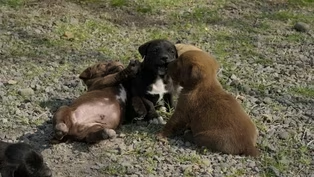
First Nations Vet Treats “Rez Dogs” for Free
Video has Closed Captions
Clip: S37 Ep3 | 8m 25s | A mobile veterinary clinic treats pets in need on the Warm Springs Reservation. (8m 25s)
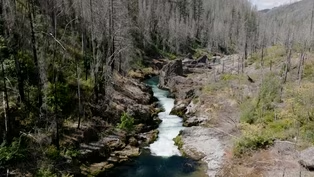
Five years after Oregon’s Labor Day Fires, scientists find surprises in burned forest streams
Video has Closed Captions
Clip: S37 Ep3 | 5m 29s | Scientists have been studying how water quality and wildlife have fared in 30 streams in the five ye (5m 29s)
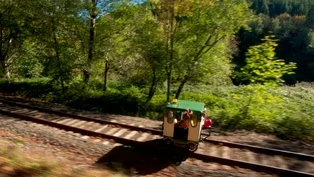
Railroad Speeder Cars Make a Scenic Holiday Run
Video has Closed Captions
Clip: S37 Ep3 | 10m 9s | Enthusiasts drive railroad speeders along the Oregon Coast, taking gifts to kids in need. (10m 9s)
Providing Support for PBS.org
Learn Moreabout PBS online sponsorship















Support for PBS provided by:
Oregon Field Guide is a local public television program presented by OPB