Oregon Field Guide
Railroad Speeder Cars Make a Scenic Holiday Run
Clip: Season 37 Episode 3 | 10m 9sVideo has Closed Captions
Enthusiasts drive railroad speeders along the Oregon Coast, taking gifts to kids in need.
Once a year, enthusiasts drive vintage railroad speeder cars across the Oregon Coast Range and down the coast, getting to see gorgeous places few people see — all while delivering gifts to kids in need. There are speeder runs across the Northwest, but this annual run is often cited as the most scenic. It goes across trestles and through tunnels, over bridges and sloughs, and past the Oregon Dunes.
Problems playing video? | Closed Captioning Feedback
Problems playing video? | Closed Captioning Feedback
Oregon Field Guide is a local public television program presented by OPB
Oregon Field Guide
Railroad Speeder Cars Make a Scenic Holiday Run
Clip: Season 37 Episode 3 | 10m 9sVideo has Closed Captions
Once a year, enthusiasts drive vintage railroad speeder cars across the Oregon Coast Range and down the coast, getting to see gorgeous places few people see — all while delivering gifts to kids in need. There are speeder runs across the Northwest, but this annual run is often cited as the most scenic. It goes across trestles and through tunnels, over bridges and sloughs, and past the Oregon Dunes.
Problems playing video? | Closed Captioning Feedback
How to Watch Oregon Field Guide
Oregon Field Guide is available to stream on pbs.org and the free PBS App, available on iPhone, Apple TV, Android TV, Android smartphones, Amazon Fire TV, Amazon Fire Tablet, Roku, Samsung Smart TV, and Vizio.
Providing Support for PBS.org
Learn Moreabout PBS online sponsorship(metal squeaks) (tailgate thuds) - [Narrator] It's a brisk and sunny fall morning at a sawmill west of Eugene, near the tiny town of Noti.
And people from as far away as Texas, Colorado, and even Pennsylvania have converged here to be part of Oregon's longest and largest rail speeder run.
- Get her on.
- You bet.
- [Narrator] What's a rail speeder?
Well, these are rail speeders, also known as a section car, motor car, putt putt, track maintenance car, crew car, or inspection car.
They're basically metal boxes with motors that go down railroad lines.
They were once used on railroads by track inspectors and work crews to move quickly from work sites.
Now they're a hobby.
- It's just, it's different.
There are not that many people get to run the rails or have cars like this this.
- There are speeder runs all across the US and Canada and these folks have gone on many of them.
But this run is a favorite and many say it's the best.
- [Nick] Yeah, I mean for me it's definitely the top.
I mean, it's number one by far.
- [Narrator] For the club members, this run is a special treat.
It plunges through tunnels and crosses over hundred year old trestles, passing covered bridges, misty valleys, and old sawmills, offering a perspective of Oregon.
It feels, well, quintessentially Oregon.
- It's reputation spreads and people talk about it and say, "Oh, you gotta do that."
- [Ralph] We're running rails that Amtrak doesn't run on.
These are not passenger rails, these are freight rails.
We get to see country you can see no other way.
(car squeals) - [Narrator] The run starts at the foothills of the Willamette Valley, cuts through the mountains towards the Coast and near Florence, it swings south crossing through Reedsport and Coos Bay all the way to Coquille.
Then retraces the route back, 250 miles in all.
(car whirs) This run is not only the longest in Oregon, but it has a special purpose.
- [Bill] We have three stops to pick up presents.
This is our once a year Teddy Bear Toy Express.
- [Ralph] This is the first year we've had Santa Claus.
- They asked if we would be elves.
So we're Santa's elves and it's for the kids.
- [Narrator] Of course, to do the run, the hobbyists need rails to run on.
So club leaders, Bill and Nancy, keep a relationship with the railroad company.
The speeders follow behind a railroad employee driving what is known as a hi-rail.
- [Nick] They have the little steel wheels that go down and you can just take a full-size truck and run up and down the railroad tracks.
Before they had those, they had these little boxes on wheels.
- [Ralph] In the mid eighties, they went to the pickups and started using those and so all these became surplus and that's how they all came for us to use them and do these kinds of things, the hobby.
- [Nick] And that's what's kinda of kept these things alive and out of the scrapper.
(horn honks) They've got forward and reverse.
And then you just got two gears.
They're pretty straightforward.
And then of course with steel on steel, especially in the fall, and these tracks get wet and you go to hit the brakes, I mean, it's not like your car.
These things will just keep moving.
You're not skidding, you're sliding.
(laughs) - [Narrator] The first stop is the town of Mapleton, population 493.
- [Teacher] It's Mr.
and Mrs.
Santa Claus.
- [Santa] Hello.
- [Mrs.
Claus] Hi.
- So good to see you.
- [Santa] It's good to be here.
- [Narrator] And the local school has set up a donation booth.
- [Santa] Good, good, thank you.
Kids are gonna love this - Leave 'em in the bag.
- That'll be great.
- Aw.
- Okay, a lead motor car is heading out.
- Ho, ho, ho!
- [Narrator] Setting off from Mapleton, the procession parallels the Siuslaw River.
Here, the river slows and widens.
The weather sets into a gray sogginess.
The coast is near.
(car whirs) The tracks had been pointing west, but at Cushman, they make a sharp turn to the south, crossing over the Siuslaw.
They skim over a marshy slough for the next several miles, then roll over the many inlet fingers of Siltcoos and Tahkenitch Lakes.
(cars clack) None of this can be seen from the road.
- [Ralph] I've lived here all of my life.
I've been in all these places many times, but I've never seen them from these views.
- [Dorothy] You get to see the scenery nobody else sees.
(car clacks) - [Ralph] When you got the tracks rolling out in front of you and you're just seeing the scenery and everything, it is very relaxing and the clank, clank, clank of the rails.
It's got a rhythmic part to it that is very soothing.
- [Nancy] Our first run, we knew we loved it.
There's a feeling and sensation about it that we just enjoy.
- [Narrator] From Tahkenitch Lake, the rails cross over the Umpqua River and roll into the town of Reedsport.
(horn honks) - [Steve] So much fun, I love it.
- [Ralph] You get lots of people honking and waving when you are paralleling the highway.
And people will pull and they'll take off and get way ahead of us and find a place to pull over where the tracks are and watch us come by.
- [Narrator] After Reedsport comes the small town of Lakeside.
The locals have turned out with toys to donate to the cause.
- It means a lot to the citizens here.
We're a small community as you realize.
- I don't think I can climb up there.
- [Dorothy] I don't know if I can either.
Thank you.
- [Steve] We won't make you do it.
- [Dorothy] Here, honey, you do it.
- Thank you, okay.
- Thank you very much.
I'm getting it in there.
- [Ralph] There's lots of kids that will show up with parents to give these toys away to other kids that are less fortunate than them.
- [Bill] That's really touching to us to get the young kids involved with it and that's what it's all about.
- [Steve] Now we're getting full.
- Thank you so much.
- [Nancy] That just struck me.
I thought that was just the real essence of giving.
You know, here I'm gonna tear up.
All of this, these people give so much to us, you know, make us feel so good over the years that it's good to give back.
(car clacks) - [Narrator] After Lakeside, the rails continue southward, past the Oregon Dunes.
(wheels purr) Then the famous McCullough Bridge of Coos Bay appears.
(car clacks) This is historically a working town, the economic muscle of the coast.
The motorcars stop for the night before continuing south up the Isthmus Slough.
(car clacks) - [Steve] It's a good thing for my wife and I to do together.
- [Nancy] My husband and I have been in this hobby for many, many years, 32 years.
- [Steve] Dorothy here, she's my partner in the car, - Yeah.
- and my life.
- [Dorothy] Yep and you put up with me.
- Yeah and we put up with each other, so- - Yes, we do.
- It doesn't get any better than that.
- [CB Operator] We're down at the end.
So once you get out, everybody turn your cars.
- [Narrator] The speeders reached the farthest point on their trip, the town of Coquille.
It's time to turn around and retrace the route.
But turning a rail speeder around is not like turning a car.
You might wonder how a rail car does a 180 degree turn on the tracks.
Well, that's exactly what they do.
180 degree turn.
(wheels clank) After getting all 45 cars turned around, the procession rolls back to Coos Bay for the finale of their toy run.
- [Mrs.
Claus] We made it!
- [Nancy] Let's unload these toys.
Come on, elves.
(elves chatter) I like having all the motor car operators and passengers involved.
They brought many toys with them and these people, some of 'em don't even know each other and we all worked together.
We just did it together as a unit.
I like that.
(laughter) - [Narrator] The donated toys or handed off to the Coos Bay Fire Department to be later gifted to local kids during the holidays.
- [Nancy] Thank you guys.
- [Narrator] This year's toy drive, another success.
(tailgate clanks) (music) The only thing left to do is head back.
- [Nancy] Bill and I'll probably have to retire.
We keep saying that.
We're 86 and we say we're gonna retire, but we don't.
So, we'll go as long as we can.
Yeah.
(music) And when we do leave, we'll pass it on to somebody else.
(music continues) (cars clank)
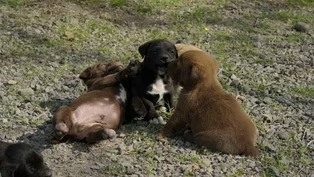
First Nations Vet Treats “Rez Dogs” for Free
Video has Closed Captions
Clip: S37 Ep3 | 8m 25s | A mobile veterinary clinic treats pets in need on the Warm Springs Reservation. (8m 25s)
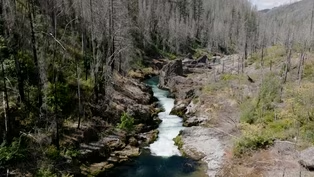
Five years after Oregon’s Labor Day Fires, scientists find surprises in burned forest streams
Video has Closed Captions
Clip: S37 Ep3 | 5m 29s | Scientists have been studying how water quality and wildlife have fared in 30 streams in the five ye (5m 29s)
Providing Support for PBS.org
Learn Moreabout PBS online sponsorship














Support for PBS provided by:
Oregon Field Guide is a local public television program presented by OPB