Prairie Sportsman
Raptor Rehab
Clip: Season 17 Episode 3 | 8m 58sVideo has Closed Captions
We profile work being done to rehabilitate, research, and educate people about Minnesota’s raptors.
We profile work being done to rehabilitate, research, and educate people about Minnesota’s raptors. We see how the center’s hospital cares for these birds, and we check in on an educational camp where students experience close encounters with these birds of prey.
Problems playing video? | Closed Captioning Feedback
Problems playing video? | Closed Captioning Feedback
Prairie Sportsman is a local public television program presented by Pioneer PBS
Production sponsorship is provided by funding from the Environment and Natural Resources Trust Fund and Shalom Hill Farm. Additional funding provided by Big Stone County, Yellow Medicine County, Lac qui...
Support provided by:


Prairie Sportsman
Raptor Rehab
Clip: Season 17 Episode 3 | 8m 58sVideo has Closed Captions
We profile work being done to rehabilitate, research, and educate people about Minnesota’s raptors. We see how the center’s hospital cares for these birds, and we check in on an educational camp where students experience close encounters with these birds of prey.
Problems playing video? | Closed Captioning Feedback
How to Watch Prairie Sportsman
Prairie Sportsman is available to stream on pbs.org and the free PBS App, available on iPhone, Apple TV, Android TV, Android smartphones, Amazon Fire TV, Amazon Fire Tablet, Roku, Samsung Smart TV, and Vizio.
Prairie Sportsman Premium Gifts
To order, email yourtv@pioneer.org or call 1-800-726-3178.Providing Support for PBS.org
Learn Moreabout PBS online sponsorship- [Narrator] Eagles, hawks, falcons, owls and vultures.
These avian carnivores are known collectively as raptors.
- A raptor is basically a bird of prey and there's a couple different characteristics that make a bird a raptor and one would be excellent vision.
So these raptors are amazing in that their ability to see from long distances.
They also have very sharp talons or claws and a very sharp beak.
(upbeat music) (bird squawking) - [Narrator] Founded in 1974, the Raptor Center located on the St.
Paul campus at the University of Minnesota is a world class surgery and rehabilitation center that also performs outreach and education about these majestic birds.
- We are a scientific based organization that really is devoted to ensuring the health of raptors and the world we all share.
We have a three-pronged mission: teaching, research, and service.
And probably what we're best known for is the service component.
So we have a fully stocked raptor hospital with experts in caring for these amazing birds.
And we also do a fair amount of teaching too.
We collaborate and teach people across the world on how to take care of raptors.
- [Narrator] Minnesota is home to a diverse array of these apex predators, thanks to its four major biomes and Hawk's Ridge, a geographical feature along the north shore of Lake Superior that naturally funnels migrating raptors south from Canada.
Due to this, the Raptor Center sees an increase in patients in the early fall.
- We get about a thousand raptors, more or less into our hospital every year.
Most often what happens is we get a call from a person in the public who finds a raptor.
We have rescue and transport volunteers that will go out and help to retrieve those birds.
- [Narrator] Raptors commonly suffer injuries from collisions with vehicles, power lines or windows, as well as from entanglements in things like nets, fishing line and fencing.
It's up to the professionals at the Raptor Center to diagnose and treat the problem.
- They all get radiographs, blood work.
Certain scavengers like bald eagles and vultures will get a test for lead.
Then after we kind of figure out what the problem is, then some of them will need surgery if they have a fracture.
Others may need supportive care.
If they have lead in their stomachs, we may need to flush it out.
So there's a variety of different things that'll happen next.
- [Narrator] Of course, the birds don't necessarily know they're being helped.
- [Narrator] To them, it must feel a bit like an alien abduction.
Safety for both doctor and patient is key.
- We try to reduce their stress as much as we can, right?
So a lot of procedures, you'll notice we're covering their heads, we're talking quietly, we'll anesthetize those if it's safe to do so.
We also have to be safe because they're gonna try to defend themselves, right?
With those sharp talons and those beaks.
So our handlers all will wear protective eyewear.
They'll wear different types of handling gloves.
For eagles, they're biters, so we will also wear a welder's jacket.
So we make sure that we keep the volunteers and the staff safe as well as the reducing the stress on the patients too.
- [Narrator] This groggy great horned owl even got a post-op snack courtesy of clinic volunteers.
- Our hospital is almost 100% supported by philanthropy.
We are really a community driven organization.
We have over 300 volunteers that help us in a variety of ways, and probably I'd say about a hundred of those actually help in the rehabilitation component.
- [Narrator] A big part of that rehabilitation is pre-release conditioning.
Meet patient 25-519, which means the 519th Raptor admitted in the year 2025.
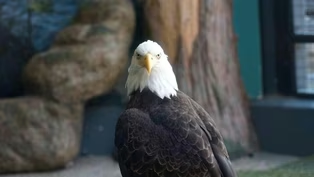
This bald eagle is taking flight for the first time since recovering from its injuries.
- Another whole crew of volunteers are trained to take these birds out on a long tether and give them opportunities to fly.
Rebuild those weakened flight muscles, reestablish flight mechanics.
Sometimes if a bird has a broken wing, it may start out a little crooked and just need time in order to build those muscles and regain his flight mechanics.
- [Minder] Yeah, I think he's tiring out.
- [Narrator] Not all of the raptors the center rescues and rehabilitates can be released.
Some of these birds go on to become ambassadors to the public.
- So we have a collection of about 25 ambassador birds.
So these are birds that cannot be released to the wild for a variety of reasons.
And they're all specifically trained to be comfortable around people and they're really the tools that inspire people.
Once you meet a raptor up close and personal, it's so natural to just get this amazing feeling of awe.
And that draws people in and really makes them wanna be better stewards of the environment.
- [Narrator] Funding from the state of Minnesota has allowed the Raptor Center to expand its educational outreach.
- So the grants that we've gotten from LCCMR have enabled us to take our programming into under serviced schools.
So kids that don't have the ability to get environmental education and not just in the Twin Cities Metro, throughout the entire state of Minnesota.
So we really feel fortunate that we're able to take our raptors and share these messages with students who would not normally get that opportunity.
- [Narrator] And for kids who want a deeper dive into the world of Raptors, the center conducts various camps throughout the summer with hands-on activities and the opportunity to get up close and personal with the Raptor Center's educational ambassadors.
The theme of this week's camp is working with wildlife.
It's meant to give youngsters a glimpse into the wide variety of careers available to animal lovers.
- When I went to school, it was the only option we really had was to be a veterinarian.
Right now, there are so many more options, ways that you can work with animals either directly or indirectly and really help the environment.
And so just exposing them to that a little bit, will hope, will really inspire them to dig a little deeper when they're choosing their career paths.
- I really like birds.
I wanna be an ornithologist when I grow up.
- I've always wanted to be a veterinarian when I grow up.
I grew up on a farm, so I love animals and stuff like that.
I've seen many vets go to my farm and work on our horses and animals.
I've helped them many times, so I just think it's very cool.
- [Narrator] Unfortunately, not every bird that enters the Raptor Center goes on to recover, but even those that don't, contribute to science and the care birds who will come after sometimes as a specimen for a necropsy, an activity that seems to connect with camp goers.
- So this is our heart.
Oh, I'm sorry, does this smell bad?
- I thought it was really cool we got to like see inside of a bird today.
- How fun, never had this.
- Did you find it?
- Dissecting the birds, that was really fun.
- [Interviewer] Yeah, did you like touching the squishy stuff?
- [Will] I stuck my finger down his throat, it's fun.
- Just giving them these opportunities to, in real life, engage with raptors, just from our experience has shown us it's very impactful on what they go on to do in their future lives.
- [Narrator] From inspiring future conservationists to being at the forefront of biosecurity protocols for avian influenza, the Raptor Center continues to build on its mission.
- We are not only a rehabilitation and education facility, but we want to expand our knowledge and continue to learn and share that knowledge around the world.
So right now, we have partnerships in Thailand and Australia, places that don't have the ability to learn like we do with our heavy caseload, right?
So our impact is more far reaching than just Minnesota.
- [Narrator] For over 50 years, the Raptor Center has educated the public, rehabilitated raptors and trained future avian experts.
Their research has expanded our knowledge of these amazing birds and the environment we all share.
It's made possible due to the dedication and commitment of the entire organization.
- Every single staff person here is very passionate about what they do, specifically, about the birds, about our mission, it's just an amazing place to work.
- [Narrator] And in case you're wondering, the bald eagle we saw flight training in Como Park was successfully released back into the wild a few days after filming.
(upbeat music) - Oh, beautiful, nice.
- That's a good one.
- [Minder] Nice, very good.
 New
NewVideo has Closed Captions
Clip: S17 Ep3 | 16m 35s | A group of guys mark 20 years of their annual rabbit hunt. (16m 35s)
Rabbit Hunting and Raptor Rehab
Video has Closed Captions
Preview: S17 Ep3 | 30s | An annual Black Friday rabbit hunt and the Raptor Center cares for injured birds of prey. (30s)
Providing Support for PBS.org
Learn Moreabout PBS online sponsorship
- Science and Nature

Explore scientific discoveries on television's most acclaimed science documentary series.

- Science and Nature

Capturing the splendor of the natural world, from the African plains to the Antarctic ice.











Support for PBS provided by:
Prairie Sportsman is a local public television program presented by Pioneer PBS
Production sponsorship is provided by funding from the Environment and Natural Resources Trust Fund and Shalom Hill Farm. Additional funding provided by Big Stone County, Yellow Medicine County, Lac qui...