This Is Minnesota Orchestra
Rebecca Albers Plays Donghoon Shin
Season 8 Episode 2 | 1h 56m 39sVideo has Closed Captions
Principal Viola Rebecca Albers performs Donghoon Shin's Threadsuns, conducted by Fabien Gabel.
The Minnesota Orchestra acknowledges the current circumstances in our communities and begins this program with Adagietto from Mahler’s Symphony No. 5. Principal Viola Rebecca Albers performs the U.S. premiere of Donghoon Shin’s Threadsuns Concerto for Viola and Orchestra. Also on the program, works from Dukas, Debussy and Roussel. Fabien Gabel returns as guest conductor.
Problems playing video? | Closed Captioning Feedback
Problems playing video? | Closed Captioning Feedback
This Is Minnesota Orchestra is a local public television program presented by Twin Cities PBS
This Is Minnesota Orchestra
Rebecca Albers Plays Donghoon Shin
Season 8 Episode 2 | 1h 56m 39sVideo has Closed Captions
The Minnesota Orchestra acknowledges the current circumstances in our communities and begins this program with Adagietto from Mahler’s Symphony No. 5. Principal Viola Rebecca Albers performs the U.S. premiere of Donghoon Shin’s Threadsuns Concerto for Viola and Orchestra. Also on the program, works from Dukas, Debussy and Roussel. Fabien Gabel returns as guest conductor.
Problems playing video? | Closed Captioning Feedback
How to Watch This Is Minnesota Orchestra
This Is Minnesota Orchestra is available to stream on pbs.org and the free PBS App, available on iPhone, Apple TV, Android TV, Android smartphones, Amazon Fire TV, Amazon Fire Tablet, Roku, Samsung Smart TV, LG TV, and Vizio.
Providing Support for PBS.org
Learn Moreabout PBS online sponsorship(upbeat music) - Feel the power of music as it captivates and connects us.
- Music is love.
Music is passion.
- [Narrator] Music belongs to everyone.
This is Minnesota Orchestra.
(audience cheering) - Welcome to Orchestra Hall, everybody.
I'm Brian Newhouse, and this is Minnesota Orchestra.
We're so glad that you are here tonight.
Before we get to the music, I want to add a personal note to these artists on stage.
I had the pleasure of spending years with them every Friday night during the concert season doing the broadcasts live on Minnesota Public Radio.
Each week they gave me, as they give all of us here in the Lindahl Auditorium and audiences around the world, experiences that open the heart and live in the mind absolutely forever.
And I am so grateful to all of you.
Thank you.
(audience applauding) Their artistry has the power to speak when there are no words.
And in light of the recent events in Minneapolis that need no recounting here, tonight's program opens with a selection from Gustav Mahler's "Symphony No.
5".
This movement that Mahler called Adagietto from his Symphony was written as a love song to his wife.
And we present it in tribute to Alex Preti and Renee Goode and those whom you honor and remember.
We share this with love for you and our beautiful, resilient city.
(audience cheering) And just wait till you hear them play.
(audience laughing) Tonight the orchestra will be led by returning guest conductor Fabien Gabel, who's put together this whole program.
So, thank you.
Settle in.
Enjoy.
We're so glad you're here.
Let's welcome Concertmaster Erin Keefe.
(audience applauding) (audience applauding) ("Adagietto from Symphony No.
5") (audience applauding) Powerful music to start tonight's Minnesota Orchestra concert, the Adagietto from Mahler's 5th.
The orchestra's extraordinary principal violist, Rebecca Albers is gonna step away from her section colleagues on the center stage for "Threadsuns" next, from South Korea's Donghoon Shin.
This piece was composed in 2024 and premiered with the Berlin Philharmonic and tonight marks its American premiere.
Because we'll all be hearing it for the first time, Rebecca tells me that the music is beautiful, evocative, and very demanding technically.
Now, if Rebecca Albers says it's tricky to play, that is saying something.
The title is evocative in itself.
Threadsuns comes from a short poem by Paul Celan, translated as suns, thin as a thread, around the grayish black wasteland.
A thought as high as a tree picks up tones of the light.
On the other side of human existence, remains songs to be sung.
Much of composer Donghoon Shin's music is inspired by literature.
As a young man, he went back and forth whether he wanted to become a composer or a novelist.
And music finally won out.
Now his work is in concert halls all around the world.
In just a minute, conductor Fabien Gabel and principal violist Rebecca Albers will bring us the American premiere of his latest piece, "Threadsuns," live here at Orchestra Hall in Minneapolis.
(audience applauding) ("Threadsuns") (audience cheering) (audience cheering) Wow, what a virtuosic workout for Rebecca Albers, the Minnesota Orchestra's Principal Viola in Donghoon Shin's "Threadsuns."
It's so good to see a violist getting the spotlight.
If the orchestra were a choir, the violas are the altos.
They rarely get the showy solos, but without their warm, glowing voices, often in the middle of things, the whole sound would be so diminished.
Violas are the unsung heroes of any orchestra.
So let's learn more about them and our Principal Viola, Rebecca Albers.
(soft music) - I play on a viola by Carlo Tononi.
It's an 18th century instrument.
It is on loan to me.
It's easy to get around this instrument because of its size and the dimensions of the body.
It also just has, I think, this incredible depth of possibility within the sound.
But playing it has definitely changed the way that I approach music and the way that I approach sound.
I feel very, very fortunate to get to play on this instrument.
I'm Rebecca Albers and I'm the Principal Violist of the Minnesota Orchestra.
(upbeat music) The Minnesota Orchestra viola section has a really strong culture of playing together.
We work as a unit and it's sort of my job to decide how that unit moves, figuring out the direction that our bows will be going, the kind of articulation we'll be using, the direction of our phrases, how to make sure that we're doing what the conductor is asking, while also bringing out things that we're aware of that maybe a conductor isn't aware of.
(upbeat music) 90% of what I'm doing is based on what I'm hearing and maybe 10% is based on what I'm seeing.
So of course I'm watching the conductor, making sure that I'm helping to support their vision.
And I'm listening, I have an ear back for the winds and for the brass and percussion because people interpret emotion from the conductor in a different way.
And then listening actually so that I'm not coming in in front of the people around me.
So often I think it's easy when you're leading something to then play ahead, but it's important to be listening back.
I absolutely love the position.
I love my section.
I love my colleagues.
It's a lovely group of people to work with every day.
- Welcome to game night!
- There's always a lot of laughter when the section gets together.
- For Thanksgiving you cook a... - Turkey!
- Or a... - Ham!
- Ham!
- Our section, historically it's a very silly group.
It makes work much more fun and actually makes all of us closer when we are a little bit silly.
(upbeat music) The section has changed a lot actually in the time that I've been in the orchestra.
It's a very young section right now.
When I started I was very much the youngest, you know?
And so it's funny to have that role reversal.
This past summer we lost an incredible colleague, a long time member of the viola section, Ken Freed.
You know, your work colleagues become your family.
And so I think losing Ken was really hard for all of us.
Ken would bring a level of levity that is just really unmatched.
I'm so glad that the newer younger members of our section knew him and hung out with him.
And, you know, he went dancing with them, you know?
His presence on stage is missed every day.
So I grew up in Colorado in Longmont, which is a small town near Boulder.
And I am the youngest of four kids.
Both of my parents are musicians.
My mom is a Suzuki violin teacher, actually here in Minneapolis.
And my dad was a choir director and a pianist.
My sisters are still musicians.
My sister Julie is the principal cellist of the St.
Paul Chamber Orchestra.
And my sister Laura lives in New York City and is a freelance violinist.
Growing up I always looked up to my two sisters.
Seeing them practice made me want to start to play an instrument.
We would do little family concerts at Suzuki Institutes around the country.
And then every winter we would go around to different care facilities and hospitals, strolling through the halls playing Christmas carols.
It was just a very joyful communal feeling and something that I'll always cherish.
So I started playing violin when I was two and I also started playing piano at the same time.
And when I was nine I switched from piano to harp.
Also right around then my mom needed a violist for a string quartet with her students.
And so I got to learn to play viola, which was really exciting.
I went to my first chamber music camp on viola at a Suzuki Institute in Colorado.
And I worked with the Cavani String Quartet, who was at the Cleveland Institute for years.
And they're just, I think, maybe the most incredible chamber music coaches that you could ever work with.
I completely fell in love with the viola.
I loved its role, I loved its voice, and I loved just actually kind of being inside the action, which is often the role of the violist.
You're not usually the star, but you're the person who's kind of making everything work for the people around you.
And it was just so much fun.
So the viola has four strings, just like the violin, and we share three of the strings.
But we have, instead of an E string on the top, we have a C string on the bottom.
I love the depth of the C string, I love what it provides.
To me it's a more mellow, deeper, and darker voice than the violin.
(soft music) As I was making that shift from being at home with my parents to kind of being in the world, it felt right to be kind of going more towards like my true self, which is that of a violist rather than as a violinist.
So I decided to switch basically for college auditions.
I went to Juilliard, where I studied with Heidi Castleman and Hsin-Yun Huang, and I was with them actually for six years.
I stayed for my master's.
My senior year at Juilliard, I auditioned for the Marlboro Music Festival and was accepted.
So I spent the next three summers there in the mountains in Vermont just playing chamber music for seven weeks each summer with just incredible colleagues and incredible teachers.
And that was actually where I got to know Maiya, my wife.
But then she won the position with the St.
Paul Chamber Orchestra.
When that happened, I was completely devastated, which is a funny response when your partner wins a fantastic job.
All I was thinking was like, okay, now I have to figure out how to be in the same place as Maiya.
I have to figure out how to get to Minnesota.
When the Minnesota Orchestra posted their audition in the spring of 2010, I decided, okay, that's my chance.
And so I practiced as hard as I could, and I won the assistant principal position in that audition.
We were exhilarated to finally be able to picture a life in the same place where we both had satisfying jobs.
Maiya just recently played our "Symphonie fantastique" program with us.
- It was super fun playing with the Minnesota Orchestra.
I mean, it's obviously a fantastic orchestra, but to see Becca leading in that kind of strong and artful way, I was super inspired and impressed.
(upbeat music) Maiya and I have two children.
We have Lillian, who's six, and Naoki, who is three.
And Lillian is already taking violin lessons and piano lessons.
She studies violin with my mom through the Augsburg Suzuki Talent Education Program.
But my mom was actually also my teacher growing up, so until I was nine, I studied with my mother.
(upbeat music) My mom and stepdad are an enormous help in pretty much every way.
They kind of make our lives possible with their generosity and time and love.
And we're very fortunate to have them in town.
I teach at Mercer University at the McDuffie Center for Strings and also at the University of Minnesota.
At Mercer, I share a really phenomenal viola studio with Victoria Chiang, who teaches at Peabody Conservatory in Baltimore.
At the University of Minnesota, Maiya and I are sharing a studio, and it's a small studio now.
But it's great to actually be teaching here in town.
I love teaching.
It kind of makes me think about what I'm doing also.
It changes the way that I play, to think about how I teach.
And it makes me think about things that I wouldn't necessarily notice, I think, if I weren't teaching.
(upbeat music) Chamber music is still a very important part of my musical life.
Accordo is a chamber ensemble that is comprised of the principal players from both the St.
Paul Chamber Orchestra and the Minnesota Orchestra.
I love that through Accordo, I get to play with the members of the St.
Paul Chamber Orchestra, particularly Maiya and actually my sister.
Julie and I used to play together all the time in our trio with our sister, Laura.
But now that we all have kids and jobs, we don't often get to play together.
So it's nice when it lines up that we're both doing Accordo at the same time.
- What is that one?
- Every day I feel fortunate to have the life that I have, to be living here in the Twin Cities, working in this incredible orchestra with my amazing colleagues.
This community supports music and the arts in a way that I think is very rare, and we are so fortunate to be here.
There aren't many places in this country where we could live and work and have the jobs that we have.
And it's also a really great place to raise kids.
So we feel very, very fortunate.
(child singing) - What a sweet family.
This concert is also live on the radio.
It's a Minnesota Public Radio tradition that started in 1971.
I hosted my first MPR broadcast in 1983, and I absolutely treasured every single Friday night I got to step into the broadcast booth here at the hall.
I handed the microphone to Melissa Ousley in 2019, and every week I listen and I cheer her on Minnesota Public Radio as well.
Minnesota Orchestra violinist Hanna Landrum went to MPR's St.
Paul headquarters to talk with Melissa about her experience hosting these broadcasts.
- Hi, Melissa.
- Hey.
- So good to see you.
- It's good to see you, Hanna.
Welcome to MPR.
- Yeah, thank you.
- Yeah, I'm excited to show you around.
- I'm Hanna Landrum, and I'm visiting Minnesota Public Radio in St.
Paul, talking with Melissa Ousley about broadcasting Minnesota Orchestra's classical concerts live on the radio on many Friday nights.
- Now while you're here, I want to introduce you to Tom Crann.
He was in classical, and then he was host of "All Things Considered" for 20 years, and now he's a classical host again.
Tom Crann.
- Melissa, how are you?
- Hi, do you mind if I interrupt you for a minute?
- Of course.
- I wanna introduce you to my friend Hanna Landrum.
- Hi.
- Hi, Tom.
- She's a violinist.
- Oh.
Yeah, sure.
- With Minnesota Orchestra.
- Nice to meet you.
- Nice to meet you too.
- Yeah, you know, I should have asked you this before, but do you listen to Minnesota Orchestra concerts many Friday nights?
- What do you think?
Of course I do.
I listen most Friday nights.
I really do.
I have sight of you during concerts.
- You have?
- Because you do such a great job bringing us there to the hall.
- Welcome to Orchestra Hall in Minneapolis for a live broadcast with Thomas Søndergård and the Minnesota Orchestra.
We're about to begin with a work for 11 brass instruments by Toru Takemitsu.
The piece is called "Night's Signal," and the 11 brass players are divided into two groups on either side of the stage toward the back.
Thomas Søndergård is in front and taking his bow just now.
- There are very few stations doing this anymore, and this makes it available statewide to everybody, whether you can be there or not.
That's an amazing thing.
It's a great tradition we have.
Yeah.
I love it.
I'm a fan.
- Thank you, Tom.
- Oh, you're welcome.
You're welcome.
- Your check's in the mail.
- Okay, good.
I look forward to it.
- Nice to meet you.
- Yeah, nice to meet you.
- Now, this is a really cool space, too.
It's the Maud Moon Weyerhaeuser Studio, so I'm really glad we're having our conversation in this room.
There is a lot of history here.
- So classical music has always been part of MPR's roots?
- Yeah, absolutely.
1967 is when MPR was founded, and classical music was at the core of what we did from day to day.
And it's easy to forget that because now we have three separate services.
We have one that's all classical, we have one that is news, MPR News, and we have The Current, which is pop music.
So it's easy to forget, but yeah, classical music has been there since day one.
- What's the history of the Minnesota Orchestra broadcast?
How long has that been going on?
Do you know?
- It started in the 1970s.
It is a long history, yeah.
So when I'm not at Orchestra Hall, I'm often in this studio, which is where we broadcast our classical service.
And for that, I have complete control over when music stops and starts because I press the button to get it started.
So I have my playlist in front of me, I have weather and underwriting information, and everything is right here.
It's kind of like driving a car.
It's pretty simple once you get the hang of it.
- Oh, okay.
What's your background?
What brought you to classical music and to MPR?
- Well, how much time do you have?
(laughs) No, my story is I had a lot of music when I was a kid, and I studied piano.
And I grew up north of New York City, so as a kid I actually had the chance to go to Manhattan School of Music.
They have a prep department on Saturdays.
So I took piano lessons and studied theory and ear training and was in a choir for a while.
And then eventually I went to school, to college, for music, but I wasn't really sure what to do because performance was not my thing.
And did we discover we were both in Rochester, New York at one point?
Is that where you were?
- Oh yes, my job before this, I was the Principal Second of the Rochester Philharmonic in upstate New York for two years.
- Because I went to Eastman School of Music for undergraduate, so I was in that hall many times.
- So yeah, Kodak Theater.
Yeah.
- I sort of wanted to be a teacher but more like a college professor, which requires a lot of education.
So it gets a little complicated, but I found myself living in Wichita, Kansas with my soon-to-be husband, and that's where I became aware of the opportunity of working in radio.
And there's a program that they had at the time called "Guest Conductor."
And any time someone new would come to town, not even necessarily in the music community, they would often interview them on this two-hour show.
So my husband was interviewed because he was teaching double bass at the university and playing in the orchestra.
And at the end of the interview off air they said, oh, is your wife a musician?
Paul was like, yeah, she's available.
So anyway, I was on a few weeks later and one thing led to another and I was like, this is really fun.
I would much rather do this than practice piano.
So that's kind of how it all started.
- Oh, wow.
And when did you come to Minnesota?
- I came to Minnesota in 1989.
And when I first came here, I was working for WCAL, which was the radio service of St.
Olaf College, a classical music service.
So I kind of cut my teeth as the morning host, the drive time host on WCAL.
I mean, it's just amazing to me because I do love radio.
I mean, yes, I listen to podcasts and all kinds of other stuff and I curate my own music.
But I do love the intimacy of radio and the fact that you can hear Minnesota Orchestra Friday nights at eight is just incredible to me.
I mean, I think it's really cool.
So I'm proud to be a part of that.
- So what does it mean to host these concerts?
How do you prepare?
What is that process like for you?
- Oh, it's pretty fun and terrifying at the same time.
Maybe you feel that about your job at times.
But I love doing research and preparation, learning more about the music.
For each program, I always interview the conductor and I try to interview the guest artists or sometimes a musician in the orchestra if maybe they're the featured soloists.
So I like digging into that information and trying to be more informed.
So when I talk to them, we have good conversations.
I wanna talk to you about this program and especially I'm curious about the "Symphony fantastique" by Berlioz.
- I learned about the "Symphony" when I was a young man and it's so deep in my DNA.
- It's so much different to host a live broadcast than a program where you have recordings, CDs or digitized music because I can't really control when it starts.
- Oh, I guess so.
- And I can't really control how long the stage change takes when they bring the piano out.
But we have to keep our listeners entertained.
So the preparation is sort of being able to pivot when you have more time or to wrap up a thought if something, you know, if they're ready sooner than you thought they'd be ready to play the next piece.
- Yeah, I never thought about that.
I will from now on on Friday nights.
- And at the beginning of the show, you might not think about this either, but our broadcast starts at eight o'clock.
But the concertmaster, usually Erin Keefe, doesn't come out on stage till 8:05.
So there's also five minutes that we have to fill, which we try to give listeners an idea of what's coming up, and there might be clips of a piece or from one of the guest artists.
- Right, because if you actually come to the concert, you have the program with the program notes and you can read through those things when you're in your seat.
But when you're just listening in, that all has to come from you.
- Right.
- So how long do you think it's going to take between the first two pieces for that stage change?
- I'm guessing... Melissa is one of the greatest radio people I've worked with.
She's extremely talented, knows a lot about music.
- That was Thomas Søndergård in the Minnesota... - And then her warm, friendly style of announcing, she brings people in and makes them feel like she's talking to them.
And that's a real art.
- I'm so glad you could join us for the live broadcast with the Minnesota Orchestra on YourClassical MPR.
- What are you thinking about when you're sitting in that booth listening?
- As much as I love being in there, I often wish I could be out in the hall.
Because when I come to rehearsals and listen to rehearsals, it is a very different experience.
But in a long piece like "Symphony fantastique," I can let my mind wander and really let the music kind of take me away.
And I really enjoy that.
(upbeat music) (audience cheering) - The "Symphony fantastique" by Hector Berlioz, played tonight by the Minnesota Orchestra under Thomas Søndergård.
A live broadcast from Orchestra Hall in Minneapolis on YourClassical MPR.
I love being at Orchestra Hall.
And I feel very privileged to be listening to that music and bringing it to a lot of people who get to hear it from week to week.
- The partnership between the Orchestra and MPR has been such a win-win for each organization.
For instance, we all couldn't pack up and go with the musicians on their tours to Cuba or to South Africa.
But MPR was invited to come along and share the music with audiences everywhere, just as they're doing tonight.
I'll see you back on stage in a few minutes for the second half of tonight's program.
(audience applauding) You all been enjoying this bone-chiling cold in Minneapolis the last week or so?
Isn't it just the best?
(laughs) Well, good news.
The piece of music that starts the second half of tonight's concert drops us into a sultry summer afternoon and the dreaming of composer Claude Debussy, his "Prelude to the Afternoon of a Faun."
So, enjoy this soft, sensual 10 minutes of bliss.
But also know that this was an absolutely revolutionary piece of music in its 1894 premiere.
It wasn't in any of the traditional forms of the day.
It wasn't a symphony.
It wasn't a concerto.
It wasn't really anything.
Just a piece that unfolded true to its own lights.
After Debussy's prelude, you're going to hear the Orchestra's first-ever performance of a selection from Paul Dukas's 1907 opera, "Ariadne and Bluebeard."
Then the concert closes with a showstopper.
It's Albert Roussel's 1930 ballet "Bacchus and Ariadne."
So, music from France with love.
Enjoy.
Miss Erin?
(audience applauding) (audience applauding) ("Prelude to the Afternoon of a Faun") (audience applauding) (audience applauding) ("Prelude to Act III from Ariadne and Bluebeard") ("Suite No.
2 from Bacchus and Ariadne") ("Suite No.
2 from Bacchus and Ariadne II") ("Suite No.
2 from Bacchus and Ariadne III") ("Suite No.
2 from Bacchus and Ariadne IV") ("Suite No.
2 from Bacchus and Ariadne V") ("Suite No.
2 from Bacchus and Ariadne VI") ("Suite No.
2 from Bacchus and Ariadne VII") ("Suite No.
2 from Bacchus and Ariadne VIII") (audience cheering) - "This is Minnesota Orchestra" is a partnership between Twin Cities PBS, YourClassical MPR, and the Minnesota Orchestra, one of the nation's preeminent ensembles.
Every year, tens of thousands of young people experience music at Orchestra Hall, and audiences around the globe enjoy free access to digital concerts.
The Minnesota Orchestra, now led by Thomas Søndergård, has been bringing people together around music for generations.
More at MinnesotaOrchestra.org.
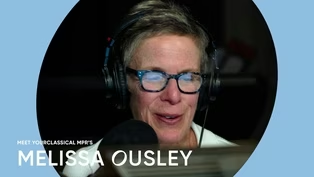
Meet YourClassical MPR's Melissa Ousley
Video has Closed Captions
Clip: S8 Ep2 | 7m 58s | Minnesota Orchestra’s Hanna Landrum visits with YourClassical MPR’s host Melissa Ousley. (7m 58s)
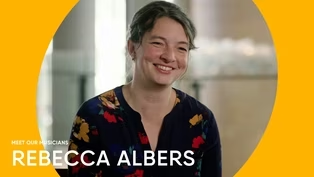
Musician Portrait: Rebecca Albers
Video has Closed Captions
Clip: S8 Ep2 | 10m 29s | Principal Viola Rebecca Albers leads her tight-knit section of the Minnesota Orchestra. (10m 29s)
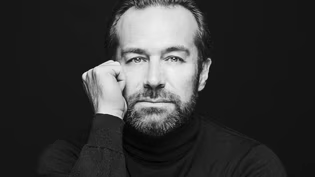
Rebecca Albers Plays Donghoon Shin | Preview
Preview: S8 Ep2 | 30s | Principal Viola Rebecca Albers performs Donghoon Shin's Threadsuns, conducted by Fabien Gabel. (30s)
Providing Support for PBS.org
Learn Moreabout PBS online sponsorship













Support for PBS provided by:
This Is Minnesota Orchestra is a local public television program presented by Twin Cities PBS