
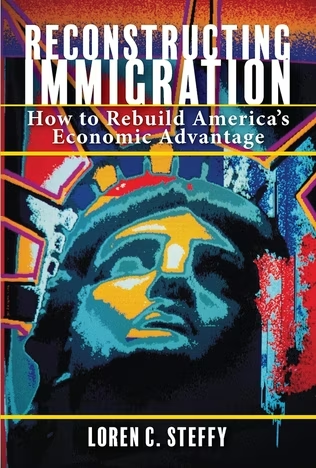
“Reconstructing Immigration: How to Rebuild America’s Economic Advantage” by Loren C. Steffy
Season 2026 Episode 12 | 27m 27sVideo has Closed Captions
Loren Steffy joins to discuss his book, "Reconstructing Immigration".
Loren Steffy, author of Reconstructing Immigration: How to Rebuild America’s Economic Advantage joins to discuss why America cannot remain a global economic leader without a modern, lawful way to attract, legalize, and retain the workers it needs and proposed solutions to these problems.
Problems playing video? | Closed Captioning Feedback
Problems playing video? | Closed Captioning Feedback
The Bookmark is a local public television program presented by KAMU
“Reconstructing Immigration: How to Rebuild America’s Economic Advantage” by Loren C. Steffy
Season 2026 Episode 12 | 27m 27sVideo has Closed Captions
Loren Steffy, author of Reconstructing Immigration: How to Rebuild America’s Economic Advantage joins to discuss why America cannot remain a global economic leader without a modern, lawful way to attract, legalize, and retain the workers it needs and proposed solutions to these problems.
Problems playing video? | Closed Captioning Feedback
Where to Watch The Bookmark
The Bookmark is available to stream on pbs.org and the PBS app.
Related to This Episode
Providing Support for PBS.org
Learn Moreabout PBS online sponsorshipHello and welcome to The Bookmark.
I'm Christine Brown, your host.
Today my guest is Loren Steffy, author of "Reconstructing Immigration: How to Rebuild America's Economic Advantage".
Loren.
Welcome back.
Thank you.
Great to be here.
Always happy to have you here because I know we're going to have an interesting discussion.
And today is no exception.
This is a very dense topic that you've managed to to put into not too dense of a book.
So it's, I think, more digestible.
Can I ask you to just introduce the topic to us?
Sure.
I mean, the whole sort of jumping off point for the book was looking at it.
You know, we kind of have an opportunity here when it comes to immigration policy.
We've been through, you know, the whole kind of post-Covid years where we had a swift surge of undocumented immigration.
Now we've had the, you know, the enforcement crackdown, and it's sort of like, okay, what comes next?
And we have an opportunity to really rebuild our immigration policy almost from the ground up in a way that we've never done in, in our country's history.
And so that was kind of the jumping off point for the book was, was if we could build this over from scratch, what would it look like?
And how did you come to this topic?
How did this spark your interest?
Well, you know, I was a business columnist and a business writer for a long time.
And so the economic issues around immigration, especially working in Houston, as I did for many years, it's just something that kind of comes up in the course of my job.
And in about 2008, I wrote a column about immigration, basically saying it's all economic demand.
And I thought it was very insightful.
And then I got a call from this guy named Stan Merrick, who runs a construction company in Houston, and he invited me over and we had lunch, and he kind of ran through the issues he was dealing with, and I realized that I had barely scratched the surface of my understanding.
And like a lot of native born Americans, I just didn't really know much about the immigration system because I didn't have any contact with it.
And so in talking to Stan and kind of doing more work on it over the years, you know, I would stand and I actually did a book together and, well, we wrote it in 2016.
We published it in 2020.
I was called deconstructed, and it sort of looked at at how we got to where we are in terms of immigration policy, using the construction industry as sort of a through line, because construction and immigration have always gone hand in hand.
It's always been an industry that very much depended on immigrant labor.
Many of the big construction companies were founded by immigrants, and so it was a natural way to kind of tell the story and not make it a kind of dull, boring treatise on, on immigration law.
So that was kind of, you know, where we were at in about 2020.
And I thought, you know, hopefully by that time we we'd get it resolved, but turned out nothing happened.
And so I decided to write another book.
And things have certainly changed since then.
So it's not like you're short on information or studies or things to talk about.
Things have changed in a lot of ways, and unfortunately, the one thing that hasn't changed is that that Congress hasn't taken any action, which is kind of what really needs to happen.
Immigration is inherently, you know, federal programs of federal law.
And so Congress is really the only one who can truly fix this in terms of like major reform or comprehensive reform.
Now, this is a large topic.
So I think I think the best way to tackle is kind of how you did in the book, which is like the first part is talking about kind of the problem.
And then the second part is the proposed solutions.
So you talked about construction, but this is this is a problem facing multiple industries kind of across American American culture.
Absolutely.
Yeah.
You know, we don't often think about, for example, the semiconductor industry is really struggling with the lack of workers.
And, you know, these are in many cases highly skilled workers.
We we the Congress did pass a bipartisan law a few years ago called the Chips act, which was designed to bring more semiconductor manufacturing back to the United States.
In the last 30 years, most of it had gone overseas.
So we've got all this, this funding to to build these wafer fabs.
But nobody really thought about who's going to work in the once they're built.
And so what we're finding now is a lot of these companies are struggling to find workers and say, well we can train them.
Right.
But the problem is we don't have the workers to train the workers.
We don't have the professors, the the, you know, the people teaching at trade schools or junior colleges or, you know, public universities that we need to be able to train that workforce.
And even if we did, that would be about a four year lag, right?
And so we need these people right now.
And so this is where things like the H-1b visas come into play.
Those have been very controversial because the backlash is oh, well, they're taking jobs from Americans, but actually they're not.
There are simply not enough native born workers available to fill those jobs.
And so what we're left with is, you know, we've made this investment in these chip companies, and some of them are going to sit idle, or they're going to run it a fraction of their their production capabilities, because we just don't have the people to staff them.
So when you look across those industries, health care is another one where it's hugely dependent on immigrant workers at kind of at all levels.
And, you know, if we don't have a way to, you know, keep those people here and sort of bring them out of the shadows in many cases, for those who are undocumented, you know, we're facing a mounting crisis.
America's population is aging, the baby boomers are retiring.
And a lot of that health care is, you know, focused on taking care of them.
And I should say, people like me in our old age.
And so we need more and more workers in that industry, and they're simply not available.
One thing that I had never thought of is when we talk about this problem, a lot of times the food industry comes up and the farm workers.
And so the solution, the previous solution was these these kind of temporary visas or seasonal, you know, kind of work visas.
But when you when you think of something like health care, that's not a cyclical seasonal industry, it's a year round.
So a different solution is needed.
And it's maybe something that we haven't thought of or hasn't been put into into practice yet.
Yeah, absolutely.
I mean, one of the big challenges that we have is, you know, if you you've seen this happen recently with, with TPS, the temporary protected status for Haitians, for example.
Right.
And they've they've been here.
They're working.
They have jobs, they've integrated into the economy.
And now we've decided, well, we're going to cancel that program because it was designed to be temporary.
Well, that's the problem with temporary programs is that once those people get established and they're contributing to the economy, there's actually a cost to taking them out.
And so what we really need is a more formalized way and a more permanent way of issuing work permits for industries like health care, like food service, food production, and even in agriculture.
We found that the that the the H-2a visas and two visas, where the people are here for a certain period of time and they leave, it hasn't worked terribly well.
And what would actually be more effective is for those workers to be able to move around the country and do agricultural work in the different places where it's needed.
For example, in South Texas, in the winter, there's an active harvest season in what they call the winter garden for a lot of vegetables and stuff.
And then, you know, workers could move to, say, Washington state and harvest strawberries in the summer or whatever.
And so mobility is an important part of this as well.
You talked about the baby boomers aging into health care needs.
But that also means we're losing a big significant part of our workforce as well.
Absolutely.
Yeah.
When you look at the the demographic shift that's occurring, you know, we're not having enough native born workers or enough native born people to replenish our population.
So without immigration, our population is going to shrink.
And there have been some studies that have been done recently that have found that by 2040, all the growth in the workforce is going to come from immigration.
So if we curtail immigration, if we just, you know, work on enforcing only and not having a policy to bring more people here legally, then we're simply going to run out of workers and, you know, have relatively short period of time, and we're going to wind up being a smaller, less economically prosperous country.
And I mean, that's that's in the title.
The our economic advantage is dependent on our ability to replace our workforce as it leaves for whatever reason.
And you talk in the book and there's lots of studies and data to show that if we're not getting especially, you know, we have people coming here for colleges and then they go somewhere else because they can't get a visa.
So I think you phrased it something like, we're training our competition in a way that was actually one of the more surprising things that I found when I was working on the book is that other countries Canada, Germany, Australia, Singapore, they now have active programs to recruit American trained students.
So basically students come here on a student visa.
They graduate.
It's very hard to get H-1b visas, which are what you need for skilled workers.
Technical workers like semiconductor plant employees and things, engineers and whatnot.
And so they can't get those visas.
They have to leave.
Well, Canada has actually started timing its recruitment efforts to our visa cycle so that when those those students are getting turned down, Canada saying, hey, come and work for us.
And so we're it's kind of a brain drain that we are encouraging through our policies or lack of policies that that is really going to hurt us in the long run, because other countries have looked at our economic advantage, that how immigration has driven the American economy for 100 years, and they're wanting to try to replicate that.
And at the same time, we're actually pulling back from that.
We're just basically giving them the tools to to compete against us more effectively in the future.
Another thing that you highlight really well in the book is that this is kind of been a cyclical issue for, for America.
We go through these kind of boom and bust.
We we let a lot of people in, people in, and then we say, oh, wait, stop.
And we we send people away.
What lessons haven't we learned or what should we learn from this?
It's interesting.
You know, we have this sort of romantic view of immigration in the past.
We like to think of ourselves as a nation of immigrants.
The Statue of Liberty, Ellis Island, all these.
What was the.
There was a cartoon movie while back with the little mouse that comes out anyway?
Yes.
And, you know, but that's kind of that romantic vision that we have.
But if you go back and you look at the time, it wasn't like that.
The attitudes towards immigrants really were the same then as they are now.
Right?
When the Italians and the Irish were coming here, it was like, oh no, they you know, they're not going to learn English.
And they have a different religion.
They're Catholic.
And, you know, all these terrible things are not going to assimilate.
And, you know, I think it would be interesting if you could take somebody from the 1920s and show them a Saint Patrick's Day parade today.
They would probably be like, oh, worst fear is a bit realized.
You know, they didn't assimilate, but but, you know, we don't think of it in that way anymore.
We think of it as no.
They came and they worked hard and they, you know, well, if you look at what was being said about those groups at that time, it's the same thing that we're saying about Haitians and Somalis and Latinos now.
And so it's like we've benefited economically from this robust immigration system, even as we've sort of fought it on a social level.
And and I think that it's time to sort of step back from that and say, no, no.
Look, we need to recognize the economic benefits and tailor a system that is that is designed, at least in part, to respond to those economic needs.
So we need a system that's more flexible, more economically based, as opposed to just being restrictions and sort of structured around how do we keep people out, which is kind of what we've done in the past.
It's always been very reactionary instead of I mean, a lot of those solutions you propose are let's step back, let's zoom out and take a, you know, a bipartisan macro look at at what's working, what where can we benefit?
I mean, the things that the proposed solutions can reduce inflation and increase GDP.
I mean, the economic value is I mean, I would say incalculable.
But you did the calculations.
I tried to do the math.
Yes.
No, but it's really true.
I mean, I think that one of the things that I found surprising as I started working through this is, is.
Oh, yes, if you're concerned about inflation, well, immigration can help with that.
Oh, if you're worried about Social Security running out of money, you know.
Yeah, maybe Congress will get around to fixing it in some other way.
But, you know, immigration would be a very, very easy way to close the gap.
I mean, it wouldn't completely, you know, fully fund what's missing or what will be missing in Social Security, but it would get us a long way down the road simply by taking workers who are already here and bringing them out of the shadows and having them pay taxes into a system that, by the way, they can never draw money out from.
So they would actually be paying to shore up Social Security even though they wouldn't benefit from it.
And that could happen again if we just had a work permit policy, the rest of that would kind of fall into place.
And so, you know, I hate to say immigration, you know, a robust immigration policy would be a solution for a lot of problems, but it kind of would, because this whole idea of expanding the labor supply really goes a long way towards addressing a lot of other problems.
You know, we have a housing crisis, affordability crisis.
Well, if we could build more houses that would obviously address that problem.
And to build more houses, we need more carpenters and drywall and, you know, other other construction laborers and those all pretty much come from the ranks of immigrants.
Let's let's talk about solutions because you don't just discuss problems in this book.
You try to present some at least foundations for for for what?
To.
So this as we've discussed, this is a tangled mess.
So where do we even start?
What do you what.
Step one.
I really I really struggled with that because you know, as a columnist I'm not used to proposing solutions.
You know, I actually say the beginning of the book, there's an old joke in journalism that columnists are guys who come down from the hills after the battle and shoot the wounded, right.
And, and so I but I really felt like.
No, you know, I've written about this for a long time, and it's not enough to just say what's happening and why.
I really wanted to take that next step and, and actually make some, some ideas, propose some ideas for how to solve it, which is a very new thing for me.
And I'm just I'm not sure I'm 100% comfortable with it, but but I think one of the things that emerges is, you know, given the political climate we have right now and there's a real resistance politically, there's not a lot of incentive politically to do much to fix this.
I think incremental steps are or how we're going to get there.
Right.
And you're starting to see some different groups.
Restaurant associations, for example, are starting to speak out about this.
You even started to hear some murmurings from the construction industry, especially from South Texas.
You know, we can't find enough workers.
We're not going to be able to do what we need to do.
And and the response to that, I think, is going to be very narrow politically, because if you try to do a broad based reform, it's, you know, it's just going to get all tangled up in politics.
But there have been some laws that have been proposed around these ideas that I was talking about, where you issue work permits for people so they can legally work, be employed, they can get a driver's license so they can have some mobility, but they don't.
You know, we're not even talking about citizenship or voting rights or federal benefits, any of that stuff that becomes much more problematic.
This is just a way to get this workforce more engaged in the economy and again, get them paying taxes.
You know, right now we got, you know, millions of workers who are being paid under the table in Cass.
And if they were if they were on payrolls, then then Social Security, Medicare would be getting the benefits from that.
And at the same time, they would be getting protections in the workplace, because one of the other big problems that you have is that right now we have this very robust enforcement environment.
And, you know, a lot of workers get threatened.
You know, oh, well, you know, I've decided to cut your pay by $2 an hour.
And if you don't like it, I'm going to call Ice and have you deported, you know, so you get around a lot of those sorts of things, as well as as workers comp insurance and other sort of basic protections that most of us as native born workers take for granted.
Right.
There's also there is broad support for for some things, like you mentioned in the book, the idea of the the dreamers making their status permanent, that that is, is, has tested and been pulled as a relatively popular option.
Yeah.
Has widespread support.
Something like 80% of Americans support this idea because keep in mind.
These are kids who were brought here as children, had no control over their circumstances.
They have grown up in America.
They've gone to school here, and most of them have gone to college, or many of them have gone to college.
Here.
They have jobs.
Some of those started businesses.
They're very, very Americanized.
They have assimilated, they speak English.
All these other things that that, you know, we talk about.
And so there's very broad acceptance for for that program.
It was issued.
It was created by executive order by Obama in 2010 or so.
It has never been codified into law by Congress.
And it's sort of a no brainer.
And if you look at the way Doca is structured, that can actually be a jumping off point for things like this worker permit program that I'm talking about, where, you know, again, you have you look at people who have been here for five years or ten years, whatever, whatever time frame you want to set on it.
They don't have a criminal record.
You know, they basically been good citizens, even though they're not citizens, right?
They're good, but they're good participants in in America.
And they're the kind of people we want to have here.
And so this creates an entry point for them to be, again, integrated into the economy and the issues of citizenship and stuff.
That's a whole different discussion.
And in many cases, a lot of these workers, they're not necessarily interested in becoming citizens.
They just want to be able to go to their jobs and not have to be afraid that they're going to get detained on the way.
And then you also spend some time in the book talking about the past difficulties of getting these things passed.
And there have been even recently, as recently as 2013 and 2024, attempts by the Senate, at least to to get some legislation pushed forward, even some having bipartisan support.
Why do we struggle?
Why does the why does it always fail?
Well, you know, the the the really critical policy failure was 2013.
We actually had a comprehensive bills and there was a gang of eight bills by bipartisan bill for sweeping reform.
It would have addressed a lot of the issues that we're dealing with now.
And it passed the Senate.
It died in the House.
It had the votes to pass the House, but it died in the House because the speaker at the time, John Boehner, invoked something called the hazard rule, which one of his predecessors had come up with, which said, if members of the Republic of my party, if I don't have enough of my own party, vote, a majority of my own party that's willing to vote in favor, I'm not going to put it to a floor vote.
So it was a very kind of insider baseball sort of thing that that, you know, really, most Americans didn't even know existed.
And it's just it died because of political gamesmanship.
And right after that, Eric Cantor was running for reelection in South Carolina, and he had voted in favor of the bill.
He was he was a supporter of the bill and a bunch of far right guys.
Steve Bannon, Smothers decided to run a primary challenger against him, and he lost.
And it freaked out the politicians.
They were like, oh no, this is like the third rail.
We can't do anything.
And so there's been real resistance, even talk about immigration in a meaningful way in terms of reform pretty much ever since.
And then, yeah, 2024, 2025, we actually had a bill, another bill, bipartisan support.
It was moving through.
Trump was a candidate at the time, and he said, kill it, because unfortunately, immigration is a very, very effective political weapon, and it's very powerful.
And he knew that that he wanted to be able to run on that.
Because keep in mind, after Covid, we had kind of this mess, right?
We had a surge of undocumented immigration.
It overwhelmed the system.
The Biden administration didn't respond to it terribly well.
And so we kind of had this big mess, and it was a very, very opportune political moment for him.
And so he wanted that weapon.
And so, you know, the bill died.
And again, it's just playing politics as opposed to solving the real problems that we're facing.
So for me, as an observer, it's very it's been very frustrating because a few times when we've been close, we just haven't been able to get it over the finish line.
One of the things you say in the book, I'm going to quote you here.
The political path to reform runs through the business community that we need these business leaders, and it needs to be a bipartisan, of course, too.
But as I mean, as the whole book lays out, there's an economic advantage to fix this problem, to figuring it out.
And so it may come to our business leaders to push that forward.
Yeah.
This is something that I felt very strongly about and for a long time is that the business community has really not spoken up about this because it's such a politically divisive issue.
I think it's significant that you see groups like Restaurant Owners, Texas Restaurant Association, for example, and the National Restaurant Association have both gotten behind some of these incremental reforms that I was talking about.
That's huge, because if you think about restaurants or one of those businesses that they always try to be careful, right?
I mean, you don't want to have a discussion of politics in your restaurant.
You just want everybody to come in and eat and have a good time.
And so they have always been very reluctant to engage in this kind of, you know, political activity.
But you're starting to see now they don't have any choice because they can't find the people to, to, you know, to, to keep their restaurants running.
And so, you know, you're starting to see more business groups get behind this idea of reform because the economic consequences are getting severe.
And I think as that pressure mounts, you're likely to see and keep in mind, businesses know how to get Congress's attention.
They know how to talk to lawmakers.
They have lobbying groups and everything.
So I think that I'm encouraged by the fact that we're starting to see more activity on that front, because the cost can be so great to that.
There's another thing you talk in the book, the theory, this idea of kind of cascading job loss.
So if they can't find the workers, then they can't keep their margins.
They can't keep their, you know, it results in job loss more far reaching than just the immigrants themselves.
Yeah, it's interesting because, you know, the sort of the counterargument is, oh, the immigrants are coming here to take our jobs.
Well, not only are they not coming here to take our jobs because because there's not enough of us to do those jobs, but if we remove them from the employment picture, it actually costs American or Native born Americans jobs.
Because, you know, if you look, for example, at a construction site and you deport, you know, a carpenter, a framer, and now that homebuilder can't build, you know, maybe he's building one for your home a week than he was otherwise doing.
Well, that affects electricians.
It affects the lumber yard workers.
It affects the accountant in the front office of the homebuilding company, you know, and maybe they don't necessarily lose their jobs, but they get fewer hours.
They're making less money.
So they're economic consequences that go far beyond just pulling that person out and sending them away.
And it's not something we typically think about.
It's almost counterintuitive in many ways, but one of the things I propose in the book is that we have some sort of a like a National Immigration Council.
I'm not sure if that's the name.
I think I had a more complicated name than that, but it would basically look at a lot of these things and produce regular reports for the public on the economic impact of these different programs, because, again, awareness is a key part of this.
And most people, unless you've come here as an immigrant and had to deal with the system, most people really don't understand how complicated it is.
And the only thing in American, in the American legal structure or legal code that is more complicated than immigration law is tax law.
And I think we all know how complicated tax law is.
Right.
But but that's because we all deal with it.
And immigration we really don't.
And so we don't fully understand the complexity there in a lot of cases.
Well unfortunately we're running a little short on time.
So in our final two minutes, what would you hope to take away from the book be?
I think the takeaway that I would hope for is that people understand that, that we are we are sacrificing economic opportunity.
We're forgoing economic benefit in the future because of the sort of pettiness and political infighting that we're having now.
So if you care about your children, your grandchildren, if you want them to have a prosperous America, there are things that we can do right now that will make this better.
And if we continue down this road of, you know, enforcement only just just looking at enforcement without any policy reform around it, we're going to wind up being a smaller poor country.
And there's really no reason for that, because we've already left a lot of money on the table, and we're going to be leaving a lot more.
Well, I want to say thank you.
This is a this is a topic that, again, I don't know everything about.
Nobody, I'm sure does.
But this was such a wonderful introduction or a way in to, to help me understand.
And I think it's going to be a conversation starter.
I hope it'll be a conversation starter for people.
I hope you're right.
I mean, we just had a wonderful conversation here, how we didn't even scratch the surface on all the wonderful solutions and ideas.
And again, this is this.
Hopefully this is a springboard to policy or nothing else.
That would be the ultimate goal, I'm sure.
I mean, I'm happy to send it to any member of Congress to read it.
So all right.
So we're going to we're going to get our mailing labels and start going to get this book to to our congresspeople.
Loren, thank you so much for being here.
I really appreciate you coming to talk to to us about this book.
Thank you.
It's always a good time.
That book, again, is "Reconstructing Immigration".
Thank you so much for joining us, and I will see you again soon.
 New Episode
- News and Public Affairs

Top journalists deliver compelling original analysis of the hour's headlines.
 New Episode
 New Episode
 New Episode







 New Episode

Support for PBS provided by:
The Bookmark is a local public television program presented by KAMU