Articulate
Reflexive Cognition
Season 8 Episode 12 | 26m 46sVideo has Closed Captions
Observation is vivid in the works of Paul Muldoon and Daniel Arsham.
The observations and experiences of poet Paul Muldoon and multidisciplinary artist Daniel Arsham are powerfully rendered in their work.
Problems playing video? | Closed Captioning Feedback
Problems playing video? | Closed Captioning Feedback
Articulate is a local public television program presented by PBS39
Articulate
Reflexive Cognition
Season 8 Episode 12 | 26m 46sVideo has Closed Captions
The observations and experiences of poet Paul Muldoon and multidisciplinary artist Daniel Arsham are powerfully rendered in their work.
Problems playing video? | Closed Captioning Feedback
How to Watch Articulate
Articulate is available to stream on pbs.org and the free PBS App, available on iPhone, Apple TV, Android TV, Android smartphones, Amazon Fire TV, Amazon Fire Tablet, Roku, Samsung Smart TV, and Vizio.
Providing Support for PBS.org
Learn Moreabout PBS online sponsorship- [Announcer] Articulate with Jim Cotter is made possible with generous funding from the Neubauer Family Foundation.
(moody music) - Welcome to Articulate, the show that explores how really creative people understand the world.
(upbeat music) - [Jim] And on this episode, "Reflexive Cognition."
Through poetry, Paul Muldoon sought reconciliation with the violence of his early life in Northern Ireland.
He found tolerance.
- It would actually come as a kind of relief, I think, if I were to accept the idea that I don't have to understand everything and that I don't understand anything.
And as opposed to what I was like when I was 18, it's okay, it's fine.
- [Jim] And Daniel Arsham has thrived in fine art, architecture, design, film, fashion, and performance by approaching each with creativity, intellect, and science.
- I think I've just always been interested in particularly like science fiction's interpretations of time, because it seems, in somebody who, you know, thinks so much about physical space and the manipulation of physical things, time is this other kind of intangible element that informs our experience of all of those things.
- [Jim] That's all ahead, on Articulate.
(upbeat music continues) (slow music) (birds chirping) (cow bells ringing) (cows moos) Paul Muldoon grew up on a farm on Northern Ireland's southern border, just as the sectarian conflict among Protestants and Catholics had begun in earnest.
- Being from there means that what happened there and what happens there is necessarily part of who one is and what one writes about.
I was a Troubles poet in the sense that everyone who lived during the late sixties, we weren't necessarily standing with one particular side.
I think we tried to be true to, to what was happening.
- [Jim] Like many of his compatriots, Paul Muldoon has a particular gift for words, and for understatement.
Thus, the 1916 rebellion against British occupation was a rising, not a revolution.
And the 30 year insurrection in the north of Ireland was called The Troubles, not a war.
In his poetry, Muldoon's view of the strife in his homeland is also handled with a light touch.
- You remember that village where the border ran down the middle of the street with the butcher and baker in different states?
Today, he remarked how a shower of rain had stopped so cleanly across Golightly's lane.
It might've been a wall of glass that had toppled over.
He stood there for ages to wonder which side, if any, he should be on.
- [Jim] Born in 1951 in Armagh, one of the six counties of Northern Ireland ruled by Britain, Muldoon was the eldest of three children.
His father, a market gardener, and his mother, a school teacher, were well-read Irish nationalists who try to shelter their children from the brutality of life outside their door.
They shared a love of popular song, of literature, of words.
- I do think that Irish people, in general, love language, and you know, that runs right through society.
The songs that, that they, that they, people were singing in English, and indeed, before that, in Irish, were designed, one would almost believe to show how smart people were, how educated they were, how many big words they could use.
I think it's fair to say that Irish people like to read and to talk.
- [Jim] Muldoon is part of a long tradition of Irish poets that stretches back through a centuries long Gaelic bardic tradition that's still alive today.
But Irish writers really came to the fore after the famines of the 1840s, when spoken English became more widespread.
Wilde, Joyce, Yeats, Shaw, Beckett, showed Paul Muldoon that a life in letters could be a worthy pursuit.
He began writing at a young age, but his early influences were not exclusively from his homeland.
- The history of Irish literature is truly remarkable.
I mean, by any standards.
It's astonishing actually, given the size of that population.
Like many, I started writing when I was a child, essentially.
I got really, really serious when I was in my mid teens, the way people in their mid teens get suddenly very serious about many things.
But at that stage, funnily enough, it was T.S.
Eliot who really got me started.
A combination of T.S.
Eliot and John Donne.
I read Yates a little later on as a teenager.
He was not necessarily the icon that he became, nor indeed, quite when I started out, was Joyce, who of course is in a league of his own.
- [Jim] In 1969, just as The Troubles were beginning, Muldoon left home to attend Queens University in Belfast.
There, he would become part of a coterie of poets and playwrights that would include the future Nobel Prize Laureate, Seamus Heaney.
- Both Seamus and myself, and I think most other people from that specific moment in Belfast, were very open to the idea of actually helping one another.
Rating one another.
It was a culture in which, you know, you'd write your poem- I remember often, you know, with my arriving in a bar with my poem in my inside pocket, and they'd say, "Well, you know, actually I, I'm not so sure about the end."
And "What does that word mean?"
"Is that really right?"
That's a terrific boon to have as a writer.
- [Jim] These aspirational writers would collectively become known as the Belfast Group and produced several accomplished writers and poets.
But back then, says Muldoon, they were under-aware of the depth of their talents, or maybe, just too humble to acknowledge them.
- One of the things about the Irish is that you don't, you don't start taking yourself too seriously.
You don't get notions about yourself.
I mean, you might, you know, lying in your bed at night, but to express it, I mean (laughs) you'd be, you'd be, you'd be marched out.
And, and, and that's, I think that's quite healthy.
You don't have to look too far to see people getting ideas about themselves and it's not attractive.
- [Jim] By 1973, even before he had graduated, Muldoon had published his first full length poetry collection, "New Weather."
An invitation from BBC Northern Ireland to read selections from the book led to a full-time job as an arts producer with the corporation.
- And in fact, over my desk in the BBC, I had a little line, it was from Dylan Thomas.
"In olden days, poets ran away to sea.
Now they run away to the BBC."
- [Jim] Muldoon's time at the BBC, showed him the importance of the spoken and the sung, rather than the merely written word.
He has embodied this tradition ever since.
- I wrote a lot of scripts and most of them had to do with presenting what was in some sense, the most mundane information.
- Such as?
- Such as Werner Herzog's new film would be playing next week at the Queens Film Theater in Belfast.
But that was written out, it was written out with an ear to how it was going to be presented.
So I think actually that one of the aspects, which I'm certain, plugged into my poetry, though you wouldn't necessarily think about it, was a constant engagement with how is this going to sound?
And that, by the way, was another feature of my education, which was, the song experience and the song tradition.
- [Jim] In a poem entitled "The Loaf", he uses a common feature of song, the refrain, while remembering a group of Irish navvies as he was making repairs to an old house near Princeton.
- When I put my finger to the hole they've cut for a dimmer switch in a wall of plaster, stiffened with horse hair, it seems I've scratched a 200 year old itch with a pink and a pink and a pinkie-pick.
When I put my ear to the hole, I'm suddenly aware of spades and shovels, turning up the gain all the way from Raritan to the Delaware, with a clink and a clink and a clinky-click.
- [Jim] And just like those 19th century canal diggers, and many Irish people before and after, Muldoon has spent much of his life abroad.
After a short stint at Cambridge, he's been a professor at Princeton University since 1987, and in 2003 was awarded the Pulitzer Prize for poetry.
Along the way he has published 14 collections, each reflecting their own particular geography, time and place.
- I like the notion of moving around the world and, and I mean, though I'm very, very attached to Ireland, I am Irish, I, I think we're at a moment in history where, and I think it's a healthy thing.
I think it's an enlivening thing where we, we, the more we think of ourselves as citizens of the world, I think honestly, the better.
- [Jim] In the "Sonogram", Muldoon finds a connection with Ireland and the ultrasound picture of his and wife Jean's child in utero.
His illusion to Spiddal refers to a tiny village in County Galway, which an Irish is An Spideal, derived from ospideal, the hospital.
- Only a few weeks ago, the sonogram of Jean's womb resembled nothing so much as a satellite map of Ireland.
Now the image is so well-defined, we can make out not only a hand, but a thumb.
On the road to Spiddal a woman hitching a ride, a gladiator in his net, passing judgment on the crowd.
- [Jim] Now in his early seventies, Paul Muldoon looks back in wonder at the confidence and optimism of his youth and the dawning realities of growing older.
- One of the things I do realize is this: when I was a teenager, I had more of a sense that I could indeed be a poet than I do now, you know?
Now I look back on it and think really?
Did I, did I pull it off?
Did I manage it?
I think if I were to accept the idea that I don't have to understand everything and that I don't understand anything, and as opposed to what I was like when I was 18 it's okay, it's fine.
- [Jim] Beyond poetry, Muldoon has penned librettos for four operas, written two children's books, and collaborated with Warren Zevon to create the song that would become the legendary rocker's epitaph.
And for the past five years, Paul Muldoon has been working with Paul McCartney, examining the more than 150 songs he wrote as a member of the Beatles and after.
The result of their collaboration, "The Lyrics" was published in November of 2021.
- I think he said along the way that he probably won't ever write an autobiography, and this might be the closest that, that, that this book might be the closest that would come to that.
And so, anyway, the, what we have is the text of the lyric and then his commentary, which as it happens was mediated through myself, but which appears as a, you know, a freestanding thing as he, where he's talking.
- His words.
- His words.
I mean, one of the things that comes across for me, anyone I think, or for others, is just how great a writer he is.
(rhythmic music) - [Jim] Paul Muldoon is modest about his own literary legacy and continues to push against having notions, ideas about one's own importance.
Proving once again, that you can take the boy out of Ireland, but you can't take Ireland out of the man.
(rhythmic music) (eclectic music) - [Jim] As a child, Daniel Arsham liked to draw the objects of his obsessions.
Sneakers, cameras, automobiles.
Then one day in 1992, the 11 year old sat huddled in a closet as Hurricane Andrew ripped through his family's Miami home, collapsing walls and shattering windows.
In a matter of hours, his most intimate personal landscape had been destroyed.
- When we emerged after the storm, the whole house, I mean, all the windows had blown out.
There was glass and furniture everywhere.
And there was this pink insulation foam from the ceilings that had been blown like over everything.
And some of the rooms were like completely covered in it.
So like the whole room was pink.
I think in, in, in psychoanalysis, they, they, they sort of think of the house or the home as like a representation of the self.
And you're literally like physically dismembering this thing but then it was also put back together.
- [Jim] During reconstruction, Arsham for the first time glimpsed the inside of his house: the underlying structural framing, the plumbing and electrical wiring behind the walls.
Thus began an obsession with architecture, decomposition, and the impermanence of physical things.
- I have this memory of when they gutted the house, they took everything out of it.
Even the term 'gutted' is like very, you know, much about the self.
And I was standing on one end of the house and I could see through my bedroom, the kitchen, my sister's room, all the way to my parents' room, like straight through in a line.
And I had never, the space of that had never occurred to me.
That, just the way that it was laid out that way.
So it was a different conception of architecture of space.
I mean, certainly the storm itself was pretty scary, but the aftermath of that was more like, you know, this, this kind of incredible sense of all of the normalcy of the everyday had been removed.
(rhythmic music) - [Jim] Born in 1980, Arsham took to drawing and photography as a kid, after being given a Pentax K1000 camera by his grandfather.
He studied architecture in high school, but Cooper Union, a small college in New York City, gave him a full scholarship to study art rather than architecture.
Cooper Union encouraged his multidisciplinary interests, especially painting, but architecture was never far from his mind.
More recently, Arsham has based much of his work around the concept of fictional archeology to create what he calls future relics of the present.
- All of the works tend to have some familiar element within them that I think allows a wide variety of viewer to enter the work.
And then once they're there, there are all of these different ideas present.
There's the, the idea of the materiality or a shift in, in materiality.
There's the idea that, in some cases, with the fictional archeological work, that you might be looking at an object that you know from your own life as if it was this kind of archeological object.
It's not a camera painted to look old, or it's actually made from crystal or volcanic ash.
These materials that we, as a, you know, almost viscerally we associate with time passing.
And so how can you look at an object that you know, from your own life as if you're viewing it in 10,000 years?
(dramatic music) - [Jim] He and his studio have recreated a variety of modern, relatable cultural objects that are, or soon will be obsolete.
These objects appear old, to have been found in the distant future.
- I'm selecting things that I have some personal relationship or that I know inherently.
The camera, a basketball, a Pokemon character.
But I'm also selecting them with the knowledge that those objects are a sort of universal, you know, accepted language, right?
People know, a basketball means the same thing here as it does in Paris and Hong Kong.
And so they represent an idea of culture maybe.
They also represent an era of time, right?
The basketball is not from 500 years ago.
So they locate the idea in a particular moment, which by transforming the material of them, by pushing that outside of this time, it creates this gap between them that people have to reconcile.
(slow music) - [Jim] Early on, Arsham began his practice of collaborating with others: choreographers, illustrators, engineers, and architects.
- I think it's become less difficult now or less egregious, but in the beginning, even the collaboration that I did with Adidas, I think that for a lot of my core collector base, and even like, you know, some of, some of my gallerists, they, they saw that as a way where the company was using my work as this vehicle to sell sneakers.
- Which they were.
- Which they were.
(dramatic music) - [Jim] One of his first major collaborations, was with the legendary choreographer, the late Merce Cunningham.
In their first four projects together, Arsham designed the stage set for eyeSpace, which premiered in 2007.
As was his habit, Cunningham gave the artist no input, aside from requiring that Arsham's designs be safe for his dancers.
- And that was probably the most informative experience in terms of showing me what collaboration could be.
- And he was a master of it.
- He was a master of a very particular way of collaborating.
So he would create his choreography, a musician would create the score and an artist would make the set, (dramatic music) but none of them knew what the other one was doing until the premiere.
- [Jim] That exact way of working didn't suit Daniel Arsham but the idea of collaborating did.
He has since sought partnerships for much of his work.
- The idea of collaboration and the, the ability to bring other people into the circle.
I think certainly started with him.
- [Jim] One such collaboration was with the Pokemon company of Japan after they saw his sculpture of their character, Pikachu, at a gallery in Japan.
- I saw it as me using this company with enormous reach, with reach to audiences that don't have anything to do with the art world to show my work in and to create a kind of more egalitarian vehicle for the dissemination of artwork.
And that was maybe a radical (eclectic music) sort of proposition to them at the time, but I think that thinking has evolved.
- [Jim] A dream come true collaboration for Arsham was with the German auto maker, Porsche.
He proposed to erode a brand new Porsche 911 to create a totally drivable work of art.
- I had to work with the engineers there because you know, those cars, the exterior of them is aluminum and it's actually structural.
So once you start cutting holes in it, it affects, you know, the veracity of the car.
They were very skeptical in the beginning to the point where they sort of said, you know, "We're gonna give you the car."
And they sort of said, like, "That's our contribution to this project and let's see what happens."
The original idea was that I was gonna keep the car after that.
And when this thing was first unveiled, it was at Selfridges in London.
We, it was in the front window on the corner and it was just like instant (fingers snap) bang, like so many photographs, people taking of that object.
And in the end they decided the car is actually gonna go into the Porsche Museum in Stuttgart.
Once we finished the first project, they sort of saw what I'm doing here, which is really to, to interpret the same way that I might interpret another object in my own work.
I'm interpreting this car through a particular lens.
I'm making alterations to it.
But a lot of those alterations have to do with Porsche history or some sort of racing element, kind of blending these two universes together.
So for them, I think it's, there's an added, you know, value there.
(rhythmic music) - [Jim] Arsham's two sons, aged five and eight, take delight in their dad's work.
They enjoy playing in the studio with the same objects that fascinated their father when he was a boy.
- They're very interested in Porsche, in Star Wars, in racing, in photography.
When it crosses over into a universe that they know, like Pokemon, they're obviously enthralled by that.
And you know, they come here to the studio and with all of these different potential things around, they always gravitate towards like the miniature car models.
- [Jim] Daniel Arsham continues to follow his passions, the partnerships and projects that mean the most to him.
He doesn't spend a lot of time interpreting his art for others or worry too much about critical reaction.
- I think I've accepted that certain things are kind of inevitable.
In being an artist, you know, you're putting yourself out there, right?
For people to understand and interpret and criticize and judge.
And that's just part of the game.
It's not really about me, in so many ways.
It's like the work.
So once I've created the work, it's outside me, right?
And when people are questioning it, I don't feel it as a personal attack.
(rhythmic music) - [Jim] Time is something Daniel Arsham thinks about a lot.
He's compared the present to a knife's edge, so fleeting as to be non-existent.
But during the pandemic, he's made the most of it.
Taking up painting once again and spending time with his family.
In a recent book of quotes titled, "Arsham-isms", published by Princeton University Press, he says, "Being a dad has brought me back to my own childhood, where everything holds wonders and is new and fresh."
(slow rhythmic music) (slow music) For more Articulate, find us on social media or at our website, articulateshow.org.
(dramatic music) On the next Articulate, in his lifetime, the celebrated science fiction writer Samuel R. Delany has witnessed great positive change, and he has hope for more.
- It's getting better, but I'm a big believer in the dialectic.
And I think the way of the, time doesn't go, it's not circular, it moves, and the technology moves.
And then the only way we're gonna solve it is some active encouragement of positive technological change to do something radical.
- [Jim] And curiosity and collaboration have been driving forces in the life of interdisciplinary artist, Orkan Telhan.
- Most important thing for me is to come up with the good questions and sometimes I'm capable of answering the questions myself or I initiate conversations where we ask those questions together.
- Join us for the next Articulate.
(rhythmic music continues) - [Announcer] Articulate with Jim Cotter is made possible with generous funding from the Neubauer Family Foundation.
(bright music)
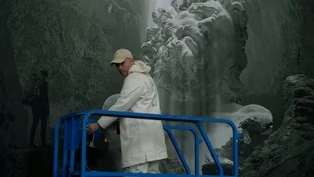
Daniel Arsham: Connecting Time
Video has Closed Captions
Clip: S8 Ep12 | 11m 24s | Daniel Arsham has thrived in art, architecture, design, film, fashion, and performance. (11m 24s)

The Frolics and Detours of Paul Muldoon
Video has Closed Captions
Clip: S8 Ep12 | 13m 25s | With poetry, Paul Muldoon sought to understand the violence in Ireland during his youth. (13m 25s)
Providing Support for PBS.org
Learn Moreabout PBS online sponsorship

- News and Public Affairs

Top journalists deliver compelling original analysis of the hour's headlines.













Support for PBS provided by:
Articulate is a local public television program presented by PBS39