
Restore, Release
Season 2 Episode 1 | 26m 46sVideo has Closed Captions
Lighthouse preservation, community renewal, and sturgeon teach Native American culture.
Volunteers work to preserve a historic Great Lakes lighthouse, a Chicago community finds new life through embracing its past and high school students learn about Native American culture with the help of lake sturgeon.
Problems playing video? | Closed Captioning Feedback
Problems playing video? | Closed Captioning Feedback
Great Lakes Now is a local public television program presented by Detroit PBS
Restore, Release
Season 2 Episode 1 | 26m 46sVideo has Closed Captions
Volunteers work to preserve a historic Great Lakes lighthouse, a Chicago community finds new life through embracing its past and high school students learn about Native American culture with the help of lake sturgeon.
Problems playing video? | Closed Captioning Feedback
How to Watch Great Lakes Now
Great Lakes Now is available to stream on pbs.org and the free PBS App, available on iPhone, Apple TV, Android TV, Android smartphones, Amazon Fire TV, Amazon Fire Tablet, Roku, Samsung Smart TV, and Vizio.
Providing Support for PBS.org
Learn Moreabout PBS online sponsorship- [Narrator] On this edition of Great Lakes Now.
The push to restore a historic Great Lakes lighthouse.
- All the technology that was developed and engineered for Spectacle makes her kind of the grandmother of every other offshore lighthouse.
- [Narrator] Green development in an industrial Chicago community.
- If you listen to the community and put the resources behind what the community is looking for, I don't think you can lose.
- [Narrator] And students learn about Native American culture by caring for lake sturgeon.
- [Narrator] This program is brought to you by: The Fred A. and Barbara M. Erb Family Foundation.
The Charles Stewart Mott Foundation.
Laurie & Tim Wadhams.
- [Narrator] The Consumers Energy Foundation is committed to serving Michigan from preserving our state's natural resources and sustaining our future to continuing business growth, academic achievement, and community involvement.
Learn more at consumersenergy.com/foundation.
- [Narrator] The Richard C. Devereaux Foundation for Energy and Environmental Programs at DPTV.
The Polk Family Fund.
Eve and Jerry Jung.
The Americana Foundation.
The Brookby Foundation.
Founders Brewing Company.
And viewers like you.
Thank you.
- Hi, I'm Ward Detwiler.
Welcome back to Great Lakes Now.
Lighthouses has been guiding sailors on the Great Lakes for more than two centuries.
Some are showing their age, but at one remote light in northern Lake Huron, restoration efforts are underway.
Lake Huron and Lake Michigan come together in the Straits of Mackinac, long considered one of the most treacherous waterways on all of the Great Lakes.
For nearly 150 years, the Spectacle Reef Lighthouse has guarded ships passing through the Straits.
It sits 12 miles and a world away from the mainland.
- You can see the Straits of Mackinac up there-- - [Ward] Patrick McKinstry is the president of the Spectacle Reef Preservation Society, a non-profit organization he and a group of lighthouse enthusiasts created to restore and preserve the light.
- So, northern Lake Huron buoy has six-foot seas.
other has four, which means the light right now has four to five.
- The lighthouse was sold at auction in 2014 to a private individual who was a friend of mine, and he offered me the lighthouse.
I wanted to buy the lighthouse for myself but I believe they should be in public hands because these were built with taxpayers dollars to save the lives of the public and the people who lived there should be remembered as public servants.
We put a team together of lighthouse historians, restorationists, enthusiasts, and the society raised the cash and purchased the lighthouse.
- [Ward] When we caught up with him, Patrick and a group of volunteers were getting ready to take the 17-mile trek from Cheboygan to the lighthouse, hoping to make up some restoration work before the weather makes such trips too dangerous.
- This crew is a very good crew and all of our volunteers are fantastic.
We got 157 volunteers that joined the organization this season and all their knowledge and skill sets all played a role and what impressed me is just the amount of passion that people have for this organization and saving this lighthouse.
- [Ward] But working on a lighthouse that's this far off shore isn't easy.
The first challenge?
Just getting there!
- My greatest fear is the same thing the keepers experience.
It's the weather out here.
There are days where you think it's great and then a storm kicks up.
- [Ward] And though the weather on this day looked pleasant enough, the threat of a sudden storm with high winds and heavy seas forced the crew to return to the marina.
The lighthouse would have to wait.
Fortunately, by the next day conditions had improved.
- If you look down the water you'll see the reef plain as day.
- [Ward] Spectacle Reef Lighthouse gets its name from the shallow reef it was built on, there are two shoals with a ridge between them that resemble a pair of eyeglasses.
The design of the lighthouse makes it even stronger in severe weather.
- The lighthouse is built out of giant limestone blocks that are two foot tall, and their width and the radius differs based on where they are the light tower.
But the way it's built they have these edges are cut almost like puzzle pieces, so that when the waves hit the tower it actually smooshes it all together making the joints stronger over time.
- [Ward] Spectacle Reef was considered a technical marvel when it was built in 1869, and it became a model for lighthouses built throughout the northern Great Lakes.
- The technology and the base camp that was built for Spectacle on Government Island built every other offshore lighthouse up in the straits of Mackinac, particularly the Lake Huron Side.
All the technology that was developed and engineered for spectacle makes her kind of the grandmother of every other offshore lighthouse on the Great Lakes.
We are at the top of Spectacle Reef Lighthouse, about 97 feet above Lake Huron and the lower parapet, there's two parapets up and the lower, we're on the lower side right now.
The entire next level was just the lens and a level below was the service room where they kept oil and wicks and material, had their little office to take care of their logs each night.
You know when light was lit when the foghorn went off.
So when you're out here at night you'll see include this, I believe it's 10 or 11 lighthouses flashing out here and I think it's a type of real idea of why these are so important in the middle of a lake you know and how the sh patterns are all different.
So people knew what they were looking at.
Nowadays it's hard to tell because you got all these radio towers and what not but when they were built of course it was pitch black out here and the only source of light you had was lighthouses.
- [Ward] The goal of the Spectacle Reef Preservation Society is to create a "learning light" where people can come and experience the life of a lighthouse keeper and learn about the history of lighthouses on the Great Lakes.
- This thing is kinda cool.
It says for spec, ortho-tooth iodine.
If you pull the label back here.
It's kind of toothache medication.
So in '64, a guy had a baby on shore, and the wife sent him the footprints of their child, and so these footprints are still here.
The engineering and the history there is important but really it's the stories of the people that were tough enough to survive working at a lighthouse 18 miles away from port, 12 miles in the middle of the lake, with no human contact for months on end, and some of whom gave up their lives to protect the sailors out there.
Those stories need to be preserved and told over and over again, and the lighthouse is the perfect conduit for that since that was where they were based and that was their home for years on end.
- [Ward] The first step of renovation was making the station safe for the people working on it.
That meant filling holes in floor, and remediating lead paint.
Next came structural repairs, waterproofing, and other basic fixes.
It all paves the way for the restoration and cosmetic work that will happen in the future.
- This one's cracked behind me.
There's another one up top that's cracked we'll replace those today too, and we'll take all the plexiglass out that's yellow, but these five over here, six, excuse me, five, they were all shattered with holes in them and we replaced all those last weekend with brand new glass.
It's in here.
It's bullet proof, allegedly bullet proof now, so it should take a pounding from the ice and wind out here pretty good.
But we are in the lantern room of spectacle reef, this is our beautiful light that's out here.
It's an LED light thatashes red every five seconds, one second on, four seconds off.
- [Ward] The light is still maintained by the U.S. Coast Guard and can be seen for 11 miles, but the fresnel lens that was in place when the lighthouse was automated in 1972 had a far greater reach.
- This piece comes to us from our light spectacle reef.
This is one piece of it.
And our lens had panels inside that rotated around the eight-foot diameter light that made it flash every four seconds.
- The lens was a second fresnel and had a red shroud attached to it on the outside so it was actually the heaviest fresnel lens ever used on the Great Lakes.
And when it was installed, it could be seen for 29 miles.
- Just needs a lot of tender loving care.
- [Ward] Carl Jahn is known as Keeper Carl.
He's a lighthouse keeper re-enactor and a member of the Spectacle Reef Preservation Society.
- Makes you look a little more official.
It's a love for lights for whatever reason that draws people like me and Patrick and different ones.
- This is my weirdness, right?
You put your ear up against it sometimes, and it's almost like she kinda talks to you.
In a weird way.
- "Come back!"
she says.
We've got volunteers coming all the way from Texas, Wisconsin, families come over here to spend time to help us restore this light, paint, scrapin' paint, sweeping floors, paint and stuff.
It's enjoyable.
There's nobody comes out there and has to work this six eight hours that we can spend on station.
You're there to have as much fun as you do help us get the light preserved.
- Out here at the lighthouse it's pretty much whatever you can do to make it work and make everything stick.
- [Ward] Mark Lee lives 20 miles across Lake Huron from the light, and he can see it from his home.
He's a masonry specialist who does foundation repair and brick work, and he's a volunteer.
- Just gonna give it one of them.
Today I patched a couple of holes that were pretty significant holes in the stairwell going up to the tower on the first floor.
And then I did a little bit of caulking and getting stuff ready for paint and making sure things are waterproof for the winter.
- [Ward] The crew of volunteers had intended to stay and work until late in the day, but once again, the weather had other plans.
- We've got a storm coming in right now.
We're trying to beat it back to shore.
And we'll lock her up in a couple minutes and we're out of here.
- We got 20 minutes to leave before we might get caught in the weather.
I'm still trying to get ahead of the weather.
Otherwise you guys might get wet on the way home.
and I don't want to repeat what we did two weeks ago when we were out here in eight foot seas for three hours, 'cuz that was awful.
This far off shore at the second most remote lighthouse on the Great Lakes and the third in the country, mother nature calls your shots.
Let's be ready to pull, go.
- [Ward] Patrick and his crew of volunteers will be back, to continue their efforts to preserve the Spectacle Reef Lighthouse and to build a new generation of guardians of the Great Lakes.
- What I want to achieve is build that generation.
So when I can no longer walk and be in a wheelchair or whatever, you know, when I can't climb the ladder anymore, I know it's in good hands and she'll still be there in great shape, teaching people the story of spectacle reef, teaching people on shore some history, teaching techniques and methods to how restore lighthouses, that I can sit back in my retirement home and know she's in good hands.
- The Spectacle Reef Preservation Society hopes to have the tower restored inside and out by 2024.
After that, work will begin on the fog signal building.
Not long ago, it was hard to see a bright future for Pullman, a once-thriving industrial neighborhood on Chicago's south side.
But today, developments in Pullman could serve as a model for other struggling cities in the Great Lakes region.
- Growing up, I had no idea the history that we had here, but I was a kid that rode my bike through the community because it was seemed like you went into a whole nother community, a whole nother area of the city, but didn't understand the history.
- [Ward] Chicago Alderman Anthony Beale represents the southside area that includes the Pullman neighborhood.
He calls it a true gem.
- There's nobody in this community does not understand what we have here.
They know we have a crown jewel, and so they knew we had to protect it.
- [Ward] The Pullman neighborhood is named for the Pullman Palace Car company, which built luxurious rail cars and leased the cars to railroads.
The company was founded by George Pullman in 1867, and it was so successful that he built an entire town in 1880.
- It was part of a vision that he had to kind of create this model town where people could live and work and play all within the same neighborhood.
- [Ward] David Doig is President of a Chicago Neighborhood Initiatives, a key player in Pullman's recent turn-around.
- The interesting thing about Pullman is he owned it all.
And so he basically controlled his workers' lives.
He controlled their housing, he controlled where they shopped.
- [Ward] Things went pretty well in Pullman until the Panic of 1893, which kicked off the worst depression the country had ever seen.
Pullman made the unfortunate decision of cutting people's wages without cutting their rents and so that created labor strife.
We have Labor Day today because of the Pullman strike of 1894.
- It had some ups and downs as well.
There were a couple of labor unrests, one of which was the Pullman Sleeping Car Porters, which were the black porters who serviced the cars.
- [Ward] Audrey Henderson is a freelance journalist who has written extensively about Pullman.
Many of the Pullman Porters were former slaves.
Historians say they fueled the Great Migration, and helped launch the civil rights movement.
- And a lot of people trace the advent of the black middle class to the Pullman Porters.
They were some of the first kind of formally freed slaves that traveled the country.
- [Ward] Pullman and the railroad industry were booming until around World War II.
- Train travel really declined sharply in the 1940's, and that coincided with the rise of airplane travel and automobile travel, really replaced long distance train travel.
- [Ward] The Pullman company's fortunes began to fade.
The last passenger car rolled off the assembly line in 1981, and was sold to Amtrak.
It was called the George M Pullman and is still in operation today.
For a time, steel employed many in Pullman, but by 2006, the steel mills were gone, too.
- A lot of people were out of work.
There was a disinvestment and there was a decline in population, sharp decline.
- [Doig] Then you saw the community start to decline as well.
And that's when the city came forward with this plan to build an airport.
- [Ward] So when the Pullman neighborhood faced the threat of being bulldozed out of existence to make way for an airport, that's when the community came together to take control of its own destiny.
In 2015, President Barack Obama designated Pullman as a National Monument site.
- You stand on the shoulder of giants.
You stand on the site of great historic movements.
- [Ward] The historic clock tower building housed the administrative offices of the Pullman company.
$37 million dollars has gone into converting the building and the surrounding area into a new visitor center.
- And that was really the touch point for, I think, the area's rebirth.
So over the course of the last, probably 30 or 40 years, you've seen new investment come in.
- [Ward] Companies such as Amazon, Walmart, and Method have all built facilities in Pullman, employing hundreds of people.
- Now we have interest from hotel chains.
We have restaurants coming into the area.
We have industry that's in the area now.
- Jobs brought people back in the community.
The community itself again was very invested.
There were people who stayed here and people who were very invested here, and people who were very passionate and advocated for Pullman here.
- [Ward] One of the companies providing hundreds of jobs is Gotham Greens.
Jenn Frymark is the Chief Greenhouse officer.
Its main facility is located on a plot of land in Pullman where a steel plant used to be.
- So, here in Chicago we have two greenhouses next door and the one that we're standing outside right now and we have together about 175,000 square feet in Chicago.
It's equivalent to about 30 times that area if we were growing outside in a field.
So it's a lot of lettuce.
- [Ward] Gotham Greens employs about 100 people at its facility in Pullman.
And Methods Pullman Plant employs about 100 more.
Many of the jobs go to people who live in the neighborhood.
- We've done community benefits agreements with most of those companies, and part of that is a commitment to hiring locally.
It also focuses on job training.
And so we work with the companies to get those workers prepared, get them ready for the jobs that will become available.
- They're not high end jobs.
The management jobs, of course, are high end, but they're jobs that you can raise a family on.
- And that's one thing that Alderman Beale really emphasizes that he wanted and the people here in Pullman wanted, and even the people in Gotham Greens and Method wanted.
Jobs where people could make a living, raise a family and they wouldn't have to work two or three jobs.
So these are living wage jobs.
- [Ward] Alderman Beale says employment is up, and crime is down.
The population has stabilized, more people are moving in than moving out.
The neighborhood now has the second highest home appreciation in Chicago.
- A lot of the housing stock here is very striking, very handsome.
- [Ward] The end result: Pullman has been transformed from a post-industrial neighborhood with dwindling opportunities into a thriving, green industry sector with solid, sustainable jobs.
So, can this be a blueprint for other struggling communities in the Great Lakes Region?
- Pullman could absolutely be a model for other Rust Belt areas.
I would emphasize that it's not a utopia.
I would also emphasize that it would require a lot of commitment and investment by a lot of parties.
- When we started the redevelopment of this area, we had over 77 community meetings.
We listened to the community first, and the community told us what they were looking for.
- [Ward] David Doig says revitalization starts with a focus on the assets that already exist in a particular area.
- Here in Pullman we have wonderful historic housing stock.
We have access to transportation, whether it's highways or rail.
We even have a port that can get goods out to the Atlantic or down to the Mississippi.
It might be historic buildings.
It might be a university, an anchor institution, but build off of what you've got, leverage that and use that to drive economic development for the community.
- There has to be commitment.
There has to be planning.
It's not going to be perfect.
It's not gonna happen overnight.
- And so there's no one template.
But if you listen to the community and put the resources behind what the community is looking for and move that into a nice redevelopment plan, I don't think you can lose.
- For more information about Pullman, visit our website at: GreatLakesNow.org Lake sturgeon are some of the most remarkable fish in the Great Lakes, and it turns out, they're pretty good teachers, too.
- [Voiceover] In some Michigan classrooms, lake sturgeon are not only engaging students in science curriculums like biology and chemistry, but the fish are also creating opportunities for students to learn about Native American culture.
In 2014, the Little Traverse Bay Band Education Department partnered with staff members from the Tribe's fish hatchery to develop a program that would introduce lake sturgeon or nme in Ojibwe into Michigan classrooms.
- Our education department thought this would be a great opportunity to hit some standards, like next generation science standards, while also teaching about Anishinaabe lifeways historically and contemporarily, and how that feeds into the natural resources work that we do.
- [Voiceover] The classroom program is now in more than a dozen schools throughout the state but it started with a pilot program in Pellston, in the Northwestern corner of Michigan's lower peninsula.
Brooke Groff, a science teacher at Pellston High School, was the first teacher in Michigan to begin raising a sturgeon in a classroom.
- Eight years ago during the summer, the tribe reached out to my principal, Mr Bacon.
In August, we met, and then we had sturgeon by the end of September.
- [Voiceover] The Little Traverse Bay Band designed their program to fulfill Michigan's strict science teaching standards, but the tribe also crafted the program to include cultural lessons from a Native American perspective.
- We really wanted to make sure that students are able to learn about everything there is about nme to Odawa people.
It can be taught in any setting, and it doesn't necessarily have to be social studies or history classrooms, which is often the case.
So we want to promote it in all classrooms, and it's especially exciting to do science related work.
- [Voiceover] The program is broken into 12 units that require the students to track the sturgeon's growth, learn the importance of the sturgeon to indigenous cultures, and even build model dams.
- The lessons are built in a way that it pulls everything together to talk about the sturgeon.
We complete math with some of the studies that we do and the lab activities that we do.
There's an engineering component with building the dams.
And then there's also some English with that, because they write some papers and they summarize their thoughts.
We feed the sturgeon bloodworms based on their body weight, daily, and so the students do take the mass of the sturgeon each week on Mondays, and then they know how much to feed them during the week.
- [Voiceover] Kris Dey manages the Little Traverse Bay Band fish hatchery in Levering, Michigan, and he helps teachers keep their classroom sturgeon alive, using internet-connected sensors.
- That change allows me to help with schools across the state.
So, when people are down in Saginaw or somewhere like that, and they say, "My fish does not look good.
"Something's wrong," I'll log in and I'll look at what their parameters have been, not only today, right now, this week, last week, a month, I can look at all that.
Maybe it's a fish health problem, or maybe your tank is a little too cold, or maybe your tanks a little too warm, or that's just what sturgeon do.
- [Amanda] Often an obstacle for teachers to decide to take on this program is the commitment of making sure that the fish is fed over weekends or over long breaks.
- I do come in on weekends to feed the sturgeon.
And I work with cleaning the tank and teaching the students how to do that.
And so I think that the time that I put in, the value of what the students get out of it is worth my time.
- [Voiceover] At the end of the school year, the Tribe hosts a very special afternoon event for the students and the sturgeon.
Each fish is blessed with a traditional song and ceremony before being released.
- [Amanda] The release day, we want to make sure that we're putting fish, the nme, into the water in a really good way.
We gather everyone around and then we each have a pinch of tobacco or Sema in Anishinaabemowin.
We each have same in our left hand and then we bring it together as a group, and then we have students bring the whole collective good thoughts into the water, before we release the nme.
- [Brooke] We really like the release event because it brings everything together.
And so it's a great closing, it brings all the pieces together, and the kids can see that connection between the tribe and the sturgeon in the work we did all year.
If there's more than one volunteer, I'll try to pick someone that has done the most care.
And so a student who, when I've had a sub, has stepped up to feed the sturgeon or do something extra or offered to help, and so I know that those students care about the sturgeon and I think that's nice for them to get to do the release.
There's this excitement of knowing that we finished the year and we were able to release the sturgeon, and looking forward to next year.
- Thanks for watching.
For more on these stories, and the Great Lakes in general, visit greatlakesnow.org.
When you get there, you can follow us on social media or subscribe to our newsletter to get updates about our work.
See you out on the lakes!
(melodious instrumental music) - [Voiceover] This program is brought to you by: The Fred A. and Barbara M. Erb Family Foundation.
The Charles Stewart Mott Foundation.
Laurie & Tim Wadhams.
- [Voiceover] The Consumers Energy Foundation is committed to serving Michigan from preserving our state's natural resources and sustaining our future to continuing business growth, academic achievement, and community involvement.
Learn more at consumersenergy.com/foundation.
- [Voiceover] The Richard C. Devereaux Foundation for Energy and Environmental Programs at DPTV.
The Polk Family Fund.
Eve & Jerry Jung.
The Americana Foundation.
The Brookby Foundation.
Founders Brewing Company.
And viewers like you.
Thank you.
(melodious instrumental music)
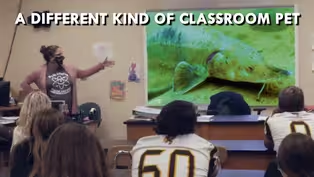
Video has Closed Captions
Clip: S2 Ep1 | 5m 27s | Lake sturgeon bring science to life and expand understanding of Native American culture. (5m 27s)
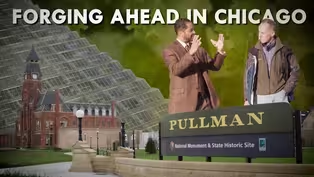
Greening the Pullman Neighborhood
Video has Closed Captions
Clip: S2 Ep1 | 8m 1s | A once rusted out industrial corridor finds new life as a green industry success story. (8m 1s)
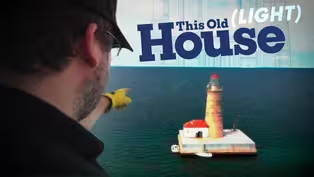
Video has Closed Captions
Clip: S2 Ep1 | 11m 22s | Volunteers battle the elements to preserve a historic lighthouse on the Great Lakes. (11m 22s)
Providing Support for PBS.org
Learn Moreabout PBS online sponsorship
- Science and Nature

Explore scientific discoveries on television's most acclaimed science documentary series.

- Science and Nature

Capturing the splendor of the natural world, from the African plains to the Antarctic ice.












Support for PBS provided by:
Great Lakes Now is a local public television program presented by Detroit PBS