Prairie Sportsman
Restoring What Lies Beneath
Clip: Season 17 Episode 6 | 10m 27sVideo has Closed Captions
The Minnesota Aquatic Invasive Species Research Center methods of restoring native aquatic plants.
Researchers at the Minnesota Aquatic Invasive Species Research Center are working to bring native plants back to lakes that have been impacted by invasive species. These underwater forests are critical to the health of Minnesota’s lakes, and these researchers hope to improve the methods available to restore them.
Problems playing video? | Closed Captioning Feedback
Problems playing video? | Closed Captioning Feedback
Prairie Sportsman is a local public television program presented by Pioneer PBS
Production sponsorship is provided by funding from the Environment and Natural Resources Trust Fund and Shalom Hill Farm. Additional funding provided by Big Stone County, Yellow Medicine County, Lac qui...
Support provided by:


Prairie Sportsman
Restoring What Lies Beneath
Clip: Season 17 Episode 6 | 10m 27sVideo has Closed Captions
Researchers at the Minnesota Aquatic Invasive Species Research Center are working to bring native plants back to lakes that have been impacted by invasive species. These underwater forests are critical to the health of Minnesota’s lakes, and these researchers hope to improve the methods available to restore them.
Problems playing video? | Closed Captioning Feedback
How to Watch Prairie Sportsman
Prairie Sportsman is available to stream on pbs.org and the free PBS App, available on iPhone, Apple TV, Android TV, Android smartphones, Amazon Fire TV, Amazon Fire Tablet, Roku, Samsung Smart TV, and Vizio.
Providing Support for PBS.org
Learn Moreabout PBS online sponsorship(diver splashes) (dramatic music begins) Beneath the surface of Minnesota's Lakes exist vast underwater forests that serve as an important habitat for aquatic animals of all kinds.
For years, these ecosystems have been threatened by invasive species like curly leaf pondweed, Eurasian and hybrid watermilfoil, and starry stonewort.
On the frontline against these invaders are researchers at the Minnesota Aquatic Invasive Species Research Center, or MAISRC.
Their battle plan against invasives involves more than simply stopping the invaders.
(dramatic music continues) - Invasive plants can be a problem in lakes for a number of reasons.
One is that they can just grow really densely, produce floating mats that are a nuisance for lake users, and interfere with recreation.
All that abundant growth can also affect native plants by shading them out and displacing them.
And there are also variety of environmental consequences.
All that dense growth can just change light, and oxygen, and then potentially have effects on fish and other animals that we care about in lakes.
One thing that's really important for people to understand is that eradication is almost never a feasible management goal with aquatic invasive plants.
So eradication would be fully eliminating the population.
That is just about impossible to do.
- We have a lot of invasive plants in our lakes across Minnesota, and every year we go out and treat hundreds of them with herbicide.
But the problem is, oftentimes the invasive plants keep coming back, and the native plants, which are needed to reestablished the plant community there don't.
So we're hoping that by planting native plants back in there after these herbicide treatments, we're able to break that kind of herbicide cycle and get good things back.
- To be clear, we're not here just to kill invasive species.
We're here to restore ecosystems.
Once we develop tools to get those invasive species out of a water body, we have to think about that restoration piece.
It's an essential component.
(dramatic music continues) (upbeat music begins) Think about a forester maybe who's managing trees, cuts the timber down.
You have to replant.
It's not expected that it's just going to come out of nowhere.
And the same is true for lake ecosystems.
It's just an underwater forest.
We have to, in some cases, give it a little oomph to get it going again.
We wanna be real sure that something else doesn't take over that open space in the environment.
- As somebody who is a plant ecologist, I care about the native plants themselves and their biological diversity.
So I wanna see them there, kind of for their own right.
But that aside, native plants are really valuable to have in lakes for stabilizing sediment, providing cover and refugia for fish and other animals.
They contribute to good water quality and potentially even taking up space to reduce the extent to which the invasive plants come back following management.
They bring a host of different benefits.
- Our underwater forests are just the bedrock of our lake system.
So without healthy plant communities, it's really hard to achieve anything else in a lake, like having good fish habitat, having good water clarity.
- So one of the species that Abha has been working with is Vallisneria Americana, or water celery is one of the names for it.
And that's a species that ducks love, in particular canvasback ducks.
It's in their Latin scientific name.
This plant species is right there built into it, 'cause they love to feed upon it.
So that's an example of an aquatic plant species where there's a direct wildlife benefit.
- [Bret] However, saying you're bringing native plants back and doing it are two very different things.
- Dealing with things underwater is difficult, because oftentimes a lot of these conditions that lead to invasive species and deteriorated lakes happen simultaneously.
So you have low water clarity, you have other invasive species other than plants, like zebra mussels, et cetera.
And these can really complicate that revegetation process by making the conditions difficult for those native plants to establish, but also for us to go in there and reestablish them.
(upbeat music continues) - [Bret] Researchers hope that someday the process of restoring native plants underwater will look very similar to that of another ecosystem.
- Many people will be familiar with prairie restoration.
Maybe they've even been involved as volunteers or had it done on land that they hunt on.
And any of us could go online today and order some really good native seed mixes to go out and do that restoration.
And I think of aquatic plant restoration, we're kind of in the dark ages compared to what's been developed for terrestrial restoration.
So not only can you not go online and order those plant species, for the most part, with a few exceptions, but there's really basic questions about propagating those species.
There's basic questions about their seed biology and establishment that are unanswered.
And there are also special challenges to working in aquatic environments.
And it requires really labor intensive, technically challenging things, like Abha has been doing in her research, going in and scuba diving, hand planting these things.
- [Bret] One aspect of the MAISRC project is to make these labor intensive efforts more successful.
- The standard practices in the state right now is that you would go to a donor lake that has a really healthy native plant population and take those plants and put them in a more degraded lake.
And so we're looking at different techniques, such as wrapping them in burlap to make sure their roots sink and establish.
We'll dive and we'll use landscaping staples to put them in there.
And we're looking at different species and method combinations to see what's really gonna work.
(gentle music begins) - [Bret] In addition to improving traditional methods, researchers are seeking answers to questions that could potentially lead to a game changing approach to restoring aquatic plants.
- I think the biggest breakthrough that we need to increase capacity for lake restoration of plant communities is being able to do seed based restorations.
And if we were able to reliably germinate seed of these species, we could really scale up what we do.
So Abha's been doing really exciting things in the lab, investigating how she can improve germination of native aquatic plant species.
- Some of the most exciting things that we've found is that we've been able to germinate and grow 11 different species this year, which is really exciting for us.
- There's been past efforts, past research where we've had very poor germination, where there have been species where we couldn't get any of the seed to germinate, or they would germinate, but in really low numbers.
And so what Abha has done on the technical side is kind of investigate how to collect, store, treat, the care of that seed to get better germination.
And it's led to results that I did not expect.
I was very skeptical at first and I've been blown away by how much is germinating.
And the hope is that, over time we can translate that into the field and eventually be able to do seed based restoration of aquatic plant communities, which would be huge.
- I would wanna highlight that there's so much amazing work happening already by folks across the state.
And so what we're really hoping with this project is that we can gain a more like, synthesized understanding of what's going on.
There are these big questions of which plants, how do we get them back, when do we put them back?
How long is it gonna take?
- It's a great example though of the progress of research.
Over the last decade or so, we would not have been thinking about the idea of restoring post-treatment.
Like treating was our big question.
Like we didn't even know how to do it or do it successfully all that well.
Like now we're talking about restoring it.
And that is a huge transition, and we have some of the best and brightest scientists working on this topic here in Minnesota and Minnesota's problems.
That's an incredible resource.
- [Abha] I love being outside, I love being in the lakes.
I love diving.
But being able to use those in a solution oriented way that I hope will have these resounding impacts and be able to improve that outdoors over time is something that really excites me.
- My pie in the sky hope for long-term impacts is that we could be talking 20 years from now and you would be able to go online and purchase native aquatic plant species for use in restoration, and that we would have the methods worked out well enough that it'd be a high chance of success.
The work is still underway, so we don't know where it's gonna take us, but I think this could be a big step in the fight against invasive species to have that natural resistance to re invasion.
- [Narrator] We can stop aquatic hitchhikers from infesting more lakes and streams by cleaning up everything we pull out of the water.
It's a simple drill, clean in, clean out.
Before leaving a water access, clean your boat and water equipment, remove and dispose of all plants and aquatic species in the trash.
Drain water from your boat, ballast tanks, motor, live well and bait container.
Remove drain plugs, and keep drain plugs out while transporting equipment.
Dispose of unwanted bait in the trash.
To keep live bait, drain the water and refill the bait container with bottled or tap water.
And if you have been in infested waters, also spray your boat with high pressure water, rinse with very hot water, dry for at least five days.
Stop the spread of AIS.
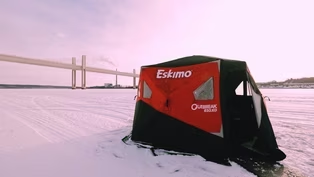
St. Croix Sturgeon and Aquatic Plant Restoration
Video has Closed Captions
Preview: S17 Ep6 | 30s | Joins anglers on the St. Croix River to fish for sturgeon and Minnesota aquatic invasive species. (30s)
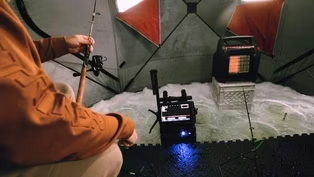 New
NewVideo has Closed Captions
Clip: S17 Ep6 | 14m 48s | Fisherman from north of the border fish for their first American Sturgeon on the St. Croix River. (14m 48s)
Providing Support for PBS.org
Learn Moreabout PBS online sponsorship
- Science and Nature

Explore scientific discoveries on television's most acclaimed science documentary series.

- Science and Nature

Capturing the splendor of the natural world, from the African plains to the Antarctic ice.












Support for PBS provided by:
Prairie Sportsman is a local public television program presented by Pioneer PBS
Production sponsorship is provided by funding from the Environment and Natural Resources Trust Fund and Shalom Hill Farm. Additional funding provided by Big Stone County, Yellow Medicine County, Lac qui...