At Issue with Mark Welp
Rethinking Punishment for Incarcerated Parents
Clip: Season 4 Episode 4 | 4m 37sVideo has Closed Captions
Nia Frazier and Kaitlyn Foust discuss alternatives that could keep parents with children.
Nia Frazier and Kaitlyn Foust discuss alternatives to incarceration for parents and why they believe punishment should account for family impact. The conversation also explores domestic violence, self-defense and how a criminal case can look different when the full story of the person involved is considered.
Problems playing video? | Closed Captioning Feedback
Problems playing video? | Closed Captioning Feedback
At Issue with Mark Welp is a local public television program presented by WTVP
At Issue with Mark Welp
Rethinking Punishment for Incarcerated Parents
Clip: Season 4 Episode 4 | 4m 37sVideo has Closed Captions
Nia Frazier and Kaitlyn Foust discuss alternatives to incarceration for parents and why they believe punishment should account for family impact. The conversation also explores domestic violence, self-defense and how a criminal case can look different when the full story of the person involved is considered.
Problems playing video? | Closed Captioning Feedback
Where to Watch At Issue with Mark Welp
At Issue with Mark Welp is available to stream on pbs.org and the PBS app.
Providing Support for PBS.org
Learn Moreabout PBS online sponsorship- So how do we balance having someone who's been found guilty of a crime and serving their time, especially someone who is pregnant or is a parent?
I mean, there are plenty of people who go to jail and prison who have kids who are five, six, teenage, whatever.
How do we balance having them serve a sentence and still letting them be a parent to their kids?
- Do you have a thought on that, Nia?
- That's tough.
I could go if you, but I wanna give you the chance first.
- I think that we need to revisit what punishment looks like.
I think that rather than holding parents in prison, they can have them on house arrest if possible or just some sort of alternative, because in those formative years, personally, I feel like all childhood, even up to late teenage years, those are all formative years.
Like these kids need their parents.
And there has to be some other way that we can still punish these people and allow them to be with their kids, especially if they made a mistake, or in some cases, these people are incarcerated by the theory of accountability, which means that they didn't even commit the crime, or they were found not guilty after they had their case overturned years and years later.
You can't get that time back.
So why not another route?
- That's a tough question to answer.
What are your thoughts?
- Absolutely.
I think, kind of to Nia's point, we're kind of very far away from having a future that can balance both of those things, but I think it really starts from looking at the reality of who we're incarcerating.
And our systems are really not designed to accommodate these nuanced situations that a lot of women face.
One of our projects at the Illinois Prison Project is called the Women and Survivors Project, because when you look at the women that are incarcerated, if you just look at their cases on paper, it seems very black and white.
But when you start to actually listen to their story, a lot of it comes down to self-defense in gender-based violence scenarios or domestic violence scenarios that, because the way that people experience those, you know, abuse or traumatic situations doesn't perfectly align with what our criminal legal system needs to incarcerate somebody, you're already walking in with two different stories being told.
And I think that also goes into like understanding how we can accommodate for both people that are incarcerated and for their motherhood.
It starts by looking back at the original way that the system incarcerates people, right?
Like we don't really have a system that can judge people on both lines.
You're judged as the criminal, not as this full person that you are.
I'm forgetting the woman's name, but right now, there is a woman who is incarcerated, or she took a plea for involuntary manslaughter for something that was her acting in self-defense.
And so there's a lot that we need to really do, but I think it comes from listening to people like Nia and asking these questions and these types of conversations, so that when we're having these conversations, it's not about some evil group of people that we need to be protected from.
It is mothers, it is wives, it is survivors of abuse, like that is who we're incarcerating.
- And there are people out there who say, "Oh, well, that's unfortunate, but you did the crime, so now, you gotta do the time."
They have that attitude.
But when you think of a child who is without their mother, the effects it could have on that child could be far worse than, you know, feeling like you're getting vengeance or something against a person who's committed a crime.
- Especially when we have so many other options.
Like I think that a lot of times people think that incarceration is the only solution in these situations, but there's a lot of ways you can have someone have accountability for what they've done without compounding that trauma.
And I just think even to the people that say, "You did the crime, you should do the time," I think there's ways that we, as a rational, reasonable, intelligent community, can find better ways that isn't perpetuating the harm.
Video has Closed Captions
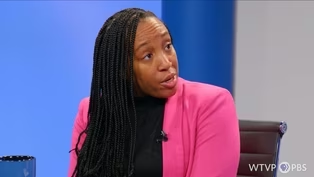
Clip: S4 Ep4 | 2m 44s | Nia Frazier recalls giving birth while jailed and the painful separation from her newborn. (2m 44s)
Preview: When Mothers Are Incarcerated
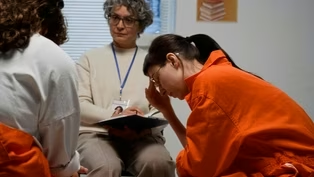
Preview: S4 Ep4 | 35s | Preview: When Mothers Are Incarcerated (35s)
Video has Closed Captions
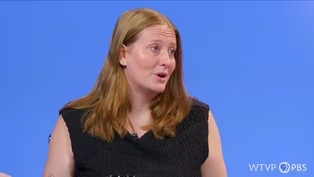
Clip: S4 Ep4 | 2m 56s | Nia Frazier explains how incarceration continues to affect her daughter years later. (2m 56s)
Providing Support for PBS.org
Learn Moreabout PBS online sponsorship New Episode
- News and Public Affairs

Top journalists deliver compelling original analysis of the hour's headlines.
 New Episode
- News and Public Affairs

Today's top journalists discuss Washington's current political events and public affairs.
 New Season
 New Episode
 New Episode
 New Season
 New Episode
 New Episode

 New Episode
 New Episode
Support for PBS provided by:
At Issue with Mark Welp is a local public television program presented by WTVP