
Return of the Wild in Argentina
Episode 5 | 27m 24sVideo has Audio Description
A former executive is bringing jaguars back to a wilderness in Argentina.
Kris Tompkins went from Patagonia CEO to conservation visionary, spending her fortune with late husband Doug to protect over 16 million acres in Chile and Argentina. Miles O’Brien joins her in Argentina’s Ibera wetlands as jaguars, extinct there for a century, are captured, collared, and released into the wild. It’s a bold experiment in reversing extinction that comes with risk, loss, and hope.
See all videos with Audio DescriptionADProblems playing video? | Closed Captioning Feedback
Problems playing video? | Closed Captioning Feedback
Made possible in part by support provided by Sue Hart-Wadley and Searle Wadley with additional support from Jerry Cox.
Return of the Wild in Argentina
Episode 5 | 27m 24sVideo has Audio Description
Kris Tompkins went from Patagonia CEO to conservation visionary, spending her fortune with late husband Doug to protect over 16 million acres in Chile and Argentina. Miles O’Brien joins her in Argentina’s Ibera wetlands as jaguars, extinct there for a century, are captured, collared, and released into the wild. It’s a bold experiment in reversing extinction that comes with risk, loss, and hope.
See all videos with Audio DescriptionADProblems playing video? | Closed Captioning Feedback
Where to Watch Resolve to Solve with Miles O'Brien
Resolve to Solve with Miles O'Brien is available to stream on pbs.org and the PBS app.
Providing Support for PBS.org
Learn Moreabout PBS online sponsorship♪ ♪ ♪ ♪ MILES O'BRIEN: You could say this is my natural habitat, my range.
The ecosystem where my species thrives.
All right.
All right, let's do it, guys.
I'm Miles O'Brien, a North American thick-bellied road warrior.
♪ ♪ A frequent flyer, touching down only to meet people who are hatching solutions to big problems.
We don't travel light.
This time, that meant plunging into the human swarm 16 million strong in metropolitan Buenos Aires.
And then pushing far beyond it, from concrete sprawl to untamed wild, where people are vastly outnumbered by rare and remarkable animals.
(engine starting) (pilot speaking Spanish) ♪ ♪ O'BRIEN: I'm on my way to the Iberá Wetlands, nearly two million acres in all.
A place that feels like a cross between the Everglades and the Serengeti.
(speaking Spanish) O'BRIEN: I'm here to witness a new trend in wildlife conservation: rewilding.
Not just protecting what's left, but restoring what was lost-- bringing back missing species, rebuilding food webs, and helping nature recover its ability to sustain itself.
♪ ♪ (engine stops) How are you?
Good to see you.
As I gazed out over the tall grass, I realized there were likely many more eyes looking back at me than I could see.
It gave me a thrill and a chill.
All of this is what nature intended, but humans erased.
(plane engine humming) Until a woman on a mission landed here.
(engine stops, door closes) Hey, Kris, good to see you again.
(speaking indistinctly) -How are you?
KRIS TOMPKINS: Nice to see you.
O'BRIEN: Yeah, it's good to be here.
Her name is Kris Tompkins, and she is a conservationist who thinks on a scale most people can't fathom.
KRIS TOMPKINS: Have you been out to the cats yet?
O'BRIEN: No, no, we're excited.
We've been waiting for you.
-Okay.
O'BRIEN: She has committed her time, talent, energy, and fortune not just to preserving wild places, but to filling in the pieces that are missing: rewilding an empty landscape with animals that belong here.
♪ ♪ The story begins right here, at a jaguar breeding facility, the first of its kind in the world.
These beautiful cats are the most prominent success story of the organization Kris Tompkins helped put on the map: Rewilding Argentina.
KRIS TOMPKINS: Okay.
We decided that if we wanted to bring jaguars back here, we were going to have to breed them, because we couldn't get any jaguars to start the program with.
O'BRIEN: Mm-hmm.
And we made it like the jaguar Fort Knox.
(both chuckle) O'BRIEN: There are nine large enclosures with trees, shelter, and pools.
(jaguar growls) They filled the pens with animals from zoos and rescue centers and some from the wild that could not be returned, including one with three legs.
All of this ensured genetic diversity.
So this is kind of the crown jewel... KRIS TOMPKINS: Yes.
-What do you think it proves?
KRIS TOMPKINS: It proves that you can very likely bring a species back, even a top predator.
♪ ♪ O'BRIEN: That's easy to say in hindsight.
For about a century, jaguars were an essential missing piece of the puzzle here in Iberá.
But not anymore.
(jaguar hisses) When I first came here five years ago, the cubs were sequestered from any human contact, learning how to hunt from their mothers and instinct.
Then, in January of 2021, the first mother and two cubs walked through the fence.
Today, there are at least 50 jaguars roaming free here, on the same side of the fence as us.
♪ ♪ Hunting, breeding, and building a healthy wild population.
And it all started with cats that could never live in the wild themselves.
Captive animals gave rise to a truly wild future.
KRIS TOMPKINS: I look over at these guys, and I get tears in my eyes.
Because I know what it's taken to get them here.
(chuckles) Yeah, they mean a lot to me, to all of us.
(chuckles) ♪ ♪ O'BRIEN: Kris invited me here on this day to witness a milestone, one made possible by her vision and persistence.
Acaí, a two-year-old female jaguar, was heading to a new park in Argentina.
JEGER: Okay, good morning, everyone.
Welcome to the CRY, to the reintroduction center.
O'BRIEN: Acaí is the second jaguar to be translocated from Iberá, a sign that what's working here is ready to be replicated elsewhere.
♪ ♪ First step: tranquilization.
Mattias, the vet, loads a blow dart.
It's low-tech, but reliable.
He enters the enclosure, a second fence between him and Acaí.
(Acaí growling and snarling) He moves quietly behind her... (Acaí growling) ...and takes the shot.
(dart shoots) (Acaí growling, moaning) She's not thrilled.
(growls) (growling softly) (snarling) ♪ ♪ O'BRIEN: Once the sedative hits, they've got only a half-hour to do their work.
Mattias prods her gently.
She's out cold.
♪ ♪ KRIS TOMPKINS: She's gonna go into the wild in a couple of months.
So they have to make sure, before they release her, she's completely fit to be released.
-Yeah.
They weigh her.
MATTIAS: Cincuenta y seis.
Bajen.
O'BRIEN: About 125 pounds.
That's a big cat.
(woman talking in background) KRIS TOMPKINS: There are, like, six people working on her.
And they're not speaking.
And they're on the clock, because the anesthesia only lasts so long, and everybody's very clear about that.
O'BRIEN: They attach a collar that allows them to track her with both GPS and VHF radio signals.
They are, after all, helicopter parents who want to keep an eye on her in the wild.
MATTIAS: Uno treinta.
MAN: Veinticinco más dos.
O'BRIEN: It's okay if I...?
KRIS TOMPKINS: Yeah, yeah, yeah, yeah.
Oh, my gosh, wow.
(Kris Tompkins chuckles) O'BRIEN: That's something, isn't it?
KRIS TOMPKINS: They're really beautiful.
O'BRIEN: This is... (people talking softly in background) O'BRIEN: This is like the realization of a dream, isn't it, to see this all happen.
KRIS TOMPKINS: Yeah, it is, it is, it is, yeah.
It is.
When you first had this idea, could you have imagined this scene?
KRIS TOMPKINS: No, because we didn't know how to do it.
We just knew to do it.
O'BRIEN: They closely studied rewilding efforts in South Africa as a template for their own playbook.
KRIS TOMPKINS: They managed wildlife in an extraordinary way.
I mean, they're the best at it anywhere.
O'BRIEN: And then started looking for skilled scientists.
And when you put a sign on your chest that says, "We want to bring back species that have gone extinct," and just wait on the sidewalk long enough, you can't imagine who comes to your door.
(chuckles) And that's what happens all the time.
So we attract extraordinary people who couldn't imagine having this as their work.
This is like a dream job.
O'BRIEN: Creating and funding this idea has become her dream job.
MAN: La cola.
O'BRIEN: It is the culmination of a journey as unlikely as it was serendipitous.
♪ ♪ Kristine McDivitt was a teenage surfer from Ventura County when she met Yvon Chouinard, who had just started a small rock-climbing gear business.
♪ ♪ At 18, she was packing boxes.
By 28, she was C.E.O.
of the company, by then called Patagonia.
♪ ♪ I think there were two other female C.E.Os.
at that time.
So there was lots of press because I was a woman.
We thought we were fabulous and moving around the world and, uh, building companies that had a great ethos.
O'BRIEN: Would you consider yourself an avid environmentalist at that time?
No, it was new to me, and I... This is not something I'm proud of, it's just the fact.
O'BRIEN: In 1991, she met Doug Tompkins, Yvon's old climbing buddy, who had co-founded The North Face and Esprit, two retail empires.
But he walked away from it all, disillusioned with the culture of consumption he helped create.
DOUG TOMPKINS: I realized I was, you know, making products that nobody really needed.
So I threw in the towel and got working on environmental and conservation issues.
O'BRIEN: He had cashed out and was living off the grid on a remote farm in Chile when he saw Kris at a café in Argentina.
Sparks flew.
♪ ♪ KRIS TOMPKINS: I went down to visit him in Chile for ten days, and I stayed five weeks, and went back and told Yvon that I was leaving at the end of the year.
I was gonna move to Chile.
♪ ♪ I was done.
O'BRIEN: So, she went from Patagonia the company to Patagonia the region.
Doug had already begun buying up wild, ecologically rich land that he would later donate to create national parks.
♪ ♪ Together, Kris and Doug set out in a bush plane, scouting for landscapes worth saving.
♪ ♪ At first, they faced a lot of skepticism and distrust.
People were understandably suspicious of wealthy North Americans buying huge tracts of land and then promising to give it all away.
KRIS TOMPKINS: I look at it today very differently than I was probably looking at it 30 years ago.
I think we were kind of naive to think, "Oh, people are gonna love this."
O'BRIEN: But they persevered.
Over three decades, Doug and Kris Tompkins helped protect more than 16 million acres across Chile and Argentina.
Roughly two million acres were donated directly to governments creating or expanding national parks that now belong to the public.
♪ ♪ KRIS TOMPKINS: We weren't just in the business of buying land and making national parks.
We had to fully restore these places, as close as one can, to its original richness and diversity.
And then the work gets really difficult.
And that's rewilding.
(chuckles) (engine starting) ♪ ♪ Okay?
Hola, hola.
O'BRIEN: Check, we hear you fine.
In 1997, they landed here in Iberá.
♪ ♪ KRIS TOMPKINS: What a great place.
-It's beautiful.
KRIS TOMPKINS: Yeah, it is.
It's a pretty dreamy place.
♪ ♪ O'BRIEN: The scale is hard to grasp.
The park is nearly two million acres, about the size of Delaware, and it is brimming with life.
KRIS TOMPKINS: We barely knew what was here, much less, if someone was absent, how to bring them back.
♪ ♪ O'BRIEN: They methodically reintroduced missing animals, each one playing a distinct role in the ecosystem: giant anteaters, Pampas deer, collared peccaries, red and green macaws... (macaw squawking) ...and then jaguars.
Sadly, Doug Tompkins never lived to see Iberá's full revival.
In 2015, he died while kayaking in Southern Chile.
Strong winds capsized his boat, and he succumbed to hypothermia in the frigid water.
He never got to witness the return of the jaguar to Iberá and beyond.
♪ ♪ ♪ ♪ MAN: Ahí nomás, porque está ya muy cercas.
MAN: Ahí, ahí está bien.
O'BRIEN: Which brings us back to Acaí.
KRIS TOMPKINS: Ahí va, mi amor.
O'BRIEN: She had a ticket to ride on a small plane to her new home 400 miles to the northwest.
MAGALI: ¿Es qué sea bastante pista por el peso?
-Por el peso y no... Atrás tiene un margen muy chico.
MAN: Despacito.
Despacito.
Okey, chequealo.
-Vale.
Pero esta firme.
Puede... Ah, ya.
O'BRIEN: All the lofty goals that Kris has tenaciously pursued all these years are wrapped up in this moment.
KRIS TOMPKINS: I can be the happiest woman on the planet, because if I drop dead this afternoon?
They're, they're on their way.
(engine starting) They know exactly what they're doing.
♪ ♪ O'BRIEN: How proud would Doug have been of that moment?
Well, he would've wanted to be flying.
He probably would've elbowed... (both laugh) ...Delfina out of the left-hand seat.
He'd be so proud-- I think he is proud.
He's still flying, somewhere.
(plane engine humming) ♪ ♪ O'BRIEN: At this point, I was as curious as a cat.
What lay in store for Acaí?
(plane engine starts) So we hopped on a plane, to another plane... ...to a pickup truck and a long, long drive down dirt roads covered in a soupy, clay mud... ...to a place called El Impenetrable National Park, another patch of nature preserved by Rewilding Argentina.
The next phase of the Rewilding Argentina campaign is to introduce some females to this part of the world, and, with a little bit of luck, there'll be a vibrant, wild jaguar population here.
And I'm very excited to be witnessing this little piece of rewilding history.
♪ ♪ And I was excited to meet up with an old friend.
Ah, Sebastián, my friend.
-Hi.
Hi, Miles.
How are you?
O'BRIEN: Sebastián di Martino.
Bring it in, bring it in.
-Ah, nice to see you.
O'BRIEN: It's been five years, how are you?
Yeah, five years, five years.
-Five years.
He was the conservation director.
You will not believe what you will see here now, yeah.
- Yeah.
Sebastián took me to the enclosure where jaguars destined for the wild here in El Impenetrable are acclimated before release.
So now we are trying to replace the breeding in captivity program by the translocation of wild animals.
That is much faster, is more efficient.
O'BRIEN: Acaí was already here, but she was out of sight.
As was another female, Miní, who was hours away from release.
DI MARTINO: The last record of a female was, uh, 1990.
So, 35 years ago.
So, last year, we started to release females, and we released two, and tomorrow, we are going to release the third one.
O'BRIEN: Rewilding is not complete until the apex predators return.
Their presence triggers a trophic cascade, a chain reaction that ripples through the food web, helping restore balance across the landscape.
Top predators influence how their prey behave.
KRIS TOMPKINS: Everybody's on the alert.
They need to hide again, instead of lounging in the middle of roads and so on.
So, behaviorally, everybody comes back into line when the top predators are back.
♪ ♪ O'BRIEN: The apex animals of the waterways here are the giant river otters.
(squawking) The otter, as, as you can see, they are very noisy, they are diurnal, they are, uh, live in big groups, and they are very curious.
So, yeah, they are spectacular animals, very charismatic.
O'BRIEN: And they became at least locally extinct... DI MARTINO: Yeah.
...because of why, what happened?
So, most of the historic records of giant otter is people shooting the groups because it was fun.
And when you shoot one of the members of the group, the others tend to stay.
They are trying to help the one that is injure or dead.
So it's kind of easy to shoot them, them all, yeah.
People... That, that is some horribly sick fun.
DI MARTINO: Yeah, it's, but that's the culture of that time.
(otter squawking) So... O'BRIEN: I think they want out, don't they?
MAN: Yeah, they want out, yeah.
(all laughing) (otters squawking and squeaking) O'BRIEN: For Sebastián, the bold idea of restoring entire ecosystems isn't just a conservation mission.
It's a boyhood dream brought to life.
DI MARTINO: As a kid, I was always dreaming, like, it would be great to have, like, a time machine to go back in time to create, like, a big national park and preserve the environment and all the species.
O'BRIEN: Sebastián was ready to write the next chapter in his time machine story.
Not far away, Miní was ready to step out of the confines of her enclosure to spend the rest of her days in the wild.
It's like seeing your kid off to college or something or... Something like that.
(both laugh) DI MARTINO: She will be monitored with a collar that has a GPS that collects points every three hours, and every day, we get the position points, so we know where she is.
♪ ♪ O'BRIEN: And right now, her position point is nowhere near us.
Yeah, she's far away.
O'BRIEN: And that seemed to me like a wise time to open the door.
♪ ♪ So, we will open this door right now to allow Miní to get out and start her free life in El Impenetrable.
O'BRIEN: All right.
DI MARTINO: Yeah.
O'BRIEN: An exciting moment.
DI MARTINO: Now we only have to wait.
She will go out maybe in a couple of hours, maybe in a couple of days, but... O'BRIEN: Excellent.
Congratulations.
-No, con.... Yeah.
-Yeah.
O'BRIEN: Let's let nature take its course.
♪ ♪ Several hours later, long after we'd left, Miní edged her nose through the open door, didn't smell us, then padded off into the wild.
♪ ♪ ♪ ♪ The time machine Sebastián dreamed of as a boy is working.
DI MARTINO: Rewilding is, uh, bringing back species from regional extinction, it's... Yeah, like, recovering the best of the past to have, uh, some opportunities in the future, yeah.
O'BRIEN: Back to the future.
The success of rewilding has created a new challenge: what happens when the animals they've introduced start to leave the parks?
Rewilding Argentina has helped locals establish small businesses that cater to tourists eager to explore the parks.
(guests exclaiming) DI MARTINO: We are eating pastel de papas.
That is like a potato pie.
O'BRIEN: It's a way to make top predators more valuable alive than dead.
♪ ♪ KRIS TOMPKINS: If you can make the case, and, in reality, the local communities are benefiting from the reintroduction of an array of species, then everybody's focused on maintaining that and growing that economic option.
The success for rewilding is not found simply in the, in the rewilding work itself.
You have to have the communities active in that process.
O'BRIEN: And yet there have been crushing setbacks.
Sadly, that brings us back to Acaí.
Six months after I got to touch her, she was released wearing a tracking collar.
Three weeks later, the radio and GPS signals abruptly stopped.
KRIS TOMPKINS: Either she'd lost her collar and she was fine or, um, somebody had killed her.
But it was quite a while.
It was a month or so until they finally found her collar in the river.
♪ ♪ O'BRIEN: Acaí was gone, presumed killed by a poacher, despite all the effort to educate communities and encourage ecotourism.
MAN: Acaí era parte de un programa de reintroduction de jaguar.
O'BRIEN: The loss of this famous jaguar triggered some soul-searching about poaching in Argentina.
(mouse clicks) KRIS TOMPKINS: The news of her demise hit every newspaper around the country, and it has changed the way the country looks at poaching, because her little life, um, or the end of her little life made that possible.
So, she had a very short life and an enormous impact.
So in her death, Acaí has become a symbol.
She's a little saint now.
-(laughs) She's like the poster child for wildlife in the country, and that they belong to everyone.
♪ ♪ O'BRIEN: Not long after Acaí was killed, two jaguar cubs were born in El Impenetrable.
Kris says there are now perhaps a dozen jaguars roaming free in a place where, for decades, there were only solitary males.
The work they're doing here is challenging, expensive, and time-consuming.
(jaguar growls, snarls) Ultimately, it's a small, fragile attempt to do something about a global crisis.
Many scientists believe we're living through the early stages of a sixth mass extinction... (otters squawking) ...driven by habitat loss, climate change, pollution, and our growing footprint on the planet.
Rewilding won't stop all of that.
But it does prove something important: when we choose to act, nature can recover, and some things can still be saved before it's too late.
♪ ♪ ♪ ♪
Video has Closed Captions
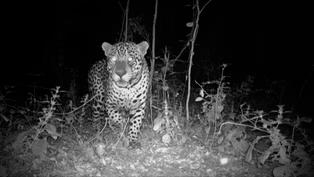
Clip: Ep5 | 5m 7s | The relocation of jaguars is part of an attempt to rewild the Iberá Wetlands of Argentina. (5m 7s)
Providing Support for PBS.org
Learn Moreabout PBS online sponsorship New Episode
- Science and Nature

Explore scientific discoveries on television's most acclaimed science documentary series.
 New Episode
- Science and Nature

Capturing the splendor of the natural world, from the African plains to the Antarctic ice.

 New Episode







Support for PBS provided by:
Made possible in part by support provided by Sue Hart-Wadley and Searle Wadley with additional support from Jerry Cox.