Articulate
Reuben Margolin, Jennifer Higdon, Chemi Rosado, Sara Rahbar
Season 2 Episode 5 | 26m 51sVideo has Closed Captions
Reuben Margolin, Jennifer Higdon, Chemi Rosado-Seijo, Sara Rahbar.
Reuben Margolin attempts to evoke the natural world with his kinetic sculptures. Composer Jennifer Higdon makes classical music, but still loves Beyonce. The art of skater/painter Chemi Rosado-Seijo is founded in community activism. Rahbar has found the antidote to her existential angst in her work.
Problems playing video? | Closed Captioning Feedback
Problems playing video? | Closed Captioning Feedback
Articulate is a local public television program presented by PBS39
Articulate
Reuben Margolin, Jennifer Higdon, Chemi Rosado, Sara Rahbar
Season 2 Episode 5 | 26m 51sVideo has Closed Captions
Reuben Margolin attempts to evoke the natural world with his kinetic sculptures. Composer Jennifer Higdon makes classical music, but still loves Beyonce. The art of skater/painter Chemi Rosado-Seijo is founded in community activism. Rahbar has found the antidote to her existential angst in her work.
Problems playing video? | Closed Captioning Feedback
Where to Watch Articulate
Articulate is available to stream on pbs.org and the PBS app.
Providing Support for PBS.org
Learn Moreabout PBS online sponsorship- [Jim] Coming up on articulete the kinetic sculptures of Reuben Margolin are extraordinary mechanic attempts to evoke the modern world.
- I know that sometimes that really gut reaction, I don't entirely trust it and it's weird not to trust your gut reaction, but I've learned that sometimes if I back away and give it time that it'll work.
- [Jim] Jennifer Higdon is among the most performed living composers in the world today and she's part of a storied musical lineage.
- Our world is much noisier, so I'm aware when I'm writing a piece of music that I'm also marking our time here now.
I'm both a mirror of our experience, but I'm also the hammer saying are you paying attention?
Are you paying attention?
- [Jim] The art of skater and painter Chemi Rosado-Seijo is founded in community activism.
He's an agent for change in places where creative expression may be low on the list of priorities for survival.
- This is an artwork, we cannot do like a really nice flat wall, we need to make it like really organic.
It need to reflect the community, too.
It needs to reflect that it was handmade, hand built.
- [Jim] And Sara Rahbar spent a lifetime looking for the antidote to her existential angst.
It turns out the work itself is the cure.
- I'm not comfortable in my skin all the time and I wake up just like that.
- [Jim] That's all ahead on articulete.
(mellow music) (mellow synthesized music) The kinetic sculptor Reuben Margolin has dedicated his life to making waves.
His practice brings together his love of math, making, and the beauty of the natural world.
He spent the past 15 years working here surrounded by past objects in a shop in Emeryville, California, just next to where he grew up in Berkeley.
- And I think I feel at ease that everything's always changing and at the same time nothing ever changes.
Like the sculptures, they don't repeat themselves, but at the same time they're always doing the exact same thing.
And so I think I just feel comfortable with that sort of level of uncertainty.
- [Jim] With each new project Margolin's approach has grown more sophisticated.
But every skill he's learned has only served to teach him how much he doesn't know.
- If I'm dreaming about the sculpture and I see how to make all aspects of it, it's not nearly as much fun as if I'm dreaming about a sculpture and there's some very interesting problem, like, hmm, how am I gonna do that part?
You know, that's weird.
More often it'll be something a lot more mundane like I'll just be suddenly feeling like, it'd be so nice to work with some cherry wood.
Cherry wood has that really nice warm color and it's soft and I haven't worked with wood in a long time and it smells good and I just really, really wanna work with some cherry wood, it's more often something like that.
- Like a craving.
- Yeah, it's like a craving.
I have this new lave and I wanna make something like really precise, you know, to half a thousandths of an inch, that'd be really fun.
- [Jim] But for as much as he enjoys the process the most fun Margolin has with his work happens at the very end.
- The way the sculptures work is that I have to have 'em done before I can turn them on, right.
It's not like as I'm half way through it I can like test it and get a preview.
I mean, it's done.
Every last piece is in and the only thing left to do is to turn that on button on and all kinds of things have happened at that point.
You know, the very first one, the overhead piece, the Square Wave right above us, I turned on after nine months and it moved and I was so shocked that it was actually working and running and it looked so good, I turned it off immediately and I took a walk around the block.
And then I came back and I turned it on again for another two minutes and I was like, "Wow, look at that!"
I turned it back off again.
And here it is, it's still running like 14 years later, I mean, who would've thought?
I've also turned on sculptures and they didn't work at all.
Nothing moves and it takes me up to a couple weeks to figure out where I messed up something, some torque, some ratio, and having to sort it out.
But probably the strangest ones was turning on the Double Raindrop for the first time.
And I turned it on and I seriously disliked it, right.
I this incredible visceral reaction that this was wrong, that this sculpture was bad.
And I had designed it to be eight feet wide with the idea that I could put it on a truck and transport it, but I realized I could just get a big dumpster and just lower it right in the dumpster.
Now, a friend of mine, Cullin, happened to be over right when I'm turning it on, and he was like, "Reuben, just don't throw it away.
"Just see what it looks like tomorrow, "I think it's pretty good, just wait a minute."
And the next day it looked a little bit better and it looked a little bit better and now it's one of my favorites.
And what happened?
I think it just didn't match at all what I thought it was going to look like.
There was just such a disconnect between what I was imagining it looking like and what it actually did, that that shock just made me dislike it initially.
I know that sometimes that really gut reaction, I don't entirely trust it.
And it's weird not to trust your gut reaction, but I've learned that sometimes if I back away and give it time that it'll work.
- [Jim] Reuben Margolin is surprisingly easygoing for someone whose art requires so much precision.
And he says he's always been like this.
At Harvard he changed majors frequently, bouncing from math to geology to anthropology and eventually earning a degree in English.
Though such a winding path would be stressful for some, not so for Margolin.
- Those are all great things to study.
I mean, how are you supposed to pick one of them?
- But how did you get to do that?
Who gave you permission to be this free?
- Well, I think probably my parents.
They're both artists, my dad's a writer and a publisher, and my mom's an artist and they just instilled in us this sense that a creative life was something that was, you know, really special.
And I think I had become something else, like a lawyer or a doctor, I would've really shocked 'em.
It was just to be creative was, and to make something beautiful was really where is was at.
- [Jim] This is probably why Margolin got no push back at home when he announced his intention to take a road trip to write poetry in a car that also doubled as a writing desk.
And why these days he's still making work just for fun.
Like this, The Dandelion Wave.
It took a year and a half to make and is one of Margolin's most ambitious projects.
And though he doesn't know its final destination, he says for now he's just happy to revel in all the creative freedom that life has given him.
The composer Jennifer Higdon is no stranger to accolades.
In 2009 she won a Grammy Award, in 2010 the Pulitzer Prize for music.
But despite the lofty place she occupies in the culture Higdon believes that music is for everyone.
- I think it's my job to make the music communicative enough that if this is your first experience hearing something by a living classical composer it should speak to you.
I don't think that you should have to have a PHD to understand what's going on.
- [Jim] And though well versed in the works of Mozart and Beethoven, Higdon's music is firmly rooted in the present day.
- Our world is much noisier, so I'm also aware when I'm writing a piece of music that I'm also marking our time here now, this is humanity's time, this is what we're experiencing.
I'm both a mirror of our experience, but I'm also the hammer saying, "Are you paying attention?
"Are paying attention?"
This is what's going on now.
- [Jim] And Higdon is paying attention.
- So, for instance, Beyonce's Lemonade CD, everyone's talking about it, I'm like, okay, I'm gonna by this thing, I'm gonna check it out, so I started listening to it and I'm like, "Wow, this is really fantastic."
And most people aren't really shooting for anything, they just wanna sell discs.
For Beyonce Lemonade was a statement, it was a point of grieving, you can hear it.
It's a point of coping, very much the same way the Blue Cathedral was for me.
- [Jim] Blue Cathedral is Jennifer Higdon's most frequently performed work.
She wrote it nearly two decades ago in memory of her younger brother Andrew Blue, whom she lost to cancer.
- The whole last quarter of it, I think I wept the entire time I was writing it for like a couple weeks.
It was very cathartic, but it was also just really hard to get through.
And it's amazing to me because somehow in some unspoken manner the audience picks up on that, even for people who don't know that story, I get emails and letters from people who are like, "Wow, I was really moved by this piece "and I don't know why I was moved by this piece, but I was."
And to me that's kind of the magic of music.
It's the one language that you can go anywhere in the world and present it and people will understand it.
- [Jim] Creating such emotionally resonant music benefits from a strong base of emotional support.
For Jennifer Higdon this comes from high school sweetheart turned partner of 36 years, her wife, Cheryl.
Together they run Lawdon Press, a publishing company exclusively dedicated to distributing Higdon's music.
Which they do at a rate of around half a dozen orders a day.
- We're at FedEx literally everyday and I remember one day I was walking down the street and I'm carrying like four boxes to FedEx and some guy across the street that I don't know said, "Congratulations!"
And I said, "Thank you!"
And I kept walking and there was a guy walking in front of me and he turned and he said, "What are they congratulating you for?"
And I said, "Oh, I won the Pulitzer Prize."
And he looked at me like, "What?
"You're still carrying these boxes down the street?"
I'm like, well job's gotta get done, you know.
We have to get the music out.
- You got super busy, not only with the publishing part of what you'd already written, but also people lining up at your door to offer you commissions.
- Well, this was an interesting thing, I thought, and I told some people, I said, "Look, I've got a lot on my schedule, "so if you want a piece you're gonna have to wait "'cause I've got an opera coming somewhere in the future."
And they said they would wait and I though, oh surely they wouldn't wait.
This was like five or six years off.
But much to my surprise when I was halfway through writing the opera these people started calling.
They had actually waited.
- [Jim] The opera that demanded years of Higdon's attention was an adaptation of Charles Frazier's Homeric Civil War novel, Cold Mountain.
- I realized very quickly that Cold Mountain was in really good hands with Jennifer Higdon.
When you're lucky enough to have the kinds of people wanting to adapt your work that I've had you kind of step back and let them exercise their talents.
(opera singing) - [Jim] But a command of one art form doesn't stop Higdon from exploring others.
She's recently begun dabbling in the visual arts and has been surprised to find continuity between the two practices.
- When I'm composing I am filling space.
I am filling the sound space.
When I'm drawing something it's kind of a similar thing, I don't use light lines and there's barely anything there.
I often have quite bit, I'm like filling in the space.
It's the visual space, it's not the audio space, it's the visual space.
But it has made me stop and look at everything in the world, every shadow, every shade, every curve, every corner, and the three dimensionality of things.
And the thing I realized with visual arts is anybody can walk up and look at it and if they don't like it they can walk off and that's it.
With music it's an in the time experience.
The person taking in the art has to actually kind of be present some way and they have to be in the moment in a different way that they are if they just walk up and look at a piece of art.
(chorus singing) I think everyone needs music in some form.
This is the thing about beat and pulse, it's something so primal and there's something so basic that it registers inside as a little piece of familiarity in a very big universe of chaos.
It's just a reminder that we're human.
- [Jim] Next up for Jennifer Higdon a low brass concerto for the Chicago Symphony and the Philadelphia Orchestra.
And a tuba concerto for the Pittsburgh Symphony, the Royal Scottish National Orchestra, and the Curtis Symphony.
She's also begun writing her second opera as yet untitled.
The Puerto Rican painter and conceptual artist Chemi Rosado-Seijo believes that when driven and executed from within, conceptual art can strengthen a community.
For the 2017 Whitney biannual he instigated a swap between an exhibition space and high school classroom.
Students attended class at the museum and their classroom in turn became a gallery.
This was based on a similar exchange he coordinated in 2014 and both projects redirecting the visitors and the students paths of travel was itself the experiment and the artwork.
- And the exchange was constantly, you know, like the students would be in the museum everyday, people from the museum would be in the school everyday, too.
And this version in the Whitney is different because of conditions, so we negotiated all that.
So, it depends on the people that I work with.
- [Jim] Rosado-Seijo continues to orchestrate these community based interventions which began back in 2001 when he first approached the villagers of a rural mountain community in Naranjito, Puerto Rico called El Cerro.
He proposed a project that would visually reintegrate the town into its natural surroundings.
More than 15 years later it's still going strong under the leadership of community organizer, Yvette Serrano.
And all this despite early misgivings about making the village seem even more rural than it actually is.
- What is cool is to be modern and contemporary, you know, city-like.
So, there's like that thing I grew up with in the countryside, so I knew that.
When I went to El Cerro I knew that green was gonna be like, oh.
So, when we were proposing like no, this is a mountain, they used to tell us, like this is a mountain already, why you wanna paint it as a mountain?
And it's like, yeah, that's why.
- When you started and you went to them and said, we wanna almost reintegrate the village into the mountain, we want it to become part of the mountain, what did you think that it would do for the community if they agreed to do this?
And how was the reality different?
- The very beginning was a little bit a little more conceptual in my head, I would say, but once we started and I got like Yvette telling me, "I think this is going to be good for the youngsters "of the community, let's do it."
And she became the leader of the project basically.
And I just left it, leave on its own, I was just another painter going there just letting her be a leader and that's something that kind of like last longer than painting or the ideas of most artists, you know, like it was a community empowered.
- [Jim] Away from the bucolic serenity of El Cerro, Rosado-Seijo indulges his other passion.
- Skateboarding could be another medium of another art medium.
It is a performance, there's many ways of performing it.
Perform in the city as architects will say, it's probably the one that I more admire, like the cities were invented to do certain stuff and designed to do certain stuff and we skateboarders do different stuff with that and that's basically that one of the things that I learn the most about art when I was starting out, the thing the I liked more is like tackle the view of things how you can see a urinal as a fountain.
So, how can you see steps as a jumping ground or as a ledge to grind on it and the fixation that we have with surface and all this syntality in skateboarding also, I'm really attracted to that 'cause the cities are vertical driven and we don't look up mostly.
Being skateboarders, you can ask a skateboarder about a sculpture and he would know about the base, but he won't even know that it's a sculpture up there.
- [Jim] Chemi Rosado-Seijo first had the chance to merge art and skateboarding in 2004 with this La Perla's bowl.
- I see it as a formal sculpture, it is a two dimensional object with aesthetics on its outside and on its inside and with content in both ways.
And since we begin to do the bowl we knew it was gonna be an art object, like on a sculpture and that was part of the fun of making it actually.
So, we were developing the outside first 'cause the community told us that and we were having fun, this is an artwork, we cannot do like a really nice flat wall we need to make it like really organic.
It need to reflects the community, too.
It needs to reflect that it was handmade, hand built.
- [Jim] The dual function skate ramp and swimming pool is a throwback to modern skateboarding's DIY beginnings in the dried out pools of 1970s southern California.
- But for the people in the barrio skateboarding has been there since the 50s and 60s, too, because there's two surfing spots just in front of the bowl, on each side of the bowl, so that culture is there.
That's why in the beginning we decided to make it 'cause there was a space for that for the community.
- [Jim] La Perla began life as a 19th century shanty town created for freed slaves in the shadow of the more affluent old city.
Today it's one of San Juan's poorest neighborhoods, but it's run by a well defined set of community values.
- First things that happen to me in LA Perla, we were talking to the guys there, you know, how police were so for that and this and that and some of them will go like, "Yeah they are, "but I don't wanna live in a place without police."
I'm like, "What?"
Like yeah, I want that if someone makes something that is not good to my grandma I don't want to go and like kill that guy, I don't wanna do justice myself, I want that guy to go to jail and learn his lesson.
So, when I got the first time, the first day seeing La Perla it was like the opposite that I was supposed to go like crazy anarchist, nothing should happen.
So, for me it's been a place of learning definitely and I was studying art right there and La Perla was there, so it was like a part of my university.
I mean, I think I got awesome teachers at the university and then La Perla there, too.
So, it was for me the first university on the community so our own backyards in Puerto Rico.
- [Jim] And this continues to be at the very heart of Chemi Rosado-Seijo's artistic practice, engaging communities artfully and artistically.
Sarah Rahbar's approach to both her life and her art is bold.
- Honestly, if I was gonna think things out I wouldn't do anything.
I just jump in.
- [Jim] She finally succumbed to becoming an artist at the dawn of her 30s after years of trying and failing to find another satisfying career.
A decade later, the mostly self taught mixed media artist has had her work shown at the Pompidou center in Paris and London's Saatchi Gallery and the British Museum.
Self-trust remains at the heart of her entirely intuitive practice.
- I can't try.
If I feel like I'm trying I need to leave it alone and come back tomorrow.
I'm very clear that that ruins everything.
- [Jim] But though she's not one for planning, patterns still do emerge in Rahbar's work.
The theme of belonging comes up often, not because she craves it, but she doesn't understand other people's obsession with it.
- I never needed to belong to something, so I think that's why.
I noticed that was existing around me, so I was always questioning it.
My whole work has been about trying to understand that need, to have to belong to someone, to something, to a nationality, to a religion.
I'm good with not knowing.
I have no idea where I'm going and I have no idea why any of us are here and I'm okay with not knowing, but I don't wanna make up a story to give myself a feeling of security while I'm here.
- [Jim] Still, Rahbar does know where she comes from, though she has little interest in label Iranian-American.
She was born in Tehran in 1976.
Her family fled the Iranian revolution when she was six.
She returned for the first time in her early 20s, tagging along as the photographer for a friend's documentary project.
- So, I just bought a camera and went.
And I don't know why, I did not know how to use a digital camera and I learned how to use it on the plane, read the manual, and I took a lot of awful photos and just learned while doing it.
Once the film was done it was me and the camera and I hadn't left Iran yet and a lot of things were proving to be very challenging.
I was someone in public, I was someone with my family, I was someone in private life.
I was constantly going through all these personality changes because you couldn't fully be all the things that you are in one place.
There was a lot of covering up.
I almost feel like I went into the studio and just put on all these layers and all these costumes and photographed myself and it was like a scream, I don't know, it was like a release.
I didn't really know what I was doing and I didn't really think this is art, I just needed to do it.
And once I left Iran I came back to the states I never touched a camera again.
So, I think that was something that was very situational that happened and that series was about a lot of love and frustration.
- [Jim] Over the years Sarah Rahbar has used textiles, wood, and found objects in her work.
But today her favorite material is the strongest she could find, bronze.
The series Confessions freezes Rahbar's own tense gestures for the ages.
- I just have this angst.
I mean, it's getting better, but it's not comfortable in my skin all the time.
I wake up just like that.
My whole life has been a process of, how do I deal with what's happening inside my brain?
What do I do with this?
And I think the only thing I found is that I continue to work.
- [Jim] For more articulete find us on social media or on our website articulateshow.org.
On the next articulete Mark Mothersbaugh has sustained a life in art that far removed from his beginnings as the front man of the 1980s cult band Devo.
Liz Casella designs for a part of the fashion industry that few people know exists, but much of haute couture feeds off her creativity.
And in trying to illustrate the complexity of the human brain Greg Dunn has created great beauty.
Join us for the next articulete.
(mellow music) - [Announcer] Articulete with Jim Cotter is made possible with generous funding from the Neubauer Family Foundation.
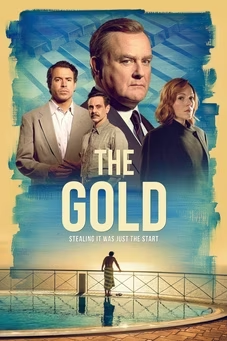 New Episode
- Drama

Hugh Bonneville stars in a crime drama inspired by one of the largest robberies in British history.
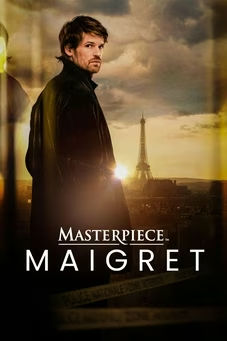 New Episode
- Drama

Benjamin Wainwright stars as Maigret in the contemporary adaptation of Georges Simenon's novels.


 New Episode
 New Episode


 New Episode
Support for PBS provided by:
Articulate is a local public television program presented by PBS39