
Rhode Island PBS Weekly 11/17/2024
Season 5 Episode 46 | 24m 45sVideo has Closed Captions
Rhode Island youth struggling to overcome mental health issues.
An in-depth report on the mental health issues that many of Rhode Island’s young people struggle with every day. Then, Follow the Wampanoag tribe members as they build an ancient wooden canoe known as a Mishoon. Finally, Michelle San Miguel and WPRI 12’s politics editor Ted Nesi discuss the ailing Senate President remaining in his job, and the funding battle over Providence public schools.
Problems playing video? | Closed Captioning Feedback
Problems playing video? | Closed Captioning Feedback
Rhode Island PBS Weekly is a local public television program presented by Ocean State Media
Rhode Island PBS Weekly 11/17/2024
Season 5 Episode 46 | 24m 45sVideo has Closed Captions
An in-depth report on the mental health issues that many of Rhode Island’s young people struggle with every day. Then, Follow the Wampanoag tribe members as they build an ancient wooden canoe known as a Mishoon. Finally, Michelle San Miguel and WPRI 12’s politics editor Ted Nesi discuss the ailing Senate President remaining in his job, and the funding battle over Providence public schools.
Problems playing video? | Closed Captioning Feedback
How to Watch Rhode Island PBS Weekly
Rhode Island PBS Weekly is available to stream on pbs.org and the free PBS App, available on iPhone, Apple TV, Android TV, Android smartphones, Amazon Fire TV, Amazon Fire Tablet, Roku, Samsung Smart TV, and Vizio.
Providing Support for PBS.org
Learn Moreabout PBS online sponsorship(gentle upbeat music) - [Michelle] Tonight, Rhode Island's young people are in a mental health crisis.
Why some are faring worse than others.
- Feel really tense all the time and you feel like everything is gonna like happen, like everything wrong is gonna happen to you.
- [Pamela] Also, celebrating Native American culture through the making of an ancient water vessel.
- Fire brings about change and that change can be a beautiful and powerful and positive thing.
- [Michelle] And the funding fight over Providence Schools with Ted Nesi.
(upbeat music) (upbeat music continues) Good evening and welcome to "Rhode Island PBS Weekly".
I'm Michelle San Miguel.
- And I'm Pamela Watts.
We begin tonight with a story about why many youth around the country and here in Rhode Island are feeling lost.
- Tonight, students are opening up about their mental health struggles and we're also hearing from area professionals about what needs to be done to help those who are in the midst of a crisis.
This story was generously underwritten by Blue Cross Blue Shield of Rhode Island.
- The whole pandemic kind of made my academic skills go down and I felt like really lost ever since.
I didn't really know how to socialize again.
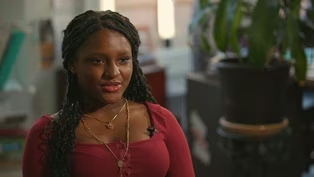
- [Michelle] 17-year-old Arianna Bouzi is a high school senior in Providence.
She says her mental health was in a dark place last year.
- When I went to school, I had like really bad anxiety.
I did open up to people in sophomore year, but then it went down again during junior year.
I started not going to school.
- You would skip school, because you were feeling anxious?
- Yeah, I would skip school, because it was like a whole like cycle.
So, like I would not go to school then feel bad for not going to school.
- Bouzi says she missed about half of her junior year, because of her mental health.
She believes most of it had to do with struggling to socialize after learning remotely during the pandemic.
On the worst of days, what was that anxiety feeling like in your body?
- It's like your body is like all like tense, like you feel really tense all the time and you feel like everything is gonna like happen, like everything wrong is gonna happen to you, so you don't wanna step outside.
- [Michelle] Bouzi's experience is shared by many others.
A report by Rhode Island Kids Count found young people are in a mental health crisis both nationally and in Rhode Island.
- We had seen increased rates of anxiety and depression prior to the pandemic, but then when the pandemic hit and young people were at home or away from their peers were not able to be learning in school, it got worse.
- [Michelle] Stephanie Geller is the deputy director at Rhode Island Kids Count.
She wrote the report which describes how mental health issues are at higher rates among Black, indigenous, and other people of color and lesbian, gay, bisexual, transgender, and queer youth.
- One of the things that they talk about is racism that they experience in their community.
Racism they experience online.
Members of the LGBTQ+ community talk about lack of acceptance and isolation in their own families when their parents don't accept them, as well as how they feel in their schools and community and the way that they're received or what they see online in terms of negative comments about their identities.
- [Michelle] Geller analyzed data collected from the Youth Risk Behavior Survey, which is distributed to high school students nationwide every two years.
It found that in 2023 9% of Rhode Island high school students reported attempting suicide one or more times during the past year.
Black and Hispanic or Latino teens consistently have higher rates of suicide attempts than white teens.
- I think that it really shows the struggles that young people are facing.
The lack of confidence in themselves, the lack of acceptance they're feeling, the lack of support they're feeling.
And this anxiety and depression that we are seeing is translating to unfortunately to action.
- It's terrifying to like think about the average experience of young people.
- Marco Lima is a sophomore at Brown University.
He helped lead focus groups with high school students from two youth development organizations, Young Voices and Youth Pride Inc. Those experiences were included in the Rhode Island Kids Count report to help understand the issues facing young people in the state.
What was the most difficult thing that you heard a student share?
- Having those feelings that you know something's wrong and then you can't really go to anyone about them or at least not a professional about them.
And I think another one was just the not accepting or their family didn't accept them fully for their queer identity.
- [Michelle] Lima describes himself as a gay man who's Latino and indigenous.
He remembers how difficult it was to watch the news during the pandemic.
- Seeing how much police violence was out there and like the negative comments around queer people, but then also people of color.
And at this point I wasn't really out to my family, so it was all like an internal battle where I'm just like fighting these causes and like explaining to my family why it's important.
- [Michelle] Lima recalls feeling anxious and depressed during the pandemic, but says he did not seek professional help.
- I didn't mostly, because I didn't know where to go.
At this time, like our insurance wasn't the best either.
So, it was really a challenge, 'cause when I would talk to my mom about it, she would just say the truth of like, "We don't have the money for that."
And then in my school, I just didn't know where to get that help.
And once again, we're on Zoom so there's no office to go to.
- [Michelle] Julio Sabater is a licensed clinical psychologist in Pawtucket.
He's not surprised that young people in marginalized communities are reporting higher rates of mental health issues.
- You already have PTSD, you have trauma< and then you have your networks are maybe small, right?
You don't have a lot of connections.
And then when the pandemic hit, again, that intensified it.
- [Michelle] But Sabater and Geller say the situation is not hopeless.
One of the solutions Geller writes about in the report is the need for funding to increase the number of mental health professionals in schools.
- When we talk to young people about any policy they want to see passed, this is their number one ask.
They've been working, a number of the organizations have been involved in a campaign called Counselors Not Cops, which is around trying to get school resource officer out of school and use that funding to replace them with mental health providers.
- Another recommendation, recruit and retain more diverse mental health providers.
Do you hear from people who seek you out specifically, because you are a Latino man and they want someone who speaks their language, who looks like them, reminds them of a relative they have?
- Yes, absolutely.
All the time it's about connection, but particularly for our people, the Latinos and the BIPOC community, it's been proven that that's what helps in therapy.
One of the top indicators that therapy works and is successful is because you have someone in front of you that you could tell them.
It's like you don't have to explain it two or three times, you know?
'Cause we get it.
- [Michelle] Arianna Bouzi who identifies as bisexual and Haitian says she once tried to get help at school when she was having a panic attack.
When she went looking for a guidance counselor, she was told there was no counselor available and felt dismissed by an administrator who told her to go back to class.
- Once I'm 18, I am gonna go get a therapist, talk to a therapist like routinely, but right now I can't, 'cause it's obviously, my parents have to do it.
- [Michelle] She says her mother is not supportive of her going to therapy.
- She thinks I have to talk to her.
When I talk to her, she just like blows up on me and she doesn't really get like how I'm feeling, so that's why I really wanna talk to a therapist, but she doesn't really support that.
- [Michelle] As for Lima, he says his mental health has improved and he's better able to manage his emotions.
- If I'm having a bad week and everything's going wrong, I'll sit with myself and like really kind of go through each problem that I'm having and try to unpack it a little bit and just like really work through why I'm feeling the way I do with that problem.
- [Michelle] Both Lima and Bouzi credit afterschool programs like Young Voices with having a positive effect on their emotional wellbeing.
- I've surrounded myself with like people like me.
I have way more like support, like I could go to anybody talk about anything, and I just really love it here.
- [Michelle] Lima says it's important that young people ask for help when they need it, even if that help comes from outside of their family.
- Once again, like you're not alone in this.
So many youth are going through this and we're just all not willing to share, but we should be.
- Up next, November is Native American Heritage Month, celebrating the history, culture, and achievements of indigenous people.
In honor of that, we take you to one Rhode Island community deepening its connection to a local tribe through the unfolding of a unique and ancient watercraft.
It's called in the Wampanoag language mishoon.
- [Jonathan] It's prominent throughout our stories, our artwork, our way of connecting to the living world, our language, our dances, everything is reflective of that place and of that relationship that we have with the sea.
(ads thudding) - [Pamela] Jonathan James-Perry is a master mishoon maker.
A mishoon is a dugout canoe crafted from a single massive tree trunk.
James Perry is also an artist, singer, Native American educator and tribal leader of the Aquinnah people in the Wampanoag nation.
- Wampanoag means People of the Dawn or People of the First Light, and it has to do with the fact that we're the most Eastern native people and you know, it's rooting and grounding to the Earth, because we are not central to the place, but more so the place is central to us.
- [Pamela] The Wampanoags were the first Native Americans to interact with the Mayflower pilgrims, and they're accredited with helping the Europeans survive that first brutal winter.
While Wampanoags comprise eastern woodland tribes, they are also a seafaring people.
With their mishoons, they enlightened the pilgrims about the endless bounty of the ocean.
- We come from people who made vessels and whaled in the sea and shell fished and fished and utilized the edible sea grass or the seaweeds and such for our food.
When you think of clam bake culture, that's certainly a big part of our feast and gathering times on the beaches.
- So, these vessels were vital to a village?
- Dugout canoes were as vital to Wampanoag people as I would say your cars and trucks are today.
- [Pamela] James Perry, who also hand makes paddles for use and for symbolic art, says mishoons were essential for transporting goods, for trade, for recreational water sports, and much more.
- We were traveling, we were using them for political and governmental actions between nations.
We were using them in military conflicts.
We polled, paddled, and sailed our vessels for thousands of years.
- [Pamela] And for an estimated 13,000 years, Little Compton was homeland to the Wampanoags.
In acknowledgement of that, the little Compton Historical Society is marking the town's 350th anniversary with the creation of a mishoon.
James Perry says, "Sharing his heritage with the community helps counter centuries of attempts to erase Native American culture."
- These traditions, these practices, these connections to our ancient place and to our ancestors is something that is in our blood and our bones.
It's really important to me to see these teachings be passed down.
- [Pamela] And James Perry says, "It's equally important for tribes people to be visible."
- To have annual connections to places, to have landowners and townspeople and town councils and state leadership and federal leadership understand that we as a people need to maintain these practices or they're gone forever.
- [Pamela] Turning the mammoth white pine log into a canoe begins with a blessing, a smudge of sage and sweetgrass in a cohog shell.
- I want to acknowledge our relatives and ancestors who are in the ground, water, trees, and stone here.
- [Pamela] The primary tool for hollowing out the mishoon is unique.
It is sculpted by fire.
- Ultimately, the fire is what does most of the carving, and you scrape charcoal and you do occasional moving of the hot coals and material so you can even out uneven areas of burn or thin the sidewalls of the canoe or get just the right shape.
- How do you know that you're making it to be seaworthy, that it's going to be, like you said, light and right in the water.
- There's a process of looking and watching the burn and making sure the sides are even.
fire brings about change, and that change can be a beautiful and powerful and positive thing.
- [Pamela] As the smoke rises, the community is offered a better understanding of Wampanoag ways.
- And one thing to remember is in like a sort of a native approach to things.
You're not creating something that isn't there already.
You're releasing it, right?
You're just helping to be what it already is.
It's just a constant burn 24 hours a day from start to finish.
- [Pamela] At a night burn, Wampanoag tradition holds that the hands-free method of sculpting allows the tribe time to feast, tell stories, and share music.
(somber flute music) Musician Rashid Young is from the Mashantucket Pequot tribe.
(audience applauding) Jonathan James-Perry says he's thankful for the townspeople who have gathered.
- I'm also celebrating the fact that Wampanoag people, Narragansett people, Nipmuc people, Pequot people, and so on, we're still walking this Earth.
We are working on our languages, we're working on traditional techniques and artistry, and we're still singing our songs.
(upbeat tribal music) - [Pamela] Beating a water drum, James Perry is accompanied by his family on rattles and rhythm sticks as they perform a moccasin dance song.
After the festivities, the fire in the mishoon is managed.
The crew removes hot coals in preparation for the final formation of the canoe over the next few days.
(upbeat tribal music) (audience applauding) The mishoon evolved during a month long process.
This tool an ads is used for the last shaping of the canoe.
The shell of the mishoon is torched creating a blackened, watertight seal.
Then the first leg of a mishoon's voyage begins.
- [Speaker] It's coming.
- [Pamela] Meanwhile, a crowd congregates at Lloyd's Beach on Sakonnet Point.
As they waited, members of several tribes hiked to nearby Squant Rock.
It's believed to embody the legendary woman who protects paddlers making ocean journeys.
James Perry says, "This was a major component of the mishoon project."
- Re-establishing our relationship with Squant Rock and getting back to the ceremony and the connection to that space, because that's on private land, other people, whether they realize it or not, whether it's inadvertent or not, are now caretakers of a sacred space that we have held for thousands of years, and it is now up to them to have a relationship with us and to be good stewards of that place.
- [Pamela] Finally, the mishoon's moment on the tide arrives.
Several Little Compton residents pitched in with the Wampanoag crew to launch the dugout canoe.
And on this morning, the People of the First Light smoothly paddled out, voyaging in a seaworthy mishoon.
- Just this idea that you sculpted this from a living tree, it sacrificed itself for you to make this vessel that will then carry you forward.
Every time that paddle touched the water, it was so powerful and I felt like I was with my ancestors, with my people doing something that was just so vitally important and that feeling will never go away.
(tribe members singing in native language) - [Jonathan] Things are cyclical, and there are times when things are taken away, and then there are times and opportunities where things can heal.
- The mishoon will now remain on display at the Little Compton Historical Society.
Finally, on tonight's episode of "Weekly Insight", Michelle and WPRI12's politics editor Ted Nesi, discussed the growing number of state senators questioning whether the ailing Senate president should remain in his job.
But first, they unpack the funding battle over Providence Public Schools.
- Ted, the debate over funding Providence Public Schools is intensifying.
This comes after a judge ruled in favor of the state, which controls the schools.
The judge essentially is saying that the city needs to spend more money on education.
We're talking about potentially a large sum of money.
- Yet, depending who you ask, Michelle, some people are saying $10 million.
I've heard $55 million.
Mayor Smiley has suggested it could be as high as over $80 million.
Now, most people seem to think that some compromise would be on the lower end of that range, but even $10 million is quite a bit of money for Providence.
- And this ruling has really sparked a war of words between Providence Mayor, Brett Smiley, and the city school superintendent, Javier Montanez.
Let's listen to what both men had to say.
- It is critical for taxpayers, residents, families, business owners, and every member of the Providence community to know that there are going to be real consequences as a result of this ruling.
And depending on the outcome of the final judgment that could come as early as tomorrow, we are gonna have no choice, but to have harmful, harmful cuts and potentially new taxes.
- At no point was I or the district ever trying to bankrupt the city.
Never.
I am a resident of the city.
Why would I want that?
I wanna make sure that everyone is clear.
I'm gonna always advocate for my students.
Our students deserve this.
Our students are the reason why we do this work.
- Ted, some of this back and forth is complex.
The bottom line is that nobody is disputing that the city is funding the public schools below what is required by state law.
- Right, state law appears to be clear that when a city is in a takeover, their school district I should say, they have to reach a certain threshold of funding, Providence has not done that.
One way to look at it is that Providence only allocates about 35% of its municipal tax revenue to the schools.
That is one of the lowest levels in the state.
- At the same time though, Providence remains in a very difficult financial situation, and this certainly, is not going to help that.
- Yes, that's the context people always have to keep in mind.
I mean, remember, Providence was a city on the brink of bankruptcy barely a decade ago, and even now, I looked at the statistics recently.
Providence is spending almost 2/3 of its municipal tax revenue just on debt and retiree benefits, so pensions and healthcare.
That means more than half the tax revenue is gone before they've begun to fund city services.
So, it's still a challenging fiscal situation there.
- And the judge is holding off on making a final ruling in the hopes that both sides can reach a potential settlement.
So, we'll see if that happens.
Let's turn now to fallout from the election at the State House.
There was recently a caucus among Rhode Island Senate Democrats where they were trying to oust Senator President Dominick Ruggiero, that failed.
They were trying to replace him with majority leader Ryan Pearson.
The backdrop, of course, being Ruggiero's health, he's been largely absent from public meetings.
Here's what both men had to say after that meeting.
- There are some concerns among senators.
Anything you wanna say about those concerns?
- They should be concerned, but I think everything's gonna be okay and we'll see what happens in the next couple months.
- I think what ultimately, matters that senators care about is getting things done and being effective for the people of Rhode Island, and that is what has to happen.
So, I am hopeful for something different, but if that does not come, I do know that senators are gonna be looking to make a change in the future.
- And even though the dissenting senators failed to remove Ruggiero, that sort of criticism is rare on Smith Hill.
- Yes, I think it speaks to the frustration a lot of senators have about Ruggiero's situation.
As you said, Michelle, he's been sick most of the year.
We know he's battled cancer.
He's had other ailments, some related, some maybe ancillary to the cancer, but the bottom line is it's kept him, he missed a lot of legislative sessions during the first half of the year.
He's remained absent frequently.
He couldn't campaign for himself in his re-election race.
He's missed a fundraiser, he's missed an award dinner he was supposed to have.
He just has not felt present to a lot of senators.
The other problem is for the senators, the ones who were frustrated, is that they felt it hampered them in end of session negotiations with the House.
That they didn't get their priorities advanced as much, because they didn't have their leader there to do it.
I think Ruggiero had the benefit of the doubt from a lot of senators last spring, but I think now there's more concern, is this gonna continue into next year?
- There's concern, but not enough to change leadership at the State House.
- No leadership usually, wins these fights in my experience, but it is I think something to watch, a dynamic to watch, when they reconvene in January.
- Thanks so much, Ted.
Appreciate it.
- Good to be here.
- And that's our broadcast this evening.
Thank you for joining us.
I'm Pamela Watts.
- And I'm Michelle San Miguel.
We'll be back next week with another edition of "Rhode Island PBS Weekly".
Until then, please follow us on Facebook and X and visit us online to see all of our stories and past episodes at ripbs.org/weekly, or listen to our podcasts on your favorite streaming platform.
Goodnight.
(upbeat music) (upbeat music continues) (upbeat music continues) (upbeat music continues) (upbeat music continues)
Video has Closed Captions
Clip: S5 Ep46 | 9m 26s | A report sheds light on why marginalized youth are in a mental health crisis. (9m 26s)

Video has Closed Captions
Clip: S5 Ep46 | 9m 58s | Sharing Native American culture teaches a local community through a handmade dugout canoe. (9m 58s)
Video has Closed Captions
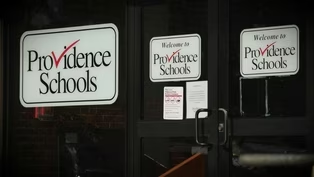
Clip: S5 Ep46 | 4m 29s | The fight over funding for Providence Public Schools has intensified. (4m 29s)
Providing Support for PBS.org
Learn Moreabout PBS online sponsorship
- News and Public Affairs

Top journalists deliver compelling original analysis of the hour's headlines.

- News and Public Affairs

FRONTLINE is investigative journalism that questions, explains and changes our world.












Support for PBS provided by:
Rhode Island PBS Weekly is a local public television program presented by Ocean State Media