
Rice
Season 1 Episode 3 | 8m 2sVideo has Closed Captions
How do you typically serve rice in your country?
Rice is life, as they say, but how it's made around the world differs greatly. In this episode, we've brought in Brad who comes from a Libyan Jewish family, and Ted, who is first generation Greek, to explore this beloved grain. By swapping a Libyan red rice with lamb and a Greek spanakorizo, our guests try new techniques and new flavors as they learn about one another's cultures in the kitchen.
Problems playing video? | Closed Captioning Feedback
Problems playing video? | Closed Captioning Feedback
Rice
Season 1 Episode 3 | 8m 2sVideo has Closed Captions
Rice is life, as they say, but how it's made around the world differs greatly. In this episode, we've brought in Brad who comes from a Libyan Jewish family, and Ted, who is first generation Greek, to explore this beloved grain. By swapping a Libyan red rice with lamb and a Greek spanakorizo, our guests try new techniques and new flavors as they learn about one another's cultures in the kitchen.
Problems playing video? | Closed Captioning Feedback
How to Watch Pan Pals
Pan Pals is available to stream on pbs.org and the free PBS App, available on iPhone, Apple TV, Android TV, Android smartphones, Amazon Fire TV, Amazon Fire Tablet, Roku, Samsung Smart TV, and Vizio.
Find Cooking Shows, Recipes and More!
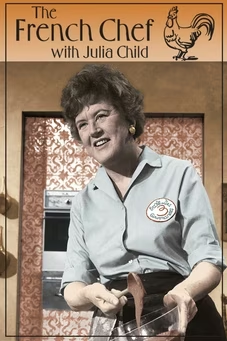
Discover why PBS is the original home to food and cooking content. From Julia Child to Lidia Bastianich to Pati Jinich, get the best recipes and shows from your favorite chefs.Providing Support for PBS.org
Learn Moreabout PBS online sponsorship(traditional music) - [Beryl] Rice is ubiquitous around the world.
- I love rice, so rice is like my favorite carb.
- [Beryl] But it's prepared differently everywhere you go.
- Oh, it's seasoned just right!
- [Beryl] My name is Beryl and this show explores how our foods can bring our different cultures together.
(Brad chuckles) I paired up two people, and they'll be swapping rice dishes that I have never heard of.
- Welcome to my kitchen of insanity, okay.
(upbeat music) - I like trying to cook new cuisines.
I don't get intimidated, but I definitely get a little anxious.
- This recipe's pretty straightforward.
I say that now until the whole thing becomes a disaster.
- [Ted] I think this looks good.
I think this is working right.
- [Beryl] Today we'll be meeting Brad and Ted.
Ted is making Brad's Libyan red rice and Brad will make Ted's Greek spanakorizo.
Let's get started.
(bright music) - Dear Ted, my name is Brad, and today you'll be making a Libyan rice dish.
It's a spicy red rice with fava beans and lamb.
So my family on my dad's side is from Libya from a small town outside of Tripoli, and one of our signature Passover dishes was this red rice with lamb.
And I think I actually now make it better than everyone else in the family.
It's red from tomato paste and from the paprika, so definitely from the spices.
And you do see beautiful fava beans in there, so there's some nice color.
There's cilantro, so it looks very herby as well.
- I've never cooked with fava beans before, so this'll be fun.
- And then there's pieces of lamb in there, so you know it's gonna be very savory.
- [Ted] We would eat a lot of lamb in Greek cuisine, so I can't see why I wouldn't really like this.
- The process of making the rice isn't too difficult.
It's a lot of eyeballing the amount of water ratio to the rice ratio, and I think that's actually the hardest part of the recipe.
(water spraying) (playful music) Definitely brown your meat before you boil it, because you wanna present really beautifully once it's a done dish.
And also, after you take the lamb out, taste the water and then adjust the spices as needed.
You really don't want the recipe bland.
You want it to be spicy and have the proper amount of salt.
- It tastes good, we're gonna add a little more salt and a pinch of the cayenne.
- [Brad] I love cooking firstly, because I love to eat, but in terms of Libyan and Jewish food, there's not a whole lot of representation, but it should be.
People are missing out.
Ted, when you try this I hope that the dish is packed with flavor, beautiful, rich lamb notes and that the rices cooked perfectly and that you're gonna be converted and want to cook tons of Libyan dishes going forward.
And I'm so excited to try your dish out, and I hope we can cook together someday in person.
With much love, Brad.
(bright music) - All right, let's see how this turned out.
That's really good, (laughs) that's really good, I'm so happy.
That deep lamb flavor reminds me of Greek cooking big time.
I swapped out the vegetable oil for Greek olive oil, and that gave this a really good flavor.
This is my first time cooking with hot paprika, and I put just enough in that it gives a little bit a kick, and I put in just a dash of cayenne, so you get that little bit of a heat but not too much that it's overpowering.
I'd never cooked with leek, which is basically like a giant green onion, so that wasn't too difficult.
(traditional music) Even though this recipe came from a very different region and religious background, there were a ton of similarities between this dish and what's in the Greek heritage, the lamb, the rice, and this mixture of these flavors.
I think what really makes it different is I don't recall any Greek dish where we've used cilantro in our dishes.
It's interesting, you get that line that you kind of cross from the two different cultures, and you see where they're together, and then you see where they're very far apart on this dish.
Everybody thinks you put feta cheese on something, it becomes Greek.
But I think that creaminess and the saltiness would go perfectly with this rice and lamb dish.
I'm gonna get some right now for Brad, and we're gonna try a little bit.
Just a little bit.
(bright music continues) Yeah, that gives it a really nice, the saltiness and creaminess of the feta, really good.
This is probably not something I would have made and sought out on my own, but I'm so glad that I made it.
Brad, good luck with my dish, I hope you enjoy it.
(playful music) - Dear Brad, this is Ted.
You are going to be making a traditional, Greek rice dish called spanakorizo.
I am first-generation Greek-American on my father's side and third-generation Greek-American on my mother's side.
This dish is one of my favorites, because it is not what people may expect from a Greek dish, because there's no meat in it.
- Onion, garlic, parsley.
- This was one of those dishes growing up that we often ate during those 40-days of Lent leading up the Easter.
- This is the first time I think I've ever used cheesecloth in my whole life.
Well this is my new scarf.
(laughs) - [Ted] One of the things to be mindful of is managing your onions, 'cause you really wanna get them to be translucent.
You definitely don't wanna overcook them, 'cause you wanna make sure that you taste that flavor and have a little bit of that onion texture when you have the final dish.
(bright music) - [Brad] So we got some onions, Ted, what do you think, are these translucent enough for you?
- I've been cooking Greek cuisine ever since I was little with my mom, who was the cook in our house.
And cooking this dish definitely makes me feel connected to not only my Greek heritage, but it also makes me feel connected to my heritage growing up.
- The flavor profile tastes Greek.
It definitely has a different flavor profile than something I would make, so it's funny.
- Now as an adult, I cook for my family all the time.
- [Brad] Listen, if this is not actually the way it's supposed to be, I don't care because it looks really, really good.
- Brad, when you eat this dish, I really hope that you feel a connection to my family and my culture and heritage.
Love, Ted.
(upbeat music) - All right, let's see what we got.
Let's try this dish.
Wow, super, super yummy.
The combination of the tomato sauce with the lemon, like if I was blindfolded, 100% hands down, I would be like, "This is a Greek dish."
This is definitely gonna become part of my culinary repertoire.
Both mine and Ted's dish were both red rices, but even then, I put the tomato paste in first, and his gets put in with the water, but at the same day it yields the same result of it's red rice.
Getting the water to rice ratio is hard.
I actually think it might need a little more water.
So obviously I've cooked with spinach before, and I squeeze it out with usually a dish rag, which is not the best, it's always a mess.
And I'm definitely pro cheese cloth.
It's changed my life, so that's a new thing.
When you make a dish for the first time, it's always challenging, because you wanna make sure you get the steps in order and read as you go, but I think you make this once or twice and then it becomes second nature.
A little rice, Logan?
I think Logan likes it.
It is kind of cool that we both did red rices.
They're both a representation of our holidays, which means time with the family.
And I feel like in a way, like I'm entering into Ted's family, joining his family through this dish.
- I hope you enjoyed this episode of "Pan Pals."
Let me know in the comments what is your favorite rice dish from your country or culture?
And, if you liked this show, you should check out "The Great American Recipe" on PBS.
The show features 10 talented home cooks in a competition that celebrates the diversity and flavors of foods across the United States.
You can watch the first episode here on the PBS Food YouTube channel and the rest of the season on the PBS app or on your local PBS station.


- Food
Christopher Kimball’s Milk Street Television
Transform home cooking with the editors of Christopher Kimball’s Milk Street Magazine.









Support for PBS provided by: