Consider This with Yvonne Greer
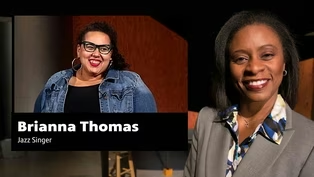
S05 E03: Brianna Thomas
Season 5 Episode 3 | 29m 4sVideo has Closed Captions
Brianna Thomas sings all over the world, but her musical journey began in Peoria
Being born to musician C.J. Thomas meant early exposure to a variety of genres for singer Brianna Thomas. She joined his band, Dave and the Dynamics, when she was just six years old! Learn how she was able to musically convey her feelings at such a young age, why jazz is so important to her, and what impact her Peoria teachers had in her becoming a performer, arranger, and composer.
Problems playing video? | Closed Captioning Feedback
Problems playing video? | Closed Captioning Feedback
Consider This with Yvonne Greer is a local public television program presented by WTVP
Consider This with Yvonne Greer
S05 E03: Brianna Thomas
Season 5 Episode 3 | 29m 4sVideo has Closed Captions
Being born to musician C.J. Thomas meant early exposure to a variety of genres for singer Brianna Thomas. She joined his band, Dave and the Dynamics, when she was just six years old! Learn how she was able to musically convey her feelings at such a young age, why jazz is so important to her, and what impact her Peoria teachers had in her becoming a performer, arranger, and composer.
Problems playing video? | Closed Captioning Feedback
How to Watch Consider This with Yvonne Greer
Consider This with Yvonne Greer is available to stream on pbs.org and the free PBS App, available on iPhone, Apple TV, Android TV, Android smartphones, Amazon Fire TV, Amazon Fire Tablet, Roku, Samsung Smart TV, and Vizio.
Providing Support for PBS.org
Learn Moreabout PBS online sponsorship- Consider this few things warm the heart faster than a young child singing a song.
Even if the notes aren't quite on point, their faces seem to light up a room.
Oh, for one Peoria couple, not only were their daughter's notes on point, she was able to improvise and add notes that weren't a part of the original and make the song even better.
What were they to do with her talent?
Well they added her to dad's band until she was old enough to start a musical career of her own.
Did I mention she was only six years old at the time?
The jazz community is really happy that she made that career on her own.
And we're about to find out how she did it.
I'm Yvonne Greer and my guest is jazz singer, Brianna Thomas.
Next on Consider This.
(upbeat music) I called her a jazz singer, but she writes music, she sings music.
She's also a percussionist and an arranger as well.
Brianna Thomas, welcome to Consider This.
What a pleasure.
(giggles) - Hello.
- So take me back.
Do you remember those early days of singing at five, six years old?
- Of course, yes.
I, I'm.
I remember singing my entire life.
I grew up in a household that celebrated music of all different kinds of, from all different kinds of places and different kinds of sounds.
And I was exposed to a lot of different things so, by the time I was six years old, I had been singing around the house for a while and listening to music and listening to my dad's band rehearse and being in the midst of it since I can remember.
And it was a natural transition.
I don't think I realized how exposed and what a difference it made until I got older because you don't think about it.
Nobody thinks about how they walk when they're walking.
They just do.
- You just say.
- Yes.
(laughs) - Did you have a favorite genre back then?
- No, I, I was truly brought up in a household that celebrated music that was soulful.
And, and I would say not in the sense of like not only in the sense of soulful, like James Brown or Otis Redding or Areetha, but soulful in that it spoke to the heart, the spirit.
My dad used to always tell me sing whatever you want to, but sing it with conviction.
♪ What can I do ♪ ♪ What can I do ♪ ♪ For am in love with you ♪ ♪ I, I, I, I, I ♪ ♪ I guess I will never see the- ♪ He would have everyone from Billy Holiday to John Coltrane, to Bonnie Raitt, to Ella Fitzgerald, to, you name it.
- (Yvonne)Yes.
- There was a wide gamut of just music that, that was just generally, it felt good to listen to, and to enjoy with others.
And, and I'm glad I grew up in the spirit of music in that way.
- And we should mention your dad was CJ Thomas.
- Yes.
- Of Dave and Dynamics.
- Yes.
Of course.
(giggles) The twenty, growing up in Peoria, I was not, I was not Brianna, I was CJ's little girl like.
(Yvonne laughs) And, but it was an honor to be, to be, the, and to be around the band that he worked with and to be just kind of ushered in a direction by all of these amazing musicians around town that, that all said something, gave.
I remember Grant St. Julian and also Steve Duggan Ford.
My dad's the, the, the guitar player in my dad's band.
They used to make me tape cassettes of different vocalists like Edward Jones.
And, I grew up in a rich community of music and both traditional and, spontaneous and, and fun, that.
- Certainly the music was impactful.
- Yes.
- But were you impacted that you were gonna be on stage singing to live audiences at six years old or did it just feel like, well, this is what I do with dad anyway.
- I don't think that, I mean it was such a natural thing to do.
Music was just, just as people brush their teeth or go to church or say their bedtime prayers or eat dinner with their family.
It was something that happened in my household.
My mother is not a musician, as you would think of one.
She doesn't play an instrument, but she's definitely one of the most musical people that I know.
And she, and my father, CJ Thomas and Marilyn Thomas, they they definitely exposed me to music in a way that allowed my brain to think beyond where I was.
And by that, I mean, they exposed me to all kinds of different sounds.
And watching videos of like Sarah Vaughan watching videos of Ella Fitzgerald and watching most importantly, my father perform live on a regular basis was just, I mean, as a little girl you don't think, I didn't think, Oh, when I grow up this is what I'm going to do for the rest of my life.
I certainly loved to sing but it wasn't until I got to high school.
And I did the Betty Carter's Jazz Ahead, that took me outside of Peoria that I realized what the people around me had fed into me into my spirit and my mind the whole time that that it was something that I, I possibly could do.
And I took it seriously from that point.
And I was serious before, but from that point it became a definite focus goal and dream.
I was bitten at the Betty Carter's Jazz Ahead by the Composers Bug firstly.
It was such an amazing thing to take a song, I had written around musicians that I did not know.
And take that chart and put it in front of them and have them interpret what was in my brain and in my mind in my spirit and swimming around in my head through their own vision and have it come out sounding not only something like I'd imagined but a whole bunch of things but I couldn't possibly imagine.
And that just blew my mind.
And it made me wanna delve into that even more and and not only sing songs that I'd written but just appreciate other composers on a deeper level.
- It reminds me of that (indistinct) scene in Mr. Holland's Opus where the symphony has he's written has been now performed - Yes - By one of his former high school students.
That you get to hear it outside of your head - Yes.
- And how amazing that must feel.
- Yes, it really is like sharing something deeply personal but to have to be able to share that space with someone else not only is intimate it leaves a lasting mark on you.
And, and for every stage that I'm sure every musician out here that that has performed on a stage can attest to this.
You, you take away the stories you take away the moments and you take away the feelings and they stay with you forever and make you who you are.
You're constantly becoming something and having these experiences with people along the way, certainly impact that.
- Oh, I like that very much.
And I, I agree wholeheartedly.
Music for me has always been one of those things where it doesn't matter what you're feeling.
There is a song.
- Yes.
- That will explain that, that will identify that for you.
That will let you just sort of get in it and roll around in, - Yes.
- (indistinct) things for a minute.
So, is that what you tap into or what you did tap into as a young performer?
Because a six-year-old singing an Areetha doesn't know anything about respect?
(laughs) - I assure you that my parents.
(laughs) - Let me back that up a bit.
(laughs) - I know what you mean.
- But not in the vain that she's saying.
- No, no, but I, I teach vocalists a lot and of every age and I will say on that note, it's feelings are an interesting thing.
Because whether you are 90 or whether you are two years old or even two months, two weeks old, you know what it is a baby will cry when the pacifier falls out of their mouth and they lose that thing.
Then they miss that thing.
We know from an early age what it is to love, want, or miss something.
Those are like inherent in what it is to to be alive and to survive and to thrive and to be growing as human beings.
So when you're dealing with music it's kind of like your reason for feeling sad or happy or elated might not be the same as mine.
And it may come on what somebody might think of as a different, the other end of the spectrum.
Like maybe a two year old, again, they're, they're sad that they lost their pacifier, but by the time you get to high school, you know what it is to lose something more serious, like, an expensive toy a parent bought or your homework, or even a friend.
And by the time you're in your twenties and thirties you might've lost people in your life on a permanent level.
And so loss is something and love.
And those things that are, that are that leave footprints and impressions on our spirits and our minds.
Those things that, that get us from moment to moment in life that we, that we revel in and live through those things that we sing about, people know about them.
And that's what happens when you sing into a room and you sing with your own truth.
It may not be exactly their truth, but if you sing with the truth, they will recognize their own story in it.
And the whole room comes together.
And it's like, I didn't know much about respect from a man when I was six years old, I knew about respect and my dad and my mom they're like.
(laughs) But, but I did.
I did know being loved I think, anybody who loves you and spends time with you and, and teachers I had some amazing teachers growing up.
I was really blessed, here in Peoria to be around musicians teachers in school and out that fed into my spirit.
And when you are taught something you're taught to love yourself.
You're taught to practice and to get to learn what it is that you need to learn but to forgive yourself along the way and to get past those little things that keep you from where you're going so that you can actually get get to the place that you're.
In practice it's like you're doing something over and over again, to, for an end goal.
And in life it's like that.
And all that to say, respect respecting my dad, respecting my mom.
I may not have known as a six year old.
And this is for all kids 'cause kids are little people and adults.
You may not know the, the story may not have been Areetha story about being respected by a man.
But I think that the reason that perhaps I was able to sing that with such conviction as a child, is when you learn about self-respect and you learn about the process of practicing, and you learn about something greater than yourself being a part of a band bigger than you.
Being a part of a choir larger than you being a part of something that you belong to.
And that's what music does, and that's why it's so important for not only everyone to listen to too.
Maya Angelou talks about curling into a note, and balling up there when she's going through something.
I'm paraphrasing, but I love this quote that she gives.
And it's like, music does that.
When you go to the I've, I've gone to like Southeast Asia.
We went into, I was with American Music Abroad, at the time.
We went into a very remote part of the area we were in.
It was basically in the jungle.
And, but these people were beautiful.
We exchanged songs and these people had a song for everything.
The rain, a death, a wedding, a birth the sun, sleep, like they had a song.
And I think music has always been that in communities.
Music brings people together the music of the civil rights movement.
It, it, it fed that movement.
It still feeds us today.
And music in churches brings people together in one spirit on one accord, for one purpose thinking of and concentrating on a higher thing.
Music in schools teaches kids discipline.
It teaches kids to focus on something and to meticulously try and try again, which is, those things are very important to us as a society, as a whole.
And I think that growing up in Peoria, Illinois I truly, and honestly, I've been all over the world.
I lived in Nashville, Tennessee.
I've lived in New York for the past, like 13 years.
And this community of musicians around here the community teaches you a lot about yourself and a lot about how to be.
And I'm being so long (indistinct) that I think- - No, it's okay.
And I love listening to you speak, I feel like a fan myself.
It's no wonder you're so successful because I'm in that moment with you when you close your eyes and describe what music means to you.
I believe you and I think that's the mark of a true professional is that we, we get to be right there enjoying that musical journey with you.
When you talk about your education you received here in Peoria, I know both Mary Jo Papich and Sharon Samuels' Reed, have been mentors for you over the course of your career.
They speak so highly of you and are so very proud of your accomplishments.
How do you take the step from going?
Alright I, I appreciate this gift that I have, I understand its nuances, I believe I can move it forward.
How do you move forward from an educational standpoint?
Because there are lots of people who feel they're good singers or great musicians or good songwriters.
How do you turn that into a business?
- Well, I think that the first step in moving forward in any direction is decision.
And I know that seems like a small thing, but I, as a child I was, I was, a successful vocalist here, I was very, people were very encouraging to me and that meant all the world.
I think that's super important in and of itself, Ms. Papich and Sharon Reed.
I had teachers around me who took me by the hand and led me forward and watching them showed me how to proceed.
I was just telling Ms. Papich the other day that watching her be a boss lady in front of a band, a big band or in front of a small band or in a group in a room full of people who are predominantly males in this business was an invaluable lesson for me and Mrs. Reed, the same way.
They're very fierce and they they command respect and also give it, and to watch that it kind of put me on a trajectory by itself.
I think as a teacher and as a teacher the students are not only absorbing what you say and how w how you teach them to think they're absorbing how you are.
And I was very fortunate to be around some very high.
And I say this with, with the most humility and gratefulness in my heart about them.
High stepping, proud and vivacious women that taught me to go after the things that were in my head.
Whether it was a song I was writing or an idea that I wanted to do, or just the the idea that when I woke up and I said I do wanna be a singer.
And I do wanna pursue this.
And I cannot imagine doing anything else.
So if there's anyone, whether they're young or old that has a dream, I think deciding that you're gonna go after it means that everything that you do from that point forward is towards that goal.
What you eat, what you say, how you do decide to think, how you decide to let yourself your mind wander.
Sometimes you have to stop the chatter in your mind.
That's a big one.
It's very important because that voice can not be louder than the voice that says let's get up and go.
And and it's very important to we don't just feed ourselves food.
We feed ourselves by the people we keep around us by the books we read, by the social media that we expose ourselves to and w how we decide to, to be on that platform.
We feed our trajectory in that way.
Have you ever seen a tree grow, and there's a little bit more sunshine over here, so it goes that way.
That's, that's, it, it works that way and.
- It's a great analogy.
But as you mentioned, we all have those moments where life sort of seeps in and that little voice creeps into your head.
Do you still have the voice?
Or have you learned to, yes?
(laughs) - The voice, unfortunately, and maybe this is just my experience.
Maybe for some, it, it has gone away.
And, but I will say, there's this, the song that says, "Lord don't move my mountain, but give me the strength to climb."
And I feel like that about that voice.
I feel like that voice is is going to be there.
And it's not about silencing it.
It's more about finding a peace in yourself and finding the actual place of truth in yourself that allows you to hear that voice and not be bothered.
We don't get bothered, when we hear the birds sing.
We don't get bothered, when we hear a horn, car, a car beat.
We don't get bothered, when we hear the baby cry.
It's, it's more about learning to, to, to allow yourself to be where you're at, allow that chatter to happen but don't allow it to rule you.
And, and once you exercise that muscle and it gets stronger and stronger, it becomes easier.
And then you may not notice it some days but the voice will pop up.
It will, its there to- - I heard another performer tell me once, if you say, I'm terrible, I can say, let it go.
If I say, I'm terrible, then I'm in trouble.
- Yes.
- And because my voice is the most important.
- Yes, it's true.
And as a growing child, you're, you, you under the teachers, they teach you how to hear that voice.
That's another thing that is taught.
I had some very good teachers that taught me to, that yes, that voice is there, but you don't have to listen to it or you can decide to think otherwise.
But it's true.
As you think, so you will be.
And as you think, like, that's if that's the way that you will go.
And so your mind is your strongest tool.
And singing, I I'm sure I'll all music is very mental.
But singing is, is very mental.
The clarity of mind, the clarity of your voice and the clarity, the, the, the range that you have, the way that you sing across your voice, deeply depends on the clarity that you have here.
Just like in life, when you are stretched out in your life and you're breathing and things are going well, and you're you're walking in pace, you have mental clarity here.
And when you don't have mental clarity here things, aren't kind of- - Helter-skelter.
- Yeah, yes.
- And all over the place.
- So it can work that way.
And, but it's meant not to be a nuisance.
I don't think, I've learned to look at it as that five pound weight, that 10 pound weight that you, it's meant to strengthen you.
- Understood.
What drew you to jazz as a primary mode of, I wanna say communication because that's what it feels like to me, when you sing, communication.
- Thank you.
That's such a big compliment, thank you.
I, I grew up, my father his, the band that he played with "Dave and the Dynamics."
They played everything.
So, when I heard, I heard my dad would give me Billy Holiday CDs.
I had Steve Duggan Ford given me Edward Jones and Grant St. Julian, also giving me like Nancy Wilson CDs and all of these things, but like, and Ms. Papich is exposing me to, so, so many things, vibe, things that I needed to learn to sing with her band and just things that she wanted me to hear.
But I just, I heard Sarah Vaughn, Ms. Papich gave me this, this album that was called, it was like the greatest jazz vocalists or the best of the best jazz vocalist.
And it was a compilation CD of like Mel Torme Maine Billy Holiday, Sarah Vaughan, Billy Eckstein.
Yes.
I think that, that, that was there.
An Ella, Ella was on that on of course.
But there was like this cream of the crop and on this one album and it was just a mini kind of like huge exposure to like a small little sect of, of these handful of jazz vocalists.
And it, I wore this CD out.
And I heard Sarah Vaughn singing, "Smoke gets in your eyes."
And I was like, first of all, how is she singing every word?
And I can see, it, it was like a, she would sing the word rain, I would see the rain.
Or if she would sing silk, I would feel the silk.
And I was just like, who is this woman?
And, and she had this big velvet voice that was like around velvet dot.
And, but it felt so easy.
And, and I had, I knew who Whitney Houston was.
I had sung and some talent shows Proctor Center and Carver Center had song talent shows.
And I had sung Whitney Houston and Gloria Estefan and Oleta Adams in these talent shows.
And, and I, I, I knew who Billy was and I knew my dad gave me a CD of Nina Simone.
And I was, I remember when he gave me that CD, I was like - (Yvonne)That had to be a powerful moment.
- He asked me, the first question he asked me actually was what did I think?
Because Nina Simone's voice is so very different.
And he says and I know this may sound strange and it's no slight, it was his, his teacher ways.
He was a brilliant teacher, as well as a musician.
my father.
He says, is it a man or a woman?
Because Nina has this huge voice that is so powerful.
And so every word she sings goes here but that's not into genre, but, or gender rather.
But the tone quality of her voice was so unique.
I had never heard anything like it.
And I wasn't quite sure at first and I listened a little longer and determined it was a lady.
And I didn't fall in love with her right away, but I, she's one of my favorite, vocalists of all time.
There's nobody that can sing an emotion so directly to somebody's spirit.
Where you can't hide from it.
As, as much as she, I have found her and Shirley Horn- - One of Nina Simone's most powerful songs that really, I don't wanna say work against her because I know what the mission was.
- Yes.
- Was "Mississippi Goddam."
- Yes.
- And now you perform that song.
♪ You don't have to live next to me ♪ ♪ Just give me, give me my equality ♪ ♪ Everybody knows ♪ ♪ They what ♪ ♪ Everybody knows ♪ ♪ Sing it out ♪ ♪ Everybody knows about Mississippi ♪ ♪ Everybody, ♪ ♪ Everybody knows yeah, yeah, yeah ♪ - I thought a great long while before performing that song.
And it wasn't because I was shy to speak out about the things that are still happening today that were happening then that, that the the violence that happens against African-Americans and people of color that happened that happened then, and that, that still happens now.
I, I wanted to use my voice to speak out about it but it's not always about it's not always about the message that you're telling.
It's how you tell it that matters as well.
And I will say this, I taught a class on Nina Simone, it was a six week lecture course.
And there were people in the class that were alive during the civil rights movement when her music was so celebrated and so powerful.
And they didn't understand when I played the song in the class that it was a protest song.
They thought it was a happy song.
- Yes, because the beat is very- - Yes.
And I was, I was very, you have to find the, as, as a as anyone delivering a message, whether you're a teacher someone on stage performing a song, whatever it is if there's something coming across you deliver a beautiful message, with your words and your, your vibe.
And I love your voicemail expect (indistinct), - Thank you - I love it.
I just love it.
But whatever message that you're delivering, you have to get on the level that the PR of the people that you are talking to, or else they will not hear you.
And so, as I thought about doing that song it had never occurred to me that people didn't know that that song was about a play by play of what was happening in the civil rights movement.
It had never occurred to me that someone would not understand that it was a song about Medgar Evers death, the 16th street bombing with the with the girls in Birmingham, Alabama, and all of the things that were happening over voter registration and black people being thrown off of there.
It didn't occur to me that at this day and age, that, that moment and how she so clearly spelled it out, what I thought was clear.
It didn't, and I know it was clear to so many but there were people there RP was a great lesson because there are people who who don't listen past the music.
And as you go to what I mean by that there was a person that I encountered that heard the lyrics of the song, and they exist in the world.
Not just that person, but others who hear the beat.
- (indistinct) the depth and the breadth of the song.
- I wanted.
- Brianna, I must apologize because we only have about a minute left.
on the show.
- Oh my gosh.
- And I wish I had another hour.
I wanna make sure people know about your CD.
Everybody knows this.
- Yes.
- How can we get it?
- You can get it on every social media platform, Amazon, iTunes, anything you can find it it's.
It's available everywhere.
And we do have hard, hard copies that are now gonna be available.
- Thank you for the music, thank you for this time.
Thank you for coming back to Central Illinois and sharing your gifts with the community during COVID.
when you're not performing so much in New York.
It has been an absolute pleasure.
And I know that your mom and your mentors here in Central Illinois are very proud, and I know up in heaven your dad has got to be smiling on his little Brie.
- It is, it is a pleasure to be here.
And I, I really, truly thank you so much.
- It has been my pleasure as well.
- Thank you.
- Jazz singer, Brianna Thomas.
This has been Consider This.
I'm Yvonne Greer, I'll see you next time.
(upbeat music)
S05 E03: Brianna Thomas | Trailer
Preview: S5 Ep3 | 30s | Brianna Thomas sings all over the world, but her musical journey began in Peoria (30s)
Providing Support for PBS.org
Learn Moreabout PBS online sponsorship















Support for PBS provided by:
Consider This with Yvonne Greer is a local public television program presented by WTVP