Consider This with Yvonne Greer
S05 E05: Dr. Joe Couri
Season 5 Episode 5 | 26m 54sVideo has Closed Captions
Medicine, Music, Photography and Philanthropy… the many talents of Dr. Joseph Couri.
Retired Peoria rheumatologist Dr. Joe Couri has always had a passion for the arts. He sang in grade school, learned guitar in high school, and started a band during his residency. Find out what inspires him to keep creating, and why he credits his Lebanese heritage with his many acts of philanthropy.
Problems playing video? | Closed Captioning Feedback
Problems playing video? | Closed Captioning Feedback
Consider This with Yvonne Greer is a local public television program presented by WTVP
Consider This with Yvonne Greer
S05 E05: Dr. Joe Couri
Season 5 Episode 5 | 26m 54sVideo has Closed Captions
Retired Peoria rheumatologist Dr. Joe Couri has always had a passion for the arts. He sang in grade school, learned guitar in high school, and started a band during his residency. Find out what inspires him to keep creating, and why he credits his Lebanese heritage with his many acts of philanthropy.
Problems playing video? | Closed Captioning Feedback
How to Watch Consider This with Yvonne Greer
Consider This with Yvonne Greer is available to stream on pbs.org and the free PBS App, available on iPhone, Apple TV, Android TV, Android smartphones, Amazon Fire TV, Amazon Fire Tablet, Roku, Samsung Smart TV, and Vizio.
Providing Support for PBS.org
Learn Moreabout PBS online sponsorship- Consider this: Medicine by day, art by night.
No, this isn't the focus of some new PBC drama series, it's my way of encapsulating all of the interests of a Central Illinois rheumatologist, who has a passion for the arts.
How did he combine his love of medicine with all of these other things and still be respected by his colleagues, adored by his patients, and just, thoroughly, entertained by audiences, many of whom did not even know he was a doctor?
We're about to find out.
I'm Yvonne Greer and my guest is Doctor Joe Couri next, on "Consider This."
(uplifting music) Central Illinois native, Doctor Joe Couri has always loved music and, very early on, loved medicine too.
So let's find out how he combined his love of the arts and his love of medicine.
Doctor Joe, welcome to "Consider This."
- Well, thanks for having me, Yvonne.
- You do so many things.
Take me back to your youth because you started playing guitar at a really young age.
- Well, I started singing in high school, in chorus and picked up the guitar, about age 21 or 22.
- Okay, so it was the singing that came first?
- Yes.
And Cornstalk Theater, in the late '60s, early 70s, also.
- So what drew you to the arts, in the beginning?
- I always give credit, well our family gives credit to our uncle Bernard.
And we used to go Christmas caroling with him in the '60s, mid '60's and we call ourselves, "The Couri Family Singers."
- (laughs) I love it, like the Von Trapp singers - That's right.
- That's right.
So he was our inspiration for music and then, my cousin Jim and my brother Dave were my inspiration for playing guitar.
- Ah.
And what made you combine the two?
Because that's a difficult thing to do.
I've tried, one, to play the guitar and two, play the guitar and sing and those two things did not mix well, for me.
- Well, I guess I was fortunate and blessed with the ability to do that, you know?
And talent from above, you know?
And, doing as much singing as I did beforehand, I guess, helped me feel comfortable with singing, along with playing.
- Gotcha.
And so you graduate high school and you go on to college, what's your field of study when you first enter college?
Did you know you wanted to be a doctor or did you want something more artistic?
- I had a very good idea about that.
Chemistry was my major.
Yeah.
- And then on to medical school?
- Yes.
- But you had a band in medical school?
- The band actually came at Cleveland clinic when I did my residency and fellowship.
- Okay, you gotta tell us the name of this band 'cause I think this is hysterical.
- "DNR" - As in, "do not resuscitate"?
- That's right.
(Yvonne laughs) (both laugh) - And how did that go over with all of your studies?
Because I know, just getting through school had to be climbing a mountain, in and of itself.
And now you're in your residency and we've seen all the shows where residents don't sleep and they're always on the clock.
How did you find time for music, too?
- Well, you just made time 'cause it's so stressful being a resident, and all the hours and lack of sleep, and you need to have some distractions to keep your sanity and music was our distraction.
- So, almost a respite from the day-to-day grind of work?
- And we just had to make it work.
It's a challenge, making practice schedules and getting everybody together and scheduling our gigs.
- (laughs) So you actually had gigs?
This wasn't just a "garage band," if you will, you actually went out and performed?
- We started it, playing at TGIF parties at the hospital, for the residents and nurses and then we end up playing at Downtown Cleveland.
(Yvonne laughs) - [Yvonne] That's so great!
- [Dr. Couri] At a restaurant, down there.
And "PM Magazine" did a story on us.
- (laughs) It's a great story: A group of young doctors who also have band and the name, "DNR," just cannot be beat.
- They called it, "the physician is a musician."
- (laughs) And so, was rheumatology always your specialty?
- Yes.
I started three years of internal medicine and then that, sub-specialists always do internal medicine, first and then they do fellowship in rheumatology.
- Understood.
So what drew you to it?
- Well, as often is the case, our professors and teachers play a big role.
My senior year of medical school, I had opportunities to do elective rotations and I heard the rheumatologist was a very good teacher.
And my two grandmothers had bad arthritis and I thought, well, this sounds like an interesting field to check out.
- And sometimes you hear that, that somebody in your life has some condition and you want to see if you can help.
- Yes.
- And, as you grew older and more experienced in your practice, I would imagine that you had to treat some of your friends, or family, or both.
- Very many family members.
(both laugh) - You were their free doctor, at home?
- That's right.
Yes - (laughs) - So what brought you back, to Peoria?
- Well, my family, the Lebanese community, my own family, very big family and I just always knew Peoria was gonna be my home, forever, after school and training.
And it was not a matter of any discussion in my mind or anything, I just knew that was what was gonna happen.
- Nobody can argue that family is, certainly, a very strong connection and you mention the Lebanese community, which is quite large, here, in central Illinois.
- Yes.
Tell me about what it means, to you, to be a member of that community?
- The Aitou society was formed 107 years ago by my grandparents - Wow.
and their generation.
They started it when one of their own fell off a boat he was working on, drowned, and they banded together to pay for his funeral.
And they decided to start a club for their members and also, to take care of the village of Aitou, which that's how it was named, the Aitou society, the village of Aitou in the Lebanon mountains.
Norther mountains is where all my relatives came from, my grandparents and all their friends and relatives came from.
And so it has stayed together, ever since.
And we grew up at the Aitou supper.
Then the Aitou shish kabab started, about 50 years ago and, you know, worked them, helped plan them, been on the board - Now, I know many people - are familiar with the shish kabab and the supper but, to think, over 100 years of this society, giving back to its home village.
And that support still continues?
Is there still some connection to Aitou?
- We've sent probably, I think, $13 thousand since the big explosion.
- Oh, yes.
- We had some fundraisers and people made donations.
- Wow.
Those connections are a beautiful thing to see continued across generations.
- Yes.
So take me back to rheumatology.
You're here, in Central Illinois, you've connected with your Lebanese community, and family, once again, and you're a practicing rheumatologist.
At what point do you get back into the arts or has it never left you?
- I bought my first, I call it, a real camera right before I left Cleveland.
I had a little Instamatic that I used on trips, prior to that.
And so, I started taking photos more seriously.
And then, there was a gallery called, the RT Gallery, back in the mid '80s, early '80s, I guess and that's where I got established as my first "home gallery."
And then, Marion Bibeau and then, Exhibit A is my current gallery.
Music has always continued from, since I left Cleveland, playing different areas, writing songs, and recording.
And, you know, it's just, as I have said, it keeps me going.
- We've got some great images from some of your photographic works.
What catches your eye, as a photographer?
- I guess the most inspiring images are in national parks 'cause it's just, God's creations are just, you can't believe it until you you actually see it and experience it.
And whether it's a sunset, a sunrise, a mountain scene, a desert scene like Arches National Park, all these amazing formations.
And you just, kind of walk along and you'll see something and it's like, that's it, I gotta shoot that.
(Yvonne laughs) Sometimes it catches you at a moment's notice, other times, you're planning it, ahead of time, you see it, like I'll see a postcard or something.
When we're on a trip, I'll say, "I gotta take that picture."
(Yvonne laughs) - I was going to ask that, as my next question.
Do the images come to you and you say, "I'm moved by that, I've got to shoot it" or do you adventure out, in search of an image, yet undiscovered?
- Oh, yes.
Like I said, it happens both ways.
Particularly, like in a national park, you have some set ideas based on research and reading and looking at books and pictures but there's always something that surprises you, in a national park, that you hadn't read about or hadn't seen and it just strikes you and it's just, you gotta do it.
- Well they're beautiful photos: The sunrises, the sunsets.
I love the pictures that you have of birds over water, taking flight or just coming down (laughs).
They're fantastic.
But you also do some sort of, I don't know if, commemorative photography is the correct word, but you've got images of the Peoria skyline, quite a few of Dozer Park, here in Peoria.
Do you set out to do those, as a matter of intention?
- Yes.
I have about 19 postcard images, actually - Wow.
of different Peoria scenes and I've done about five Peoria posters - Wow.
of different images.
- So now, you're a rheumatologist and a musician and then you've added photography into the mix.
- Yes.
You did some theater when you were younger.
What brought you back to it, now that you're doing all of these other things too?
- To theater, you mean?
Mm-hm.
I guess I had never really lost the bug.
I've done probably, oh, about eight or nine different shows in the last 40 years, since I've been back.
- Wow.
(laughs) To the average observer, some people would say, "Well golly, do you have to do everything?"
There can't be enough time to do everything and do it well.
Did you have difficulty juggling all of those roles?
- Sometimes, you got a little short on sleep, particularly, trying to do all the paperwork that goes along with work, - Sure.
family commitments.
People say, "Well, you do everything.
What don't you do?"
And I'd say, "Well, I don't play sports."
- (laughs) I always say, - I'm a good observer.
"I don't do dishes."
(laughs) - I'm a great fan.
(laughs) We all gotta do something, something to have something we don't do.
- Yep.
- What changed for you, over the years, in the field of rheumatology?
What types of changes did you see, over the course of your time as a physician?
I should probably tell people, you're retired, at this point from being a practicing physician.
But what changed for you?
What advances did you see come through?
- The most exciting were the advent of, what we call, the biologic drugs for rheumatoid arthritis and other inflammatory arthritis conditions, autoimmune conditions.
That was, approximately, 1995 when Enbrel and Remicade; those are names people have probably seen, the advertisements, came out and it really revolutionized the treatment of rheumatoid arthritis.
So that was very exciting.
And there's just been a ton of those medicines come out and a lot since I retired, four years ago.
- What's a biologic?
- It's a medicine that targets, very specifically, a marker on, I guess you could call it, a color marker, I guess, on a white blood cell, that is playing a role in the inflammatory process.
So it, actually, turns down the hyperactivity of the immune system, by interacting with that marker.
That's, you know-- - Understood.
- Easy way to explain it.
And so, If I may dig in just a little deeper, on this subject matter.
Because I know so many people that say, "My elbow hurts, my knee hurts, my hands hurt.
"It must be arthritis."
How does one know if it is or if it isn't?
Is that something that a medical doctor has to determine?
And is it inflammation, is it the "bone on bone," as we hear?
What is arthritis?
- Well, the most common form of arthritis, is osteoarthritis.
As we say, good ole wear and tear.
- Okay.
- But not all pain is arthritis.
Tendonitis, bursitis, muscle pain, muscle strain, fibromyalgia, are all conditions that contribute to pain, in and around joints, near the muscles.
- Got it.
- So, most primary docs can have a pretty good idea.
I always say, "Make two major distinctions: "Is it inflammatory or non-inflammatory?"
And that's why I taught the residents that, to get that, first of all, in your mind.
Then, if it's not inflammatory, then you go with your differential: Is it inside the joint, is it around the joint, you know, the tendons or bursa?
Or is it the muscles or other tissues?
- Okay.
Thanks, I just found that really helpful because so many people say it.
I've always wondered, what is it, exactly?
- Sure.
Did you ever have occasion where you were giving that very same explanation while you were doing a show or performing, musically, with other members in the band?
Did everybody go, "Hey, Joe's a doctor.
He can help ya."?
- I always would joke.
When I would try out for a show, and they'll have you fill out a form, saying what's your experience and I'd always say, "Every show needs a doctor in the cast."
- (laughs) So I've, on the fly, treated a fair number of people in different shows - (laughs) That's great.
Things would happen; somebody ready to pass out backstage and have to say, "Get the water!
Get the water!"
- (laughs) You are also, you have a community service-driven heart, as well.
You've been on the board of the Arthritis Foundation, I've seen you at a million different fundraising events, across Central Illinois.
Where does that love of community service come from?
- Well, I guess I have to give full credit to my upbringing, starting with my grandparents and my parents, and the example that they set.
They set a high bar for us.
And I go back to, as far as the concept of giving back, go back to when I first started my practice.
I had, periodically, older folks come in and say, "If it weren't for your grandfathers, "I don't think my family "would have survived The Depression."
You know, all the credit they gave.
My dad told the story that somebody came in and said, "Hey, Mike, do you have any of those canned goods "without labels?"
And my grandfather would be giving 'em from his store and my dad said, one time dad said, "Dad, why are you givin' all that food away?"
Got a little lecture from his dad.
And then, sometime after that, he saw my grandfather tearing labels off cans.
So people could come in and ask for those cans without labels.
- Why, no labels?
- 'Cause he said, "Oh, I don't know what's in 'em.
"You take it."
- Oh, so that was a kind way of saying, "I don't know what it is, so you can have it" as opposed to them having to ask for "food," directly?
- Yeah, yeah.
- Understood.
That's a beautiful thing.
- Yeah, yeah.
So, and we were taught at home, you know?
You're blessed with family, you're blessed with talents, you're blessed with the ability to go to school, have a career.
And we were always taught, you need to give back.
- You've done so, in a big way, with a program called, "Don't Start."
Tell me about that.
- Well, I've written, probably about 14 or 15 songs for different agencies in town, United Way and Methodist Fair Promise Quest, and I was lookin' for my next song to write, about seven, eight years ago, and Carl Cannon came on, in the news, and announced his program.
- Carl Cannon of Elite.
Yep.
Yes, announced his new program called, "Don't Start."
He thought, you know, we're doing this "Don't Shoot" program, we gotta get these kids before they even start.
So he had this elaborate plan, all lined out and got some funding from the state and, unfortunately, due to budget constraints, the grant fell through.
And so, I thought, I gotta write a song, write a song.
So, at the studio where I record, Mirror Image, Gary Manuel, the engineer, said, "If you're gonna write this song to reach the kids, "you gotta speak their language."
So we put me together with Warith Muhammad and the rest was history.
So we wrote a song, made a music video called, "Don't Start", telling the kids, don't start gangs, drugs, bullying, stay in school, be a leader.
And we've been to, at least, ten schools in town, to communities, Proctor Community Center, the Proctor Center and East Bluff Community Center, Recovery Project, the Civic Center.
- And we also had an opportunity to hear, "Don't Start," right here, at WTVP on "State & Water."
Let's take a moment and see a bit of "Don't Start."
♪ Don't start ♪ ♪ Be a leader ♪ ♪ You see this and this is wrong ♪ ♪ Gone ♪ ♪ Don't start ♪ ♪ Oh yeah, you gotta be smart ♪ ♪ I'm sayin', ♪ ♪ Everybody needs to learn to play their part ♪ ♪ Don't start ♪ ♪ Now be a leader, at heart ♪ ♪ So you can show your friends how to play it smart ♪ ♪ Don't start ♪ - Don't start stealin'.
- [Joe] That's right.
- Don't start bullying.
- [Joe] Never.
Don't start with them violent gangs and abusin' them drugs.
- No way.
Don't start with racism or reverse-ism.
Lead it, hate it, no!
♪ Love is leadership ♪ ♪ My Father created all ♪ ♪ The captain of the team ♪ ♪ Has air inflated the ball ♪ ♪ Gave you life ♪ ♪ Told you, live it ♪ ♪ Without breaking them laws ♪ ♪ Be smart, use your mind ♪ ♪ The snake is up in the fog ♪ ♪ Imma lead the pack while you runnin' with wolves ♪ ♪ I'm thinkin' run the country ♪ ♪ You still stuck in the hood ♪ ♪ Gotta lead by example ♪ ♪ Build mansions up in the woods ♪ ♪ Our leader's been dismantled ♪ ♪ They sent informants Tsu ♪ ♪ Operation Crack-shot, Street-sweep, wasn't good ♪ ♪ There's a war goin' on, outside, in my hood ♪ ♪ In my hood, poverty is real-life issue ♪ ♪ Who told you, you could solve a money problem ♪ ♪ With a pistol ♪ ♪ When the system is against you ♪ ♪ Don't try to play the victim ♪ ♪ Be smart, play your part ♪ ♪ You can Donald Trump-trick 'em ♪ ♪ 'Round 'em up, ship 'em ♪ ♪ Immigration law friction ♪ ♪ Don't start ♪ ♪ Pay attention ♪ ♪ Real ninja, on a mission ♪ ♪ Gotta listen and learn ♪ ♪ So you can take that cue ♪ ♪ So you know, exactly, how to make it smooth ♪ ♪ To be yourself ♪ ♪ You know you gotta be true ♪ ♪ Don't never, ever, ever ♪ ♪ Let 'em take it from you ♪ - [Warith] Never let 'em.
- So how is "Don't Start" received by the young students that you're trying to reach, here in Central Illinois?
- We've had, most of the schools we went to, we had a pretty good response.
Every once in a while, there wouldn't be too many questions.
We'd give them a chance to ask questions but, when we were over in Central Junior High in East Peoria, or the middle school, I guess, was middle school, teachers had, we had 500 students in the gym and we talked to them about our message.
And they had to cut off the questions 'cause they had to get the kids back to school.
- (laughs) We interviewed three of the students, afterwards, and all three of them said, we asked, "What's different about our presentation?"
You know?
And some would say, well, some people would come in and say, "Just tell us, 'Don't do that.'"
You know?
But we gave them concrete, definite reasons for not starting down the path.
- This is a long way away from your childhood, as you grew up, here in Central Illinois.
Were there any difficulties, or joys, or unexpected experiences that you had, coming through this "Don't Start" experience?
- I guess it was, it's been a very fulfilling experience.
When I'm thinking about retiring, it's like, okay, now what board to I want to get on?
Or what do I want to do, volunteer-wise?
And I had a couple thoughts.
- So you knew you weren't gonna retire and sit home and watch television?
- Right.
Yeah, yeah.
(laughs) And so, it's opened a whole, new world for me, appreciation for the community, the people in the community, the agencies, all the great work that's being done in the agencies, the challenge that happens, down in the neighborhoods.
You know, in 61605.
And it's really opened my mind to understanding things better, in general.
- So what boards are you serving on and what other volunteer opportunities have you taken advantage of since your retirement, four years ago?
- I'm on the Praise team, music team at church.
Yeah.
So that's been my most regular.
The Aitou society, the Banquet Board, I've been on that.
- How has COVID impacted you?
- I guess, the most positive thing to say is, we got a lot done (laughs).
(Yvonne laughs) Cleaning out closets, boxes, photos; stuff we, if we didn't do now, it would be ten years from now when we're getting ready to move out of the house, and be all overwhelming, so.
- I wish I'd had known how productive you were 'cause I had great goals to do all those things and I did not get any of them done (laughs).
- But it kind of, as my wife said it, I always have to give her credit for how she puts things.
- Yeah, it's because - Linda is always beside you at all of those events that I see you at (laughs).
- Yeah, she said, "This gives us a chance for a reset."
A reset on priorities, a reset on outlook on life.
We're hearing that from people.
And I just, really, hope more people look at it that way and try to find the positive in it.
- So, how are you resetting?
Are you looking at life, a little differently?
- Well, I think the biggest way, is that it's given Linda and me, time together and a chance to appreciate each other better.
And we have connected more, actually connected more with our grandnieces and nephews and we've brought them over to our house.
We have a set of woods behind us and we take them out in the woods and walk with them.
So we've done, once we got past the initial couple months and people were feeling a little bit better about getting together.
But we tried to be careful and social distance and all that.
- And I'm with you, there.
That time together, really is precious and sometimes it's easy to take that for granted when we have so much else going on.
- Yes.
- So, what lies ahead for you?
Are there other things that you'd like to tackle, other endeavors you'd like to pursue?
- I guess there's gonna be, at some point, another song.
Well, my next song I want to record is for the Underground Railroad.
- Oh, wow.
- Yeah and I'm workin' with Robin Gathers.
You know Robin?
Yeah, yeah.
So I came up with a version but it needed a little more oomph to it.
And so Robin is workin' on that.
So it's gonna be a good song.
It is a good song and it's gonna, I'm really looking forward to getting in the studio.
- Wow.
We will look forward to that in the future.
Any words you'd like to leave us with, for our community?
Because, I think, your experience and your work speak so highly to your commitment to give back.
And I know, sometimes, it must be difficult for people to want to go down that path when, sometimes, it's hard to just take care of home.
- Well, we have to look at life as positive a way as we can, which is not always easy.
Find the positives, find the good things and emphasize those good things and positives and be thankful for them that we have been placed in this situation, in this country, that is the greatest country in the world, and greatest opportunities.
And we can't lose sight of that.
And there really has been a lot of division, unfortunately, this last four years, and we have to, somehow, figure out how are we gonna agree to disagree, to move forward as a country?
And do it in a positive way and in an understanding way.
- I certainly like the sound of that.
Doctor Joe Couri, thank you so much for being with us, here on "Consider This."
Thank you for your contributions to our medical community, your contributions to the arts, and your music, and your singing, and your acting, and your photography, and your community service.
Our cup runneth over with you.
- Oh, thank you, Yvonne.
Thank you so much for giving me this chance to come on your show.
- We appreciate you, very much.
I wish you continued success, wherever the future may take you.
- Thanks.
- And I thank, you, for being with us on "Consider This," as well.
I'm Yvonne Greer and we'll see you next time.
(uplifting music)
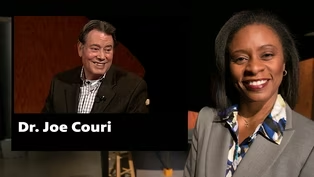
Preview: S5 Ep5 | 30s | Medicine, Music, Photography and Philanthropy… the many talents of Dr. Joseph Couri. (30s)
Providing Support for PBS.org
Learn Moreabout PBS online sponsorship















Support for PBS provided by:
Consider This with Yvonne Greer is a local public television program presented by WTVP