Consider This with Yvonne Greer
S05 E06: Jada Hoerr | Midwest Food Bank
Season 5 Episode 6 | 25m 33sVideo has Closed Captions
Jada Hoerr is a humanitarian engineer fighting hunger and poverty in her own community.
Former Caterpillar manager Jada Hoerr says a 30-degree pivot in her perspective made her realize she could have a direct impact on an impoverished Peoria community. She left her corporate job, moved to the affected neighborhood and today works to help feed the hungry in Central Illinois and beyond.
Problems playing video? | Closed Captioning Feedback
Problems playing video? | Closed Captioning Feedback
Consider This with Yvonne Greer is a local public television program presented by WTVP
Consider This with Yvonne Greer
S05 E06: Jada Hoerr | Midwest Food Bank
Season 5 Episode 6 | 25m 33sVideo has Closed Captions
Former Caterpillar manager Jada Hoerr says a 30-degree pivot in her perspective made her realize she could have a direct impact on an impoverished Peoria community. She left her corporate job, moved to the affected neighborhood and today works to help feed the hungry in Central Illinois and beyond.
Problems playing video? | Closed Captioning Feedback
How to Watch Consider This with Yvonne Greer
Consider This with Yvonne Greer is available to stream on pbs.org and the free PBS App, available on iPhone, Apple TV, Android TV, Android smartphones, Amazon Fire TV, Amazon Fire Tablet, Roku, Samsung Smart TV, and Vizio.
Providing Support for PBS.org
Learn Moreabout PBS online sponsorship- Consider This, life in the middle.
Essential Illinois engineer found herself middle aged as a middle manager in the Midwest part of the United States.
She had always had a heart for humanitarian issues.
And one day her self-described 30 degree pivot shifted her perspective.
She left Caterpillar Incorporated one of the world's largest earth moving equipment manufacturers and went to Midwest Food Bank.
One of the country's largest providers of food for the hungry.
Why did she make such a shift?
And how is she adjusting to the change?
I can't wait to find out.
I'm Yvonne Greer.
My guest is Jada Hoerr of the Midwest Food Bank.
Next on Consider This.
(upbeat music) When most of us think of pivoting I think of any way dancing and you do a pivot turn and you go in a different direction.
And that's exactly what Jada Hoerr did when she decided to leave Caterpillar and head for the Midwest Food Bank.
Welcome to Consider This.
- Thank you for having me.
- So take me back because I watched on one of your TEDx talks for Purdue University, your self-described 30 degree pivot that made you change the course of how you saw yourself in terms of service to the world.
What was that moment like for you?
- Yeah, thanks for asking.
I think that there's a moment where you wake up and sometimes you have these moments where you wake up and you just realize, okay, what am I doing?
Why am I spending the time the way I'm spending it?
And I've always been a person with a lot of energy.
So I knew I was gonna throw myself into any endeavor that I was focused on in the moment, but then you wake up and you have that perspective of how am I spending my life.
- So let me back up just a moment and not have you take me to the pivot, tell us about where your life was before the pivot.
- Sure, sure so when I was employed at Caterpillar I was really enjoying it.
I have nothing but positive things to say about my employment and my engagement and my 21 plus years at Caterpillar it was amazing.
But there was a point where I was allowing myself to be all consumed.
And I'd like to say that there wasn't a whole lot of margin.
I didn't allow myself a lot of margin in life.
And so if you think about reading a book if you don't have a margin it's a little bit difficult to get to the next line.
- The words go all the way to the edge of the page.
- Yes and so that was a little bit about how I felt I was throwing myself into my work and I wasn't able to have perspective outside of my day-to-day and my responsibilities.
Caterpillar is a global company.
And so one of the things that I most enjoyed working in a global company is just that, that I could interact with people from around the world every day but that's in a 24-hour cycle.
And so even just finding downtime and just finding moments to reflect and pause it was a little bit difficult for me.
And so there are some things in life that you just kind of catches you to pause and whether it was running to work into the office early morning or working late at night and just kind of saying wait a minute, what am I doing?
Where am I investing my time?
And that gave me pause.
- So at home you're married and you've got four stepchildren.
- Yeah.
- Was there much time for family things?
- Yeah and I think that no I wasn't, I always would try to find a way, but I was giving it to the point that it was a little bit more tiring or the best part of me wasn't given to my family.
And so by the time I was looking for other opportunities outside of Caterpillar was when it was just my husband and I at home were empty nesters.
And so that's a really sweet season in life that I was looking forward just to enjoy that season with my husband.
And I found that I was spending more of my time at work than I was really ready to commit.
- So take me to the pivot.
- Yeah so one day I woke up and I said, you know what this isn't what God called me to do.
I'm a woman of faith.
And I felt like there's something a bigger calling for me.
And I started to consider and just investigate what those opportunities were.
And thankfully my heart and my passion was really well aligned with opportunities that were available at the time with Midwest Food Bank.
- And I'm gonna pause you there.
And we're gonna show the folks at home, just a little snippet of that TEDx talk that precedes your pivot.
- Okay.
- Take a look.
- What breaks your heart?
Is it the 700 million people living in extreme global poverty?
Is it the 30 million people that are today are living under the oppression of slavery?
Is it the 65 million people that are displaced and without a home?
Is that the 150 million people that are orphans?
So the 280 million people that have a serious mental illness or worse, the stigma associated with it?
Is it the 780 million people that today suffer from hunger or malnutrition?
Or is it the 350 million people that have a rare disease that has limited funding for advocacy or research for a cure?
Or have you already forgotten the question that I asked you and you're overwhelmed by all of these numbers.
- So those numbers you recited are enormous.
- Yeah.
- And I can imagine it would scare a lot of people.
You hear the telltale, if it's one or two people, your heart empathizes, if it's hundreds of thousands or millions, it's easier to detach.
What drew you in, in the face of all those numbers?
- I'm not intimidated by the numbers because I know that behind them are individuals.
And so if you allow yourself to focus only the enormity of it, you lose sight of the stories of the individuals.
And so a large part of my job now as I convey the message of the impact of Midwest Food Bank is telling the big picture but being able to zoom in to the story of the individuals.
And so if you allow yourself to love, and have your heart broken for the individuals it gives you the courage to focus on the bigger problem.
- So tell me about your work at Midwest Food Bank.
I think a lot of folks may know Midwest Food Bank for provides food for the hungry.
- Yeah.
- But it is such a broad scope.
- Yeah so I think especially here in Central Illinois a lot of folks are familiar maybe with the Peoria location.
We also have a location in Morton.
We started the first it was launched in Bloomington, Illinois and now we have a warehouse in Normal but we now have 12 locations, 10 locations in eight States in the United States and then one in Kenya and one in Haiti.
- Wow.
- So I think a lot of people have a perspective of Midwest Food Bank, but it is actually quite large.
- And so describe for me your job as Chief Resource Officer.
- Yeah so we're a lean organization, we're largely run and supported by volunteers.
So $382 million of food was distributed last year by just 40 full-time employees.
So the rest is supported through volunteer support.
We had the equivalent of 150 full-time employees based on the hours of volunteer hours that were supported last year.
So I have responsibility for HR.
So the human resources as well as fundraising and communications.
- And your background is engineering.
Does that come into play in this role?
- Yes I mean, we need problem solving and definitely in all of these areas but unfortunately that in my career at Caterpillar I worked in technical sales and in marketing.
And so I gained some of those kind of communication and marketing savvy which is really dovetail well into my responsibilities with communications and fundraising.
I also worked as a time in recruiting at Caterpillar and so that's also been a great skill for me in an HR capacity.
- So I'm gonna come back to that pivot again and forgive me, cause I'm gonna keep coming back to it because I found it really profound.
- Yeah.
- That 30 degree pivot was about your journey from your home in Dunlap to your job at Caterpillar downtown Peoria.
- Yeah and so like I mentioned, I didn't have a whole lot of margin so it'd be really easy for me to just to focus on what's going on at work, go do my job from eight to 10 to 12 hours and then come home.
And so that was really like the scope of my life.
I really didn't have the bigger perspective.
And so I mentioned earlier that I was working in an international capacity, so I'd have a global reach but my scope was actually pretty small.
And I realized that right here in my own community, there were challenges and I talked about the individuals like there were human lives that I wanted to be engaged with that I just didn't afford myself at the time.
- Because in the scope of that 30 degree pivot in your perspective lies one of the poorest communities throughout the state of Illinois.
- Yeah that's right and so I'm referenced in the talk zip code 61605.
And I really have to give credit to my husband.
One of our second date, our second date was he took me to South side mission was just right in the heart of 61605, and we were serving there.
And so he opened my eyes to that impact, the need and the impact that one could have in 61605.
- Another amazing organization Reverend Craig has been a guest here and consider this as well.
So this isn't just about work for you.
- No, not at all this is about life.
- This is about life.
- Yeah.
- And your friends will describe you as somebody they're like no, she means it.
Like her vacations are humanitarian efforts.
Describe some for me.
- Yeah I think a kind of a critical moment for my husband and I is that we are actively involved with Compassion International.
And so we've had the opportunity to meet two of our sponsored children.
And so those were two of the best days of my life.
And so you go and you engage with an individual that you kind of sometimes, or you're it's a sponsorship program.
So you're writing letters back and forth.
They often wonder like, is this even making a difference?
Are these children even receiving these letters?
And so those sweet moments when you get to meet the children.
And so we had the opportunity to do this in Tanzania and really marked us.
And then you start to ask the question, like why are we traveling around the world to do this?
Certainly important and something that we continue to do today and we're actively involved with compassion but what is the need in our day-to-day right here in Peoria.
And how can we do this on a more ongoing basis?
- Can you give us a sense of what that need is from your perspective at Midwest Food Bank?
- Yeah, for sure especially now in 2021, still in the midst of the pandemic, one of the negative impacts of the pandemic has been increased food insecurity.
And so over the past decade prior to the pandemic we had seen that food insecurity was improving.
So the trend was going down and was really getting back to pre-recession levels or pre-recession of 2008.
And so it was a very encouraging message and it felt like a problem that could be solved.
And now we're looking at anywhere the estimates are still coming in but we ended the year in 2020, between 15 and 20% of the households in the US suffered from food insecurity, meaning they didn't always know where their next meal was coming from.
- Okay.
- So needing to rely on programs.
We have a lot of federally available programs through the SNAP program but we know that that doesn't meet all the needs.
With increased unemployment in our environment today we know that the needs have increased.
We survey and communicate closely with our partner agencies.
So Midwest Food Bank distributes food to nonprofits about 2000 and last year they saw anywhere from 30 to 50% increase of the number of constituents that would come.
And so many families for the first time ever having to rely on a food pantry, going to a shelter for the first time.
So we saw that uptick and we distributed significantly more food.
And so there was no lack of demand from our pantries.
- How are these experiences changing you?
I found a snippet of a video of you before your trip to Tanzania.
And your comment was something to the effect of I know we're going and this is a momentous occasion but I'm really concerned about who I'm going to be on the backside of this experience.
- Yeah.
- How would you describe who you've become?
- Yeah I think whether it's going on a mission trip or taking international travel you certainly come back impacted, but then how do you hold on to that?
And so I had seen in my life that I'd take a trip whether it's through my church or just personally and then you come back and you lose perspective very quickly and you're anchoring to the comforts of everyday life and feeling that that's an entitlement.
And so I'm more actively, it's still a daily challenge.
Don't get me wrong, but I'm more actively immersed in environments where I'm reminded so daily, I can be reminded.
- So that was profound.
What did you say anchored to the effects of your daily life and feeling entitled.
- Yeah I mean, I think that there's a lot of blessings that I'm afforded in my life and material blessings.
And so you don't want to necessarily be addicted to the comfort.
- So to someone watching who still works for a living, trying to get the kids through school just going through the day-to-day motions of life.
It is sometimes difficult to shift your perspective and see outside of the box of your own home when you feel like you're just struggling to get through on your own.
What, I don't wanna say suggestion because I know not everyone's called to the same line of service, but what experiences have you found that made shifting your perspective beneficial?
- Now, I really feel like proximity is the key.
So proximity allows you to have better perspective.
So if you pivot your perspective you have to be proximate.
And so the relationships that we have are gonna be forged where we have proximity.
It's a lot easier to be curious about a different lifestyle or be curious about different worldview if you can be in relationship and that has to come with proximity.
So if someone's like I don't know where to get started.
I think it's just taking inventory.
Well, what are the things that are most proximate?
Because for us, my husband and I had to think that we were gonna live in North Peoria and travel to 61605 and have an impact.
Like it's just difficult because we didn't live there.
We didn't have the proximity.
And so that caused us to rethink where we would live and who are the relationships that we're going to have.
- Wow I have so many questions okay.
I'm gonna go back to my list here.
Environment, food, stability and transportation are three areas of life that you believe could be profoundly impacted if people took the time to focus on them.
And you said, if you're an engineer, - Yeah, - you are much more readily available to have an impact.
What does engineering bring to those three points?
Those three subjects let's start with the environment.
- Well, I guess then maybe if I can take even a further step back I am very thankful for the folks that I've spoken to my life and allowed me to have the opportunity to get to receive an engineering degree.
And while most of my career I was not working in what we would think pure engineering, I'll never I can't even quantify the problem solving skills and how that has impacted me throughout my life.
And so I think that that mindset of attacking some of these major challenges that face our world today.
So the environment it's you know I don't even need to give the statistics.
I think people are aware of whether it's climate change or and how do we have to be concerned and what can we do and how do we solve that?
And as individuals, there's a role but I think there's maybe more systematic opportunities.
And so food insecurity.
So that's where I'm working now.
And again, there's lots of it's multifaceted and the challenges of food insecurity, climate change being part of that when you look on a global scale.
And then transportation, traveling whether to different communities, traveling internationally and just recognizing the value and the importance of infrastructure and people movement like we're in a global society.
And so how do we manage that and establishing the correct infrastructure for the community is critical.
- I am a woman of words and mathematical concepts and engineering concepts unfortunately have alluded me most of my life.
So I'm always fascinated when I get to speak with people like you, who can bring it back down to my level of understanding.
And I feel that every time I see a road being built or like the bridge repaired, I'm thankful for people with brains like yours that can solve the world's problems.
But I think, and correct me if I'm misunderstanding or misinterpreting here that there's still a divide of the minds.
And maybe it's fear-based I know for me it is.
I am intimidated around the facts and figures and processes.
I can have a conversation with almost anybody in the world but don't sit me down with the charts and the graphs and ask me to help build a road from point A to point B.
- Yeah.
- Do you feel that there is a divide amongst the right brain thinkers and the left brain thinkers if you will when it comes to problem solving on a global scale?
- I think that maybe it's like, if we don't think about it as a divide, but there might be a tension, but like in that tension is usually where the beauty happens.
It feels like you need both, right?
You need both and I kind of going back to the enormity of some of the challenges that we're talking about but you have to remember that these are individual lives.
And so if you can anchor yourself to the individual person so we need the one, who's the storyteller, we need the the person telling the story and being able to creatively elaborate.
But you also need the person who's thinking about it systematically.
- Are there moments of dealing with an individual and having their lives directly impact yours?
- Oh, absolutely and I think that's maybe more on my personal level.
So my husband and I now live in right in the middle of 61605 zip code.
And so that's been incredible perspective gaining opportunity for me.
- You moved?
- We did move.
Yeah, we did move.
We moved in 2019 and so we have just a little over a year and a half that we've lived in our new home and it has been an experience of incredible hospitality and incredible welcoming and relationship building that exceeded any of my expectations.
- What are you learning about you in this process?
- I'm learning just so much about what it means to be a neighbor.
What it means to care for your community because what I've seen demonstrated I think I'm maybe it might've thought that I was a good neighbor or that I was engaged in the community but I have a whole new definition of that now.
- So what's on the horizon for you.
Do you still look at the world through dreamer's eyes and say, all right, here's my list, let's just check them off one at a time.
Or have you found yourself sort of migrating back to less and less margins except in a different role?
- Yeah that's exactly it, so I do have to be cautious because that drive is still there, but you have to find that balance because you also need rest.
And so, as I engage in my new career at Midwest Food Bank and in the non-profit world, I do find that I fail in those margins and lately I've been filling them in trying to get more involved locally in our community.
And that's been incredibly encouraging and I've enjoyed that, but you hit it on the nail right on the head that I do have to be cautious of making sure I saved those margins for times of rest.
- And what do you do to relax, recharge rejuvenate your own spirits?
- And maybe that links back to the comments about the environment, I love the outdoors.
And so I really like, that's where I find my rest and my peace is just any kind of activity outdoor.
- And music I also saw.
- Yeah like... - I feel like I was a spy or something looking under into your life.
- No, no, no.
- I enjoy I'm by no means a pianist nor a musician, but that's a way to kind of relax and for me to disconnect.
So if I can find a half hour plunking out a song on the piano, you know that I'm in a good space.
- So looking back over the course of your own life you had planned to join the Peace Corps and change the world.
- Yeah.
Do you still feel like you're still on the same path to that mission through your journeys at Caterpillar and now Midwest Food Bank?
- Absolutely they're the same passion that as a college student and trying to figure out, now I'm gonna have this degree what am I gonna do with it?
And just aspiration and ideals bigger than my experience could afford.
I wanted to go to the Peace Corps because that seemed like a mechanism.
And ultimately I didn't choose that path but that's still desire to have impact is still deep inside of me.
It's like deep into my DNA of who I am.
- So when you start close if someone watching this program you've inspired them to consider this thing we call life a little bit differently.
How would you get started?
I know you mentioned proximity earlier but it is sometimes daunting just as I mentioned the shift between the analytical thinkers and the speakers and storytellers of the world.
It's daunting to look at a community that doesn't look like you doesn't have the same beliefs or traditions that you do.
What inner tools did you use to say I'm going in and I'm gonna be a part of this community that I want to be of service to.
- Yeah I think also recognizing, just knowing yourself and knowing start where you're interested.
All of this have some kind of interest and some kind of passionate if we want to make an impact and give back, do it in the way that makes sense for ourselves as an individual.
And then doing it with relationship whether it's taking a buddy with you or finding a buddy in that realm.
I think that that always helps.
And recognizing that even greatness starts with just taking the first step.
So it doesn't mean that I don't have moments of uncertainty or lacking of confidence.
I certainly do, but just pushing through it and just taking that first step.
And it's so much easier to find what's the second step.
I think also remembering that we don't have to get it right on the first time that we're all growing in life and that we can experiment and try and go in with the right intent, sort of enjoy the journey.
- Enjoy the journey, that's it.
- And respect the process.
- That's it.
- So while we all have these individual steps and paths to take, you are a member of a family.
Would you consider yourself a humanitarian family or is this your path?
How has your passion for humanitarian issues shaped your family experience?
- Oh that's great.
I feel like I bring the passion and I'm very fortunate to be married to a man who also brings a lot of direction for me.
So he kind of guides me and skills me and then I'm motor that kind of pushes us forward.
So we're an excellent team.
And so maybe I'm the one sitting here but he's maybe the heart and the mind behind a lot of it.
- Sounds like a great partnership.
- Yes, yeah.
- We've got just a couple of minutes left anything you'd like to add that I haven't asked you about?
- I just want to express like my hope for the Peoria area.
Like the Peoria community.
I'm a proud citizen living in Peoria.
And a lot of time it's, I think we can get into the narrative of what Peoria could be or what it should be, but I think we need to celebrate what it is and then from there dream forward.
So there's so much hope that I have for our community.
- Celebrate what it is and dream forward.
- Yeah.
- I like that very much.
Jada Hoerr it's been a pleasure getting to know you better.
Thanks so much for your candor and your contributions to our community.
We appreciate you very much all the best.
- Thank you.
- I thank you for being with us on Consider This too.
I'm Yvonne Greer and we'll see you next time.
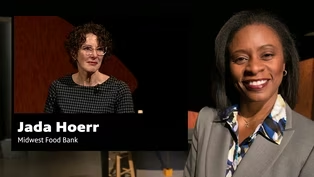
Preview: S5 Ep6 | 30s | Jada Hoerr is a humanitarian engineer fighting hunger and poverty in her own community. (30s)
Providing Support for PBS.org
Learn Moreabout PBS online sponsorship

- News and Public Affairs

Top journalists deliver compelling original analysis of the hour's headlines.













Support for PBS provided by:
Consider This with Yvonne Greer is a local public television program presented by WTVP