
Safe Haven: Louisiana’s Green Book
Season 2022 Episode 3 | 55m 54sVideo has Closed Captions
Safe Haven: Louisiana’s Green Book
Safe Haven: Louisiana’s Green Book
Problems playing video? | Closed Captioning Feedback
Problems playing video? | Closed Captioning Feedback
Louisiana Public Broadcasting Presents is a local public television program presented by LPB
The Foundation for Excellence in Louisiana Public Broadcasting
Safe Haven: Louisiana’s Green Book
Season 2022 Episode 3 | 55m 54sVideo has Closed Captions
Safe Haven: Louisiana’s Green Book
Problems playing video? | Closed Captioning Feedback
How to Watch Louisiana Public Broadcasting Presents
Louisiana Public Broadcasting Presents is available to stream on pbs.org and the free PBS App, available on iPhone, Apple TV, Android TV, Android smartphones, Amazon Fire TV, Amazon Fire Tablet, Roku, Samsung Smart TV, and Vizio.
Providing Support for PBS.org
Learn Moreabout PBS online sponsorshipIt's hard to believe if I were to travel just 70 years ago.
This little guide could potentially save my life.
I'm Carol Sincere.
And this is safe haven.
Louisiana's Green Book.
1939 was the second year that the Green Book was published for a small, rural town.
Opelousas had a surprisingly vibrant African-America King commercial district.
They called it The Hill.
For some reason, the businesses in the Hill never made it into the Green Book, with one exception.
Tourism's Hey, how you doing?
How are you doing?
My name is Kara, and Little Jerome Subsaharan remembers one of these homes very well.
They had big bands going through this town.
Duke Ellington, Count Basie, Henry James, Sam Cooke.
B.B.
King, Albert, his name.
People came to this club, and I felt that the club sub is referring to as Bradford's White Eagle, a famous venue on the Chitlin Circuit, which is for black musicians.
And and though they didn't have many hotels and motels for black.
So they had to go live.
And there are people houses, you know.
My grandmother took a bunch of them in.
You see that house on the corner, and he left right here.
Yeah, I can see it.
Yes.
The big house is Sabas grandmother, Beulah Jerome ran a tourist home, and they called it the big house because it was the big house.
And the people there all the time.
24, seven.
Yeah.
Teachers lived there.
Students, construction workers, We would never go in that house.
There wasn't anything cooked on their stove.
This is the big house on the corner of South Bombard Street or meeting Stubbs cousin, Donald Jerome.
He grew up in that brick house right behind it.
How are you doing?
My name is Kara.
I work in luckily, the current tenant, Mrs. Betty, welcomed us inside.
Oh, everything's the same house.
And you changed the the inside and renovated the four to six bedroom living room and a kitchen and one bathroom.
All these people that were you in one bathroom and right here in this room here.
She had a piano in their new home and new.
Used to play in the piano.
Yeah, they were.
They were dancing.
Yeah, they will come here.
Your grandmother was here?
Yeah, she was.
She runs out.
Even if she didn't know them back then, the people in, like, Rainbow well, blacks couldn't stay in hotel.
We're having, you know, we're tired.
Where we go, you flip in your car.
Just want to play for some of the houses that only could come to these houses, you know, and rent a room.
Surprisingly, this safe haven wasn't even in an all black neighborhood.
But all this.
All of the feeling.
White, white people.
Okay.
And over here.
With what?
Okay.
Yeah.
And the cross with the cross.
The street with white people, too.
So we, like I told her, now I live in a neighborhood with all the black family in the block.
Really?
Ma'am.
Wow.
I thought I was ten years old.
One was black.
Opelousas had one of the only all-Black high schools in the area which drew teachers from all over the state.
Cleveland, bring me in here.
This, and then let them come in the wagon.
The Geron house remained in the Green Book for 27 years.
Until its last publication in 1966.
You know, when I moved here, they say a lot of teachers leave.
If I really didn't know the history, the real history about and I'm now having this opportunity to even to witnesses.
Yeah.
Yeah.
Today, most people don't even know this neighborhood was called the Hill.
Almost all of the black owned businesses here closed after integration and things seemed to fall apart.
I'm beginning to learn this story is not uncommon.
There was a time in Shreveport history prior to the civil rights movement and even after where someone who looked like me best be gone by Sunset.
Shreveport was a sundown town, which means being outside after dark was a life or death gamble.
Shreveport was divided along racial lines in the fifties, and sixties.
The downtown area was where you could find everything, but it was distinctly white.
As for all the restaurants, the shops and all the organizations, including the YMCA, Ruth Washington still remembers those days.
Hey.
Hello.
I'm Karen.
It's nice to meet you.
Nice to meet you.
Most of the, uh, the White Derby in the YMCA downtown were basically for whites only.
We were not allowed.
We could pass them, but we just weren't able to to go in and use the facilities.
As I can remember, we were only allowed downtown on Saturdays and now to do our shopping for whatever we needed as far as clothes for school or church or whatever.
What would happen if you went downtown and we didn't?
We didn't even try.
That was just the now.
Now we're on our way to the George Washington Carver YMCA.
That's a location we're visiting today.
The boys would come here and shoot basketball and play ping pong and wedding receptions, birthday parties and things like that, because it was no real.
It was not a lot of places where we could, you know, do things like that, you know, and be safe.
This why was a place for sports and fun, but it was also for civil rights strategy meetings and education.
There were book reviews, guest speakers and political meetings, blacks saw it as an opportunity to spread ideas.
She sports white residents saw it as a way to keep so-called colored youth in line.
In 1948, the Shreveport Journal credited the Y with reducing the number of colored people arrested.
Congress passes the most sweeping civil rights bill ever to be written into the law.
The Civil Rights Act of 1964 made segregation illegal which meant black people were no longer relegated to certain parts of town or to certain businesses.
African-Americans in Shreveport started using the formerly white YMCA in town, which was a lot larger.
The George Washington Carver YMCA eventually disappeared and is now a shell of what it used to be.
This part of our community was thriving and now to see it not even functional.
It's very sad the story of the why is hardly Shreveport the only casualty of desegregation?
Ruth's old neighborhood is practically a ghost town.
It's just sad to see the neighborhoods go down the way they go down.
It's ironic that integration, the thing civil rights leaders fought so hard for, undid so many black businesses in Shreveport.
I guess everything comes with a price When I was a little girl, I learned a very valuable lesson.
Hair is never just hair for black women anyway, and it never has been.
Hi.
I'm going to show you how you and Christine can find a fantastic new hairstyle.
It's called an ultra natural.
First, you have to start with relaxed hair, and that means a trip to the beauty shop.
The way you style it determines the way people treat you and the opportunities you get, to put it plainly.
My hair directly impacts my future, and my ancestors knew that.
That's why in the early 1900s, black women started straightening their hair with relaxers.
They curled, crimped and grazed it until it was acceptable.
Until they were acceptable.
They needed something to feel good about themselves in a time when African-Americans were considered subhuman.
And so the beauty parlor became a refuge in New Orleans.
Made a porter.
Edwards saw the potential to help women while contributing to the growing community of self-sustaining black owned businesses.
So in 1939, she bought a building for poor Shrewsbury school Hi.
Hello.
Welcome home to my little kingdom.
My little hobby is to reach you.
And so good to see you.
I mean, love you the way of your life.
Thank you so much.
Made it.
McDonald is made a porter.
Edwards whimsical granddaughter.
She's all about color, sequence and fashion, which comes directly from her grandmother's beauty school.
So these are pictures that I have here.
Of Mother made when she was in her poro beauty culture school days.
She was the first African-American woman to own an operate or beauty culture school in New Orleans at 22 14 Dryden Street.
I can remember vividly the building porous beauty school almost didn't happen.
Mother Maida had to fight for it.
Now, one thing about my tomatoes story is they did not want to give her her cosmetology license.
The Louisiana Board of Examiners, they did not want her to have her cosmetology license where she can have her practice to train.
Why didn't they want her to get the license to own a business?
Well, back in that time, African-Americans were not moving in that direction.
I think that they just did not want to see her grow in that industry, which is what she was able to do.
But she was die hard to say.
I'm going to get my cosmetology license.
I am trying to do this poor.
I was brought in people from all over the South to get their hair done and buy purses and gloves from me to shop.
But more importantly, women came to learn.
She taught classes of students how to care for black hair and how to accentuate black beauty and build a business in the process.
This was liberating at a time when most black women were working as maids or cooks.
Mother Maida gave them the opportunity to be more.
And when Poor Rose was listed in the Green Book, it just brought in more clients.
But Mother made his influence didn't stop in New Orleans, 80 miles away in downtown Baton Rouge.
She worked with another woman named Karen Taylor, who had a beauty school called Karis, which was also in the Green Book.
It was a beauty school here in Baton Rouge.
That is where she did her hair practice with all of our customers.
And she was known all over the community.
I think she left really a significant legacy here in the Baton Rouge community.
And those were the days when, you know, the ladies were ladies.
They carried themselves as ladies.
They dressed from head to toe.
If they went out, they had their fur coats on.
They had their meat coats on.
They had their hats on.
They had the gloves.
They were in the finest of clothes.
So I can say that I learned a lot from coming up and seeing how they impacted me to become the woman that I am today.
From 1939 to the late sixties, both Kerry and Mother made a brought forth a new class of black women.
They created business owners that could sustain communities of color.
And they did it looking good Why do you think beauty was so important back then for black women?
When you have somebody that's giving you positive examples and they're giving you the lead in their showing you a role or they're serving as a role model, then that too helps you to become who you are.
And I contribute a lot of that to my grandmothers, to my mother, to my family, to my aunt.
Like I say, different people in the community.
I wouldn't be who I am today.
And I'm passing it on to my granddaughter and others in my family as well.
Both carries and pros disappeared from the Green Book in 1955 by then, mother Maida and Carey were both in their sixties and ready to retire.
There wasn't anyone to take over the businesses, so both salons closed down.
Do you think people ever pass by caries or pause and just know that there was so much history made at these places?
Do you think they know the impact these places had?
I think some people do.
Those that came up during that time and that era do, because I even if traveling down Government Street and I'm going in that direction of wherever I may be traveling when I turn and I pass carries, I turn and I look and I can remember that building and how at that time African-Americans were self-sustained individuals.
You know, we had our own barbershops, beauty shops.
We had our flower shops, we had our theaters, we had our hotels.
We had everything right there in our African-American communities.
It takes strength to love yourself when the world is telling you otherwise.
I'm grateful for women like Mother Maida and Carrie who've paved the way for women just like me.
Hello, I'm Robyn, America, friend and supporter of LPI, be joining you for a safe haven exploring Louisiana's Green Book and LPI be our original series.
Since you are a loyal LPI viewer, you know it is Louisiana Public Broadcasting who is best able to tell these compelling and important stories.
Show us you value learning about the history of our state by pledging your support online right now at LPI.
Be Dawjee or call us our text.
Give 2888769 5000 or by scanning the QR code that's on your screen with your phone or your smart device.
We depend on viewer support to present everything you see on LPI from this great LP production to PBS's Nature masterpiece and Finding Your Roots.
We have special thank you gifts selected for your donation made during this program.
Let me tell you about a few of them right now.
Okay.
So the $240 level of support that is $20 a month, you'll receive the Green Book combo, which includes the Negro Motorist Green Book created by Victor Green, The Dooky Chase Cookbook, a pair of LP gumbo mugs and your choice of the program, DVD or program digital download of what we're watching this evening.
At the $120 level of support, you'll receive the Dooky Chase Cookbook Awesome cookbook of, you know, Dooky Chase Restaurant in New Orleans.
You know that this is some great cuisine in the cookbook and at the $96 level of support that is just $8 a month you'll receive the Negro Motorist Green Book created by Victor H. Green and at the $72 level of support and again that's just $6 a month you'll receive the program DVD or program digital download of the program that we're watching right now.
And in addition to these wonderful wonderful thank you gifts, you'll also receive visions which is LP's monthly program guide.
It will show up in your mailbox every month right on time.
And Louisiana Life magazine and the popular member benefit LP, Be Passport that is on Demand LP Be Watching at your leisure.
888769 5000 is the number to call to make your pledge support and your gift and get these great.
Thank you guys.
So I have joining me right now in this crisis year so excited to be talking with her in studio today.
But Kara is the producer co-produced this program that we're watching right now.
And you see her telling the story all across the state of Louisiana, really bringing the Green Book home for us.
We've heard about the green book but you highlighted the portions in Louisiana.
And more specifically, you talk to a few folks who had no idea that the Green Book existed.
How did that make you feel?
Well, it was surprising because the Green Book was such a big part of traveling for black people during this time period because there were so many places that you really just couldn't go.
So to have this book and have all of these locations and these people not even knowing how influential and how important they were, it was just mind blowing.
And in one of the videos that was just played, the Opelousas big house, you talk to Jerome and you see how influential his grandmother was with this tourist home.
And he had no idea that this book existed.
And he had no idea that his grandmother was a part of it.
And she hosted celebrities that we know today, like Sam Cooke when he was a gospel singer.
So it was really it was amazing.
It was an incredible network.
Of that book was even pulled together nationwide.
So we're not talking just Louisiana, although what we're watching right now, a safe haven is about Louisiana.
The Green Book itself cover the entire country And so that was fascinating that we were able to to tell that story.
So, Carole, we're really grateful that you are choosing and have chosen this this work to do and to tell the story and to really bring these kinds of stories to life for our people here in Louisiana.
And so I want to go back to our thank you gifts, because that's so important right now to support LBB and one of the ways you can support us is to give your financial gifts to LBB, and then we will in turn give you a.
Awesome.
Thank you give so for the $240.01 time gift or $20 a month at the sustaining membership level, you'll receive the Green Book Combo, which includes the Negro motorist Green Book itself, created by Victor H. Green The Dooky Chase Cookbook, a pair of LP gumbo mugs to go along with those gumbo recipes that are in the cookbook and your choice of the program, DVD or program digital download of the program that we're watching.
And again at the $120 level of support and that's $10 a month as a sustainer your will see the Dooky Chase Cookbook and at the $96 level of support that's $8 a month you'll receive the Motorist's Green Book created by Victor Green the book that he writes about the Green Book.
And lastly at the $72 level of support and again that is $6 a month that's a digital download of what we're watching right now or the program DVD whatever works best and of course 88769 5000 is the number to call or LP.
To learn more about these great thank you gifts and so care.
Before we go into the next segment I did want to talk a bit about the beauty parlors.
We so enjoyed seeing your baby pictures.
My mom did too.
Yeah, I did.
So we watched you every week on Louisiana this day and we're like, oh, look at her as a little girl growing up and just the importance of hair to this whole conversation.
How was that to talk about those Carrie's beauty salon, the school, and then parades down in New Orleans?
Well, I would say that that was one of the most personal episodes that I've done because, you know, like I said, the episode hair really isn't just hair.
And we were just talking about this before we so much on camera talking about our hair and what it was doing, what it wasn't doing and what it's doing and not doing now.
Exactly.
And so imagine that having to deal with these same insecurities with your hair and you're living in a time period where people really consider you subhuman.
And the way that you look in the way that you present yourself is so important.
So it was really, really, you know, groundbreaking for me because I still experience a lot of these things.
And the women that came before me did and the person I interviewed, you know, she was explaining what it was like for her growing up and having to do her own hair.
So it was just I love that episode of my hair.
We could talk about this for hours, but we're going to go back into the second segment of Safe Haven.
Louisiana's Green Book and getting gas is something we likely all take for granted.
It's an easy, mundane task.
But in the 1950s, that wasn't the case for everyone.
If a black person went to the wrong gas station while traveling, it could lead to a humiliating incident or worse in the 1950s in the Deep South.
Lynching was still a threat in Louisiana alone.
549 lynchings were reported from 1877 to 1954.
African-Americans just passing through stops for bathroom breaks or car service had to be carefully planned.
Escort service stations or as we call it today, ExxonMobil or places African-American and could trust.
Dalton Honoré still remembers those days.
Hey, how you doing?
Hi, my name is Kara.
We're on our way to what's left of Horatio's Association number two.
And Scott Melville, Louisiana, which is a historic town north of Baton Rouge.
That's home to Southern University.
It was once the largest majority black town in Louisiana.
And so Standard Oil was partly the reason for that.
It's a special company for Scott Melville because it was one of the few businesses that would hire black people in all positions.
We didn't have anything else.
Standard Oil was the first one to come to this area and put a station.
We didn't have any other stations up here.
But if you had a job at Standard Oil and all you would with basically a label radio, you had one of the best jobs you could have black food, a great part of building that refinery on.
And I talked with some of them and during the time they would build in that station because my my family have been many in this community since late twenties.
In the time of Jim Crow, when blacks couldn't even use the same water fountain as whites so hired black gas attendants, managers and even franchise owners.
The company even distributed copies of the Green Book, which ended up being advantageous to a man named Horatio Thompson.
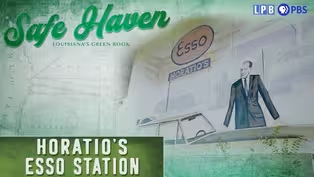
He was the first black man to own an Esso franchise in the South, and he opened it in Dalton's neighborhood.
Service stations provided more than just gas for travelers.
You could get your car repaired by food, even appliances.
But most importantly, they provided bathrooms.
And we went back and went to a gas station, and we got some females trailer.
We were the first thing we'd do with the action was you got a bathroom.
And we've been told that many times.
It was male bathroom.
So if you could make it to another gasoline station, you try.
You'd sometime have to go to two or three before tomorrow.
Yeah, we got one on the back Other than that, you couldn't go to the bathroom.
The farther west you went restriction lighten up a lot.
Horatio's Association quickly made him a leader in the community but what really solidified his status was the station's participation in the Baton Rouge bus boycott in 1953.
So everybody who had a call black in Baton Rouge was buying gasoline or Rotary Thompson because he was selling it below the cost of the independent stations or what have you.
And sold it to the patrons who participated in the boycott with the automobile sold to them at court.
All they had to do was put a sign in their window letting Horatio know they were carpoolers.
Sometimes he'd even give that gas away for free.
He lost thousands of dollars in profit that year, but still managed to become the first black millionaire in Baton Rouge, the largest investment anybody could put in his community at the time.
Little Richard Thompson.
Horatio built up a community struggling under the weight of racism.
His image is painted on the service shop because even though the station isn't there, his legacy remains.
After segregation, and very few black owned businesses in the Green Book survived.
But in the Tremaine neighborhood of New Orleans, this family run restaurant not only survived it became nationally renowned.
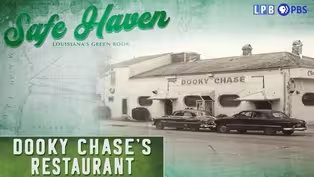
What started as a family run sandwich shop and lottery outlet in 1941 was transformed into Dooky Chase's restaurant in 1946 by newlyweds Edgar Dooky Chase Jr and Leah Chase.
It was one of the few upscale dining establishments for African-Americans Today I have the honor of beating salaries.
Chase and Edgar Chase the third.
They're both the children of Leah and Dooky Chase.
Hey, Kara, Oh, nice try.
Three.
Dooky Chase, welcome to Decades.
All right.
Happily you went our family's business.
I am happy to be here.
So your.
Oh, yeah.
Come right in.
What is your signature dish here?
So the signature dish here is the gumbo And there's a reason why it's the gumbo.
Because Mrs. Chase, our mother said that was over a bowl of gumbo.
That she and my family helped change the world.
So she said she can solve any problems over a bowl of gumbo.
So if you have any problems, you might want to tell us about Leah Chase, the celebrity chef known as the queen of Creole cuisine.
Knew that a good meal had the power to bring a community together.
And provide strength during tough times.
Well, during the civil rights movement, we were a place where you could come and you could feel welcome.
And also, we were a place where people strategize on Next Move, people like AP to row one of the attorneys here.
And our first African-American mayor, Ernest Dutch Morial, they would gather upstairs to meet with Thurgood Marshall and Reverend Ralph David Abernathy and Dr. Martin Luther King to plan that the civil rights movement how the South was going to integrate.
It was also one of the few spaces for blacks and whites to meet.
Well, the police knew that duckies was known throughout the community as a safe haven.
So the people who were coming into duckies were not going to cause you trouble.
And Mayor de Lesseps Morrison was the first person in the fifties to campaign to get African-American votes.
And he campaigned at duckies in the upper room.
So he would make sure don't mess with duckies.
And don't mess with that up a room.
So the police would basically take a hands off attitude towards what was being discussed in the upper room.
We want everyone to come here, everyone to be like our bowl and gumbo inclusion for everyone to come here and feel as much at home as the Freedom Bus Riders did.
The Freedom Riders were white and black activists who traveled the South in the early sixties protesting segregation.
Duckies fueled their efforts.
So when they went to jail, how they didn't eat the food in jail because they knew how that was.
We sent them food for them to eat in jail.
You know, traveling at that time was not an easy thing.
You know, was a little stressful.
So when you came here, come, we welcome.
We're so happy to have you.
So that stress is relieved.
With no black banks at the time, the restaurant became a place to cash checks and afterward a place to wind down, eat and have fun sometimes all night.
So people are really staying out here till four in the morning.
Oh, yeah.
Tell you.
Well, that's where the song from Ray Charles came back early in the morning because it was after these gigs, as they told and then for everyone, he couldn't go and eat everywhere.
And we weren't far from the municipal auditorium down the street.
So he came here and that's why his phone says early in the morning I went to get something to eat.
So we were open to four or five 30 on Saturday.
Yeah.
So when all these musicians come through, they would pass the word.
If you want to be welcome in New Orleans, you go to duckies.
And when my grandparents opened the business, it was in Louisiana that they open this business so people could come here and have good times, good fun in a safe environment.
And so that's what they did.
Walking through these dining rooms.
I can feel the history.
The walls are covered in African-American art and photographs of the many celebrities and political leaders who've dined here.
I'm amazed at how much this restaurant has survived in its 80 years in New Orleans.
Racism, Hurricane Katrina and the deaths of Dooky Chase Jr in 2016 and Leah Chase in 2019.
In spite of it all, a fifth generation of the Chase family continues the legacy we tell everybody that our family holds the key to the door.
But this place belongs to the community and we try to make them proud of it.
So that's why we make the sacrifices necessary to keep it up and to keep it going.
And the rest is kind of history.
Rest is history.
The rest is history.
Hard work a lot of blessing.
And yeah.
And it's our legacy that we are proud of and that we passed on.
But what makes us happy now is that when we walk into the dining room, we see people from all over all races, all ethnic groups, everyone coming here and having that good time and enjoying the food.
And then, you know, I think, oh, we made it because this is what they envision, not separate because they worked for us to be able to come together and, you know, appreciate everyone's culture and enjoy good food in a good place.
And so it's up to us in the generations that past us come behind us to keep it that way.
Hello and welcome back.
I'm Robyn Merrick, volunteering today because I value all that El-P offers.
This short intermission is our chance to tell you how much your membership support helps lobby throughout the year.
This is your chance to invest in and be a champion for the quality programs you see on LP, including the program you're watching right now.
Safe Haven Exploring Louisiana's Green Book.
Call us our text.
Give 2888769 5000 or pledge online at LPI.
Be 4G or simply scan the QR code you see on your screen right now.
Your donation at any level helps us broadcast programs such as this plus NOVA American Experience, all of our PBS Kids Children's programs and everything else you've come to depend upon from LBB.
If you're already a member, we invite you to make an additional gift to take advantage of the offers we have for you during this broadcast.
Let me tell you about the wonderful, wonderful thank you gifts we have for your generous donation during this program.
We have some really great gifts at the $240 level.
Of support, you'll receive the Green Book Combo, which includes the Negro Motorist Green Book created by Victor H. Green, The Dooky Chase Cookbook, a pair of LP Gumbo Mugs and your choice of the program DVD R Program, digital download of what we're watching and at the $120 level of support.
And of course that's $10 a month.
As a sustaining member you'll receive the Dooky Chase cookbook and for $96 a One-Time Gift or $8 a month as a sustainer you'll receive the Negro Motorist Green Book created by Victor H. Green.
And lastly $6 a month or $72 is a one time gift.
You'll receive the program DVD or the program digital download of the program that we're watching the Safe Haven Exploring Louisiana's Green Book.
And in addition to these great and awesome gifts, you will also receive the program guide every month.
Visions.
It comes to you monthly.
This is a great program guide, as well as Louisiana Life Magazine, an annual subscription to that and access to PBS Passport.
So, again, great programs.
You can get all of that right here on PBS.
Passport, of course, gives you all the things that you watch on PBS, on demand.
Any time you'd like to watch them on any of your devices, and that's going to take care of things.
Here is back.
She co-produced this program that we're watching right now, Safe Haven.
And Karen, I want to talk on and on about this, but I really got to ask you about something that we just saw Mr. Horatio Thompson and me and the gas station that was in Scotland, whom I grew up right there.
And Mr. Thompson was one of our neighbors in the neighborhood.
And so he's done so much.
He did so much at a time.
That was just incredible when you were able to tell that story or to to really see that as a native of Baton Rouge, what did that what did that do?
Well, I'm from Baton Rouge, like you said, and I've grown up here my entire life, and I didn't know about this place.
I'm ashamed to say I didn't.
So it was really interesting talking to somebody who grew up in that area, somebody like you.
And he was talking about how important Horatio was to this community.
And my favorite aspect of that interview was learning that not only did he give them a business that help them kind of, you know, self-sustaining but he also was a really big part of the civil rights movement here in Louisiana, because, as we know, the bus boycott was a really big you know, that's what you think of when you think of the civil rights movement.
But it actually started here in Louisiana with the Baton Rouge bus boycott.
And Horatio helped usher that along by, you know, selling his gas at cost.
Exactly.
And to the motorists.
Yeah, right.
He lost thousands of dollars doing that.
And he was an integral part.
And without him, I don't think the movement would have been as successful as it was.
So it was it was fascinating knowing that the place that I grew up in was able to do all of you know, you were able to tell so many stories and to see it through your eyes as a as a Baton Rouge native who said, hey, I never knew these things.
I'd drive around town all the time.
Now I'm learning about the city.
And certainly I would also add that the Baton Rouge Bus Boycott was a documentary that was also done here at LBB.
So LBB tells All these wonderful stories about Louisiana, You're not going to get these stories anyplace else.
And it's so important that we tell these stories and move them along for our future generations.
Such as yourself, who had no idea that these things existed.
And the only way we'll be able to keep them alive is to continue to tell the story.
Exactly, I would say.
And so with that this is how you come in as a viewer of LBB and making your pledge and your gift of support.
888769 5000 is the number to call, and these are the thank you gifts that you can receive when you give us a call and your pledge of support to keep programs like this going in Louisiana and that we can produce our own stories about our state.
So again, $240 level of support, that is $20 a month, you'll receive the combo that is everything.
That's the the Negro Motorist Green Book created by Victor Green, the Dooky Chase Cookbook, the LP Muggs for your gumbo and your choice of the program, DVD or program digital download of this program.
Then again at the $120 level you can receive the Dooky Chase Cookbook.
That's a mere $10 a month and then $96.01 time gift are $8 a month.
You'll receive the Negro Motorist Green Book created by Mr. Green as well.
And then $72.01 time gift or $6 a month you'll receive the program DVD are the program digital download and remember this all comes with Visions Louisiana Life magazine that won your subscription and the LPI Passport, your On-Demand access to all programs on LP and PBS.
It's awesome.
I definitely enjoy having that as part of my lineup for television viewing and care.
I got to ask you before we go back to Quick Things one.
What was your favorite part about doing this series?
It was definitely the caries episode.
I know.
Like the favorite part is usually just like what aspect of it that you like the most.
But I absolutely loved sitting down and talking to Martin McDonald.
You're my fiancee.
She reminds me of my family in a way because she's very spirited and happy and eclectic, and she was definitely my favorite part.
All right.
So I'll give the second question a few minutes, but we're going to go back to more safe haven, Louisiana's Green Book and and whenever I drive down Government Street near downtown Baton Rouge, I always wonder what all these abandoned stores used to be.
I've lived my whole life here, and I never learned about the history of this neighborhood.
Apparently, a lot of black owned businesses were in this area.
There were beauty parlors taverns, restaurants, theaters.
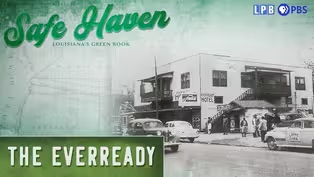
And in every edition of the Green Book, there was the ever ready built in 1938.
It was the first hotel for African-Americans in Baton Rouge.
I'm meeting John Forbes at her home.
Her uncle owned the ever ready cook place.
Okay.
How are you?
My name is Joan Forbes.
Please come in.
So I would go visit ever relatives cafe and Camp san when I was little and I was a little three and five year old sitting on the bar.
So I got to see everybody come in and leave.
And they basically taught me the business.
You know, I saw everything.
The whole black was like little Harlem.
You could call it a little home because it was all black.
Everybody was for it.
You can go nowhere in Baton Rouge was like a little country town.
Everybody knew everybody.
Trust me, they knew everybody.
In the 1930s, Jones family moved to Baton Rouge from Saint Francisville, which was a KKK stronghold gripped by racial violence.
They worked as butlers, maids and gospel singers.
And despite tremendous challenges, they eventually opened their own businesses especially her uncle Joseph.
Everybody should know how the Henderson family cared about Baton Rouge and its community.
And Uncle Joseph did so much to help others to become business owners.
And he helped the community as a whole find and giving people to stay.
Sometimes he wouldn't even charge them if they could not afford.
He would just let them stay until they got back on their feet.
Uncle Joseph always wanted to expand.
His businesses really was like a minimal.
If you think about it, you know, with the photography studio, they even had a little dress shop in there and then you had the cab stand.
And really, he had women cab drivers yeah, there were women cab drivers.
The ever ready was popular for black musicians playing around town and at clubs on the Chitlin Circuit, and everyone loved the food and the kitchen smells so good because everything was homey.
And when you would walk in the dough, you just had that aroma of good food.
You could get a plate of red beans and rice for 15 singer Betty Davis and all of them, like when they were coming down, they really like soul food.
They would stop by and get some rims and mustard greens and you.
And so they enjoyed that.
If they didn't stop by, they would order their food in Uncle Joseph and all of them would deliver it to the hotel where they were staying.
Equal rights for African-Americans were a double edged sword for thriving businesses like the ever ready.
What happened with that area?
And integration came in and it cut into their business and people became more outspoken.
I mean, the whites couldn't believe basically that blacks had that kind of money and they resented it in a way.
And they would rather see the buildings destroyed than to see them remain.
And that's what happened.
They're being torn down.
It's like they were never here in the first place.
Do you think the people in Baton Rouge, you know, how influential really this family was in this city?
No, they had no idea the ever ready closed in 1965 and today only the building's foundation is left although the neighborhood is being revitalized.
There's no sign of its black history.
And Joan is hoping to change that.
I've been telling them about it for years that they need to put markers and everything where all these businesses were.
Not only the Hendersons but you had the Bernards and you had several other families.
So there is so much importance here in Baton Rouge that the black community owned everybody needs to know about it.
Everybody.
I don't care what color you are, wherever you came from.
Rainbow colors, what they need to know.
All this existed Hotel Lincoln's history is shrouded in mystery.
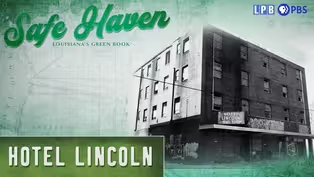
It's an abandoned brick building sitting at the heart of Baton Rouge just once prominent black commercial district.
It hasn't been open to the public since the seventies, and it shows, but some people still remember its glory days.
All right.
We are at Hotel Lincoln Lewis Hall is an 85 year old retired partygoer who still enjoys margaritas on a Wednesday night when he was in his teens and early twenties.
Hotel Lincoln was the official hangout spot for anybody who was anybody.
And Lewis was definitely somebody who was a disaster.
So I didn't know it was a black owned hotel at all.
I thought it was just an abandoned building black hole hotel.
Can't find any pictures of it.
What do you want to go head inside?
I don't know what you can see inside.
Some stuff, huh?
You see something dangerous You're all right.
Oh, wow.
Okay.
This was the main lobby here.
This right here.
Right here.
Okay.
And here you came in here.
Fun This is what you go through.
This door to the cafe.
And what they would do is.
Well, it could thrive as they fix your food, your favorite, in a way, it was put on the table to see what they serve.
Right?
What did they serve?
Oh, no.
Good food, especially breakfast ripped and eggs and stuff like that.
They ran off at that time.
Everybody had good cook.
The hotel was built by Dr. Aristotle Chapman in August 1955 and first appeared in the Green Book in 1957.
It had 46 rooms with baths and air conditioning throughout the entire building, which may seem like a no brainer, but localized air conditioning was hard to come by, especially in black owned businesses.
To Louis, this place was the epitome of style.
What made this one so modern?
What set it apart Because there's brick and mortar and bathrooms and all that stuff, and you see the floor to see the floor was under water at the time.
You know, it was luxury Hotel Lincoln quickly became a hotspot for black travel and celebrity appearances.
Artists like the Clovers will perform at a nearby McKinley High School memorial stadium and Temple Roof Garden, which was a big nightclub.
No matter how famous the artist was, their hotel options were limited if they were black.
So Hotel Lincoln was the place and the fans knew it.
Lewis vividly remembers Jackie Wilson stopping his car outside the lobby to sign autographs.
So they would just kind of hang out.
Celebrities upstairs.
Yeah, well, you know, downtown, no place to go, you know, and everybody come over here.
That's how it got for me with some of the guys, you know, like almost everything in the green book business started to decline in the late sixties.
Did you ever think that this hotel would turn into this?
No, but I felt like it because after you could see what was happening after integration and people just started backing off.
The building was sold in the late sixties and it officially closed down in the seventies.
Though many people have talked about it, no one has been able to bring the Lincoln back to life.
A developer has taken interest in revamping it recently, and I can't wait to see what he'll do.
This place is special and it should be preserved for years to come.
Today, more and more families are finding out how easy it is to become to Ford families following World War Two.
Their road trip became one of America's favorite pastimes.
More people than ever could afford cars, including African-Americans, Hence the Green Book.
But in cities like New Orleans, black travelers, both local and visitors, needed other ways to get around.
Which is why four taxicab services were listed.
And I'm meeting Munro Coleman, who knows all about the Big Easy's cab business.
Hey, how you doing?
Nice to meet you.
I'm Karen.
How you doing?
Nice to meet you.
All right, so I guess we're going to be waiting for one of your cabs.
Come pick us up.
We'll take a ride.
Okay.
That'll be fine.
All right.
It'll be.
The fare will be on me.
All right.
All right.
Oh, love is coming now.
So, how long you been in the cab business?
I was born in the business.
I was born in 1946.
Our father started calling a cab company in 1947.
So I am truly a taxi cab, baby.
All right.
All the way through and through.
Completely.
So, back in the early days, how did black people get around?
What was their most common mode of transportation?
The common mode of transportation was taxi cabs.
We did have public transit, but public transit ran on a fixed route.
Taxi cab went into the neighborhood, and it provided what we call point to point pickup.
Were they getting into white taxi cabs before these particular cab lines appeared?
The Green Book.
Only way you could ride airfields outside your race, you had to be called in by a very white person and they would provide the service.
Though Coleman's family business never ended up in the Green Book.
He came up alongside black owned taxi services that did like the VA cab line.
We used to be right there.
That's it.
That really should be right there.
Yes, that's what it looked like.
Yeah.
There was a ballroom in a lounge there back in the Green Book Days.
Multiple businesses were often combined into one.
The cab line was flexible for black men juggling multiple jobs.
If you had a day job, when you get out of that, you come work the taxi cab late in the into the night.
Most black people had two and three jobs because we really weren't paid a lot.
But if you had a family, you had to work a lot.
V8 was unique in the fact that it had a building to host cab drivers.
Many cab stands only had a street with a sign and a phone on a telephone pole.
All right.
That's a draft form.
There's a gray box the caf will pull here.
And when the phone rang, they would answer it and go pick up the person.
Pull over right here, the telephone pole.
I had never heard of a drop phone before until Monroe showed me one.
You had to cross over the dial.
Oh, my goodness.
So how old do you think this thing is if they're on the phone with.
Hang on here.
So you just kind of sit around all day and wait for this to be all day, because you serve in this area.
Okay, so people coming and going will call, and they know where the cab and so.
And the cab know the neighborhood.
And you they give you a name and everything because, you know, neighborhood, they know people.
So we're people fighting to answer the phone.
No.
First in, first out.
All right.
Yeah, the first call would be right there.
All right.
And the next call here.
And next call here.
And then you had all the cabs around, so they'll work their way onto the stand.
All right.
All the black taxis in the green book disappeared after 1955.
Only a few buildings and lanes are left as a reminder.
I'm shocked that things like the drop phone have survived this long, leaving little pieces of history for the next generation to find.
ExxonMobil, Baton Rouge is proud to support safe haven Louisiana's Green Book.
For more than a hundred years, Exxon Mobil has made a commitment to workforce diversity and the belief that reflecting on historic race relations is key to shaping a better future.
Hello.
And welcome back.
One last time during Safe Haven exploring Louisiana's Green Book, I am Robin Myrick, longtime friend and supporter of LP, and this is your last chance during this program to show us how much you value this type of original and thought provoking reporting by pledging your support to Libby right now.
You can do that by calling us or texting.
Give to 888769 5000 or pledging online at npr.org are you may simply scan the QR code you see on your screen right now.
Your donation at any level helps us throughout the year.
And we will be rejoined by our special guest, Cara Saint, here in just a moment.
But first, we have so many terrific offers for you that are available during this broadcast.
Let me tell you about a couple of those.
One more time of the great thank you gifts that you can receive on this program.
The $240 level and a course that's $20 a month.
As a sustaining member you will receive the green book combo that is everything that includes the motorist guide the Green Book rather created by Victor Green.
The Dooky Chase Cookbook, a pair of LP gumbo mugs and your choice of the program DVD our program Digital Download.
And at the $120 gift level, you will receive the Dooky Chase Cookbook that is $10 a month and it's got awesome gumbo recipes in there.
So if you've ever eaten at Dooky Chase, you get a chance to bring all these things home for yourself.
Then it's a $96 level.
Of course it's $8 a month.
You'll receive the Negro motorist Green Book created by Mr. Green again.
And then at the $72 level, that's $6 a month.
On a sustaining membership, you'll receive the program DVD or program digital download.
And remember, with all of these levels of support, you will receive Visions, our monthly program guide here at OPB, as well as a one year subscription to Louisiana Life magazine.
And Access to LP Passport.
So that's all the programing that you want to get on demand when you choose to watch it.
Lots of back programs that are there that are no longer air.
Downton Abbey.
My sister loves that.
So she watches them over and over But PBS has what allows that to happen through the OPB passport.
So, Carol, back to the question that we were asking you earlier.
Yeah, I just got to know what was one of the most surprising things you learned in doing this series.
I know it took you several months to get all of this put together for us, but what was one of the most surprising things you learned?
That's a really easy question.
The most surprising thing that I learned was really how integration was kind of a double edged sword.
You know, on one hand, you have access to all these places that you didn't have access to before, but on the other, you will lose access to the places that took you in when you couldn't go anywhere else.
Right.
Your neighborhood places, things that were right there in your neighborhood, your neighborhood places, and the ever ready episode.
You can see that clearly because, I mean, this place was a big deal.
Celebrities came there.
Even Betty Davis and at the end of it, you know, integration was slowly happening and people were moving in different directions.
And this person that owned this place, his name is Joe Henderson.
He was so successful that he wanted to go and buy a car one day.
He wanted to buy a Cadillac because he had money and he could do that.
But whenever he was going there to buy the car, the dealership owner who was white said, I can't even afford to buy myself this.
So how on earth can you do that?
Wow.
So that was kind of the last straw for him.
And he packed his bags and he left.
And in other places, you know, when integration was starting to happen, you have more, I guess, interact often with people that are different than you.
You know, they start fraternizing those businesses.
They lost their clientele.
And it just you know, there was nobody left to support it and it fell apart.
That was a really sobering aspect of the work that you did to see what's there now.
That is no longer there in the condition of some of the buildings or even of the building is still standing.
So much was lost in that.
And that was one of the things that when we saw the Green Book exhibit, at the Capitol Park Museum downtown, thanks to the support of ExxonMobil, Baton Rouge, for bringing that to us, there was a one of the displays shows a list of all of the places across the country that there were green book locations and what's there now, and hardly any of them are still standing.
So that's one of the reasons we applaud what's going on in New Orleans with Dooky Chase that, you know, they're still standing.
And you were able to tell that story from the lens of the now, I heard her say fifth generation, I think.
Yes.
She said it's telling that it's continuing that work So, gosh, we could go on, like I said, 4 hours.
But I want to tell you all more about the thank you gift that you can receive when you pledge your support to LBB so that we can keep telling these stories that that's one of the reasons that we do what we do here.
And these pledge breaks that we come in and we sort of take a break from the program to share with you about these great gifts and your way that you can partner with us and support quality television in Louisiana.
So here we are, $240 level of support, remember, is the OPB combo.
You get everything the Negro Motorist Green Book, The Dooky Chase Cookbook and of course digital download or the program DVD of what we're watching this evening.
And two great LP Gumbo mugs are really nice and huge gumbo mugs, and it's getting chilly out.
So you want to have those gumbo mugs right there ready to go at the $120 level of support is the Dooky Chase Cookbook and that's $10 a month that you can give us a sustaining member to receive the Dooky Chase Cookbook and at the $96 level of support and that is $8 a month as a sustaining member you will receive the Negro Motorist Green Book by Mr. Victor Green.
And then lastly, $72.01 time gift or $6 a month.
That is the program DVD of what we're watching this evening.
As well, or I should say the digital downloads.
Either way, you want to to receive that.
And remember, with each of these levels of membership comes all of this LP support.
You receive visions every month.
Your monthly television guide, as well as a year's subscription to Louisiana Life magazine, talks about everything across the state of Louisiana.
Every corner of the state is covered.
And lastly, LBB Passport, you have access to passport.
All the great programing on LBB and PBS comes to you right there on demand as you'd like to, to watch those things.
So this has been awesome.
I want to talk more.
Wish we could do this longer, but we're going to go back to the programing.
And Kara, you can catch her on Friday's Louisiana State.
We're in the
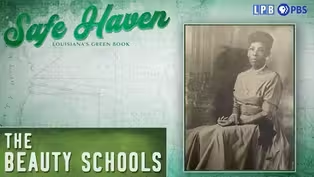
The Beauty Schools | Safe Haven: Louisiana's Green Book
Video has Closed Captions
Clip: S2022 Ep3 | 6m 30s | The Beauty Schools | Safe Haven: Louisiana's Green Book (6m 30s)
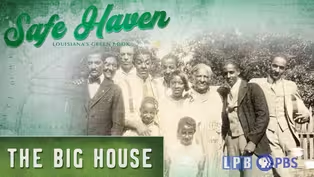
Video has Closed Captions
Clip: S2022 Ep3 | 4m 17s | The Big House| Safe Haven: Louisiana's Green Book (4m 17s)
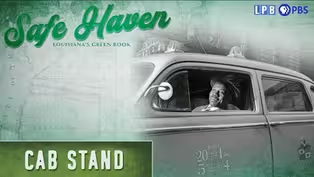
Cab Stand | Safe Haven: Louisiana's Green Book
Video has Closed Captions
Clip: S2022 Ep3 | 4m 38s | Cab Stand | Safe Haven: Louisiana's Green Book (4m 38s)
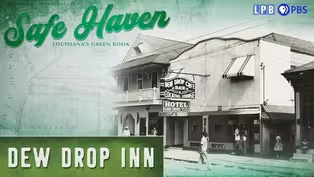
The Dew Drop Inn | Safe Haven: Louisiana's Green Book
Video has Closed Captions
Clip: S2022 Ep3 | 5m 12s | The Dew Drop Inn | Safe Haven: Louisiana's Green Book (5m 12s)
Dooky Chase's Restaurant | Safe Haven
Video has Closed Captions
Clip: S2022 Ep3 | 6m 1s | Dooky Chase's Restaurant | Safe Haven: Louisiana's Green Book (6m 1s)
The Everready | Safe Haven: Louisiana's Green Book
Video has Closed Captions
Clip: S2022 Ep3 | 5m 16s | The Everready | Safe Haven: Louisiana's Green Book (5m 16s)
Horatio's Esso Service Station #2 | Safe Haven
Video has Closed Captions
Clip: S2022 Ep3 | 4m 11s | Horatio's Esso Service Station #2 | Safe Haven: Louisiana's Green Book (4m 11s)
Hotel Lincoln | Safe Haven: Louisiana's Green Book
Video has Closed Captions
Clip: S2022 Ep3 | 3m 58s | Hotel Lincoln | Safe Haven: Louisiana's Green Book (3m 58s)
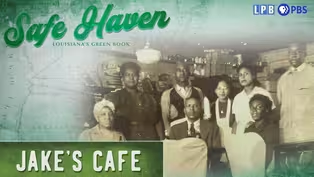
Jake's Café | Safe Haven: Louisiana's Green Book
Video has Closed Captions
Clip: S2022 Ep3 | 3m 30s | Jake's Café | Safe Haven: Louisiana's Green Book (3m 30s)
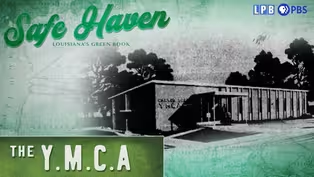
The Y.M.C.A | Safe Haven: Louisiana's Green Book
Video has Closed Captions
Clip: S2022 Ep3 | 3m 30s | The Y.M.C.A | Safe Haven: Louisiana's Green Book (3m 30s)
Providing Support for PBS.org
Learn Moreabout PBS online sponsorship















Support for PBS provided by:
Louisiana Public Broadcasting Presents is a local public television program presented by LPB
The Foundation for Excellence in Louisiana Public Broadcasting