
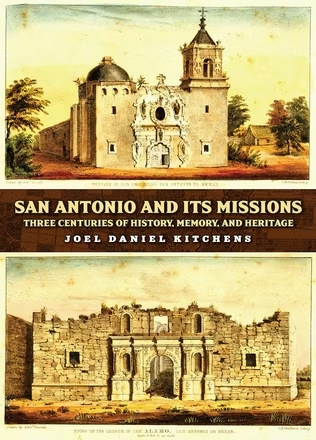
“San Antonio and Its Missions: Three Centuries of History, Memory, and Heritage” by Joel Daniel Kitchens
Season 2026 Episode 9 | 28m 32sVideo has Closed Captions
Joel Daniel Kitchens joins to discuss his book, "San Antonio and Its Missions".
Joel Daniel Kitchens, author of "San Antonio and Its Missions: Three Centuries of History, Memory, and Heritage", discusses his new book that explores how and why Spain built the missions, what happened to them after the Spanish left, and how they came to weigh so heavily in the American imagination, even into present day.
Problems playing video? | Closed Captioning Feedback
Problems playing video? | Closed Captioning Feedback
The Bookmark is a local public television program presented by KAMU
“San Antonio and Its Missions: Three Centuries of History, Memory, and Heritage” by Joel Daniel Kitchens
Season 2026 Episode 9 | 28m 32sVideo has Closed Captions
Joel Daniel Kitchens, author of "San Antonio and Its Missions: Three Centuries of History, Memory, and Heritage", discusses his new book that explores how and why Spain built the missions, what happened to them after the Spanish left, and how they came to weigh so heavily in the American imagination, even into present day.
Problems playing video? | Closed Captioning Feedback
Where to Watch The Bookmark
The Bookmark is available to stream on pbs.org and the PBS app.
Related to This Episode
Providing Support for PBS.org
Learn Moreabout PBS online sponsorshipHello, and welcome to The Bookmark.
I'm Christine Brown, your host.
Today my guest is Joel Daniel Kitchens, author of "San Antonio and Its Missions: Three Centuries of History, Memory, and Heritage."
Joel, thank you so much for being here today.
Thank you so much for having me.
I'm excited to talk about this book because on the one hand, it's a topic maybe people love and hold dear to their heart.
And then on the other hand, maybe it's the rest of the story that they are overlooking or aren't aware of.
So it's kind of a fun refresher on what you know.
And here's a bunch of things you maybe you didn't know.
Yeah, that was the attempt.
Wonderful.
I want to start by asking you to just introduce the book to us.
The book is really a culmination of about 20 years of work and photographing the missions.
It it started with a photograph.
I was looking to move, transition, from a 35mm camera to a large format camera.
And because I'm not a native Texan, I'm not Catholic.
I started taking pictures of these missions and it really wasn't sure what I was taking pictures of.
So I started reading more about the missions and what the decorations and what meant, and I started realizing there are stories here that have not been told and things kind of escalated or snowballed.
They went to a PhD program in history at Texas A&M University.
It went to a dissertation and that I earned in 2016.
And now in 2026, it's a full blown book.
And yes, there were ten years of a lot of revision and additional research between the completion of the dissertation and the completion of this book.
I think, you know, I actually don't have a lot of dissertations turned books on this program, which I think is surprising to maybe to some people.
We're on a world class university.
I actually used to work in the thesis office.
I used to edit dissertations.
I was that lady with the ruler that you would have hated.
But there is a lot of work to take.
I mean, it's already a lot of work to to write a dissertation, but then to turn it something that is purely academic that maybe not a lot of people will read, unfortunately, because there's amazing research out there in dissertations into a book that, I mean, this is still certainly an academic book that's got wonderful research, but something that the lay reader may enjoy and consume a little more readily.
And that really is one of the important goals that I had for the book, was it had to be a credible product of original research, but also I wanted it to be able to be sold in the gift shop at Mission San Jose in San Antonio.
So it's there's a wonderful book, I believe, by the by a man named William.
A University of Chicago publishes it, and it's going from dissertation to book.
And basically the dissertation was written for 4 or 5 human beings on the face of the earth.
The book, I hope, has a much broader appeal than than just my dissertation committee.
The book is written for an academic, certainly an academic audience, but also a well-informed layperson.
That's, you know, I'm I was at the San Antonio Book Fest a month or so ago, and my host there at, at my session was one of the park rangers at the San Antonio Missions National Historical Park.
And she mentioned that they had actually sold out of my book at the park's gift shop.
Wonderful.
So you've hit that 4 or 5 person goal, I think, pretty quickly and then multiplied it a few times.
I'm sorry, I hope so.
Yes, I certainly hope so.
So I want to talk about your research process.
I you know, obviously you were visiting archives, but I know there's newspaper clippings and of course, you've visited the mission several times.
How often were you actually on site at these places?
Was it a lot of travel?
Yes and no.
Fortunately for me, it's it's not like some of my colleagues in history who's whose research takes them to other parts of the world.
San Antonio is just a three hour drive from my home in College Station.
So in that respect, not that much travel.
But on the other hand, I've lost count of how many times I have been to the missions, but also to the research libraries of the daughters of the Republic of Texas, the Archdiocese of San Antonio, the San Antonio Conservation Society.
I actually had a grant that took me up to the Gallia Library at Southern Methodist University.
So it's practically all of my research was here in Texas.
But I will say one thing.
The book could not have been produced without the electronic resources that the Sterling Evans Library at A&M has.
And in.
I kind of consider it that I was I was cheating, but not really because my day job at the Texas A&M for nearly a quarter of a century was being a librarian.
So when we would get new resources, I would have ready made searches to go through and see how these things worked.
What did they have in them?
So I would I would use the electronic resources, our newspapers and magazine archives and and more to.
Well, it's not really a supplement, but it's there about probably about 5050 to actually plowing through the musty, dusty archives and looking at a book printed in the 1700s in Spanish versus looking at a magazine online.
So let's go back three centuries.
What?
When are we talking about?
When were these built?
Why were these built?
How did how did they come to existence?
Well, the Spanish had been trying to extend their empire north from Central and South America into the North American continent.
And.
The short answer is they were trying to do this on the cheap because rather than send a conquering army into the frontier, they were sending a few friars, Franciscan friars and a handful of soldiers to go in and bill establish a mission to bring the indigenous people, local indigenous people, to the mission and become good Catholics.
And then extension they would be.
They were set up and taught European farming practices, animal wrangling, all that kind of good vocational skills to be a villa on the frontier.
And one thing that a lot of people don't realize, I think about the missions, is they were supposed to be temporary.
They were only supposed to last about 10 or 20 years, because once the friars had completed their work with the indigenous and basically taught them how to be good Catholics and how to be good Spanish Crown subjects, they turned the mission churches over to the diocese, and they were supposed to go further into the further into the frontier to start this process all over again.
So it was a slow growth of both the Catholic Empire and the Spanish Empire.
The.
But things didn't always work perfectly in the New World.
And they had the Spanish had established missions in what is now East Texas, ostensibly for the Cato, but the Cato really didn't need what the Spanish or they didn't think they needed what the Spanish had to offer.
So after a while, the those missions were closed.
Well, then the French started making incursions into the area.
France and Spain are international rivals, European rivals.
But this is playing out in the North American continent.
So Spain restarted those missions.
They.
But they were far away from the nearest Spanish base, which was at the Rio Grande.
And so the San Antonio missions were set up.
The first one, San Antonio de Valero, was set up in 1718 to be a way station between the Rio Grande and those East Texas missions, and 1730.
The Spanish finally pulled the plug on those East Texas missions and moved three of them to San Antonio.
I always love when we can highlight these pieces.
America is not that old of a country, especially when we're talking about places like Spain and Europe.
They've got they've got much longer, richer recorded history and structures than we do.
But it can be easy to forget that.
We also have, you know, pre founding of our country, a lot of rich place here in Texas, in California and New Mexico.
There are these extant missions that served a purpose and then maybe didn't anymore and were continued in use or left to ruin.
I mean, there's similar and I would hope maybe this book would inspire people to first start with our backyard, look and see what we've got.
But, you know, there are there are some of these all across the southwest.
That's right.
That's true.
The Spanish borderlands really encompasses from Florida all the way to California.
That was all Spanish territory, even into the 17, even as far as the sum of parts in the 1800s, when the Mexican Revolution or Mexico declared independence.
But yeah, it was a the American history does not start just with Plymouth Rock.
Absolutely not.
I also want to make sure we're talking about multiple missions here, the book and our our history and our memory attaches a lot of meaning and therefore space.
Because if you're talking about memory and heritage, the Alamo is going to loom large.
But there are four other missions who I think you probably want to get their due and get their their maybe moment in the sun.
I think they should the of course, the Alamo Mission San Antonio de Valera was the first one founded in 1718.
But just two years later, Mission San Jose was founded just a few miles down the river.
And then ten years, about 1730 1731, those East Texas missions were pulled back and restarted in the San Antonio area.
So you have the Alamo or Valero, if you will.
Mission Concepcion, San Jose, San Juan Capistrano and Saint Francis, Francisco de la Espada.
And together it's one of the largest concentrations of Spanish colonial architecture in North America, which that was a really interesting draw for me.
I like old churches.
I hope this won't be too much of a rabbit hole, but when I was in high school, I had just finished high school.
My family went over to Great Britain and our first Sunday there I went to a church service in a church that in the year 1907, a long time ago, by American terms, they had celebrated their 1,000th anniversary as a congregation.
Wow.
So that so yeah, that kind of stirred up the interest in historical architecture for me.
But I want to talk about how I think maybe we think of visiting the Alamo as a more modern phenomenon, as a 20th century phenomenon.
But I really loved reading about these, the myth of of the Alamo.
We started almost, but then the travel tourism also started very quickly, or maybe began or even earlier than that.
People were visiting these missions and writing back home about the the romance and the they were they were already myth building.
It was.
Yes, it was.
That was one of the fascinating features that I would, as I was doing the research for the book, is people would say, oh yeah, the missions there just they got forgotten about once they were secularized.
And that was the term for closing down the the mission and becoming a local church, local parish church is that people said once that happened, they were just forgotten about.
But then I started finding the travel narratives and the booster literature, where of people who were trying to bring Texans or, excuse me, people to Texas, and not just from the United States, but also people from Britain, people from Germany.
And one of the draws were the missions.
And I was thinking, wait a minute.
What's going on here?
What is it about this?
And so that was suggesting to me that these missions and it wasn't just the Alamo, because I found a couple that were made before the Alamo became known for the Alamo.
But they the people were talking about these beautiful old Spanish churches.
And yes, some of over time they deteriorated.
Some of them were falling down.
And that just seemed to add to the romance.
The more dilapidated these things looked that, oh, that was so much more romantic.
But it was it became fodder for tourist literature, and especially after 1877, when the railroad comes to San Antonio, that's when the tourist traffic starts exponentially.
And the the missions are really sort of come into a start, commanding a lion's share of the descriptions in those.
I have to just mention, because it was fascinating to me, I did not expect to see Oscar Wilde's name in this book, but he was one of those people who came to visit and wrote and expounded on the beauty of of our missions in San Antonio.
So if you're if you're a literature fan, there's even something in here for you.
Maybe Oscar Wilde, Stephen Crane, Sidney Lanier are just some of the people who were who visited and were impressed by the missions.
I do want to mention, because they were falling into ruin.
And then there became this kind of groundswell to to save our missions.
And it's called the The Second Battle of the Alamo in the book that can you talk a little bit about about what was happening there?
Sure.
They were noticing that the Alamo and really the San Antonio de Valero as a mission was founded outside of the Villa de bear.
But over the century and decades, the town had really grown up to the mission.
And as people were coming, and especially as people from the outside were coming, they were noticing that, oh, this is such a sacred place where this massacre took place.
Why aren't you taking care of it?
They would admonish the city fathers of San Antonio, say you should be taking better care of of this, because this is really important.
And a lady named Adina De Zavala, who is a relative, I think she's the granddaughter of one of the signers of the Texas Declaration of Independence, Lorenzo de Zavala.
She began.
She and some like minded women began raising money to try to take to take care of the missions.
The.
It started with the Alamo and then, but the Alamo, because it was so close to town, it had it had been part of that property, had been co-opted by a as a warehouse for a local grocery.
And so they were trying to parse out what they could buy and what they couldn't.
And there was a shortage of funds.
And so they contacted a socialite and a lady named Clara Driscoll, who was from South Texas.
And she put up the money.
But for this sort of turned into a forced and bargain.
And she does a villa.
And Driscoll soon started falling out over what was the Alamo, what needed to be preserved for Desert Valley.
The whole compound was the Alamo.
Not just the chapel, but the long barracks, the wall space.
That whole thing was the Alamo for Driscoll.
Yeah, it's really the chapel.
And part of it plays into the myth of the chapel was where the last stand of the Alamo defenders would have been.
Well, maybe so, maybe no.
But this was certainly the Driscoll factions interpretation.
So they were concentrated on preserving the chapel as opposed to the long barracks.
And it got complicated, very complicated, when a group of investors from Saint Louis wanted to build a hotel next to or near the Alamo Chapel, and they were willing to front money to for the surrounding property if they got rid of the long barracks.
And for Adina does that was impossible.
That was part and parcel of the Alamo.
You can't tear that down.
So it was that the disagreement and schism really between the, the these two factions of the daughters of the Republic of Texas became the second battle of the Alamo.
And there's there's much more on that we can't cover, unfortunately, everything.
I want to jump ahead just a little bit, because in the 70s, a little bit, it's like 70 years.
That's when Jimmy Carter signed to make the other four missions national in the national park system.
Yes.
Can you talk just a bit about that?
Sure.
The idea that these missions should that the San Antonio's mission should be preserved and put under the egis of the national Park actually goes back to the 1930s.
And Mayor Mari Maverick had sort of done a little bit of work back then.
It became a state.
San Jose became part of a state park, but it didn't go much further than that.
But after going up into the 70s, there was a feel that these missions need more protection than than what the diocese is able to give.
And so there was the effort to bring it under the protection and of the National Park Service.
Now, President Carter.
Yes, he signed the declaration to make these part of the Park Service, but then he withheld the funds to effectively pay for the the operation.
And that was a real bone of contention for a while, because it was really kind of a half victory for the people who were really wanting the the people of San Antonio who really wanted to both protect the missions, but also to to use the missions to bring in more tourists to San Antonio.
It wasn't always a popular decision, and some, even 1 or 2 of the priests who were serving the parishes at the missions were not in favor of putting these under Park Service protection.
So it's it got very, very complicated, very, very quickly a lot of and that that seems to repeat itself through our history here.
We lots of lots of different interests are happening at once.
We can't really get into it.
But the Unesco world Site designation later on, again, the same kind of thing.
Texans can be a little territorial and then the church can be a little territorial.
And it's fascinating and I would hope people would read more about it.
But we're running a short on time, so we're going to wrap up in our final minute.
What would you hope people take away from the book?
History is messy, history is very messy, and the missions are a prime example of all this messiness that you see so many people who are making claims based on their collective memory, their heritage, their documented history.
It's it's just a very messy situation.
But then again, that's that's history.
That's life.
That's what we as historians do, is we write about life history in all its complexity.
Well, I have to say as much as one can.
You had a wonderful job of trying to untangle or at least show us all these threads and how they got tangled, because it's 300 years of various people.
And then you would, like you say you attach this memory, you attach this myth, you have a Disney movie, you have John Wayne.
We didn't even cover all that.
But, you know, the myths loom large and wild.
History get in the way of a good story.
Yes, all of that is in here.
And I appreciate you trying to clarify.
You know, where we can.
What happened, what didn't and what what we know.
Yes.
Thank you.
This is just really a fascinating book.
I would hope anybody who loves our Texas history or travel or missions or anything, it would take a look.
So thank you so much for being here and for writing the book.
Thank you so much for having me.
It was a real pleasure.
That is all the time we have for today.
The book again, is "San Antonio and Its Missions".
Thank you so much for joining us.
I will see you again soon.










Support for PBS provided by:
The Bookmark is a local public television program presented by KAMU