
Saving Shipwrecks and Sturgeon
Season 1 Episode 27 | 26m 46sVideo has Closed Captions
Marine sanctuaries protect shipwrecks while volunteers guard sturgeon against poachers.
Archeology students and Host Ward Detwiler study shipwrecks at Thunder Bay National Marine Sanctuary, NOAA designates a new sanctuary along Wisconsin’s Lake Michigan shoreline, and volunteers guard lake sturgeon against poachers looking for valuable caviar. Episode 1027
Problems playing video? | Closed Captioning Feedback
Problems playing video? | Closed Captioning Feedback
Great Lakes Now is a local public television program presented by Detroit PBS
Saving Shipwrecks and Sturgeon
Season 1 Episode 27 | 26m 46sVideo has Closed Captions
Archeology students and Host Ward Detwiler study shipwrecks at Thunder Bay National Marine Sanctuary, NOAA designates a new sanctuary along Wisconsin’s Lake Michigan shoreline, and volunteers guard lake sturgeon against poachers looking for valuable caviar. Episode 1027
Problems playing video? | Closed Captioning Feedback
How to Watch Great Lakes Now
Great Lakes Now is available to stream on pbs.org and the free PBS App, available on iPhone, Apple TV, Android TV, Android smartphones, Amazon Fire TV, Amazon Fire Tablet, Roku, Samsung Smart TV, and Vizio.
Providing Support for PBS.org
Learn Moreabout PBS online sponsorship- [Narrator] On this edition of Great Lakes Now, studying shipwrecks on Lake Huron.
- Of course it's the fresh water, right?
So it preserves these wrecks much better than salt water would for a similar wreck.
- [Narrator] Protecting shipwrecks in the new National Marine Sanctuary.
- It's gonna be a fantastic thing, not just tourism, but for the preservation of the resource itself.
- [Narrator] And, guarding lake sturgeon against poachers, as they swim upstream to spawn.
(upbeat music) - This program is brought to you by the Fred A. and Barbara M. Erb Family Foundation, the Charles Stewart Mott Foundation, Laurie & Tim Wadhams.
- The Consumer's Energy Foundation is committed to serving Michigan, from preserving our state's natural resources and sustaining our future, to continuing business growth, academic achievement, and community involvement.
Learn more at consumersenergy.com/foundation.
- The Richard C. Devereaux Foundation for Energy and Environmental Programs at DPTV.
The Polk Family Fund, Eve & Jerry Jung, the Americana Foundation, the Brookby Foundation, Founders Brewing Company, and viewers like you, thank you.
- Hi, I'm Ward Detwiler.
Welcome back to Great Lakes Now.
The Great Lakes hold an incredible collection of shipwrecks and each tells a fascinating story, but how are they studied?
I went to the Thunder Bay National Marine Sanctuary to find out.
The Great Lakes are dotted with thousands of shipwrecks, some hundreds of years old, they all offer information about the history of the Great Lakes.
Shipwrecks can be found by accident, but the scientific techniques for finding and studying them involve hard work, persistence and good old arithmetic.
(upbeat music) I recently traveled to the Thunder Bay National Marine Sanctuary, in Alpena, Michigan to sit in on an Archeology Field School course.
I learned a lot about how sunken ships are studied and documented.
I even got to do some of it myself.
- [Woman] Hey, Ward!
- Hey, good to see you.
- Hi.
- Thanks for having us up here.
- Yeah, absolutely.
- Thanks for coming.
- Yeah.
- Welcome to Alpena.
- Minutes after arriving at the sanctuary, I was put to work assembling an ROV, or Remotely Operated Vehicle.
These underwater robots are a big part of the project.
(mallet banging) - Very delicate work.
The students are with Dr. Ashley Lemke, a Professor of Archeology at the University of Texas, Arlington.
They're here to learn underwater mapping skills used in archeology, specifically locating and studying shipwrecks.
With my ROV all built, it was time to put it to the test.
- This coulda been a disaster, but we'll see.
(student laughs) - [Ashley] So we'll very delicately put your ROV in and see how it goes.
One of the students will help you out with your cable, so it will stay out of way, and then you're doing it.
You're piloting your ROV.
- And if you want to go in a straight line, push them both at the same time.
- Putting with a hand-built ROV in a small pool is important.
You need to practice maneuvering this device before trying to drive a real ROV around shipwrecks and Lake Huron.
The waves and the lake currents can make it tricky to steer the vehicle.
Next lesson, crunching some numbers.
- Ward, I'm gonna have you join this team right here, Ashley and Jonathan.
So you guys can work together and create your surveys.
- I worked with a couple of students to create a survey pattern.
This is an important tool that's used a lot in underwater archeology to find sunken vessels.
A boat with a sonar scanner will follow this path, map areas of the lake bottom or shipwreck sites.
- That's just where we are.
- It's kind of like a starting point and then - So you put that as like the middle.
- You build from there.
- And we know we need to get at least 50 meters in either direction, - Yeah, but- - But maybe a little more.
- Without a survey pattern for the boat to follow, it's like doing a cross country drive without a map.
Dr. John O'Shea is an anthropology professor at the university of Michigan.
He's explored many shipwrecks and is considered an expert in Great Lakes, archeology.
- And what we did with the students is basically kind of threw them in and said, okay, here's the, here's the pieces of information you need to know.
This is the size of the boat.
This is about where we think it is, and UTM coordinates.
Design as a survey.
- Using side scan sonar, the research boat called Blue Traveler will follow the survey patterns the students create.
The sonar data can then be used to produce a 3D digital picture like this one, that shows what lies on the bottom of the lake.
So we just spend time in the classroom, planning out our route for the scan.
- Right.
- And now we can go put it into practice and see what we find.
- Yeah, absolutely, so it's a lot of classroom time making those maps and getting your routes altogether, but one of the most exciting things is then to actually go and get to drive that route on the boat and tow the sonar behind you and see what you find.
- Cool, well, let's go find a shipwreck.
- Yeah, absolutely, let's go.
- Awesome.
- You guys ready?
- Yep.
- Okay.
- Let's do it.
- Thunder bay national Marine Sanctuary includes 4,300 square miles of lake Huron's waters and almost 100 named shipwrecks.
Today we're tying off the blue Traveler on a buoy marking the wreck of the Harvey Bissell, a wooden three masted schooner barge that sprang leak and sank in November of 1905.
It rests just a few hundred yards off shore.
Now is the moment of truth.
I get to pilot an ROV around a real ship wreck.
And this ROV has a name, Jake.
- Hey, Jake.
- This is him.
- [Narrator] Jake is a much more sophisticated version of what I built in the classroom.
Jake even has his own Facebook page with more than a hundred fans.
- [Ward] So is he pretty much together?
Like, do you have to do any stuff besides hook the cable up.
- All you gotta do is, he has a manipulator, that claw at the front, you just kind of loosen it and angle it to where you want it to go.
So this goes here, and that's what connects him to the boat.
- Jake gets hooked up to a 500 foot cable and then is sent overboard to do some exploring.
- There he goes.
See ya, Jake.
- ROV's like Jake are an important tool for giving researchers an up-close view of wrecks and other underwater features.
- Out of all the technology we use, underwater archeology is so technology heavy, but the ROV is one of the most important things because it gives you a picture of the bottom.
You'll have sonar maps, so you have an idea of what's going on, but this is the first time with Jake where you really see things the way that you would see it, if you were scuba diving.
One of the really cool things about the Great Lakes, of course, it's the fresh water, right?
So it preserves these wrecks much better than salt water would for a similar wreck.
It's really cool, these wrecks had such a long life where they were kind of used and then they were kind of rebuilt and something else an then used again.
So you can see this, this history and this life history, really of this one shipwreck just by looking at it this way.
- After a long day of working underwater, it was time to bring Jake back home.
The cable is reeled in, and Jake is carefully lifted out of the water and placed on the deck of the boat.
As valuable as Jake is, it's the Blue Traveler's sonar that will scan the rack and create a 3D image that will go into the archives of the Thunder Bay National Marine sanctuary.
The students and I have learned a lot by the time captain O'Shea fires up the engines and heads for home.
- Archeology is one of those fields that everyone always thinks of happening elsewhere.
You know, you always think of archeology in Egypt or Rome, or are these far away places.
And one of the most important things for me as an archeologist, like I work in the states, I work where I grew up, you know, or I work where I teach or I work where I went to school.
So archeology is all over the place.
- Shipwrecks are very evocative because every shipwreck, every, every historic ship record at least has a story.
And it is, you know, you, you may know the names of the people, your captain, where it was going, where it was coming from.
In fact, the reason I got involved in shipwreck, archeology had to do with a, the remains of a vessel that turned up on our beach on Lake Huron, and a bunch of jet skiers were there ripping timbers off it to sell as shipwreck timber.
And I, this just mortally offended me.
If you rip that stuff up, we may never be able to identify the boat.
And if we can't identify the boat, we can't put the story back with it.
(upbeat music) - Well, the good news is not only did we have good weather, but we had a really good survey too.
- Awesome.
- Really great.
- Obviously it was all the students who, you know, were the reason for the success, but now, now what do you do with that image?
How is that used?
- So our work today is actually gonna go in their archives.
So they're gonna have a brand new, really great survey, a really great map of that shipwreck, and then people who are coming, archeologists or the public, can see this really beautiful image of one of the wrecks that's just out here.
- Oh, that's awesome.
So it actually can get used in real scientific work.
- Yeah, absolutely.
If you wanna switch careers and be an archeologist, let me know.
I'll put you to work.
(laughing) - We'll see how things go, but thanks so much for having us.
Since the year 2000, Thunder Bay has been the only U.S. National Marine Sanctuary on the Great Lakes, but that's about to change.
Soon, we're likely to have two new fresh water National Marine Sanctuaries, and Canada has set aside parts of the lakes as well.
- On June 22nd, 2021, there was big news for lake Michigan, the National Oceanic and Atmospheric Administration, or NOAA, designated the Wisconsin shipwreck coast.
It's only the second National Marine Sanctuary in all of the Great Lakes, covering 962 square miles and including 36 nationally significant historical shipwrecks.
- So the sanctuary, this sanctuary protects cultural resources, primarily shipwrecks that are, you know, icons of our collective past, the Great Lakes to much of its history, and even today is an economic engine for North America.
- The new sanctuary runs along Wisconsin's Lake Michigan shore, from Two Rivers in the north to Port Washington in the south.
- So this nomination was really driven by the national significance of the collection of shipwrecks here.
And, you know, they represent a time period from the 1830s to the 1930s, where commerce was booming on the Great Lakes.
That story is captured here.
And the places that made that happen are well preserved right here in the Marine Sanctuaries.
- The sanctuary designation was a long time coming.
It's the result of a years long effort by the communities on the lakefront.
- And really the communities along the lake shore, Two Rivers, Manitowoc, Sheboygan, Core Washington with the state, you know, got together and said, we have a vision for a place here.
We'd like to protect these places.
We'd like to couple that with tourism, we wanna couple that with broader Lake Michigan conservation.
And so they had a vision for a national Marine Sanctuary that they thought that was a really good fit for this area.
- Justin Nichols is the mayor of Manitowoc.
One of the coastal communities that's part of the new Marine Sanctuary.
- Manitowoc is the quintessential Midwestern city, I would say, I mean, Lake Michigan and the Manitowoc River, the confluence of those two bodies of water really is what built our community.
And since early 18 hundreds, we were building schooners here.
- The proposal also had the backing of cultural institutions like the Wisconsin Historical Society.
- We believe it will inspire people.
And so whether it's being able to go under water and take your own dive, or whether you're a kayaking over a three masted schooner that is only 10 feet below you, we think that people will be inspired by these wonderful stories, because it means real live connection to the lake history, the maritime history, and a history that maybe is lost for some people.
- Also supporting the proposal, the Wisconsin Maritime Museum.
- The Maritime Museum here really is the jewel and the crown of our tourist attractions.
And you know, the cultural hub of the town we've been here for over 50 years.
You know, the really interesting thing about this designation is that it started in these communities, rather than try to vie for Noah's attention, decided to come together and put together a unified application for this entire coast.
So for over 10 years, we've all been working together to bring this to fruition.
So it's gonna be a fantastic thing for not just tourism, but for the preservation of the resource itself.
- Noah is currently in the process of using sonar technology to map the new sanctuary.
- This is the coverage that we've gotten so far off the coast of Sheboygan.
Within this box is our work area, so we have more work to do.
- Today, they're, they're doing that in the Marine Sanctuary, but we can take that data, they'll be mapping the sanctuary with the sonar, basically painting the lake bed with sound, getting an image of it.
And it's really the first time we've had a detailed look at the lake bed here in the Marine Sanctuaries.
- [Ward] This is the wreck symbol.
There's a wreck, that we put in the chart here, mariners know not to put anchors or anything like that on there.
This particular one right here is where the Selah Chamberlain is on the chart.
- [Ward] You know, we can find cultural resources with that, shipwrecks kind of pop up on these sonars, but we can take that information and use it to learn about the lake bed, to learn about the lake bed type, habitat and the bacillus species.
So we, say we map once, use many times.
And so we'll be sharing this data with biologists and natural resource managers who can use this data to do the work they need to.
- [Lemke] The sanctuary designation isn't the end of the process though, the next steps include trying to determine what facilities will be created and where, and the communities that pushed for the sanctuary will have a say, as well.
- [Ward] We'll do an infrastructure study.
That'll be one of the first things we do.
And so we'll get together with the communities, and the state, and other stakeholders and say, you know, where would Noah's presence be?
If we could stretch it out across these communities?
What kinds of things do you wanna see Noah bring to those communities?
- I think the opportunities are just endless now that we have a national park in our backyard.
- But Wisconsin shipwreck coast isn't the only proposed sanctuary that's moving closer to reality.
Soon, there could also be a national Marine Sanctuary at the other end of the Great Lakes basin in Lake Ontario.
- We are looking for two possible areas to become the eventual National Marine Sanctuary.
The first area is an area that the local community submitted to Noah, and that is Eastern Lake Ontario.
The other area that we're considering is the Thousand Islands region of the St. Lawrence River.
- Eastern Lake Ontario contains 43 known shipwrecks and one aircraft.
And the Thousand Islands region holds 20 more.
Historical records suggest there are more to be found, but the aim is to make the history accessible even to non-divers.
- You know, it's very important for this sanctuary and all sanctuaries to appeal to people who may never get wet, because there are very few divers when you consider the percentage of the population.
So through our visitor centers and through our outreach materials, through our live distance learning programs, we need to get that shipwreck experience and the knowledge and imagery of resources that people may never see directly.
The sanctuary designation process takes several years.
We started this in April of 2019, and we're anticipating that we can have a sanctuary designated by the end of 2022.
- Canada's counterparts to the U.S. sanctuaries are called National Marine Conservation Areas.
There are two in the Great Lakes administered by Parks Canada.
Fathom Five in Lake Huron is the most easily accessible.
- Fathom Five, a National Marine Conservation Area, is just a beautiful location.
You can take a boat tour to go to the Archipelago Islands and see geological formations in the shape of flowerpots, which is a huge visitor attraction.
So in addition to that, there's also 27 submerged Marine ship wrecks that a lot of divers and other interested folks, and you can take boat tours around it, but Fathom Five is really unique and accessible to the Canadian public and tourism.
- [Lemke] Far more remote is Lake Superior National Marine Conservation Area, at the Northern tip of Lake Superior.
- Much more pristine forests and a much vaster, larger water in which to experience it.
So lots of folks there as well would also experience island adventures, but in a much more secluded atmosphere, much quieter, more tranquility, lots of opportunity for wildlife viewings and unique coastal features.
And so the protection and opportunity for conservation in these Marine protected areas are huge, but they also provide areas in which visitors can explore and opportunities for education and research and scientific and increasing scientific knowledge with regards to water-based national Marine parks.
- For more about Great Lakes shipwrecks and Marine Sanctuaries visit GreatLakesNow.org/shipwrecks.
Lake sturgeon are some of the most interesting and distinctive fish in the Great Lakes, but they're also valuable.
And that can cause problems.
- Lake sturgeon are known as the grandfather of the fishes.
They can reach a length of eight feet and live for more than a hundred years, but this once abundant species has become endangered in the Great Lakes, so many have taken extraordinary measures to save them.
- These five rows of boney-like plates, they're called scoots, which is a protective armor.
- In 1999, Brenda Archambault founded the nonprofit group Sturgeon for Tomorrow.
The mission: protect the lake sturgeon within Michigan's Black River and Black Lake at the Northern tip of Michigan's lower peninsula.
- There was gonna be a lake sturgeon management plan developed.
We wanted to have input on that, which we did.
We learned there was an inordinate amount of poaching going on in the upper Black River in the springtime, when the adults are in the river.
- Every year, starting in spring time, adult lake sturgeon swim up rivers like the Black River to spawn.
Females can carry more than 25 pounds of eggs.
That's what makes the fish targets for poaching.
Sturgeon eggs are sold as caviar and the eggs from a single female can sell for thousands of dollars.
- There's a criminal underground for sturgeon, the trade of sturgeon, specifically the caviar.
So we learned that there were families that would actually camp out on the river and literally fill the back of their truck beds up.
This is going on on our watch?
No, that's not right.
- To try to stop the poaching, Sturgeon for Tomorrow began recruiting volunteers to stand guard on the riverbanks and protect the sturgeon.
Lynn Heasley is one of this year's volunteer sturgeon guards.
She's about to start her first six hour shift.
- I have never done anything like this.
And what I especially love about it is it's a chance to participate instead of just observe.
And then having a small role of my own for a day.
I'm excited to find out what my site will be.
- The sturgeon guards first report to a base camp for training and assignments.
(upbeat music) - Once at base camp, they've already signed up, they know to go at what time, they're greeted with a sturgeon ambassador.
And the sturgeon ambassador is onsite, managing the volunteers that are coming in in shifts and being deployed at different locations throughout the river.
- You're on the 12 o'clock shift.
- Yeah.
- That's from 12 to six.
- In the base camp, you are given the binder, which has a lot of information in it, but primarily what are the rules and expectations of a sturgeon guard?
Is that where you stay?
- That's where we stay, that's our favorite spot.
We watch the sunset down the river.
- Oh my goodness, that sounds beautiful.
- Sturgeon guards don't actually intervene if they witness poaching.
Instead, they're instructed to take down as much information as possible and call the poaching hotline so that federal, tribal, state and local law enforcement can respond.
The approach seems to be working.
- Since we started, the poaching has just gone straight down.
The more eyes we've got on the river, the more witnesses we've got, the less they wanna be seen.
- I love the name guard, in sturgeon guard, because it makes me feel very important.
Like you have a purpose, but I feel a little selfish about that.
Cause really, it's just a great opportunity for me to be out here and learn a new river and maybe see a magnificent fish.
- The Sturgeon for Tomorrow Guarding Program has been so successful that the group has attracted visitors from all over the world.
- In the last few years, it's been more of a eco voluntourism opportunity for people to get out in nature.
Watch spring, come to life and get some nature therapy.
- But the increasing number of visitors to the area created a new problem, erosion on the riverbank from foot traffic.
- People were coming down to the river and this whole place was eroding.
And of course they put in these stops for the sand so that they wouldn't careen into the water and, and fill in the gravel.
But people get the idea that they're steps, and they wanna use them as steps to go down to the river.
- Now, in addition to washing for poachers, Sturgeon for Tomorrow volunteers try to educate visitors about the importance of using designated trails.
- We try to also get them to stay on the trails so that we don't lose the surrounding plant life that we need to hold the soil in place at the top.
- [Narrator] And it isn't just tourists and guards on the river.
The spawning run also attracts researchers from Michigan State University and the Michigan Department of Natural Resources.
- [Connie] Guys get in the river.
They are coming down.
Following the same path of the sturgeon would be coming up.
They weigh them, they measure their length.
They measured their girth.
They take a sample for DNA.
If it's a new catch off one of the pectoral fins, and they put tags on them, they put a pit tag on like you do your cats and dogs for the vet.
- [Man] The red tag you saw, means he's a male and we already captured him.
So we don't need to get any data from him.
- [Narrator] Once tagged, the sturgeon can be detected by antennas that are located along the river, allowing researchers to track their migration remotely.
Right now the Black River is the only place where the sturgeon are guarded by volunteers.
But lake sturgeon restoration efforts are taking place across the Great Lakes.
- They're native, they've been around a million years.
They deserve a little effort here.
And so the last 25 years, there's been a huge effort across the basin.
So we will be seeing more and more fish and people coming in contact with them.
And there's no other fish like them in the Great Lakes, as we know.
We'd love these fish to survive and thrive on their own.
That would be the ultimate, but will we see that in our lifetime?
They live a long time, right?
So maybe not.
So that's why we wanna instill that conservation stewardship ethic.
- End of the shift, 12 to six.
Magical day, it was wonderful.
I don't know if you can tell here, but we're in a really spectacular cedar forest.
So in addition to being on the water, communing with lake sturgeon, I got to commune with this wonderful setting too.
And to have some kind of connection, whether it's gardening or admiring or conserving a fish like the lake sturgeon is a kind of healing exercise as well.
And so, well, worth the journey.
- The Guardian Program has really become robust because it's all about people standing vigil over the fish that they care about.
- Thanks for watching, for more on Lake Sturgeon and the Great Lakes in general, visit GreatLakesNow.org/sturgeon.
When you get there, you can follow us on social media or subscribe to our newsletter to get updates about our work.
See you out on the lakes.
(upbeat music) (graphics whooshing) - [Narrator] This program is brought to you by the Fred A. and Barbara M. Erb Family Foundation, the Charles Stewart Mott foundation, Laurie & Tim Wadhams.
- [Narrator] The Consumers Energy Foundation is committed to serving Michigan, from preserving our state's natural resources and sustaining our future, to continuing business growth, academic achievement, and community involvement.
Learn more at consumersenergy.com/foundation.
the Richard C Devereaux Foundation for Energy and environmental Programs at DPTV, the Polk Family Fund, Eve & Jerry Jung, the Americana Foundation, The Brookby Foundation, Founders Brewing Company and viewers like you, thank you.
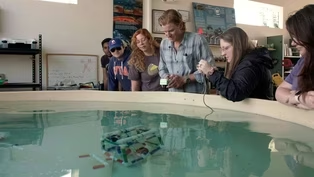
Video has Closed Captions
Clip: S1 Ep27 | 8m 33s | Shipwreck School | Episode 1027/Segment 1 (8m 33s)
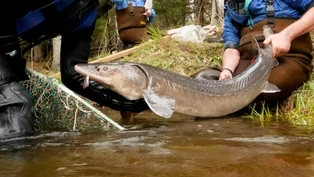
Video has Closed Captions
Clip: S1 Ep27 | 7m 36s | Some volunteers are protecting lake sturgeon from poachers looking for valuable caviar. (7m 36s)
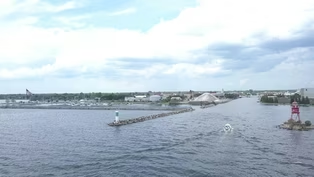
Video has Closed Captions
Clip: S1 Ep27 | 8m 55s | The Great Lakes could soon host new marine sanctuaries | Episode 1027/Segment 2 (8m 55s)
Providing Support for PBS.org
Learn Moreabout PBS online sponsorship
- Science and Nature

Explore scientific discoveries on television's most acclaimed science documentary series.

- Science and Nature

Capturing the splendor of the natural world, from the African plains to the Antarctic ice.












Support for PBS provided by:
Great Lakes Now is a local public television program presented by Detroit PBS