
Science in Flight
10/5/2023 | 26m 45sVideo has Closed Captions
Falconry, winter bird migration on the NC coast, slo-mo insect flight and fly-fishing.
Explore the ancient sport of falconry, and watch tens of thousands of migratory birds that winter on the NC coast at Pocosin Lakes National Wildlife Refuge. Plus, discover the beauty of insect flight captured at 6,000 frames per second and the science of fly-fishing.
Problems playing video? | Closed Captioning Feedback
Problems playing video? | Closed Captioning Feedback
SCI NC is a local public television program presented by PBS NC
Sci NC is supported by a generous bequest gift from Dan Carrigan and the Gaia Earth-Balance Endowment through the Gaston Community Foundation.
Science in Flight
10/5/2023 | 26m 45sVideo has Closed Captions
Explore the ancient sport of falconry, and watch tens of thousands of migratory birds that winter on the NC coast at Pocosin Lakes National Wildlife Refuge. Plus, discover the beauty of insect flight captured at 6,000 frames per second and the science of fly-fishing.
Problems playing video? | Closed Captioning Feedback
How to Watch SCI NC
SCI NC is available to stream on pbs.org and the free PBS App, available on iPhone, Apple TV, Android TV, Android smartphones, Amazon Fire TV, Amazon Fire Tablet, Roku, Samsung Smart TV, and Vizio.
Providing Support for PBS.org
Learn Moreabout PBS online sponsorship- Hi there, I'm Frank Graff.
A modern look at the ancient sport of falconry.
Why tens of thousands of birds spend their winter on the coast and insect magic in the air.
We're soaring with science in flight, next on "Sci NC".
- [Announcer] Quality public television is made possible through the financial contributions of viewers like you who invite you to join them in supporting PBS NC.
[gentle music] - [Announcer] Funding for "Sci NC" is provided by the North Carolina Department of Natural and Cultural Resources.
[gentle music continues] ♪ - Hi again and welcome to "Sci NC".
Falconry is the art of hunting with birds of prey, what we call raptors.
Falconry has existed for thousands of years.
Well, students from the UNC Hussman School of Journalism and Media, introduce us now to a master falconer.
- Put your feet down.
Put your feet down.
You're standing on your own.
Sometimes I don't even know what to do.
Step up, step up.
It takes a certain kind of person to become involved in falconry.
You gotta have some time, you gotta have some space.
Kind of messy though.
In the eighties, I worked in Montana a lot and I really enjoyed watching raptors.
I hunted raptors, took a billion pictures of them.
Then as my son got older and we finished up with scouts and soccer and all that sort of stuff, then it was time for me to go play with the birds and that's how I got going.
My name is Richard Shores.
I am a practicing falconer in North Carolina.
I've been doing this for, I believe about 17 years now.
The idea of falconry is you become your bird's hunting partner.
Birds are never pets.
The birds could care less.
They only want to eat.
They only want to go kill something.
That's the name of the game, that's their life.
It's kind of simple.
- This is one of the only cases where you get to work with a protected species as basically your partner for hunting.
My name is Falyn Owens and I'm the Extension Wildlife Biologist with the North Carolina Wildlife Resources Commission.
The Wildlife Resources Commission is responsible for issuing and managing falconry licenses.
We think it's a great sport so we wanna encourage people to get into it if they want to but also to take it very seriously because these are protected species.
There are specific birds that are allowed under falconry.
They're basically gonna be hawks and owls, falcons and in some cases, in some rare cases, actually, eagles.
But it does take a lot of know-how about the behavior and the needs of the birds.
Every species that can be used in falconry is different and has different needs.
- We've got two Harris's Hawks that we're going to be flying today.
The female's name is Lagertha.
She's flying at around 1,025 grams, quite a bit bigger than the male, that the male is flying about 625 grams and his name is Ragnar.
These birds hunt together, Harris's hawks hunt, cooperatively and then they honor each other on a kill.
They will help each other with killing the prey and then they will actually eat together on that prey.
[nature sounds] [birds chirp] This is the first day they've flown together this year so we'll see what happens.
Never can tell.
Take a perch.
[bell rings] All right, you ready?
Take a perch.
All right, now I usually come over here to my bird.
Pick up, pick up, pick up, pick up.
That means get up in the sky 'cause they can't do any hunting laying on the ground.
I gotta walk across the street over here and see what we find.
A little bit of briars here.
This is a great place to find some bunnies.
So, in falconry world, when we see a rabbit or see something the squirrel's want, what we say is ho, ho, ho, ho.
And then the birds are gonna be right on top of you.
[nature sounds] So, I have the transmitter to get away from me beyond bells and I got bells when they're close.
I have two different alloys on the bells so I can tell the male [bell rings] and the female on the bells the different tones so I can tell which bird's flying by me.
I go to bed at nighttime hearing bells, by the way.
It's just like, oh, there's a bell.
[sensor beeping] So the male's over there someplace.
Nice to know they're still with me and all.
The female, well, it says the female's over that way someplace.
[sensor beeping] Nope, female's over here someplace.
[bells jingling] Falconry's all about as much as just going for a nice walk in the woods.
Get your birds exercise, see things that you would not otherwise see.
I probably get something about every other time out, something like that.
We don't have a lot of real good falconry hunting spots around this area here.
I have to hunt to go find those.
This area here is a perfect example of an expanding economy where there's lots of land being sold, there's lots of houses being built, and every time you're built on something, you're displacing wildlife.
And you know, there's just, it's kind of an impact thing.
It's people impacting mother nature.
- On a broad scale, the biggest threat that most of our birds of prey face is loss of habitat.
So, development that cuts down a lot of the vegetation, trees, and old fields and shrubbery and things like that, those are the types of places that provide food and shelter for our birds of prey.
And when we develop the land and remove all of that, they don't have a way to survive.
But there's a lot of natural spaces mixed in.
So, it's not all doom and gloom.
Development is not always bad for wildlife but we do need to make sure that we provide the vegetation, the native trees and plants that can provide the food and shelter for them.
[bell ringing] - I'm gonna just put her leash on and you see she was a little bit hesitant coming but early in the season, we're still figuring stuff out.
I'm happy with what they did today.
I think they did just fine.
They followed nicely.
If we did jump something, they might've seen it.
As a beginning of the season, I'm pretty happy with the whole situation.
One of the beautiful things about being a falconer is you get to be close and personal to these natural things that go on every day around us.
It's not a badge of honor that I've got a raptor in my house.
It's something that I'm doing personally myself.
I like the experience of understanding just one more thing in the world around us.
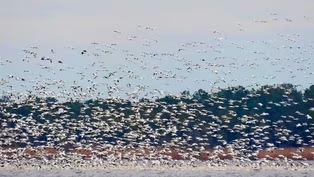
[bell ringing] - Beautiful birds, still in the air because North Carolina's coast is along the Atlantic Flyway hundreds of thousands of migrating birds spend their winter on our state, and our coast, and it's quite a spectacle.
[birds chirping] The dawn of a new day across Eastern North Carolina's farm fields.
But as light fills the landscape, wings erupt from those fields and fill the sky and swell and settle like a living breath.
And then you hear the sound floating through the air.
The call of tundra swans and snow geese.
[birds cawing] - It is just a fantastical experience.
I don't know, I've never seen numbers like that before where I see literal seas of white out on the landscape and they travel such a long distance that I think it's just that whole wonderment of like, how does it happen?
Why are they here specifically?
And like how, how are they just congregating like this?
And it's just so beautiful to see.
So people that are really into wildlife or really into birding, I mean, they get to see a species that's normally found in the tundra coming all the way to eastern North Carolina.
I just think it's just like one of those kind of like magnificent like awe inspiring type moments to see them out here.
[birds cawing] - [Frank Graff] The swans and geese are the show birds but tens of thousands of migratory birds, 19 species in all, spend from roughly November through February at the Pocosin Lakes National Wildlife Refuge and five other refuges along the North Carolina coast.
- I absolutely love it.
It's just, so I get excited to give programs 'cause I'm like, oh, I get to be outside and I get to see this really cool event.
Absolutely, this is like my favorite thing to do.
- [Frank Graff] And most of the birds eventually find their way to the Pungo Lake area of the Pocosin Lakes Refuge which is where Katrina Ramos leads visitors and shares her love of nature.
- A lot of these behaviors, you're just seeing them kind of relax out on the water.
They don't really have to worry about a predator out here in the middle of the water unless it's another bird of prey.
So, it's the most northern part.
Like if you think of like where Canada ends or where Alaska ends towards the north, that is the area.
- [Observer] Okay.
- Yeah, that's where they'll build their nests and have their babies all throughout the summer until they're ready for their next migration season down here.
- [Frank Graff] Ramos is with the North Carolina Chapter of the National Wildlife Federation and works as an Outreach Coordinator with the refuge.
- I am also like a super big dork, [laughing] so I'm like, look at it.
Could be the same thing happening over and over again.
And I'm just like, wow.
- [Frank Graff] And as if on cue- - Look at that entire flock that just went up.
Do you see the white in the sky right there?
- Yeah, oh, oh.
- Yeah.
- [Frank Graff] That white cloud on the horizon is not a cloud at all.
- [Katrina Ramos] Yeah.
- [Observer] Oh my gosh.
- [Katrina Ramos] It is a legitimate cloud on the landscape.
It is, yeah right, isn't it so cool?
- [Frank Graff] Tundra swans are temperature sensitive, not too hot, not too cold.
They nest in the Arctic, but then head south for the winter.
- Once they start realizing, you know, okay we've had our, our fledglings, you know the temperature's not kind of going where we want it to be.
We're gonna start following that colder temperature down the east coast.
Granted some of them do go down that western flyway but they're more, they're in larger numbers.
Coming down the eastern coast - [Frank Graff] The tundra swans have flown almost 4,000 miles from the north of Canada.
Scientists have clocked the birds flying at 100 miles per hour as high as 26,000 feet.
- [Katrina Ramos] They're really just eating food, hanging out, just waiting until the tundra's back into the season for them to start nesting and having babies again.
So it's just kind of part of them chasing the cold.
- [Frank Graff] The refuge is specifically managed for migratory birds.
- So they have a cooperative farming agreement that basically allows farmers that have land out here to farm their crops as long as it's in agreeance with Fish and Wildlife on the certain types of crops that they do.
Usually those are soybean and corn and then in return the farmers leave 20% of their crops for wildlife.
- [Frank Graff] But that could change.
Habitat loss and climate change threaten all of the migratory birds but especially the tundra swans and the snow geese - 1.5 degrees Celsius increase overall in the Earth's temperature, they completely stop overwintering in eastern North Carolina and they start moving more towards Michigan and the western part of the United States like Utah and Nevada.
We would never see them after we start reaching that one and a half degrees Celsius average increase over the entire earth, we would not see them in Eastern North Carolina anymore.
Hopefully, I don't have to experience that.
I'd be very sad.
[laughing] I'm really big into being outside, so the fact that I get to take other people outside and show them something as cool as this over and over again is just, I don't know, I'll never get tired of it.
- Let's keep flying, but this time with insects.
Adrian Smith from the North Carolina Museum of Natural Sciences captures earwigs in flight at 6,000 frames per second.
[gentle music] - This is something I've been trying to film for years, something I've seen captured in slow motion only a few times before, an earwig in flight.
[gentle music continues] At first glance, it's easy to miss that earwigs even have wings.
That's because they carry them around, folded up, and hidden underneath a small pair of hardened forewings.
Watch as this one unfolds and reveals its wings.
[gentle music continues] Wing folding earwigs is one of those magical fun facts in the insect hall of fame.
There are about 20 or so different fold lines in the wing and they fold up to be 10 times or more smaller than when they're outstretched.
[gentle music continues] No other animal wing comes close to this type of complexity.
And the species I filmed, a shore earwig seems to just use a single down and upstroke of the wing to throw it all open and snap it into place.
I don't think I've ever been more excited to have captured an insect flight sequence than I was when I finally got this.
Seeing these wings in action at 6,000 frames per second is amazing to me.
I'm glad I finally found a species that would cooperate and fly in front of the camera.
While those earwig clips are some of my favorite of the past year, I've also filmed a bunch of other new insect flight sequences.
So I put this together to show you some of my favorite captures of the past year, ones that haven't yet made it into a video.
[gentle music continues] This is a tree cricket.
They employ some impressive wing folding too as the hind wing is stored through a series of fan folds.
Once the wings are up, a big jump sends them into a flight.
I filmed grasshoppers and katydids before, but these are the first true crickets to make it into a video.
[gentle music continues] Next is another type of insect that hasn't yet appeared on this channel, a Trichoptera or what's better known as a caddisfly.
This is a northern caddisfly, which is a name for a family of more than 300 species.
I filmed these sequences and some others in this video over the summer in a makeshift studio in my mother-in-law's basement.
And you can see evidence of that in the dusty bits of cobweb stuck to the rear tarsal claws of the one on the right.
Here's another caddisfly from a different family, a giant casemaker caddisfly.
The casemaker part of the name refers to the aquatic larvae which constructs spiraling cases out of plant material.
These adults are brightly colored active flyers around the aquatic habitats they grow up in.
[gentle music continues] These are oak treehoppers.
A spring loaded kick from their hind legs sends them into a flight.
For the one on the left, slipping while jumping sends it into a flip but it's quickly controlled and steadied with the wing beats.
Some treehoppers, like these, go through a warmup routine before taking flight.
They flap for a bit, rocking their bodies up and down.
And compared to the oak treehopper, they seem to manage their spring loaded takeoff jumps a lot better.
[gentle music continues] Pull back, here's a look at both those species.
Their flight trajectories are wildly different.
The oak treehoppers start with a chaotic spin and the green tree hoppers with their keeled helmets arc upwards and end up in an inverted flight.
[gentle music continues] Speaking of inverted flights, this is a wheel bug flight that starts out great but ends up in disaster.
[gentle music continues] One thing you'll see that's interesting about this clip is when the wings come into contact with the platform.
You'll see them bend and absorb the impact, demonstrating some impressive material properties.
[gentle music continues] This is also something I've been trying to film for years not because it's hard to get a crane fly to fly but because it's hard to find them and then wrangle them in front of the camera with all their legs intact.
This one, a hairy eyed crane fly amazingly still has all six of its legs attached to its body.
It's incredible to see how much airspace it takes up in flight.
The front legs extend nearly a whole body length out in front, and the middle and hind legs do the same to the sides.
In the air, it's like a flying spindly cobweb.
[gentle music continues] This is a yellow-collared scape moth.
There are a bunch of subtle details to admire on this moth.
[gentle music continues] For instance, the transparent middle portion of the hind wing and the slight glimmers of iridescent blues and greens that reflect from the scales on its body when it maneuvers through the air.
[gentle music continues] Lastly, here's a natural enemy of moths, a braconid wasp, belonging to a subfamily known for attacking moth eggs.
They use their long ovipositors to inject an egg into a developing moth.
They're what's known as koinobiont parasitoids, which means once they're in their host, they allow it to develop and grow larger before eventually consuming and killing it from the inside.
- There's no flight in our next story, but there is the word fly and "NC Culture Kids" takes us fly fishing.
- Hey everyone, Emily here.
I'm at Stone Mountain State Park to learn a little bit more about some fly fishing in these cool clear mountain streams.
[gentle music] Hey, Ranger Michael.
- Hey, how are you doing today, Emily?
- I'm good, thanks for having me out here.
- We're glad to have you.
We're here today because this is one of the most popular spots for anglers from across the state to fly fish.
- Awesome.
Well, so fishing in my mind, I'm definitely picturing more of the like worm and hook situation but this definitely looks different.
- It is very different because mountain streams ecosystems are so much different.
So with lakes or reservoirs, what you have is you use a worm or night crawler and you're basically casting out and the fish are relying on smell to be able to find their food.
With the swift moving current that we have here in the park, what our trout are doing are they're actually watching for aquatic insects like mayfly, caddisfly, and stonefly to wash down to them for food.
- You said some interesting bug names.
Mayfly, caddisfly, stonefly.
I have no idea what any of those are.
- [Michael] These aquatic insects, they're actually called macro invertebrates.
- [Emily] Okay.
- Macro meaning that you can see them with your eye, invertebrate meaning they do not have a vertebra or a backbone and they're extremely important to our mountain stream ecosystem because the trout feed on the aquatic insects.
In addition to that, they're ecosystem consumers.
So these aquatic insects or macro invertebrates they're gonna eat all of the algae off the top of the rocks and they're also gonna help eat some of the leaves that are on the bottom of the stream.
- So the fish eat the insects and are those insects what you put on your hook?
- That's a great question, Emily.
Actually, what we do is we try to mimic or resemble one of the aquatic king snakes in the water and we pick a fly that matches it closely.
- I would love to find some, but before we start that, I would love to see you in action doing a little fly fishing.
- All right, let me demonstrate some casting for you.
[gentle music] - All right, let's catch some macro invertebrates.
I've got this net here.
How do I, where do I start?
- With that V-shaped net that you have, you can sit it down on the bottom of the stream but you can just start kicking around rocks.
So, you're gonna kick the rocks around on the bottom and you're just gonna let that water flow through the net after you've kicked around rocks for just a minute or so.
You wanna raise it up and take a look and see what you've caught.
We're not getting a whole lot of- - Oh, there's something.
- Did you find something in?
- Right there?
- Oh, good eye.
Good job, Emily.
So what Emily has found is she's actually found a golden stonefly.
You identify the stonefly by the fact that it has a two fork tail.
This one's a little bit different as it's lighter in color 'cause we also have a black stone fly here at Stone Mountain in addition to the caddisfly and then there's also mayflies.
And one thing that's really significant about these different species of aquatic insects or macro invertebrates that they're all indicators of a healthy water source.
So, this is good clean mountain water.
It doesn't have a lot of pollution in it, not a lot of sedimentation.
- Nice.
- We know by having these species that we have a healthy stream.
- Awesome.
All right, yeah, let's catch some more.
[gentle music] This is the big macro invertebrate.
A huge macro invertebrate.
[gentle music continues] [rod whooshes] [gentle music continues] - [Film Crew] So can you show it to Emily and like tell her about the species?
Nope.
Yeah.
- [Film Crew] Did you catch a leaf, Emily?
[gentle music continues] - Well Michael, I know we didn't catch any fish today but I am still having the best time out here fishing.
And I also wanna know how does the park help keep this beautiful water so clean?
- That's a great question.
So essentially as state park employees, we actually protect natural resources, which also means that we're managing our forest.
Tree cover gives the canopy so we have shade to keep the water cool.
In addition to that, the roots and the native grasses on the edge of the stream, they actually help to filter the water that runs into stream.
It prevents a lot of the sedimentation and erosion.
- Is there anything I can do on my next fishing trip or moving forward to help protect this area?
- Well, the biggest thing is by supporting state parks, you're actually encouraging habitat protection.
In turn, every time you buy a fishing license, part of those proceeds go to protecting fish habitat.
- Nice.
Well Michael, thank you again so much for having me out here.
I am now the the most excited fisherwoman that there ever was.
- Glad to have you and hope to have you back soon.
- And that's it for "Sci NC" for this week.
I'm Frank Graff.
Thanks for watching.
[gentle music] ♪ [gentle music continues] - [Announcer] Funding for "Sci NC" is provided by the North Carolina Department of Natural and Cultural Resources.
- [Announcer] Quality Public Television is made possible through the financial contributions of viewers like you who invite you to join them in supporting PBS NC.
Video has Closed Captions
Preview: 10/5/2023 | 20s | Falconry, winter bird migration on the NC coast, slo-mo insect flight and fly-fishing. (20s)
Providing Support for PBS.org
Learn Moreabout PBS online sponsorship
- Science and Nature

Explore scientific discoveries on television's most acclaimed science documentary series.

- Science and Nature

Capturing the splendor of the natural world, from the African plains to the Antarctic ice.











Support for PBS provided by:
SCI NC is a local public television program presented by PBS NC
Sci NC is supported by a generous bequest gift from Dan Carrigan and the Gaia Earth-Balance Endowment through the Gaston Community Foundation.