
Sculpting the Past
Season 2025 Episode 6 | 25m 51sVideo has Closed Captions
Sand art, vintage baseball, and Sauder Village surprises await this episode!
Scenic Stops & Stories features the incredible sand art of Carl Jara, historic baseball at Greenfield Village, and the Soda Fountain, Barber Shop, and secret speakeasy of Sauder Village.
Problems playing video? | Closed Captioning Feedback
Problems playing video? | Closed Captioning Feedback
Scenic Stops: People.Stories is a local public television program presented by WBGU-PBS
Sculpting the Past
Season 2025 Episode 6 | 25m 51sVideo has Closed Captions
Scenic Stops & Stories features the incredible sand art of Carl Jara, historic baseball at Greenfield Village, and the Soda Fountain, Barber Shop, and secret speakeasy of Sauder Village.
Problems playing video? | Closed Captioning Feedback
How to Watch Scenic Stops: People.Stories
Scenic Stops: People.Stories is available to stream on pbs.org and the free PBS App, available on iPhone, Apple TV, Android TV, Android smartphones, Amazon Fire TV, Amazon Fire Tablet, Roku, Samsung Smart TV, and Vizio.
Providing Support for PBS.org
Learn Moreabout PBS online sponsorship(bright upbeat music) (vehicle swooshing) (bright upbeat music) (vehicle swooshing) (bright music) (lively music) - [Presenter] On this episode of "Scenic Stops and Stories"... - [Andi] Here at Sauder Village, we bring the past to life.
So you step in the buildings, you smell the smells, you see the cooking, you engage with our wonderful staff.
- [Presenter] But first... - I am a competitive sculptor.
I've been competing in master level events since 1997.
(keyboard clicking) (gentle music) I hate this material.
I hate sand.
I hate it with a passion.
It is just, it gets in all of your equipment, it gets in your clothes, it gets in your house, it gets in your car, it's everywhere.
It's an obnoxious material.
(chuckles) (sand rustling) But for an artistic medium, man, you can't beat it.
(lively music) I am a competitive sculptor.
I've been competing in master level events since 1997.
And now I have this burning thing that I have to just get off my chest, so I'm gonna make the piece.
(chuckles) I dunno what to say.
(grunts) What I strive for with what I do in sand sculpture is, especially if I'm doing a contest piece or something related to where where it's not a commercial piece specifically, I really try to just describe the world around me.
There are a lot of times if you were to go back through my portfolio, I'm pretty sure you could just pinpoint the exact moment in time that those things occurred.
Because I am trying to describe in a fashion the world without it being too blatant and too raw.
You know, I'm not trying to give the news, I'm just trying to give an impression of what's going on.
To me, that's really what I strive for in my work.
With the commercial work, I'll give people what they want.
You know, you're paying for sculpture, I wanna make sure that you get what you paid for.
With the contest piece, I'm given a lot more artistic freedom, although some of my clients too just are like, "Hey, you do whatever you wanna do 'cause this is why you're hired."
(chuckles) And I appreciate those kind.
(gentle music) The Lake County Sand Sculpture Trail this year, it's just kind of a cool idea that the Lake County Tourism Bureau had.
They wanted to introduce public art out into their community.
So they're really investing in this idea of putting an artist out, working, talking, people can watch.
So we developed this idea of the trail and it's just a series of four pieces all the way along the coast of Lake Erie in Lake County.
This is a Osborne Park out in Willoughby at the far western end of Lake County.
And then Headlands Beach State Park, which is kind of in the middle.
Fairport Harbor, which is slightly to the east of that.
And then all the way out on the eastern edge of Lake County is Madison Township Park.
For the first three pieces that I did, I really wanted the pieces to kind of relate to their geographic locations.
Osborne Park sort of a celebration of the future Osborne beach.
Planning on building a breakwater and a peer out and that's gonna naturally build the beach for them.
And I incorporated that into a postcard with the future children playing at the future Osborne beach.
The piece of Madison Township is more about the location.
In that area, you have one of the highest concentrations of wineries in Ohio.
So we're just kind of celebrating that fact.
Osborne's very quiet and intimate.
You have to get up and look at it.
And Madison is just this huge thingy you almost can't step away at far enough to see.
The third piece at Fairport Harbor was really more about kind of celebrating the idea of the lighthouses and the Lake Erie monsters is they've got two lighthouses in the area and I thought it would kind of fun to play with the lighthouse, but then I find architecture to be a little stiff on its own.
So I thought I'd add in the Lake Erie monster to go with it, just to kind of tie in with the local lore and legend.
Now, what I'm doing here at Headlands is a completely different animal that's something more meaningful to me and about the current times that we live in.
(Carl grunts) So this seems stupid and counterintuitive, but I'm gonna carve right into the middle of this pile.
I'm just gonna dig a trench right through the center of it.
'cause I wanna save about half that sand to use here.
And if I don't have to move it over, I'm not gonna.
(Carl chuckles) I like moving sand.
I actually, it's one of the few times when my body feels normal is after I've shoveled about 10 tons.
(sand rustles) (Carl grunts) This also is a really good test to see how vertical the sand will go.
Ooh, that's nice.
Okay.
So all I'm doing here is I'm just gonna start packing out my base.
(sand rustling) My piece will intentionally kind of just be, it's an exploration in motion and trying to capture a moment of action.
(gentle music) So having good material is absolutely the first and foremost thing.
Having good sand to work with, and a sand sculptor can work with any sand, you know, we pride ourselves in that, but I've bit my tongue a few times.
I've had beaches that were so bad.
My sculptures were about three inches high and 16 feet across and I couldn't get any taller than that 'cause they just collapsed out.
The sand here at Lake Erie tends to be rocky.
It tends to be very round.
And you'll find that on almost any beach, you're gonna get rocky round particles.
When you're talking about like Gulf Coast sand, that gets a little bit better.
You can often find some nice fine sand, but often you'll have to add clay to it, otherwise, as it dries out, it loses its adhesion.
There's a thing called covalent bonding, which is when water gets between two panes of glass, you almost can't pull them apart, right?
It creates a almost a vacuum there.
Well that happens with sand castles on the beach.
If you add a lot of water, the water tends to hold the sand particles together.
But as soon as you eliminate the water, that's gone.
So the sand that I use here is a glacial till.
It's a very, very sharp, very fine grain, almost crystalline in structure.
It hasn't been washed and eroded so it's not rounded off.
As a result, the particles will clinging more like Velcro together.
They'll jam together and stay that way.
So when the water evaporates, I'm left with a matrix of material, not a bunch of failing covalent bonds.
(chuckles) (water rustling) Think tomorrow I bring an extra length of hose.
(water rustling) We're a little tight on the hose today.
(water rustling) I just, I wanna make an oval, but I wanna make an oval that'll eat up about a quarter of this pile.
So I'm kind of mentally going through in my head and I gotta think about that size.
And I'm thinking about the three sculptures I just finished up 'cause they're the same size.
And even though I've done this for 34 years, this is still the part that I am most likely to screw up.
There's really no easy way to do this.
(molder rustling) And there's no better time to second guess yourself than at the beginning.
Because if you're halfway through and you go, "Oh man, I made that form too big and I ran outta sand," you're done.
Now I don't carry around a lot of tools.
The guy who taught me carried enormous, enormous bag of tools.
Like I realized quickly that I didn't need an enormous bag of tools to do this.
I've got a couple of these small trowels that have worn down over the years, they work really nice for all of your little detail work.
I've got some larger trowels to do larger cuts.
I'll work with a shovel if I need bigger cuts.
And then if I am doing some really tiny things, I have just a single tool or two for really tiny detail work.
I figure if I have more tools than I can hold in one hand, I got too many tools.
And the fewer tools I have, the fewer tools there are to leave in the pile.
Okay, I think we're ready to get off this pile.
(Carl grunts) There you go, magic moment.
(chuckles) (molder rustling) (sand rustling) (liquid sloshing) (people chattering) It's like magic.
There are times when it is like it's, I have to walk away from an area if it's not working and there's always a million other places to step onto and work.
(gentle music) (people laughing) People always say, "Oh, you'd be so much fun to bring along on vacation."
Actually, no I wouldn't because I don't like going to beaches.
I will go into the mountains.
If I'm going on vacation, I'll go find a stream, I'll go find some trees, I'll go find some shade.
(laughs) Anywhere that has no sand is good for me.
(gentle music) (keyboard clicking) (lively music) - We are here at Sauder Village right in the heart of our 1920s main street located in our reproduction soda fountain and pharmacy.
The Sauder Village Soda Fountain is a recreation of what soda fountains would've been in the 1920s.
With the rise of prohibition, people couldn't go to bars to get a drink, so that really led to the popularity of soft drinks, soda pop, as we call it today.
Soda Fountains and pharmacies have gone together really since the beginning because when soda pop came out, it was marketed as a medicinal drink to give you energy and pep through the day.
So pharmacists used to dispense what we now think of Coca-Cola and Pepsi and Dr.
Pepper.
And then with that and with the rise in things like refrigeration, ice cream became a part of it.
So when the bars all began to shut down, the soda fountain gained popularity in the 20s.
It was a great place to gather with friends, maybe go on a date and get something cool to drink.
And some of the really popular drinks in the 1920s were things like phosphates, which is a fruit flavored syrup and seltzer water and a little bit of phosphate that gives it kind of a tangy, tart tastes.
And then of course, banana splits and milkshakes and things that we know and love today.
Now here at our soda fountain, we continue that tradition so you can step right on in, get a real taste of the past.
So this is a wonderful place not only to see the past, but also taste the past as well.
(quirky music) The other wonderful thing about our 1920s soda fountain is even though the outside is brand new, a lot of the fixtures here really do day back from the 20s actually from right here in northwest Ohio from Wauseon.
And so it is a wonderful way for us to preserve not only the stories of the past, the food of the past, but we're also preserving these wonderful little artifacts.
And that's one of the wonderful things about what we do here at Sauder Village.
And you find that up and down Main Street.
(lively music) Here at Sauder Village, we bring the past to life.
So you step in the buildings, you smell the smells, you see the cooking, you engage with our wonderful staff.
We are a multifaceted destination.
Of course, we want you to come and enjoy the history.
But we also have a campground, we have a hotel, we have the bakery.
You can spend the whole weekend here just connecting with each other, stepping back from the everyday, and making memories for your own future.
So we wanna welcome everybody to Sauder Village and of course to our 1920s Main Street.
(lively music) - [Presenter] Coming up next.
- This barbershop was originally located in a town nearby called Continental Ohio.
And the barber here was A.W.
Okuley.
(lively music) (keyboard clicking) (upbeat music) I've worked here around eight years, I believe.
I'm not completely sure.
But once I retired, we moved home back to Archbold and always wanted to be a part of this village.
And I love history, so now I do a number of jobs here.
(upbeat music) We're here in the barbershop here at Sauder Museum, and this is what a barbershop was like 100 years ago in the 1920s.
It's part of our downtown 1920 street.
And this barbershop was originally located in a town nearby called Continental Ohio.
And the barber here was A.W.
Okuley.
He actually got interested in barbering while he was a kid.
And so once he finished high school, he went off to barber school.
And once he finished barber school, it just so happens that the local barber shop was for sale.
So he bought it, that would've been in 1911, and he barbered here, listen to this, for 69 years.
He was nearly 90 years old when he retired from being a barber here at this barber shop.
But we have it set in the 1920s when he was a young man, young father.
All the men in the community for the most part would come to the barber shop.
Now they're coming here for a couple things.
They're coming here for a weekly shave because the style for the most part was a clean shaven look.
And that's a little bit due to the fact that World War I has just ended.
And during that war, soldiers were actually forbidden to have any facial hair because they fought that war from trenches and they would've attracted lice to their body.
And they also wore a gas mask.
So most of the men in this community are getting a weekly shave because even though we have electricity, the electric razor hasn't been invented.
The safety razor is on the market, but everybody hates it.
It just cuts up your face.
So a shave would cost you 10 cents in 1920.
And if it was that time of the month for your haircut, that would be another 15 cents.
And so if a gentleman sticks his head in the door and says, "How much for a haircut and a shave?"
I go, "Two bits," meaning 25 cents.
And so they would come in for their shave and he would get a lathering cup like this and lather them up with shaving cream, and then he would pull out the straight edge razor.
And this would be sterilized 'cause they know about germs in the 1920s.
And then he'd come over to this strap here and he'd sharpen it, smooth it out, and then give the man an incredibly close shave.
And if he needed a haircut, he would pull out his scissors and comb along with hand clippers.
The electric clippers, again, hasn't been invented.
Even though we got electricity, no such thing as electric clippers.
He is still using hand clippers to give a haircut.
And then once that's done, if he doesn't have indoor plumbing for other 10 cents, he could go to the back room here and get a warm bath.
But once all that's completed, I guarantee you he's gonna stick around.
That's why you see the cigars here.
A lot of men on Saturday would be puffing on a cigar because this is where men socialized in the 1920s and this is where they got their news.
News traveled by word of mouth in the 1920s.
And so we have traveling salesmen stopping in here every week, bringing us news from other places.
Also, the telegraph is over there bringing us news.
And so if you wanna find out local news or national news or international news, you come to the barbershop in the 1920s.
That's pretty much what the barbershop is about, so thanks for stopping by.
(gentle music) - [Presenter] After the break... - Welcome to The Broken Barrel Speakeasy here at Sauder Village, where all are welcome to dip their bill, where you have an opportunity to experience prohibition, the gangsters, the suffrage movement.
(gentle music) (keyboard clicking) (gentle music) (guest knocking) - What's the nature of your business?
- [Guest] Looking for Miss Ruby.
(playful music) - Welcome to The Broken Barrel Speakeasy here at Sauder Village, where all are welcome to dip their bill, where you have an opportunity to experience prohibition, the gangsters, the suffrage movement.
We'll be going through all of those things and hopefully we'll have a little bit of fun while we're doing it.
(playful music) Welcome to the Broken Barrel Speakeasy.
I'm your host this afternoon.
Follow the rules and everything will be Jake.
Do you know what I mean by being Jake?
It means everything will be fine.
Now break the rules and you're gonna get the bums rush (poof) out the door.
House rules.
Number one, no credit is extended.
No lettuce, no tiger milk.
Keep it civil.
No fisticuffs.
Booze hounds, do you have any booze hounds?
'Cause booze hounds are gonna get bounced.
We have any dips, sharpers or grifters?
You don't know?
A dip, a pick pocket.
Sharper, they were swindlers.
Grifter, they were a con man.
And last but not least, do not leave the joint with liquor.
Either leave it or drink fast.
(playful music) You're here for the prohibition experience.
Prohibition prohibited the sale of alcohol.
There was a lot of immoral living that was going on.
Men would spend their paychecks at the tavern.
When they got home, they probably weren't in the best of shapes.
So part of it was to curb crime and violence.
How do you think it worked?
The homicide rate during prohibition went up 78%.
Before prohibition, there were 20,000 bars in New York City.
During prohibition, any idea how many speakeasies there would've been?
There were a hundred thousand speakeasies in New York City during prohibition.
Chicago had 20,000 speakeasies.
Some people really made out well during prohibition.
There's a gentleman from Chicago, his moniker, his nickname was Scarface, Al Capone.
Any idea how much money he made during the 20s?
$60 million a year.
And that's not adjusted for inflation.
That is your 1920s dollars that he was getting.
Now you're in a speakeasy.
Why is it called a speakeasy?
Because you spoke easy about it.
You didn't want everybody to know it was there.
And speakeasies were actually kind of higher class establishments.
In 1838, the state of Massachusetts tried to curb some of this alcohol consumption, so they passed a law that said alcohol could not be sold in quantities of less than 15 gallons.
Now if you're stopping at the carryout on the way home, how often do you pick up 15 gallons worth?
They figured out a way to maybe get around that.
Maybe they could give it away.
Maybe if you paid to see an attraction, then you'd get a drink with along with paying for seeing this attraction.
So there's a gentleman, he had a striped pig.
I mean stripes just like a zebra.
They were painted on.
But people would pay to see this striped pig and then they'd get their drink.
- [Presenter] Still to come.
It's one last call for the crew.
(gentle music) - Prohibition prohibited the sale of alcohol with two exceptions.
Medicine, you could go to your local doctor and he could get you a prescription.
Say, doctor, my tooth hurts a little bit today.
Well, I know what'll take care of that."
So he'd write you out a prescription so you could get something.
Doctor, my little toe just doesn't feel right today.
I'll write you out a prescription for it.
So that was one of 'em.
And then there was one other one, religious reasons.
You can't take the wine out of the Eucharist, so they decided they still needed somebody to be able to sell that.
So the government decided they would issue 10 permits to produce alcohol for sale.
All they had to do was apply for that permit.
There were only six applied for.
- Six?
- Six.
One of them was Frankfurt distilleries.
Have you ever heard of something called four roses?
Frankfurt Distillery produces four roses.
Glenmore was another one.
They produced Yellowstone, Kentucky Tavern, Old Thompson, Schenley, Buffalo Trace is what they produce.
AMS, American Medicinal Spirits.
Jim Beam, Basil Hayden Overhaul, APH, Stitzel, Weller.
Have you ever heard of Bullet?
And then there was one more, Brown and Foreman, and what they made was Old Forester.
(gentle music) Now, George Garvin Brown was a pharmaceutical rep, and in 1870, he and his half-brother opened a distillery down on Whiskey Row in Louisville, Kentucky.
And after a year, I don't know, brother-in-laws, maybe they don't get along very well, but he got out of the business.
So he went into business with his accountant, a man by the name of George Foreman.
And this was before he started selling grills.
George Garvin Brown was a pharmaceutical rep, so his unique concept was he was going to sell everything in glass bottles.
Before that, everything would be in barrels and then they would tap those barrels and pour 'em into bottles, but he was going to sell it direct from bottles.
(gentle music) Now I like to tell little puns, little stories.
Do you know what can go up a chimney down but can't go down a chimney up?
An umbrella.
Along those lines, all bourbons are whiskeys, but not all whiskeys are bourbons.
We hold to there being seven unique things that constitute being a bourbon.
It has to be made in the United States.
It has to be a minimum of 51% corn.
It has to be made in a new charred oak barrel.
It's distilled to no more than 160 proof.
It enters the barrel at 125 proof.
It has to be bottled at no less than 80 proof.
And the last one is no additional flavorings or colorings are added to it.
(bell ringing) Oh!
Well, it's time to 86.
(gentle music) (upbeat music) (upbeat music continues)
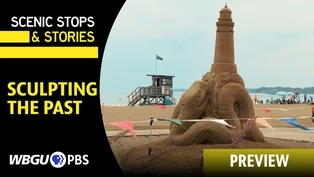
Preview: S2025 Ep6 | 20s | Sand art, vintage baseball, and Sauder Village surprises await this episode! (20s)
Providing Support for PBS.org
Learn Moreabout PBS online sponsorship













Support for PBS provided by:
Scenic Stops: People.Stories is a local public television program presented by WBGU-PBS