NH Crossroads
Sea Shanties In Portsmouth and Stories from 1989
Special | 28m 24sVideo has Closed Captions
This New Hampshire Shipworking Town keeps the traditional music of sea shanties alive.
Produced in 1989, this New Hampshire Shipworking Town keeps the traditional music of sea shanties alive through a weekly event. Other segments include: A profile of Nashua artist James Aponovich, and we follow the footsteps of Governor Benning Wentworth through the words of Henry Wadworth Longfellow.
Problems playing video? | Closed Captioning Feedback
Problems playing video? | Closed Captioning Feedback
NH Crossroads is a local public television program presented by NHPBS
New Hampshire Crossroads celebrates the people, places, character and ingenuity that makes New Hampshire - New Hampshire!
NH Crossroads
Sea Shanties In Portsmouth and Stories from 1989
Special | 28m 24sVideo has Closed Captions
Produced in 1989, this New Hampshire Shipworking Town keeps the traditional music of sea shanties alive through a weekly event. Other segments include: A profile of Nashua artist James Aponovich, and we follow the footsteps of Governor Benning Wentworth through the words of Henry Wadworth Longfellow.
Problems playing video? | Closed Captioning Feedback
Where to Watch NH Crossroads
NH Crossroads is available to stream on pbs.org and the PBS app.
Tonight, on New Hampshire Crossroads.
Feast your eyes and soul on the work of Nashua artist James Aponovich, whose paintings are so realistic, you may feel you are seeing the essence of the objects themselves.
Then the tradition of the shantyman lives on in the harbor town of Portsmouth.
Come out of the cold for a warm round of bittersweet ballads and rousing sea shanties.
And I follow in the footsteps of Henry Wadsworth Longfellow to tell the story of New Hampshire's Royal Governor, Benning Wentworth, whose life was certainly colorful and not always so dignified.
Hi, I'm Fritz Wetherbee, and this is New Hampshire Crossroads.
Theme Music Presentation of New Hampshire Crossroads is made possible by grants from Weeks Dairy Foods Incorporated, makers and distributors of fresh dairy products and premium ice creams for your family.
First NH Banks, serving the financial needs of individuals, corporations, and local governments throughout New Hampshire.
The Union Leader Corporation, publisher of New Hampshire's statewide newspapers.
We’re right for New Hampshire.
And East Coast Lumber of East Hampstead, New Hampshire, Ossipee, New Hampshire, and Portland, Maine, supplying quality building materials to housing and industry throughout New England.
Today we're at the Holy Cross Gallery at Notre Dame College in Manchester, New Hampshire, where they are presenting the Boston Globe Scholastic Art Awards competition.
Now, this is a competition that's open to junior high school and high school students from all over the state of New Hampshire.
And over a thousand young artists submitted work to this juried show, and they have culled it down to a little over 100 works of art, which include paintings and drawings and pastels and sculpture and photography.
And this is a beautiful portfolio here, and we are lucky enough to have the photographer, one Debbie Reynolds, and Debbie did all of this beautiful work here.
My favorite, Deb, is is this one here.
Can you tell me how you did that?
It's a stop the action photograph.
How old are you?
18.
And where's your school?
Gilford Middle High School.
Well, very talented.
Beautiful portfolio.
Thank you.
You got a lot of talent.
Do you ever see a picture that was so real that you thought it was actually the thing itself?
Now, what I'm talking about is I remember going up to a painting once to pull a thumbtack out of it, only to find that the thumbtack itself was painted Well, artist James Aponovich paints like that.
He’s one of the great realist painters around today.
In fact, the critics have called him one of the great realist painters in the world, and we were lucky enough to visit his studio.
Often times, things that people looked at, aren’t really true to it in paintings.
For a painter, they're they're like tricks, you know, tricks of the trade.
And a lot of that, that kind of making a piece of paper look like it's on the wall.
It's not good painting.
It's just good showmanship.
That's what we call, in French, trompe-l il, which means fool the eye.
Music I try to paint from the inside out of an object, not from the outside in, you know?
I try to get at things that are not as tangible as a visual surface.
Other than that, other than that, if you just deal with the visual surface of painting things that you see, it's really a waste of time, you know, because who cares?
You know?
And (inaudible) why don’t you just take a photograph of it?
You know, it's true to a certain extent.
If you can't get beyond the surface, let a great photographer do it because they can do a lot better than you can.
Music I am a painter who paints three subjects: I paint still life, primarily, I paint portraits, and I paint landscapes.
And what I try to do in each one of those is not work from a prescribed point of view.
I don't set something up, or I don't really find a wonderful still, landscape, or I don't really see a wonderful person and decide to, to do them.
Normally I try to work from a more rough hewn, abstract if you may, assemblage of shape.
Form becomes important as as an overall shape, as an overall unit.
I'll begin.
And then as I begin to work, I'll put in spheres that may would oftentimes work over and over through a composition.
And sometimes these spheres would be broken down by rectilinear verticals or horizontal units that would then be, create a visual rhythm.
There has to be a key.
It's only after a while that I begin to determine what these shapes are.
Oftentimes it's by color, in this case, obviously in orange, orange, other times it's by the shape itself.
Here, two circles become a vase turned on its end.
And that's just, it's for me, it's the, it's the path of least resistance.
Whatever seems to work in the shape best.
I will use.
And this same sort of shape here becomes a, my daughter's recorder with a little Chinese doll lopped over it again to repeat the rhythms that seem to want to exist through through the still life.
So the objects themselves and the actual painting of the objects, the thing that determines that I'm a realist, is the last thing.
in a sense, the least important, because at this stage in the game, I'm only getting into the surface because I like to paint the surface of things.
I take a lot of joy out of looking at and painting the way things look to me.
Music So, a still life to me, you know they’re really not, they’re not things that are still, they’re things that are constantly moving with their own symbolism or their own meaning.
And I think it's really a short sighted view to say things are really boring because they're not.
I mean, no more than any person is boring, you know, nor are things boring, we’re all kind of the same, just in the same situation here in life.
They’re we're all coexisting and it's our attitude towards them, I think, that's, that makes a thing boring.
Music What happens is that, is that, and this is what happens to all art, all artists.
I mean, there is instant vision, that explosion, that flash, that you see something or you think of something, or you conceive of something that you know has great significance and and it's instantaneous.
It's come and it's gone, in between a blink of an eye.
And then what you do is that you try to recapture that.
It's like having a dream and waking up from a deep sleep.
And it's vivid at first, and maybe you can hold on to it.
But the longer you wait, the less and less clear it becomes.
So the artist in me, in my case, I will, I will have this particular vision and it comes as it comes, not, I can't control that, and then I try to get it down.
I get it down, those little sketches, and then I try to do it, to recreate that initial excitement, that initial blast.
And and it's always a diminishment of that initial vision.
Music I tend to continually devalue the importance of a really, an international, national name.
And I just do the work, do it well, and eventually whatever you want in terms of that stuff will come to you, and probably beyond a point when it means anything to you.
All that fame doesn't mean anything.
It's why I'm here on television.
Music Here in the state of New Hampshire, it's more difficult to see any of James Aponovich’s work than you might expect.
The Currier has a couple of his paintings, but they're not on exhibit currently.
He does have work, however, up at the First Capitol Bank in Concord and also in the Chubb Life Insurance building up in Concord.
Other than that, you'll have to go to New York to his gallery to see his work, or wait until about this time next year when he'll have a one man show.
James, incidentally, was recently appointed to the New Hampshire Arts Commission, which means he'll be among those who choose what moneys go to what starving artists in the state.
And speaking of starving artists, we have here Steve LeMay from, from where?
Manchester, NH.
Manchester.
And you are, what a senior?
No.
Eighth grader.
You're an eighth grader.
At what school?
Southside Junior High.
Wow.
And you did this work, which is a?
Pencil drawing.
Wow.
Well, you got a lot of talent.
It's a beautiful piece of work, a gorgeous piece of work.
Sea shanties.
Sea shanties are work songs.
Back before the hydraulic winch, it required teamwork to raise a yardarm or a sail.
And it was the shantyman who led the crew in song.
Nowadays, over in Portsmouth, Tom Hall and Dave Bem fancy themselves modern shantymen.
And their crew?
Well, their crew is just whoever happens to show up on a Friday night at The Press Room.
Darlin’.
Good, how are you?
(tuning up instruments) Well, I consider myself a shantyman.
And Dave.
Dave is also a shantyman.
There are a couple of us who know all the, lot of the leads but we couldn't do without the chorus.
You can't sing a shanty by yourself.
It just doesn't work.
She became a star, a’shining in the sky He became a thundercloud and hided her from sight .
Hello, hello, hello, hello, you cold blacksmith You shall do me no harm you never shall have me maidenhead, which I have kept so long.
I'd rather die a maid!
Ah, then she said and be buried all in me grave than live with a rusty, dusty husky, fusty, musty coal blacksmith But if you've got a bunch of people singing together on the refrain.
It comes alive.
Aye we’ll all go together to pull wild mountain thyme All around the blooming heather.
Will you go lassie, go If me true love, she were gone I should surely find another To pull wild mountain thyme All around the blooming heather Will you go lassie, go?
Music When the collectors are going around in the turn of the century, they’d find a lot of cases where the old timers who'd been at sea couldn't do it unless, couldn't sing these at all.
They said, well, you know, it's one thing if I'm out on the ship with, you know, half dozen men.
I know all their names.
I can make verses about them.
We've got a line in hand.
We're raising that yardarm, he said, sitting here in this flat, he said, I can't sing those here.
What’s that Confederate ship?
The Alabama.
The Alabama.
We'll sing about that before we’re through From the Western Isles She sailed forth.
Roll, Alabama, roll!
To destroy the commerce of the North Oh, roll, Alabama, roll!
To Cherbourg port, she went one day Roll, Alabama, roll!
To take her share of prize money Oh, roll, Alabama, roll!
Many a sailor saw his doom.
Roll, Alabama, roll!
Oh, I started coming in here about a year ago.
Last June, I think it was.
It was kind of by accident.
And it doesn't take very long to, to get into it.
I, when there's music that I like on, I usually hum along and annoy the, the band to the ocean floor.
Sank to the ocean floor Oh, roll, Alabama, roll!
(applause) I like to sing.
I've always liked this kind of music.
And, it, it makes you want to join in.
And I don't really play any instrument well enough.
So I, one of the other girls from playing spoons and I just gradually got it up enough nerve to, to participate.
We've had different closing song, but finally I decided to learn a song called Leave her, Johnny, leave her and that's the song which the crew would get out their hostilities.
They'd sing nasty things about the captain, first mate, the boatswain, the ship, ship's owners, whatever came into the minds.
The shantyman had to know the mood of the crew and just how to lead that.
That was the tricky thing about shanties.
The shantyman had to be a psychologist.
Johnny, leave her For the voyage is done , and the gales don’t blow, and it’s time for us to leave her Now, tis time to say goodbye.
Leave her, Johnny.
leave her.
For the old pier head’s is drawing nigh And it's time for us to leave her Leave her, Johnny leave her Oh, leave her, Johnny, leave her For the voyage is done And the gales don’t blow And it's time for us to leave her (applause) In his great novel, Two Years Before the Mast, author Richard Henry Dana describes a time when a shantyman saved the day.
It seems he tried three songs and the crew still couldn't get the yardarm up.
And then he tried a fourth song and up it went.
Incidentally, The Press Room is located on Daniel Street, right across from the post office, and Tom and his crew sing sea shanties every Friday night from 5:00 until 9:00, and you are welcome to stop by.
When you think of scandal, chances are you do not think of colonial times.
Although there was as much scandal back then as there is nowadays.
To wit: Hester Prynne and the Scarlet A or the story you're about to see which is about Governor Wentworth and the scullery maid.
I am about to tell you a story so scandalous it will shake you to your roots, yet a story so compelling that Henry Wadsworth Longfellow wrote a poem about it and included it in his Tales from the Wayside Inn.
This Is the story of Lady Wentworth.
The scandal happened here.
This is Wentworth Hall.
250 years ago, this was the home of this man.
This is Benning Wentworth, who was the first colonial governor of New Hampshire, named in 1741 by His Majesty George the Second, King of England.
Benning Wentworth was described by Longfellow as being A portly person with three cornered hat, a crimson velvet coat, head held high in the air, gold-headed cane and nicely powdered hair and diamond buckles sparkling at his knees, dignified, stately, florid and much at ease.
He was also terribly rich, rich enough to own this beautiful house, described again by Longfellow as A goodly place where it was good to be.
It was a pleasant mansion, on abode near, yet hidden, from a great high road, sequestered among trees, a noble pile, gables and dormer windows everywhere, and stacks of chimneys rising high in the air.
Within, unwonted splendors, met the eye, panels and floor of oak and tapestry; carved chimney pieces, where on brazen dogs reveled and roared the Christmas fire of logs.
Okay, enough of this description.
Let's get down to the juicy stuff.
And the juicy stuff, of course, concerns a woman.
Specifically a woman who worked here in the kitchen of this great house.
She was a cook’s assistant and her name was Martha Hilton.
There are no portraits of Martha, but Longfellow has a wonderful description of her.
He says, Barefooted and ragged, with neglected hair, eyes full of laughter, neck and shoulders bare, a thin slip of a girl like a new moon, sure to be rounded into beauty soon.
And yes, Martha was just a child, only a teenager, til that old goat get his hands on her.
The fact is, Benning Wentworth suffered greatly.
All three of his sons died.
When he was 55, his wife died, and for seven long and lonely years, he was all alone here in this great mansion.
And then in the winter of 1760, Benning Wentworth had a birthday party right here in this room.
This is the actual room.
Benning was 64 years old.
Martha Hilton, incidentally, was 20 years old.
And this is Longfellow's account of that evening.
He had invited all his friends and peers - the Pepperels, the Langdons, and the Lears, the Sparhawks, the Penhallows and the rest; For why repeat the name of every guest?
But I must mention one in bands and gown.
The rector there, the Reverend Arthur Brown.
When they had drunk the King with many a cheer, the Governor whispered in a servant's ear, who disappeared and presently there stood within the room, in perfect womanhood, a maiden, modest yet self-possessed, youthful and beautiful, and simply dressed.
Can this be Martha Hilton?
It must be!
Yes.
Martha Hilton, and no other, she.
Dowered with the beauty of her 20 years, how ladylike, how queen like she appears.
Yet scarce a guest perceived that she was there until the Governor, rising from his chair, played slightly with his ruffles, and then looked down and said unto the Reverend Arthur Brown, this is my birthday: it shall likewise be my wedding day.
You shall marry me.
So the rector read the service loud and clear.
Dearly beloved, we are gathered here and so forth to the end.
At his command, on the fourth finger of her fair left hand, the Governor placed the ring, and that was all.
Martha was Lady Wentworth of the Hall!
And so.
But you see, this isn't the end of the story.
Benning actually lived another ten years, and Martha, I understand, took very good care of him.
And when he died, he left her his entire fortune.
Martha remarried almost at once.
A distant cousin of Benning's, a retired English colonel called Michael Wentworth, whom it is said needed the money more than he needed love.
Michael was a charming man.
He played the harpsichord, in fact, this harpsichord, beautifully.
The couple entertained lavishly.
Why, George Washington himself actually attended parties here.
But Michael had one major fault: he was a compulsive gambler.
He built this room just to play billiards in.
And this room was built simply for playing cards.
And this room down here, this room was also built simply for playing cards.
And before he was done, Michael managed to squander the entire fortune.
Michael lived a long life, and he died here.
And it is said that he boasted on his deathbed, I have had my cake and I have ate it.
Tell that to your children.
Let it be a lesson to them.
Music Isn't it amazing that over 200 years have gone by, and that story is just as shocking today as the day that it happened?
Well, that's our show for this week.
Join us next week when I visit an old friend of mine, Al Daloz, who has one of the finest collections of antique music boxes anywhere, and they sound just beautiful.
And producer Chip Neal will show us what it means to be a witch in the 20th century when he visits Lady Sabrina, a high priestess of Wicca down in Nashua.
Before we go, I'd like you to meet a friend of mine.
This is Heather Clark.
And Heather did this beautiful, I guess it's a drawing, is it?
Yes.
Colored pencil.
Is it - Is it,is it pas- oh, colored pencil, not pastel?
And the, the plant is what?
An aloe vera plant.
The kind that you wipe on your on your face if you’ve got a complexion like mine.
That's, I, I use it all the time.
Now you are the Hallmark Nominee, which means that this painting goes to, it’s the Hallmark company sponsors this?
Yeah.
It goes to?
New York, yeah.
And you get, if you win there?
$100.
In a scholarship.
Where's your school?
Trinity in Manchester.
Okay.
And you are?
A senior.
A senior.
Okay.
Let's go look at some of the other stuff.
Oh my gosh there's a lot of talent here.
What do you like?
Theme Music Presentation of New Hampshire Crossroads is made possible by grants from Weeks Dairy Foods Incorporated, makers and distributors of fresh dairy products and premium ice creams for your family.
First NH Banks, serving the financial needs of individuals, corporations, and local governments throughout New Hampshire.
The Union Leader Corperation, publisher of New Hampshire's statewide newspapers.
We’re right for New Hampshire.
And East Coast Lumber of East Hampstead, New Hampshire, Ossipee, New Hampshire, and Portland, Maine, supplying quality building materials to housing and industry throughout New England.
Theme Music
 New Episode
 New Episode
- Drama

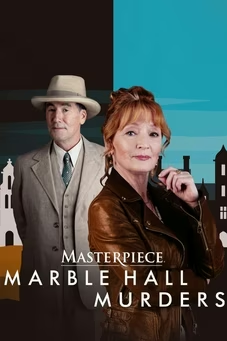
Lesley Manville and Tim McMullan return in the final installment of the Susan Ryeland mysteries.

 New Episode
 New Episode
 New Episode

 Recently Added


Support for PBS provided by:
NH Crossroads is a local public television program presented by NHPBS
New Hampshire Crossroads celebrates the people, places, character and ingenuity that makes New Hampshire - New Hampshire!