Oregon Field Guide
Search for the Skyline Trail; Octopus Brains; Newt Balls
Season 34 Episode 1 | 27m 35sVideo has Closed Captions
Search for the Skyline Trail, Octopus Brains; Newt Balls
A father and daughter’s search for the Skyline Trail is as much about a trail lost to time, as it is about how nature helped forge a family’s bonds; Octopuses are incredibly smart, yet the majority of their neurons exist in their arms and suckers and not in their brain, making them as close to alien intelligence as we can find on Earth; Newt Balls Photo Essay.
Problems playing video? | Closed Captioning Feedback
Problems playing video? | Closed Captioning Feedback
Oregon Field Guide is a local public television program presented by OPB
Oregon Field Guide
Search for the Skyline Trail; Octopus Brains; Newt Balls
Season 34 Episode 1 | 27m 35sVideo has Closed Captions
A father and daughter’s search for the Skyline Trail is as much about a trail lost to time, as it is about how nature helped forge a family’s bonds; Octopuses are incredibly smart, yet the majority of their neurons exist in their arms and suckers and not in their brain, making them as close to alien intelligence as we can find on Earth; Newt Balls Photo Essay.
Problems playing video? | Closed Captioning Feedback
How to Watch Oregon Field Guide
Oregon Field Guide is available to stream on pbs.org and the free PBS App, available on iPhone, Apple TV, Android TV, Android smartphones, Amazon Fire TV, Amazon Fire Tablet, Roku, Samsung Smart TV, and Vizio.
Providing Support for PBS.org
Learn Moreabout PBS online sponsorshipMajor support for Oregon Field Guide is provided by... [ ♪♪ ] MAN: My rappel!
MAN: Oh, my gosh, it's beautiful.
MAN: Good morning, everybody.
Woo!
Let's do it again!
MAN: Nicely done!
MAN: Oh, yeah!
Fourteen and a half.
Yes, that was awesome!
[ people cheering ] There you go, up, up... ED JAHN: Tonight on Oregon Field Guide: Did you know that an octopus can essentially think with its arms and suckers?
In fact, it may be the closest thing we have to alien intelligence on Earth.
Then, it's the fascinating mating ritual of the newt.
But first... MAN: This is called the Dance of the Skyline Trail.
...a story that's about a lot more than just a path through the woods.
[ groans ] If you're watching this show, it's probably because you feel some connection to nature.
But where does that connection come from?
For some of us, it might be from working in the garden or playing in the fields as a kid or seeing birds in the city.
Well, this next story is as much about a trail lost to time as it is about how nature helped forge a connection between a father and his daughter.
MAN: There's a sign over there.
It's probably from the mid-'20s.
Yeah, white ceramic.
Tree grew into it.
This sign is just right off of Highway 26.
It's only half a mile up the trail here, but there's a mystery here for anyone to solve if they kind of investigate a little bit.
What's with the "line"?
What are they doing?
What are they trying to tell us?
It's quite a story.
IAN McCLUSKEY: This is a story about Bob and his time machine and his quest to go back in time.
Ready to go?
Yeah.
His traveling partner is his daughter, Eva.
Together, they've been exploring the Mt.
Hood National Forest in search of a path that will lead them back to the early days of outdoor recreation, the 1920s and '30s.
This path they seek was once Oregon's greatest recreational trail, the Skyline.
No one's heard of the Skyline Trail.
There's this forgotten link that was so important 100 years ago.
Nobody knows it's even there.
The internationally famous Pacific Crest Trail, or PCT, is arguably Oregon's most well-known trail.
Yet the Oregon Skyline Trail came first and literally blazed the way.
[ ♪♪ ] The Skyline was Oregon's first long-distance recreation trail.
It ran along the spine of the Cascades, from Mt.
Hood in the north all the way south to Crater Lake and then into California.
Today, few traces remain, and those can be hard to find.
BOB: This is called the Dance of the Skyline Trail.
[ groans ] I don't know if it's easier under or over.
EVA: You're walking down the middle of this, like, barely visible trail, and it's like you would never know that there's so much there and so much that you can discover.
And you can decide to be like, "No, actually, I'm going to find this again."
BOB: Her time in the woods evolved from just camping and picking huckleberries to joining me on these adventures to find these old trails and to see where there used to be a Ranger station.
"R. E. Bartell, 1933."
These guys were working hard out here.
Hmm.
I think part of being a parent is to sort of instill wonder into your kids.
I mean, I'm my own dad, so to speak.
I like to instill my own wonder and look at a map and say, "Well, let's go there.
Look at this mountain.
Maybe there's a meadow.
Maybe there's an abandoned trail.
Who knows what's there?
Let's research it.
Let's go find out."
Where do we go?
Which way?
Where's the next blaze?
That way?
The word "trailblazer" is commonly used, especially in Oregon.
It's a general term for someone who leads the way.
Yeah, there's a blaze there.
But it has a very literal meaning: notching a cut into a tree trunk with an ax to create a permanent scar on the bark called a blaze.
Yeah.
Well, there's one.
You can still see kind of the ax mark in there from 100 years ago.
Boop, boop, boop.
So what's interesting about the Skyline Trail is they have these three dots, and they're on both sides of the tree.
And they're so plentiful.
The guide just took a little hatchet and just... carved it up, carved the bark away.
So even though the trail's completely abandoned, it hasn't been used in 50 years or more, it's still blazed.
You can still follow it.
If you don't mind climbing over a few logs, it'll take you where you gotta go.
There's a blaze.
Bob's fascination with the Skyline is not just the lost trail but the abandoned places that it once connected.
And some of those places can still be explored.
This is Clackamas Lake, and it's been a very important place for a very long time.
Skyline Trail went right through the middle of it.
If you would arrive here in 1925 or so, it would've been a bustling, lively place.
The Forest Guards running back and forth and crosscut saws on people's shoulders and pack-horse strings.
And it's a little different today.
It's quiet.
It's a little forgotten-about corner of our National Forest.
Oh, it's very dark in there.
There's a mirror or something in there, that's about it.
Here, it still feels alive.
You still have the experience of being in the 1930s and the '20s.
It's really frozen in time.
[ ♪♪ ] EVA: My whole life, I've been like, "Oh, I'm going camping this weekend," you know.
My friends have-- You know, they're like, "Oh, that's nice.
Me too."
I'm like, "No, no, no.
You're not going camping the way I am.
These are two separate experiences right here."
It's like, this is how most people do it.
This is how my dad and I do it, you know?
You gonna do your tent now?
Probably.
Following the Skyline Trail came the Skyline Road, which allowed the very first automobiles into the National Forest.
A new form of outdoor recreation was created: car camping.
Bob's version of car camping is, well, part of the time-travel journey.
Yeah, my dad definitely has a more specific way he likes to exist in the woods and the way he likes to go about camping.
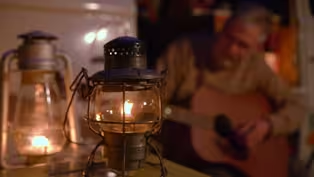
BOB: I was 16 when I got my first lantern.
Been with me for a long time.
So it's kind of sentimental.
This one's called a Superbaby.
He lights his lanterns at the end of the night, you know, and, I don't know, I think it's definitely like a more classic experience than a lot of people have.
I think part of me has a hard time with the modern world.
Just kind of want things to be a little more manageable.
This is just oil and a flame, glass.
"Oh, okay, I understand that."
EVA: Setting up camp, you know, my dad spent like half an hour lighting all his crazy lanterns.
It's like, "Okay, now we're surrounded by lanterns."
[ crickets chirping ] [ guitar playing folk song ] [ birds chirping ] [ engine starts ] [ ♪♪ ] BOB: So we're heading down to Lemiti.
In the '20s, there was just the Skyline Road.
[ Bob sighs ] All right.
Let's see if anybody's home.
I doubt it.
The door's open.
[ knocks softly ] This would've been totally different, though, with the Rangers in here.
They would've had it all set up, and a place to keep their boots and a little desk to do paperwork, and it would've been a tidy little place.
Been many years.
There's a lot of neglect, and that's the frustrating thing about all these wonderful places.
Yeah.
Seen better days.
Talk about time travel.
You want to do it, you just sit right here.
EVA: Imagine how many Rangers have sat here.
BOB: Yeah.
[ ♪♪ ] This cabin you see was a historic guard station.
It was built in 1910, right after the Forest Service was established.
And there were many such guard stations that looked just like this one scattered all across the Mt.
Hood forest.
And this one is unique because there's only one of two remaining in Mt.
Hood forest.
The rest of them have either burned or been torn down.
EVA: It's definitely interesting how he sees the world and sees the wilderness as well, you know?
I think that he himself wishes he was a Ranger in the '20s.
I think that's part of the reason why he loves it so much.
BOB: There's just a part of my being that feels like I stepped out of the 1920s that I can't let go of that.
It's a long, rattly drive to get here, even now.
Imagine being on the back of a horse or walking here in that time.
It would've been a few days to get out here.
You can still feel like you're a long way from anything.
I think part of that is the appeal, that it is close to town, but it still feels wild for now.
There's still that sense of wildness, of quiet.
Bob finds a section of the former trail clear-cut by heavy equipment.
The modern world has torn a hole in the fabric of his time travel.
Well, the last time I was here, this was essentially wilderness.
The road was barely a road.
They brought us into the present day, and that kind of sucks when you're out trying to find something that'll link you to all these different times and experiences that are sort of timeless in themselves.
Maybe I'm romanticizing the past, heh.
The trail that first introduced Oregon to long-distance recreational hiking became sections of the PCT.
And the dirt road that first let automobiles into the forest is paved over in spots by modern roads.
The in-between places have been left to grow back and fade into memory.
Bob and Eva have reached Olallie Lake, just north of Mt.
Jefferson, one of the original camping destinations on the Skyline.
Soon they'll have to turn around, head back to the city where jobs and school await.
This will be the last camping trip of the summer.
And perhaps one of the last in their search for the Skyline.
[ ♪♪ ] EVA: Just spending time in the woods with my dad is always something that I'm going to look back on and be like, "Aw, that's so sweet."
You know, like, "Aw, father-daughter.
Look at those memories," you know?
Their search for the Skyline started when Eva was in middle school.
She's now starting her last year of high school.
It's not going to be as easy to go to the woods for weeks on end with my dad when I'm in college, you know?
BOB: She's going to go to college and she's going to have her own life.
And, sure, we'll camp and we'll hike and things, but our roles will change.
And, yeah, yeah.
I'm going to miss her a lot.
EVA: I mean, in the most literal sense, Skyline is-- is a thing that's made to connect.
It's not just something that's been abandoned.
It's something that's like-- takes you where you need to go and still can even after years of being, like, discarded.
It's like you can always choose to come back to something, even if it's labeled as, like, lost.
You can always choose to find things again, and I think that's a beautiful thing.
[ water bubbling ] We humans believe that we are so smart because we have this big brain to think with.
But what if we could think with our entire bodies?
What if our hands could think for themselves?
What would that be like?
Well, it turns out there's an animal whose mind works just that way.
Welcome to the ingenious world of the octopus.
If you wanted to study how aliens might think but you didn't have the ability to travel light-years into space to find them, where would you look?
For scientist Dominic Sivitilli, the answer is under the sea.
It feels like being on some alien planet, especially in the Pacific Northwest, where you're just floating among this green haze and with how dark it is and with how cold it is, and then surrounded by this incredible diversity of invertebrates and other life forms down there.
It definitely does feel like I'm on, like, a completely different planet or, like, almost in a completely different dimension.
There is a creature in these murky waters that has a mind so foreign to ours it might as well be an alien.
The trouble is finding it.
One of the interesting things about this is that octopuses have one of the best camouflage systems in the entire world, and so we're effectively going out and trying to find an animal that evolved to not be found.
You do see them bob their head up and down, so you can kind of see, like, a piece of kelp or rock playing peek-a-boo and then realizing that this is actually a very intelligent being that is staring at me and assessing what I am.
It gives me a very uncanny feeling.
Of course, octopuses and squids have long captivated, inspired, and terrified humans.
I think it's appropriate that we base so many of our monsters and aliens off of them, because they are extremely alien-looking creatures, just their multiple limbs and their camouflage, and their unblinking eyes.
But the reason Dominic and other scientists see them as models for alien intelligence is that they branched away from humans on the evolutionary tree some 500 million years ago.
The octopuses' long, separate evolution toward cognitive complexity makes them a very appropriate model for what intelligence might look like if it evolves on a completely different planet.
The main question that drives me is like, really, what are the different forms that the mind can take?
What are all the different kinds of ways that the mind is experiencing the world out in the universe?
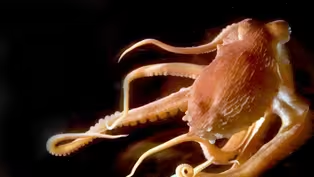
This is Lisbeth.
She's our giant Pacific octopus.
She can grow to being 20 feet long if she spread her arms out.
And those spreading arms, they're not like ours.
They're far more sensitive.
Our fingertip might have 400 mechanical receptors.
A given sucker might have tens of thousands of mechanical and chemical receptors on it.
So each sucker is many times more mechanically sensitive than one of our fingertips is and also has the benefit of being able to taste and smell the world around it.
And it's able to do this because each sucker has a local computation center where most of this information is being processed.
A computation center.
In other words, the suckers not only feel, they not only taste and smell.
Each sucker basically has a mini-mind of its own.
Dominic calls it distributed intelligence, and it's the focus of his research.
See, they're just like cats.
They really like boxes.
To find out how these suckers think for themselves, Dominic uses a tank, a puzzle, and some juicy shrimp bits.
But before we break it down, let's see the entire octopus in motion, doing what it does best.
Their web is something that, like, blows my mind.
Just like, wow, how do they use that?
It shows what they are doing, right?
I mean, these, again, are, like, very cognitively complex animals, and so looking at what they do best, which is find and capture food, is quite impressive.
Watching Lisbeth hunt, it's easy to think her central brain is controlling all her movements and the color and texture changes in her skin.
But that's not really what's happening.
It's really hard to imagine how these animals are experiencing the world.
Their nervous system and their perceptions and sensory systems are built entirely differently from ours.
While most of our neurons are in our brain, most of their neurons exist beyond their central brain in their arms and suckers.
So their arms are, in essence, thinking on their own.
To try to figure out how this distributed intelligence works, Dominic has created a puzzle box that contains changeable rows of crevices, like the octopus would find naturally in the wild.
He hides a piece of shrimp in one of the crevices and then sets the octopus loose to explore the box with its suckers.
And he films it all with a high-speed camera.
There seems to be a strategy that the suckers use to coordinate, and this strategy seems to rely on a recruitment mechanism.
So if one sucker finds something of interest, say if it's like a clam or a mussel or some kind of prey, a sucker will find that prey, and then it will tell the next sucker over, "Hey, I found something of interest" and that sucker will turn toward that prey.
WOMAN: She got it!
DOMINIC: She got it?
WOMAN: Yeah.
DOMINIC: Excellent.
Good girl.
It's a bit like a sucker chain reaction.
And the more suckers that get involved, the higher a signal they send to the brain.
The octopus' mind network.
Using a CT scanner, Dominic has actually been able to create a visual of the octopus' distributed mind.
The brain itself has about 50 million neurons.
Each of the optic lobes has about 60 million neurons.
And then beyond the brain, in the arms and suckers, is where 350 million of the octopus' 500 million neurons are.
Spreading its brain out amongst its arms serves an evolutionary purpose.
Unlike humans and other simple vertebrates which can only move our arms and legs in a couple directions, an octopus can bend its eight arms with seemingly infinite freedom.
Add the fact that they mostly hunt at night, when they can't see well, and you can see that's a lot of information for the brain to process on its own all at once.
What the brain will do is send out a very generalized command to multiple arms at once and let the arms kind of figure it out from there.
And the suckers, with all their chemoreceptors, all their mechanical receptors, are very well equipped to then find interesting objects out there in the world.
And in the lab, Dominic is one of the most interesting things for them to find.
If they see me around the lab, they will approach, go to the edge of their tank and just watch the interesting things that are happening.
You never really feel like you're alone in that lab.
That was one of the first things that fascinated me about them, was their curiosity.
Here's your little man.
Here I am studying them, and yet they seem to also somehow be studying me in their own way.
But like all studies, this one comes to an end with the end of summer.
It's always sad to see an animal go that you've grown close with, but they're also going back home into their natural habitat, so it's really hard to stay sad about it for too long.
In my time studying the octopus, I've really learned to appreciate that there are many varieties of intelligence out in the world and possibly the universe.
The human mind is just one of many different varieties.
It's not about how intelligent they are, it's about how they are intelligent.
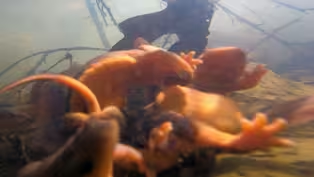
On a walk by his house one day, photographer Brandon Swanson came across a wonder of nature: rough-skinned newts making, well, more rough-skinned newts.
[ ♪♪ ] [ ♪♪ ] You can now find many Oregon Field Guide stories and episodes online.
And to be part of the conversation about the outdoors and environment here in the Northwest, join us on Facebook.
[ birds chirping ] Major support for Oregon Field Guide is provided by... Additional support provided by... And the following... and the contributing members of OPB and viewers like you.
Search for Oregon's Skyline Trail
Video has Closed Captions
Clip: S34 Ep1 | 13m 50s | Search for Oregon's Skyline Trail (13m 50s)
Providing Support for PBS.org
Learn Moreabout PBS online sponsorship















Support for PBS provided by:
Oregon Field Guide is a local public television program presented by OPB