Destination Michigan
Season 12, Episode 3
Season 12 Episode 3 | 25m 46sVideo has Closed Captions
Explore the Rivers of Michigan.
It’s no secret how Michigan garnered the nickname “The Great Lakes State.” It’s Flanked on all sides by massive inland seas. There are over 11,000 lakes, big and small, peppered across its landscape. But the truth is that Michigan’s river systems have had an immense natural, economic, and cultural impact since people first inhabited the land that would come to be known as the State of Michigan.
Problems playing video? | Closed Captioning Feedback
Problems playing video? | Closed Captioning Feedback
Destination Michigan is a local public television program presented by WCMU
Destination Michigan
Season 12, Episode 3
Season 12 Episode 3 | 25m 46sVideo has Closed Captions
It’s no secret how Michigan garnered the nickname “The Great Lakes State.” It’s Flanked on all sides by massive inland seas. There are over 11,000 lakes, big and small, peppered across its landscape. But the truth is that Michigan’s river systems have had an immense natural, economic, and cultural impact since people first inhabited the land that would come to be known as the State of Michigan.
Problems playing video? | Closed Captioning Feedback
How to Watch Destination Michigan
Destination Michigan is available to stream on pbs.org and the free PBS App, available on iPhone, Apple TV, Android TV, Android smartphones, Amazon Fire TV, Amazon Fire Tablet, Roku, Samsung Smart TV, and Vizio.
Providing Support for PBS.org
Learn Moreabout PBS online sponsorship- Now it's no secret nor surprise how Michigan garnered the nickname, the Great Lake State.
It's flanked on all sides by massive freshwater seas.
Over 11,000 lakes, big and small are peppered across the landscape.
Hashtag lake life is seemingly a culture all into itself.
So in the states, so enamored by its lakes, I suppose you couldn't blame anyone for overlooking Michigan's rivers.
But the truth is that Michigan's river systems have had an immense natural, economic and cultural impact since people first inhabited these lands.
Tribes across the state have depended heavily on rivers for thousands of years, mainly as a source of food and an effective means of travel.
In modern times, people have learned to harness the power of Michigan's rivers in a multitude of ways.
We send our cargo through them.
Much of our infrastructure is put in place to go over, under, and around them.
Rivers are a powerful force of nature yet, they also provide a place for quiet introspection.
Quite simply, we enjoy the rivers.
We fish them.
We swim them.
Any stream or Creek, we can fit a kayak or canoe into, you better believe we're going to paddle it.
Large or small, city or countryside Michigan's rivers touch the lives of every Michigander.
As Michigan's rivers stretch all across the state, We'll have quite a bit of ground to cover in this episode.
To kick things off we'll join Stephanie Mills as she introduces us to some of Michigan's top river experts and take a closer look at how rivers have impacted and shaped our lives.
In Lansing, we'll explore Michigan's longest river - the Grand River.
What was once used as the city's dumping site now has become a gathering place for residents and visitors.
Then, we head north to the Black River where these sturgeon are getting a watchful eye from some very dedicated guardians.
We'll also meet photographers Steve Jessmore whose long hours on Torch River have garnered some very striking images.
All these stories are coming your way on this episode of Destination Michigan.
(upbeat music plays) - If you look closely, you can see the impact of Michigan's rivers everywhere.
From recreation to creation, Michigan's rivers have carved paths for industries to rise and cities to thrive.
From the very first immigrants who followed the streams into our Great Lake State, to the fur traders and loggers.
Michigan's rivers have shaped the course of our history.
We haven't always taken the best care of these majestic and scenic waterways, but more is being done today than ever before to help preserve them for future generations.
- We've got a variety of rivers that are absolutely wonderful places to just go and relax and enjoy.
Take your family, take your friends.
- Whether they're winding through the woods or hugging city shorelines Michigan's rivers really are a sight to behold.
The state has more than 51,000 miles of river meandering through it.
- I'll start with the longest river in Michigan.
Some people know what that is, others don't.
It's the Grand River.
It keeps collecting rivers as it flows through Michigan, until by the time it flows into Lake Michigan, it's a pretty good sized river.
The St. Mary's is not that long, but it's very important because of where it is.
Its location.
The Muskegon river is another important river that flows into the, Lake Michigan.
But it was originally a place where a lot of different native villages were.
(inspirational music plays) - [Stephanie] Starting with the earliest settlers, our rivers and streams sculpted our landscape, crisscrossing the state from the very top of the UP to the most Southern parts and everywhere in between.
- [Gordon] Well, if you go all the way back to the first native people, they certainly learn how to make good little personal boats, canoes, and use those up and down the river.
Now that's the first freeway system by the way, are the rivers.
Now all of a sudden there they are.
And they're moving from village to village along the rivers mixing in, "oh, well, we'll go a little further.
I've always wanted to know where this river goes.
Let's , let's go!
Let's travel a little further."
You can almost hear them saying, "Let's go a little further and see what's down there.
You know, you know where the river disappears, let's go there and see what it is."
And they did!
- [Stephanie] For our first people, rivers were a means of getting around, but also a critical food source where they netted and trapped fish.
Eventually fur traders and loggers used these maritime highways to transport goods, but it wasn't always smooth sailing.
- [Gordon] Grand rapids.
The rapids are here and the rapids made it so that if you came by, even at the time, steam-powered boats and things, you could get this far, but no further.
And so, what do you do?
You look around and say, "well, there's other people coming so we could start opening some businesses around here."
If you look at the river, the cities that are built on rivers, and there are a lot of them in Michigan, that's what they're finding.
They're finding that spot that were natural stopping points and they started building.
And the first thing was they were the simple businesses, but then the next thing you knew, they were bigger and bigger.
- [Stephanie] As people settled and assess their surroundings, they made use with what they had and established a way of life.
- [Gordon] Believe me, not every immigrant who came, for example, knew how to cut logs and take care and make furniture.
Those are the things you do once you get into an area, and those are the resources available to you.
That's what the people of Michigan have been doing since the very first person who wandered in here, I don't know where he came from, or she came from.
- [Stephanie] When the flow of commerce picked up, So too did the need to help ships get across the rough terrain they encountered in places like Grand Rapids and the UP.
Until 1855, When the Soo locks were built, the St. Mary's river located between Lake Superior and Lake Huron had some of the most treacherous rapids due to a 23 foot drop between the two lakes.
Today, an estimated 80 million tons of cargo passes through the locks each year helping fuel the American economy.
- Cultural, recreational, and ecological These things are critical.
I mean, the water is driving every ecosystem.
Hey, we're lucky enough in Michigan to have so many water bodies, um that we tend to take them for granted.
- [Stephanie] As economies grew, the need to care and preserve rivers and their ecosystems wasn't exactly a top priority.
- [Dr. Don] Especially the pre-1970s, we were really good at thinking the solution to pollution is dilution, dump it in, get rid of it.
If I, you know if i I dump a 50 gallon drum of toxicant X here, it's out of my hands, it's their problem downstream, right?
And that was the way we really functioned.
Sometimes it's best to leave it alone and let it be buried.
If it's moving, we have to do something.
But in some cases you do less damage by leaving it.
But that, you know, that's a legacy that we live with.
That, that was, that's how you got rid of pollution.
You put it in water bodies, which, you know, we think about that today and we smile and go, "what were we thinking?"
- [Stephanie] Fortunately, the old ways are not today's ways.
In 1968, multiple groups, including the National Park Service created the Wild and Scenic Rivers Act.
In Michigan about 1% of our rivers fall under that because it requires them to be on federal land.
1970 Michigan DNR created the Natural Rivers Program, which protected some private river areas and their ecosystems.
- [Dr. Don] And what they're doing is they establish zoning laws that protect within 400 feet of the river itself.
And about 4% of Michigan's river miles fall under that program.
We have to keep in mind that they are critical systems and they're pretty delicate.
And it's easy to change that system into something it's not, and we can never win.
We always try to fight the natural processes.
It'll come back and get us, you know, through floods or what have you.
I mean, think of tourism and, and the money that's spent to go use these ecosystems: canoeing, fishing, birdwatching, you name it.
- [Stephanie] Our rivers are a way of life here in Michigan, have been since the very first settlers came to shore from the riverbanks.
From farming to fishing, work or pleasure, they help drive major industries across the country, but also provide a place of refuge to relax and recharge.
- [Gordon] One way or another, Everyone who is living in Michigan or who has ever lived in Michigan is, is affected by how the rivers have shaped the states and shaped their lives within the state.
- The longest and perhaps most appropriately named river in Michigan is the Grand River.
It stretches over 250 miles and passes through two of Michigan's largest cities, Lansing and Grand Rapids.
And as we've already learned rivers near congested cities weren't treated as preciously as they are today.
Much has improved over the years, but there's still much more to be done.
And in the city of Lansing, folks are working hard to not only spruce up the river itself, but also its image, showing people that by recreating on the river, even in the middle of a bustling city, one can gain a better appreciation of their value and their beauty.
- Let's go ahead and turn back the clock a little bit, say about 120 years.
Lansing is a relatively new and bustling city along the Grand River.
It was a time where the solution to pollution was dilution and anything unwanted was simply cast into the river.
However, today in Lansing, it's a much different story.
As a resident's relationship with the Grand is much different.
Over recent decades, there have been incremental positive changes that have made it a happier and healthier river experience for everyone, including the Grand itself.
- Many people have the impression of the river as an open sewer as it was in the 1950s and '60s, but it has come a long way since then.
It is now a beautiful resource and uh, ready to be enjoyed by, by the public.
- [Matthew] And visitors to the capital city can see the change for themselves.
Starting with a stop at this small building, with a sign that reads " Rivertown Adventures."
- Rivertown adventures, uh, we opened in 2014, um, right here on the banks of uh the Grand River in Downtown Lansing.
And then kind of set up a little lemonade stand, you might say, on the banks of the river here and see what people, if people would want to come out and experience the rivers and Lansing and just do something a little different.
The operation just kind of started on a, on a guess and a hope and uh sure enough, it started to pick up and people started realizing you can recreate out here in these rivers.
We wanted to bring that kind of that livery feel that you get up north, uh right down here to the heart of the capital city.
- Never one to turn down an opportunity to get out on the water, I had to grab a kayak and head out on the Grand and see it for myself.
A short paddle upstream for more I put in, I found myself surrounded by nature.
You see, at this point I'm only about 10 minutes away from where I started right in Downtown Lansing.
And now you can see both sides of the river are flanked with trees.
I mean, I could be anywhere in the state right now, but I'm not, I'm right in the middle of the capital city and it is just silent and quiet.
You hear a little bit of road noise, but I mean, come on.
I can be in the middle of up north right now, but I'm not.
I'm in the middle of Lansing.
And for the land lovers who also want to enjoy the river, there's the Lansing river trail.
First built in the 1980s, It's used every day by the residents of Lansing connecting nearly the entire city through wooden boardwalks and sidewalks that follow the path cut by the river.
- [Paul] And here we're really blessed to have pretty extensive trail system within the city of Lansing proper, there's over 16 miles of trail that will take you through uh Scotland's park, which is nice, beautiful wooded area, through downtown, old town, REO town.
It really takes you in many different directions, but it's ever-growing, ever expanding.
And so it's a great way to recreate, great way to commute, great way to see the city and the area from a different perspective.
What's important is not only that we have the trail system, but that we're maintaining the trails.
Throughout the summer, You'll always see some sort of project happening to continue to enhance and expand our trail system.
- [Matthew] With all the improvements that have been made over the years, keeping the river clean is a never ending process.
- [Fred] While we're encouraging people to get out and enjoy the river.
We're also cautioning people that there are still problems mostly after rainfall.
The rain in the city of Lansing causes the sewer system to overflow.
We don't advocate people get in the river during or after rains, but in between it's a beautiful river.
Plenty of wildlife to see, good fishing.
It's a beautiful resource to enjoy.
- [Matthew] Thankfully, the Grand River has some dedicated folks who are rolling up their sleeves to keep the waters as healthy as possible.
- We started the Lansing Earth Project in 2017 where we get volunteers together and we host and organize different cleanup events.
When we opened for business, there was a lot of bigger debris on the river banks.
There are parts of the river that just seemed neglected.
And so the first couple of years of us doing these cleanups we were really pulling out big items like couches and treadmills, and printers and all kinds of weird things.
And as we did more and more cleanups, we saw less and less of that.
And then also tries to starts to change the perception to what other people think of the river is this isn't a nasty dumping ground.
This is a thing we should protect and love and enjoy.
But again, it's always a work in progress.
There's always things that can get in the river.
It's our focus to make sure that we're maintaining the areas that we play on out here.
- [Matthew] While volunteers in Lansing are busy taking things out of the river.
Here in Northern Michigan, the Department of Natural Resources is busy putting fish back into the river.
Michigan has six fish hatcheries located all across the state that raise millions of fish every year and of all different species.
The DNR then takes their Fish for the Future truck out to public water bodies throughout the state and releases them with this fish cannon.
Their purpose?
Well for one it rehabilitates fish populations, as well as reintroduces species whose numbers have decreased.
By regularly rejuvenating fish population it offers greater fishing opportunities for anglers to land their evening supper.
- Fishermen flock to favorite spots across many in Michigan River in search of a trout or salmon.
And while some venture to take a fish or two out of the river, in northeast Michigan, there's an organization working to keep fish in the river.
Lake sturgeon, also known as the dinosaurs of the great lakes, are one of the most unique fish species in the state.
They're also among the most threatened.
Starting in the 1800s their population was decimated, but over the past 30 years, there has been a huge effort to increase their numbers again.
It's a major undertaking uniting various groups, researchers and volunteers.
- [Kris] Sturgeon are a dinosaur really, right?
I think 64 million years, I want to say.
They're basically the same, so it's been a long time and they're somewhat charismatic If you get to see them in the tank and whatnot or old one, I think, you know, they're so different from everything else.
And I think that it really is fascinating or enticing.
- [Stephanie] While dinosaurs no longer roam land on earth, it's a different story below the surface of the water.
Lake sturgeon are the largest freshwater fish in the great lakes basin and they've existed since prehistoric times.
Not only is their size impressive, so is their lifespan.
While males can live up to 55 years, females can live a lot longer than that.
- [Kris] I think we found some that we think maybe like a 100 to 150.
I want to say the average right now is around 80.
I think we've caught them here over 200 pounds and we've caught them maybe around seven foot, seven foot long.
- [Stephanie] While sturgeon didn't go extinct with the dinosaurs, poaching and over fishing decimated the population, starting back in the 1800s.
In Michigan, they're considered a threatened species and a lot more is being done to protect them.
- [Kris] Just about 20 years to mature so if it takes it 20 years to have the next generation come up, it's a long time to recover from anything.
If you think of like walleye where it's only three years so if you have a problem, it generally corrects itself pretty fast.
They can rebound pretty fast.
So for sturgeon, it's not going to be a 50 year rebound.
It's gonna take hundreds, if not thousands of years, just to bounce back if we don't kind of step in and try to help.
- [Stephanie] Sturgeon return to their native rivers every spring to spawn.
During this time, researchers try and learn as much as they can about the existing population.
Thanks to the help of divers who bring these giants up to the surface.
We spent the day with them watching the process unfold.
- [Kris] Michigan state does a bunch of research projects here on the river.
They've probably got 6 to 7 ongoing research projects.
They dive the river every day and they capture every fish that comes up, they tag them, do a length and weight.
They'll get the sex of the fish.
So each fish has a microchip tag just like your dog or cat would.
So they know each individual fish.
River has antennas up and down the river so we can actually read them as they go through and so that's really important for getting things like how many are running.
So even if we don't catch them, we actually still read them.
- [Stephanie] The effort to protect these creatures is huge and it involves local groups, tribes, and schools.
They're also volunteers who camp out for weeks at a time and keep watch when sturgeon are at their most vulnerable.
- We're here on the upper Black River in Sheboygan county.
We're here, Sturgeon for Tomorrow, on our guarding program.
So as the fish in the river, we guard them because they're vulnerable to poachers during this time.
At the same time we have sturgeon in the classroom so it's kind of several programs coming together at one time.
- [Doug] The guard's responsibility is mainly to be seen.
We want people to know that there's presence down here that there's always somebody around.
So that way the poachers are a lot less likely to try to do anything in this area while we're here.
- [Stephanie] This is all part of a huge undertaking, but one people feel passionate about.
While there's still much work to be done, the effort seems to be paying off.
- [Brenda] About 22 years ago, our program started to initially protect them in the spring time so that the population had a chance to rebound.
Now, 20 years later, we are seeing population increase, and, which is wonderful because the people came together and cared enough about the resource.
- Michigan's rivers are home to not only the mighty sturgeon, but also an incredible variety of birds.
Torch lake is hailed as one of the most beautiful lakes in the country, but one photographer has spent the last year documenting the river that flows out of the lake.
We sat down with Steve Jessmore to discuss how the pandemic rejuvenated his passion for the outdoors.
(birds chirping) - Like many, 2020 was an interesting year for freelance photographer Steve Jessmore.
- [Steve] A lot of us were told we didn't have work anymore.
And all my work that was booked got canceled for most of 2020 and I was left pretty much with just time.
- [Matthew] Jessmore's wife, Brenda encouraged him to view the time as a gift.
To utilize it and pursue a new purpose.
She pushed him to find and overcome a new challenge.
- We have a cottage on Torch Lake, which, you know, this is our view and I had always looked at that view, but never really did a lot of photography here.
When I was here, I was, you know, downtime.
I wasn't working and so I would just sit and appreciate it.
I got in a kayak.
I uh ,ended up loving it.
and took my cameras out.
I got a little better kayak so I wouldn't drop my cameras into the water.
I started going into the marsh behind us and uh, began making pictures and noticing what was around me.
I began to notice all the little insects and fish and bugs and turtles and snakes, and then birds.
The other stuff seemed kind of easy to photograph, but it was the birds that uh, were flying usually before sunrise and after sunset.
And I tried to make those pictures and soon realized that, that was kind of gonna be my challenge for COVID was to learn how to do bird photography.
- [Matthew] Jessmore readily admits.
He became obsessed, spending hours outside and all seasons searching for birds and wildlife to capture.
He began sharing some of the photos he made online and quickly found a following.
- [Steve] I had no idea where this was going to go and I thought maybe I'll do a book for our coffee table at the cottage or make one for my kids, you know, at the end or something like that.
But that was really all I thought.
And when I started posting, you know, people loved them and they would send me messages, private messages that said, "Hey!
you know, thank you.
I've been holed up in my house.
I'm isolating.
You know, I can't get out.
I can't see the world.
You're bringing this joy into my house regularly as you post."
And for me, that was sort of an unseen benefit.
You know, I thought that was really great.
And I even got a lot of messages from my photographer friends that I was worried losing.
You know, they said, "man, you've really inspired me that you have taken your time and done something with it.
I need to get out and create too.
- [Matthew] The images Jessmore captures along his riverfront property gives us a glimpse into a world that many of us never see.
His talent, dedication and patience are evident in the pictures he creates.
Of the world that travels up and down the river and through the marshes.
- [Steve] I'm like minutiae.
I sit there and I watch what moves around me.
I'll see little tiny damselflies.
It's just swallows are especially fun.
Swallows are so fast and they're so unpredictable and they turn and they eat, you know, bugs that are actually flying.
So I'll sit out here for hours and try to photograph a swallow and in most of the time be unsuccessful.
It's been a great learning experience.
Brenda always laughs at me, but I'll come in every morning I'll say, "oh my God, that was the best morning ever".
And I truly do.
I'll say it every morning like, "I never had a morning like this".
- [Matthew] In the year that Steve has spent in his kayak, he's learned about more than just bird photography.
His time on the Torch River has given him an opportunity to build a deep connection with a diverse natural world that lies just beyond his back porch.
- [Steve] I can go back and see what birds were here in July.
I can go back and see what was still blooming in September and what birds were coming through in September that weren't here in July.
What bugs were out, what flowers were in blossom.
And I find it fascinating, you know, to see how life around us changes.
Everything changes week by week and season by season.
And um, now I'm starting to see some of the same things I saw last year.
- [Matthew] It's safe to say that Steve Jessmore has used his gift of time well.
The time under his tree at sunrise and his evening spent in his kayak have afforded him a new skillset.
One that earned him the highest award for bird photographer.
First place in the national Audubon Society Photography awards.
He didn't just win first place, He swept the entire professional category!
Steve plans to continue photographing birds and capturing the world around them.
- [Steve] I tend to look at things real, but real is there's a lot of beauty around us and um, you just have to stop and take notice.
And so I hope um, with my pictures, people will do that.
- There are about 120 major rivers in Michigan, and I know we weren't able to visit all of them in Today's episode.
We hope that perhaps you'll look at them a little bit differently now.
Our rivers are one of our most precious gifts here in the Great Lake State and we all can play a part in keeping them happy and healthy for generations to come.
And just like that, this episode of Destination Michigan comes to a close and, from all of us here, thank you so much for joining us and we'll catch you next time.
(upbeat closing music plays)
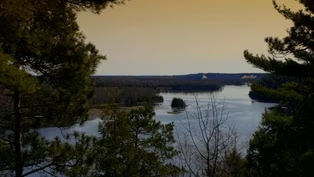
The Legacy of Michigan's Rivers
Video has Closed Captions
Clip: S12 Ep3 | 7m 26s | Discovers how river systems have shaped the lives of Michiganders. (7m 26s)
Providing Support for PBS.org
Learn Moreabout PBS online sponsorship














Support for PBS provided by:
Destination Michigan is a local public television program presented by WCMU