
Sen. Bill Frist
Season 15 Episode 7 | 26m 46sVideo has Closed Captions
Get to know a Tennessean who blazed trails in surgery and politics, Sen. Bill Frist.
Alison gets to know more about Tennessee's pioneering surgeon-turned-Senate Majority Leader, and continued healer in more ways than one, Sen. Bill Frist.
Problems playing video? | Closed Captioning Feedback
Problems playing video? | Closed Captioning Feedback
The A List With Alison Lebovitz is a local public television program presented by WTCI PBS
Sen. Bill Frist
Season 15 Episode 7 | 26m 46sVideo has Closed Captions
Alison gets to know more about Tennessee's pioneering surgeon-turned-Senate Majority Leader, and continued healer in more ways than one, Sen. Bill Frist.
Problems playing video? | Closed Captioning Feedback
How to Watch The A List With Alison Lebovitz
The A List With Alison Lebovitz is available to stream on pbs.org and the free PBS App, available on iPhone, Apple TV, Android TV, Android smartphones, Amazon Fire TV, Amazon Fire Tablet, Roku, Samsung Smart TV, and Vizio.
Providing Support for PBS.org
Learn Moreabout PBS online sponsorship- [Alison] This week on "The A List," I sit down with a man who has built a remarkable career around a commitment to healing.
- The one thing that my parents gave me was this trust through medicine and healing.
And one-on-one relationship with patients where nothing else matters, but that patient and the bond between a doctor and a patient.
And then carrying it to government, if that's your mindset, it does attract.
People say, why did you become majority leader at your age with so little leadership experience?
And it was because people trusted me in dealing with them.
And today that trust is lost.
- Join me as I talk with transplant surgeon and former US Senate Majority Leader Bill Frist.
Coming up next on "The A List."
(upbeat music) Over the course of an impressive career, Bill Frist has performed over 150 heart and lung transplants, been elected Majority Leader of the United States Senate, led medical mission trips and emergency response teams.
And lent his knowledge and expertise to combating global climate change.
Oh, and in between he also found time to host a podcast.
Senator Frist's lengthy and varied resume illuminates a lifelong commitment to humanitarianism and healing.
Of individuals, of communities, of the country and of the world.
And he's not slowing down anytime soon.
Well, Senator Frist, welcome to "The A List."
- It's great to be with you.
- And I asked you beforehand, I don't know whether to call you Senator, doctor, I'm certainly not gonna go by Bill, even though you offer that, there just feels like there's a lot of ways I can address you and they are all testament to the incredible life you've had and the careers you have enjoyed.
- Yeah.
You know, it's interesting.
They're all one and the same to me.
You know, this sort of narrative of health and healing and hope and all of that.
So you're nice.
It can be Bill.
(Alison chuckles) - Well, Bill, Senator, doctor.
Let's go back before you were any of the monikers and really just Bill, growing up in Nashville, what was your childhood like?
- It was a great childhood and I don't know if a lot of people start that way or or not, but I was fortunate to grow up here in Nashville, middle class neighborhood.
Dad was a family practice doctor here, had five children.
I was the last of those five children.
The baby of the family.
And I always tell the stories, hand me downs and kind of ignored and, you know, an accidental child and all but in truth had great siblings, two brothers, two sisters, grew up in Nashville, not too far from where we're sitting now.
Dad had a family practice, really beloved in the community as family practitioners and internal medicine people were back then and was blessed to have the siblings who kind of led me along the way.
I got to watch them, got to sit back, got to observe.
And that taught me a lot of life lessons.
My parents never looked at my report cards.
My parents never had any rules.
And I thought about that because with my own children I had a lot of rules and I did look at the report cards, but there really wasn't much in terms of expectations.
It really was the last of five children.
And you're part of this bevy of children growing up.
Went to grammar school at a public grammar school here that was like a lot of the traditional grammar schools.
It was before the time of desegregation and it was a all white school, which is the way it was at that time.
And then went to high school at a boys day school here, Montgomery Bell Academy, and then went off to college after that, but didn't have any great trauma growing up.
The usual ups and downs of challenges in life and adolescence.
But no great trauma, no great losses, no great challenges that seemed insurmountable at the time.
So really blessed in a lot of ways.
- So when did you know you wanted to be a healer?
- You know, I go back a lot.
I did go on rounds with my dad when I was young.
And, you know, at age five or six or seven years of age, he'd come home at about 5:00.
No, about six o'clock at night.
We'd have dinner for an hour and then every night he'd go make house calls every night, every night growing up.
And so from about 7:30 or about 7:00 maybe 7:30 I'd be sitting in his big old black DeSoto car.
And I remember that 'cause he'd never get a firsthand car.
He'd never get a new car.
He'd always buy a used car and he'd keep it forever.
And I'd be sitting in the car with my, you know, arm up on the doctor's bag and him driving and we'd pull up to a little house and he'd go in and he'd drag me along and he'd sit down and I'd watch the way he interacted with patients and how there would be an 80-year-old woman in bed, you know, looked meek, looked like a ghost.
And he'd walk in and all of a sudden her face would brighten up and he'd sit on the edge of the bed and he'd hold her hand and all of a sudden she came alive.
And so sitting across the room watching that sort of time and time again, it clearly it affected me and I wanted to be like him, I wanted to have that impact on people through a profession.
And that profession would be being a doctor.
So it probably started with that.
- When did you decide though, to be a surgeon?
Because that surgical lane is like, I mean, you just take everything from a non-medical person, but I think of everything in medicine and everything in medical school and everything in residency, et cetera.
And surgery feels like the pinnacle of that.
That is the highest pressure.
And then you add on to surgery, transplant surgery and what you were able to not only do, but accomplish in terms of the life saving treatments and the center here in Nashville.
- No, it is a good question.
And dad was an internist, family practitioner, not a surgeon.
He always wanted to be a surgeon.
But when he was coming along in the 1930s, he had no money at all.
And to be a surgeon would take an extra two or three or four years.
And so he never had the opportunity to be a surgeon.
But he always talked about, I'd love, I wish I had been a surgeon, had the opportunity to be able to get information, have somebody walk in the room with a problem that is literally killing them many times.
And with my hands be able within eight or nine hours to cure that person to live a normal life.
And that probably stuck with me some when he would tell that story.
He didn't make a big deal about it, but I heard him tell it a few times.
And so when I had the opportunity to go medicine or surgery, surgery is a lot faster pace.
It's action oriented.
You're held accountable.
It's your hands, it's your mind, and you're changing things that are for the better.
In medicine it's more healing and more talking and more hands-on and more giving drugs and medicines and takes a little bit longer and all.
So the personality of being able to act, to cut, to sew, to fix within minutes and then to be held accountable long term is something that appealed to me.
And then the transplant story is interesting because after doing surgery for five years, I said, what's the most exciting thing, the most innovative world of surgery today?
The most futuristic, the most radical, the most unheard of.
And there was this field called transplantation and lung transplants had never been done before ever in the history of man.
Heart lung transplants had never been done before.
There was a new procedure called a heart transplant.
And it had been done in the 1960s, but none of those worked.
And in the 1980s there were just a very few being done.
And I said, that's the most exciting field.
It's pioneering, it's new.
It requires creativity, it requires dynamism.
It requires taking risk.
But literally taking somebody who by definition is gonna die within two months or three months and being able to open them up because of a gift of a heart of somebody who tragically died elsewhere.
Being able to take that heart out and put it in a new person and then give them 20 years, 30 years, 40 years of life, that idea was appealing.
So I guess the choice of surgery was action fixing things, not being satisfied, yes, more dramatic.
And then gravitating the creative side has been a thematic through my life now.
I didn't know it at the time, but went to the most creative part of surgery, and then heart lung transplant, and then the creative side of the policy world and the creative side of the business world.
And now doing the creative side of climate change and big existential problems.
So I didn't know all that at the time though.
And that's just I like the creative side of things.
I can't draw, I can't sing, I can't play a musical instrument.
So when I say all this, you have to put it in perspective.
(gentle music) - That inclination toward innovation has led to some remarkable achievements over the course of Senator Frist life.
No matter where his career has taken him.
In 1985, he accepted a position in Nashville.
And began the cutting edge work of creating a multi-organ and multidisciplinary transplant center.
The first of its kind, today The Vanderbilt Transplant Center performs more heart transplants annually than anywhere else in the world and remains a leader in the field.
But less than a decade after its inception, this forward thinking surgeon shifted his focus in a radical way.
So what on earth made you say, I'm such a successful surgeon with such a career ahead of me, all of these accolades, I should go into politics and spice things up?
- Yeah, you know, that's a good one too, because I didn't have a mentor.
I didn't know really whether I was a, you know, Republican or a Democrat.
I wasn't a party, you know, a political party animal.
I didn't have time for that, I didn't vote many times 'cause I was doing surgery over the course of those days and that's how far I was from it.
But I did realize what one is able to do, and mine was pretty dramatic because of the transplant world.
But being able to fix and give hope to people and give them this healing, I asked myself, is there any way to take it to scale?
I could do hundreds of heart transplants and I could operate on thousands of patients and probably operated on 10,000 patients, but what about the a 100,000 or the million or the 5 million or the a 100 million or people, I said, is there any way to take this sort of thematic of service and healing to scale?
And there aren't many ways to do that.
And I was naive at the time too, and I said, you know, and I said, the only way you can do that is a policy, a policy that impacts a community in Nashville or a state or maybe maybe a region or maybe a country.
And if got lucky, maybe the world.
And then I said, okay, it has to be policy.
Would it be governor, would it be mayor or the school board?
I didn't really know that either, but I said, might as walk, you know, look at the country and run for the United States Senate.
Went to see Howard Baker not too far from where we are in East Tennessee or where you are in East Tennessee.
And he said, no, Howard Baker, I didn't know him at all.
I said, I'm a heart and lung surgeon over in Nashville.
Nobody knows who I am, but I wanna run for the United States Senate, and he- - You just cold called him.
- Yeah.
- You said can you talk?
- I looked over and drove over there and he looked at me the first time and said, you know, I'm sure that just like for me now, hundreds of people come by and said they want to do it.
But I'm sure he looked at me and basically said, you know, that's good.
And he told me, he said, you know, that's good and keep your interest, but you're doing heart surgery every day and you're doing a good, you probably don't want to leave that world.
And what he was saying is, you don't have a prayer in this world.
And then I went back to him about two months later, and again, he kind of told me the same thing.
And then I went back to him two months later and he said, you know, if you're really this focused on it, what you have to do is leave what you're doing, leave the operating room, spend a year traveling the state, listening carefully to people.
And he said, even if you're just driving down the road, somebody's working on the interstate.
I remember the conversation.
He said, you know, stop, get out of the car.
Walk up and talk to the people who are building that interstate, why are they doing it?
You know, and what are their concerns about in Tennessee?
And so again being naive, not knowing, I didn't know any politicians, I'd never run for public office at all.
Nobody in my family had ever run for public office, a fairly apolitical family.
And that naivete said, okay, I'll do it.
So I found my success rate, Vanderbilt jumped in and ran the United States Senate and figured that out as best I could.
And that was it.
- Just like that?
- Well, you know, there's a lot of luck involved.
I ran against an 18 year incumbent.
Right?
It was a big year of anti-incumbency.
- Sasser.
- Yeah, Jim Sasser, a fantastic servant to the state.
He'd been there for 18 years in 1994.
We didn't know it at the time.
We didn't know it in 1993.
But in retrospect in 1994, there was a real revolution around the country against incumbents.
You know, 18 years as long enough was my mantra at the time.
And it resonated with people.
They wanted freshness.
They wanted new thoughts, they wanted new ideas, they wanted to break out.
They were tired of big government and higher taxes.
And therefore rode that coming in, again, didn't know it at the time, everybody, the primary itself was with six other people, or there were five of us.
And nobody thought I could get through that.
We got through that.
And then the one-on-one we won.
Had nothing to do with Jim Sasser, a great public servant.
He was gonna be the next Majority Leader of the Senate.
But people around the country were ready for change.
So a lot of it's serendipity and capturing those waves.
You don't really know.
In retrospect, it's a big wave.
You don't know coming in when everybody tells you you've got one in a million chances of winning.
- Well, not only were you campaigning against this idea of incumbents, right, only being the status quo, but you made a pledge as you were running that you would never serve for more than two consecutive terms.
And you honored that pledge.
I mean, besides being a unicorn running for office, that's gotta be also a unicorn serving an office.
Especially for someone who ascended the ranks so quickly, more quickly than anyone who had served in Congress before achieving Senate Majority Leader status.
You know, just within eight years.
How did you have the discipline if that's what it was to say, I'm going to serve for two terms and then I'm out.
- You know, I guess first of all, I did that.
I basically said, I'm gonna serve 12 years and no matter what happens, I'm gonna be a citizen legislator.
Come from a job, not a regular job, come from a community, a job, this community where we're sitting now.
Go spend 12 years, do the best I could possibly do.
I mean, I killed myself working.
And it was hard for those 12 years, do the best I could do and then leave and come back and live under the laws that we pass.
And it's a little bit risky because you don't know if you can accomplish what you want to accomplish in 12 years.
But when you say, I got 12 years and you start counting the days from day one, it gives you a little intensity and a little reason to do A what's right.
What are your goals?
You have to ask yourself, if you think you're gonna stay there forever, you can just kind of, you know, come along, still be a great senator or a good senator.
But by giving yourself this limited amount of time, it gives you focus and intensity and you set goals and that sort of thing.
- Was being a senator and a doctor your superpower?
- I think being the doctor allowed me to come in with a different mindset.
There were no doctors in the United States Senate.
The last had been elected in 1928.
So the mind of a scientist of compassion, of empathy, of ethics, of medicine, of trust, that kind of thinking of taking a limited but full amount of information, making a decision, acting on it.
This is in the world of Washington, not what people conceive.
Of making a decision, taking a stand, and then being held accountable for that vote or that stand is unusual in Washington.
It's because most people are from other types of disciplines are lawyers and they like the legal things and they like, you know, all sorts of things.
But for me it was really much more sort of pointed.
I knew exactly what I wanted to do coming in.
It ended up having a big impact in that I didn't go there to revolutionize healthcare.
That wasn't my purpose.
My purpose was to serve using my experiences broadly.
And I did through being majority leader and, you know, leading that body for four years.
But if you look at things that I gravitated to, and people gravitated to me things like HIV AIDS, which at that time was killing 3 million people every year.
And Democrats weren't addressing it.
Republicans weren't addressing it.
Nobody cared that much about Africa, in Washington.
They talked about it, but nobody acted.
- And you had been to Africa.
You did mission trip trips there and you saw the people.
- So every year I would take a week or two weeks or a month and go do surgery in Africa, all over Africa, operated in 13 different countries.
And so I'd do that.
And so I would see people dying of this wasting disease there.
And so people came to me and then President Bush made this initial commitment.
He and I and a handful of others talked about it.
And to his credit, he said, I'll put my presidency on the line.
And so in the State of the Union message in 2003, he made a $15 billion commitment.
And I was the leader in the United States Senate.
We wrote the bill and with the House of Representatives and passed it.
And now there are 25 million people alive today, because of that legislation.
I can say that, you know, it wasn't me writing it, but the fact of being the only doctor in the Senate.
Working with a president who was courageous, and Democrats who were already there, they wanted to do something for the most part.
And the evangelical Christians and got Bono involved and got Jesse Helms as icon of the conservatives involved.
But by putting all of them in a room, in essence were able to make the single greatest commitment and execution of commitment in the history of this country against a single disease.
(gentle music) - Over the course of his 12 years in office, Senator Frist honored his commitment to heal at scale.
From global HIV AIDS relief, to the Medicare Modernization Act.
His leadership made a significant impact on the health of the nation and for individuals around the world.
And since leaving office in 2006, he has continued to seek out innovation and creativity in his efforts to address the monumental challenges we face in medicine, global health, conservation and beyond.
(bright music) When you think about, and look back on your tenure in the Senate and how many policies you were able to influence, how many lives, you talked about scale, how many thousands, millions of lives you were able to save literally.
And now we come to present day and we think about just still coming out of this pandemic era.
Does it surprise you that somehow science has become political?
- No, only because this politicization and partisanship and lack of trust.
I mentioned that the one thing that my parents gave me was this trust through medicine and healing.
And one-on-one relationship with patients where nothing else matters, but that patient and the bond between a doctor and a patient.
And then carrying it to government.
If that's your mindset, it does attract people.
People say, why did you become majority leader at your age with so little leadership experience?
And it was because people trusted me in dealing with them.
And today that trust is lost.
It's lost.
It's not in mosque, its churches, religion, it's not in government, it's not in a political party, it's not in banks, it's not in institutions.
The trust has gone down.
So that lack of trust, I think is the backdrop that you have to operate today.
So it makes it harder because if you can't trust what anybody's saying, especially scientists, the challenges get bigger.
And then it's more important I think to get involved and to be active, to take the surgical approach, to get in the field, jump in the arena, get your hands dirty, fight for things, advocate for them, vote, get out and move things.
'Cause you don't have that trust anymore.
And therefore we have to get leaders in there who have it.
And the trust has been lost in science today to a large part.
But I think at the end of the day, when people can relate science in which science tells us.
To the intimacy, the things that they're seeing every day, to these larger existential issues, we can still make great change.
And that's one of the reasons that I've gravitated to nature and things like climate change and the heat that we're feeling so much of today and the unstable weather patterns, these big existential causes that seem so far away.
Yet will change the course of history, are changing the course of history which come back and impact people's health and wellbeing.
Their mental health, their physical health, their ability to do things, how much they pay for insurance and all of this climate change.
So for me, all of it's the same kind of, you know, where we started in this sort of narrative of healing coming in and taking bigger and bigger problems on it at that scale.
Science is important though.
I mean that's sort of my life is my core.
And one of the goals I have in the remaining days, I've started counting days that I have left now, but is to basically rebuild that trust in science.
- Hmm, so with everything in front of you, and it feels like you still have so much more to accomplish as much as you've already done.
- I figured I got about 2,000 days.
- 2,000 days left?
- Yeah.
Anyway keep going.
(Alison laughs) - So in the next 2,000 days.
- Yeah.
- How do you prioritize and when you figure out what it is you wanna do, I you know you're the board chair for the Nature Conservancy.
You're looking at global issues and figuring out systemic solutions to these.
But as you prioritize those issues and your time as it relates to that, what gives you hope?
- Well a lot of hope.
The prioritization comes from closing my eyes and basically coming back to this trust and this healing service model, which is not like virtuous, it's just kind of what I was born with because of parents and family and values of growing up here.
So the prioritization is pretty intimate it really is.
Individuals as part of a community, but individuals and their wellbeing, their mental wellbeing, their spiritual wellbeing, their physical wellbeing and nature itself speaks to everybody.
And I'm a great believer in the sustaining the natural world for the purpose of the wellbeing of people.
Not just conservation for conservation, but conservation to wellbeing of people.
So the prioritization is pretty easy too.
- Do you ever rest?
- The transplant world trained me to stay up all night all the time.
That was bad, it was unhealthy, it was before we knew sleep was that important.
And so, the answer is yes, but I still start early and go a little bit too later.
But yes, and everybody needs to get a lot of sleep.
I'm preaching to myself.
(Alison laughs) - Well, I hope you remain as vibrant and restless in all of the pursuits that you have for the next hopefully many, many 1,000 days.
And just appreciate all you've done to not only heal individuals, not only heal the country, but heal the planet in so many ways.
Thank you, Dr.
Senator Frist.
- Thank you.
Great to be with you Alison.
- You too.
(upbeat music) - [Presenter] Watch even more of the shows you love anytime.
With WTCI passport, on the free PBS App.
Download it today.
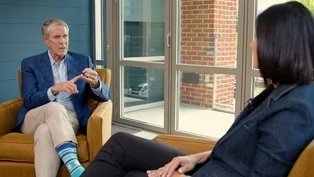
Sen. Frist talks about addressing AIDS on a global scale
Preview: S15 Ep7 | 2m 16s | In 2003, Sen. Bill Frist helped lead a bipartisan effort to address the AIDS crisis. (2m 16s)
Providing Support for PBS.org
Learn Moreabout PBS online sponsorship














Support for PBS provided by:
The A List With Alison Lebovitz is a local public television program presented by WTCI PBS