
Sen. Lamar Alexander
Season 17 Episode 9 | 26m 46sVideo has Closed Captions
Alison gets to know this public servant of Tennessee.
Few Americans have served their country in as many ways as Lamar Alexander has. From the Governor's office, to the Cabinet, and a seat in the Senate, Lamar has worn a lot of different hats, but consistently one shirt.
Problems playing video? | Closed Captioning Feedback
Problems playing video? | Closed Captioning Feedback
The A List With Alison Lebovitz is a local public television program presented by WTCI PBS
Sen. Lamar Alexander
Season 17 Episode 9 | 26m 46sVideo has Closed Captions
Few Americans have served their country in as many ways as Lamar Alexander has. From the Governor's office, to the Cabinet, and a seat in the Senate, Lamar has worn a lot of different hats, but consistently one shirt.
Problems playing video? | Closed Captioning Feedback
Where to Watch The A List With Alison Lebovitz
The A List With Alison Lebovitz is available to stream on pbs.org and the PBS app.
Providing Support for PBS.org
Learn Moreabout PBS online sponsorshipThis week on The A List, I sit down with a seventh generation Tennessean who has served alongside ten presidents throughout his long political career.
It gave me a chance to wake up every day as governor.
And then later, senator, thinking I might be able to d something good to help my state or country and go to be most nights thinking that I had.
I mean, it was almost like a stream rushing once I got into the job as governor and I. And there's not much more satisfying than that.
You could say it's a calling whenever your greatest goal fits, whatever the community's greatest need is.
But I've felt that way Join me as I talk with former Tennessee governor and United States senator Lamar Alexander.
Coming up next on The A List.
Lamar Alexander is a stalwart of Tennessee public life, whose leadership has spanned decades and defied easy categorization.
A two term governor of Tennessee.
He also served as US Secretary of Education and presiden of the University of Tennessee.
Before spending 18 years in the United States Senate.
An accomplished pianist and prolific author, Lamar has captured the lesson learned throughout his journey.
In his latest book, The Education of a Senator.
I had the chance to tal with him about his unique path from the foothills of the Smoky Mountains to the halls of our nation's capital.
Well.
Lamar Alexander.
Welcome to the A-list.
Thank you.
And I want people to know I asked in advance what I should call you because you have had several very impressive title between governor and secretary and president of the university and senator of course.
And you allowed me to call you by your first name.
I want to make sure people know that.
Well, my my family does.
My staff does.
Everybody else does.
You should too.
Well, tell me about how you got your name.
Where did Lamar come from?
We're not really sure.
I'm a junior.
I'm Andrew Lamar Alexander Jr.
And so my dad's called Andy.
And so they call me by the middle name.
And it probably came from a Professor Lamar who was at Maryville College at the end of the Civil War.
So Huguenot name.
Presbyterian name.
Well its a good name.
Well, it's a different name, a memorable name.
So, speaking of Maryville let's talk about your childhood.
What was it like growing up in Maryville, Tennessee?
Well, when I ran for president, a reporter wrote.
Mr.
Alexander grew up in a lower middle class family in the foothills of the Smoky Mountains.
And when I called home, that weekend, I could talk to my mother.
She was reading Thessalonians to deal with the slur on the family, and she said, son, we never thought of ourselves that way.
You had a piano lesson from the day you were three and a and a library card from the day you were four.
You had everything you needed that was important.
Our parents were teachers.
Everybody in Maryville had a job at Alcoa or farm, so everybody mad about the same amount of money and everybody took care of the kids, encouraged us.
So by the time I graduated from Maryville High School, I thought I could do anything because I'd been told that, you know, it was such a small town that I was too naive to know what the limits were.
Well, I've just finished your newest book, The Education of a Senator.
I feel like I have really been reading literally the pages out of your personal diary and journal and feel like I know you, but also the people around yo so well, especially your mother.
And I think we would have gotten along brilliantly.
I loved her unfiltered nature and the way she extended her own values in a very diplomatic but distinct way.
Such as God gave us this beautiful October day to rake leaves.
Thats how she extended that.
Or he gave you the gift of music so you could get up at 530 and practice the piano before you go to school.
Did you ever think you would be sitting behind a piano instead of a podiu for your professional endeavors?
I thought about it.
I mean, I had a I had I had scho college scholarship, and I played the piano, took lessons until I was a freshman at Vanderbilt and won some statewide competitions, that kind of thing.
But I figured I wasn't good enough to go on tour.
And then when I went to hear people like Dean Morris and Leonard Pinero and others, I realized that they spent all their life traveling.
And I thought well I don't want to do that here.
And then I end up in politics, traveling all the time.
So basically, I wasn't good enough to go on tour, and I thought, maybe I do something else.
So when did you get the political bug?
I'm not sure, but it came early.
I showed up at Boys State.
Tennessee Boys State, aged 17, with campaign posters already printed announcing my candidacy for governor.
How'd that turn out?
I won by four votes.
Landslide.
No, I think it came because my parents, taught me to respect public life.
My dad was on the Republican executive committee.
He counted votes.
He was elected to the school board.
We listened to the to the, national conventions.
My dad took me to the courthouse to meet our congressman, Howard H. Baker, senior.
The father of our Senator Baker, when I was ten.
I remember he gave me a dime, and I thought, I've just met the most respected man I've ever likely to meet other than my dad and our preacher.
Did you know already that you were a Republican when you were in college?
Yes, I did.
I mean, I grew up.
My great grandfather was asked, is politics?
He said, I fought with the union.
He said, I'm a Republican.
He said, I fought with the union and I vote like I shot.
So I grew up in a Lincolnite family, you know, all these East Tennessee families who who didn't secede when Tennessee seceded during the Civil War.
And so, so many soldiers from East Tennessee went to fight with the Union Army.
And as a result, our congressional district is never elected a Democrat since Lincoln was president.
So I grew up in a Republican hotbed.
Well you knew you were a Republican, but you didn't necessarily know you wanted to stay in Tennessee.
That's right.
So you headed up north.
I love this part of your story that there's only one way to test whether you really want to be in Tennessee, and there's only one city you can go to to do that.
Well, there was one that I thought.
I went to New York University Law Schoo and the law school is right on looking out the window of Washington Square Park in Greenwich Village.
And if you're in, if you want a political career in Tennessee as a Republican, that's not the place to go to law school.
My father thought I was going to a communist institution, so it was a liberal place.
It was different.
And I wanted, you know, I was a seventh generation Tennessee, and I thought, am I sure I want to live here rest of my life?
And, and I've got this political bug.
Do I need to get rid of it?
So that was one reason I went there.
And tell me about meeting who would soon be your college roommate.
This is one of my favorite stories.
Well, I'm.
We're in the registration line the first year, and this tall guy in front of me.
This is back way before computers, so we had to stand in line to register.
He was upset.
Why are you upset?
I left my money at home.
Where is home?
Jersey city.
I thought Jersey city might be in Texas.
This was my first visit to New York City.
So I said, how much do you need?
He said, I need $300.
And I said Ill loan it to you.
I had my expense money for the year in my pocket.
He thought I was a complete hayseed, that I would loan $300 cash to someon I'd never met in New York City because he'd grown up in Jersey city.
Slamming his elbows against the concrete walls in his basement so he could play.
It'd be tough enough to pla basketball in the schoolyards.
And we became friends and roommates for two years and were friends for the rest of our life.
In his life, he died, just passed this past year.
And that was that was Paul Tagliabue He grew up to be the commissione of the National Football League.
So I went to a lot of Super Bowls.
I want to say the takeaway there is loan somebody you don't know money.
Go to 15 Super Bowls.
I mean that' a good trade off of my tickets.
But I had good seats.
That's incredible.
After law school in New York.
Lamar returned to Tennessee with an eye toward serving his state and his country.
Crucial to his journe was a concerted effort to listen both to leaders he admired and to regular Tennesseans.
On a long walk across the state.
He loved.
So you talk about after la school, and through your life, there were really three me who had great influence on you.
And I won't include your father because I know he he was also one.
But tell me about those three influences and what they taught you specifically.
Well, Judge John Minor Wisdom in New Orleans, he was the federal judge who.
Presided over the desegregation of public schools in the South during the 50s and 60s.
And Eisenhower appointed very activist Republican.
You always say you went to the College of Wisdom, the right to the College of Wisdom.
And he taught me courage because he ordered James Meredith Ole Miss to admit.
James Meredith, who was th first black student at Ole Miss.
Second was Howard Baker, who I was attracted to work with him when he and Bill Brock from Chattanooga were trying to build a two part political system in Tennessee.
And he taught me how to speak, to be ethical, to ask the right questions.
And once he got to the Senate and I worked for him there, he taught me tha the other fellow might be right to be an eloquent listener.
The place was best, you know, was was based on on on a respect for each other or relationships and and that it was fine to be conservative, which we were.
But a part of conservatism was recognizing that some people might be elected who didn't agree with you and that if you wanted a result, you needed to adjus your position to get a result.
So which of those influences was most prominent when you decided to run for governor the first time?
Well, there was a third wh I didn't mention, Bryce Harlow, who who was Presiden Nixon's first appointee to the to the white House.
And he taught me.
I remember sitting next to him listening to white House aide come to see him day after day.
And the question he would always ask them was, what would be the right thing to do?
Howard Baker is the answer to your question.
He, he, he had already been elected to the Senate.
And I begin to understand when I did some work for Winfield Dunn, I was his campaign manager.
I could see the impact the governor could have that was more immediate on the people of our state.
So I wanted to be governor.
And and Howard really taught me how to go about it.
And for anyon who has forgotten those years.
Right.
Not the first run, but the second run.
This is a call back to you.
I don't think anybody's often seen me wear either red or plaid ever, much less on TV.
Well its very attractive.
when I walked across the state in 1978 to be governor.
In my first race, my wife said I was kind of a stuffed shirt and that I should be more myself, and I like music.
I like the outdoors, I like the walking.
So we ended up because of her coming up with the idea of to walk across the state.
Of course, you don't do that in a blue suit, right?
I went down to the Army surplus store and bought all the red and black plaid shirts they had, and I wore one every day.
And people remember that I was tellin someone about this conversation and they said, you know, Lamar, I think he walked across the state or else he was going to.
And I got very defensive.
I said, oh, he did.
He walked the whole tim and he stayed with 73 families.
You read the book.
And I said he, he di what he said he was going to do.
What was it about not just walking, you know, more than a thousand miles but staying with the citizens, staying with people in their homes and hearing the conversations at their dinner tables and sleeping in their guestroom beds or their couches.
That was so germane to yo really getting to know Tennessee and Tennesseans.
Well, it opened my eyes.
I thought I knew.
Yeah, I mean, I'm a seventh generation Tennessean, but I really didnt.
And doing what you just said, spending the night sleeping in their bed, sitting around the table, talking to their friends, going to the games.
It gave me a sense of what the state really was at that time, 1978.
And by the end of the walk, I concluded two things one, we're poorer than I thought.
You know, we were the only two states had lower family incomes than we did Arkansas, Mississippi.
And we lacked self-confidence.
And I determined that as governor, those were the two things I wanted to work on.
So I skipped over very important part of your life in many parts, because we're never goin to get to it all in this show.
But I want to know about Honey.
Tell me about when you met her at that now infamous softball game.
Well, I was playing softball for Senator Howard Baker's staff against Senator John Tower staff, and she was on tower staff.
She just graduated from Smith the summer of 1967, and she slid into third base wearing red shorts.
And I was completely smitten.
And I began parading around the ball field like a peacock in a barnyard, you know, home runs and impress her.
And she claims I have it all wrong.
And she said, I never slid into first base.
I never got a hit.
I had no reason to slide to first base.
But we were married 18 months later.
She was from Texas and I thought she was just as cute as she could be.
And and I was very lucky to meet her and get married to her.
And she was, you know, quite the force, not only on the campaign trail, but questioning if you should even go on the campaign trail.
She was devastated when I lost the first race in 74, and when I told her in 78, I might want to run again, she said, wait a minute, she said, first I want to know, why are you running an what do you hope to accomplish?
And is this good for the state?
Is it good for us?
You know, and that may soun like an easy question to answer, but it's probably the hardest question that anybody in public life has to answer.
And then she said, could we have a little different campaign mode?
Because she thought I was a stuffed shirt, and we ended up with a walk across the street.
When you look back, was it good for us, for you?
It was certainly good for me.
I mean, it gave me, you know, whatever gifts I had, it gave me a chance to wake up every day as governor.
And then later, senator, thinking I might be able to d something good to help my state or country and go to be most nights thinking that I had.
I mean, it was almost like a stream rushing once I got into the job as governor and I. And there's not much more satisfying than that.
You could say it's a calling whenever your greatest goal fits, whatever the community's greatest need is.
But I've felt that way now for her and for our family, it was harder.
I mean, it's inconvenient to be married to somebody at public life.
And she was very unselfish.
She insisted.
I tell her why I was running, but she didn't want to be first lady.
She was, she said what won me over was I thought as first lady, maybe I could do more for families and children.
That's what won her over.
To be happy with my running.
And she would be just as happ if I hadnt run, maybe happier, but but, it was a wonderful experience for me, and she was enormously supportive.
And so were our children.
What really struck me in your book, so many things struck me.
But one thing I really didn't realize the depth of was your relationship with Alex Haley.
Can you talk a little bit about how that blossomed?
He was the most celebrated autho in the world in the early 1980s.
And, and this was his I was governor of his native state, so we got to be friends.
And he was such a delightful person.
His his mott was find the good and praise it.
He find the good in everything.
And here was the descendant of slaves.
He wrote the autobiography of Malcolm X too.
And he small things like he'd say to one of our children, oh, that's that's a good essay with a little more work that could win a prize.
Or to the people who worked at the governor's residence, He was more interested in them.
They were in him.
So wherever he he went, he never I never heard him say a bad word about anyone or our country.
So he said a wonderful example.
And his book roots was one that we asked all of our children to read.
And they especially did becaus they knew him and will read it.
I remember as a class assignment when he was in seventh grade.
Afte serving as Tennessee's governor during a period of significant growth.
Lamar continued to seek out new opportunities to make a difference, whether in the cabinet or the classroom.
But it was his election to the U.S.
Senate in 2002 that bega a nearly 20 year chapter, marked by a commitment to listening and finding common ground.
So while you have worn so many hats, I think the one that at least most Tennesseans praise and know you fo is as Senator Lamar Alexander, that leap into, you know, DC, which was not such a far leap because you had spent a lot of time there.
But the choice to become Senator was that at a stage where you thought, this is where I can d the most good in public office?
Well at that time the answer was yes, I, I thought I didn't expect to have the opportunity.
Fred Thompson was the senator, but he suddenly decided not to run again.
And I was 62 years old at the time.
I was teaching at Harvard, teaching in the Kennedy School of Government.
And so it was a short primary and a short general election.
But I was actually teaching about the American character and teaching my students that most of the things we disagree with disagree about are about are based on principles.
So, that we agree on, like with school choice.
On the one hand, it's e pluribus unum versus equal opportunity for low income kids.
So I was teaching the students that we should resolve issues that way.
And then before I knew it, I was in the Senate and I was asking my staff t help me resolve issues that way.
So I was lucky to have I knew about 25 or so of the senators before I was elected, and in a place based on relationships, that was a big advantage.
And I worked with Bill Frist for four years, Bob Corker for 12 years.
So I had a wonderful partner to work with during that time, and that made it much more satisfying.
And I may have already said this to you, but but I had this.
People say, while one of my friends, who was a home builder, crawled under my house to pull out a dead rat one time when I was in the Senate and said, and I said I had a lot rathe have I wouldn't want your job.
And he said, I'd rather have my job.
Pulled a dead rat from under your house than your job up there in Washington, DC.
But what I would want him to know and others to know, is that I got up every day thinking I might be able to do something good for my state or country, and I went to be most nights thinking that I had.
So that's a great privilege.
I'm struck by the fact that you were only 38 when you became governor.
You were only 62, right?
When you became senator and had quite an illustriou career of more than two decades.
When you look back, is there any part of you that thinks, I wish I had done the reverse, been governor the second time later in life, and been senator earlier?
No, I think it's the right order.
Okay.
I mean, governor governor takes a lot of energy.
Fred Thompson came by the house one time and we were talking, and Honey came in and said what are you two talking about?
And I said, Fred's thinking about running for governor.
And she said, Fred, you know if you do, you'll have to work.
And Fred said, oh, Honey, I work.
She said, no, really work.
But the governorship is much more intensive, and it's good to have senators who have had that experience, maybe a little wiser and have longer term at a later stage in their lives.
You know, the issues you'r presented as a senator are huge.
You can't know much about any of them.
So you need to have some judgment to do a really good job.
So how did you know when it was time to retire?
Age is one.
I was 80, two, I had three terms.
I thought that was enough.
My little pla book says stay in Washington, DC long enough to get vaccinated, but not infected.
You managed to do that since, Senator Jeff Bingaman said I could avoid the three Ds of public life, death, disgrace and defeat.
I've always thought it was a good ide to follow Ted Williams example.
He hit a homerun in his last at bat rather than be carried off the field.
So when I got t the final chapter of your book and we discussed earlier, I listen to some on audible.
I read a lot, but I was reading it.
I was actually in th in a waiting room at an office because I didn't really know what was coming.
That final chapter, our best years.
It it, undid me.
I was sitting in the waiting room and tears streaming down my face.
Luckily, there was a box of tissues next to me.
I'm sure the woman across from me thought I had received terrible news from my practitioner, which I did not, but, I really was just undone by, you coming out so raw and vulnerable about all of it.
Was that a hard chapter?
Well, it was, but it was good to write.
I mean, the the value of a memoir.
And, Honey, she said, well, it's self-serving to write a memoir and I said yeah it is, most of what I've done has been self-serving.
But it gave me a chance to think about, you know, our whole lif together and how for 50 years, I mean, we got married when I was working in the Nixon White House, and she had her stroke a month before I left the Senate.
So I thought about all the years when she had done things for me, and I had a couple of year when I could do things for her.
And we were together all that time.
Most of the other time, I'm out walking across the state, serving in the Senate, going to Iowa.
So we were there.
You were in the same bed every night except maybe two weeks during durin those two years, she was sick.
So it was as I titled the chapter, our best years.
So what now?
What do yo what do you look forward to in, in this part of your life?
Because clearly you may be out of Washington, but it doesn't seem to me that you're quite done.
Well, I don't feel done.
I, when I, when I had lost when I retired from politics permanently for the second time before I ran for the Senate, I was watching an NBA basketball game, and Hubie Brown was the broadcaster.
He was saying if Kobe Bryant Yeah, would let, quit trying so hard and just let the game come to him, he'd be a much better player.
And, I thought maybe I should listen to that.
And and maybe that's what I should do now instead of trying hard, I think I'll see what comes.
I'm.
I'm on the board of Vanderbilt University.
I'm helping Maryville College create a Center for Outdoor Leadership of the Sciences.
I'm enjoying working with the Howard Baker School for Public Policy in Knoxville.
At UT, to help young people be interested in public life.
So we'll see what comes.
Well, if if it's okay with you, I want to quote your dear friend Ale Haley of blessed memory and say, when you see a good thing, praise it.
I'm looking at a great thing and I thank you so much.
Thank you.
Watch even more of the shows you love any time with Wtcr passport.
An exclusive benefit for members of TCI, PBS.
Watch your favorite shows and passport on the free PBS app.
Download it today.
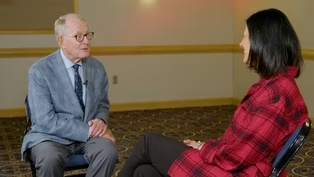
The three men who had the biggest impact on Lamar Alexander's career.
Clip: S17 Ep9 | 2m 28s | Besides his father, Lamar Alexander has three major influences in his life of public service. (2m 28s)
Providing Support for PBS.org
Learn Moreabout PBS online sponsorship New Episode
 New Episode
- Drama

Lesley Manville and Tim McMullan return in the final installment of the Susan Ryeland mysteries.
 From My Station
 New Episode
 New Episode

 New Episode


 New Season

Support for PBS provided by:
The A List With Alison Lebovitz is a local public television program presented by WTCI PBS