Living St. Louis
September 21, 2026 | Route 66 Special
Season 2026 Episode 15 | 29m 28sVideo has Closed Captions
The Great Race, Coral Courts Motel, Green Book Restaurant Sara-Lou Cafe, Muralist Ray Harvey.
Historic Route 66 celebrates its 100th anniversary in November. We caught up with vintage car drivers at the Catsup Bottle Festival in Collinsville, IL, on their way to the route's end in Pasadena, CA; plus, the infamous Coral Court Motel on Watson Road, the Sara-Lou Cafe, one of the only Green Book locations still standing; and muralist Ray Harvey's newest work in Ellisville.
Problems playing video? | Closed Captioning Feedback
Problems playing video? | Closed Captioning Feedback
Living St. Louis is a local public television program presented by Nine PBS
Support for Living St. Louis is provided by the Betsy & Thomas Patterson Foundation.
Living St. Louis
September 21, 2026 | Route 66 Special
Season 2026 Episode 15 | 29m 28sVideo has Closed Captions
Historic Route 66 celebrates its 100th anniversary in November. We caught up with vintage car drivers at the Catsup Bottle Festival in Collinsville, IL, on their way to the route's end in Pasadena, CA; plus, the infamous Coral Court Motel on Watson Road, the Sara-Lou Cafe, one of the only Green Book locations still standing; and muralist Ray Harvey's newest work in Ellisville.
Problems playing video? | Closed Captioning Feedback
Where to Watch Living St. Louis
Living St. Louis is available to stream on pbs.org and the PBS app.
Providing Support for PBS.org
Learn Moreabout PBS online sponsorshipWelcome to Living St.
Louis.
I'm Brooke Butler.
For nearly a century, Route 66 has become more than just a road.
It's been a pathway to the American dream, driving people to new jobs, new homes, new adventures and occasionally the world's largest something or other.
As America celebrates this milestone of the Mother Road, I can't help but wonder, with the evolution of travel, interstates, Airbnbs, GPS systems, even self-driving cars, how does Route 66 remain such a renowned symbol of American travel?
Our stories today remind us that it's more than just postcards and roadside signs.
The legacy lives in the people who preserve it, the places that remain, and the memories that continue to shape communities today.
♪♪ - It seems crazy to me to think that there was a time when I would just use my own sense of direction to get me to my destination, or that I could possibly reverse out of my driveway using mirrors.
But long before we had all these fancy driving assistants, we had Route 66, the open road representing freedom and adventure.
And for some, that adventure is alive and well today.
Vintage cars, two person teams.
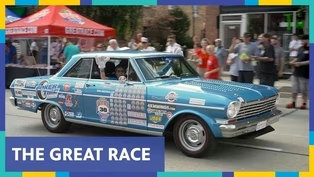
Great Race is a cross-country competition where over nine days, classic cars and their drivers are put to the test.
This year, traveling more than 2,300 miles across one of the most famous roads in America, Route 66.
The connection really this year is multiple, right?
It's the anniversary of the country, it's the anniversary of the mother road.
You know, I mean, there's never much of a distance between classic cars and the hobby and Route 66 anyway.
And this is just kind of the heightened marriage of the two.
Vintage cars and Route 66 are a natural pairing, both hearkening back to an era when the journey was just as much a part of the adventure as the destination.
It's a place that you would never really have a chance to go and it's a gorgeous country.
What we find is in this rolling car show is people in towns like this come out and say "Oh, my dad used to have one of those" and it's just great for people to reminisce and say "Oh, I used to have that Vega like that" you know that kind of thing.
It's just so much fun.
On day one, the race led competitors from Springfield to Collinsville, Illinois, a fitting location for the competition's first stop.
Decades earlier, Route 66 brought travelers through here, stopping for food, fuel and rest before continuing westward.
There's a brand new car for them this year in 2026.
We're pumped.
Buddy and Trevor, come on in, show it off.
Welcome to Collinsville, Illinois.
The concept was how can we get out and enjoy our cars?
So it's a fairly simple on paper competition format where you follow directions precisely, kind of like golf, low score wins.
- Emphasis on following directions.
Dating back to 1983, this long distance road rally isn't about who can drive the fastest.
These teams follow a carefully planned course, trying to arrive at specific points at exactly the right time.
No GPS, no smartphone telling them where to turn.
Instead, the navigator follows detailed instructions while the driver tries to maintain the correct speed.
So your job is navigator.
And the navigation, from my understanding, again, I'm a novice here, is really, really important because if you aren't getting to the exact spot, no pressure, no pressure, but if you're not getting to the exact spot at the exact time, then that all matters, right?
Yes.
Yeah.
And I would think it'd be like I can't get out my phone and GPS myself.
Yeah, no phones, no maps, only the paper instructions that they give you and your stopwatch.
It's hard.
It's really hard.
How's she doing?
Um, we'll have a redemption run tomorrow.
Most of the rallying takes place on back roads away from heavy congested areas, but touching this year's route, Route 66, as much as possible.
Most days, teams will travel 150 to 200 miles.
The cars do have to be roadworthy and safe, and if it's newer than 1974, it's not allowed in this race.
The older the car, the better.
The scoring system is set up to favor an older car.
So starting in the 50s, you have zero correction factor, but it goes back to 1900 to favor you to drive an older car.
What is your car here?
Give us a little tour.
It's a 1968 Ford Torino.
My grandpa bought this in 1969 and it's been in the family ever since.
My dad drove it in high school and college and then it sat for a while and then I've been restoring it.
At the finish line in Pasadena, California, $160,000 worth of prize money will be divided up among five competition classes.
But the big winner is Collinsville, because for one night, these vintage cars and the teams behind the wheels brought a little piece of Route 66 history back to life.
The neon signs of historic Route 66 landmarks like Ted Drew's and Donut Drive-In still persuade drivers to pull off the road and step back in time.
But for many Americans, spontaneity wasn't always an option when traveling on the Mother Road.
Route 66 was officially commissioned in 1926 and created a nearly 2,500 mile road that wound its way from Chicago to Los Angeles.
Over the decades, it would become the modern manifestation of the American spirit, promising freedom and adventure for those brave enough to face the unknown.
It was used by hopeful migrants to walk out of the dust bowl and the depression and into a better life, and by post-war families who were enjoying being reunited with loved ones and a new degree of economic mobility.
But this road that was built to create opportunities for Americans didn't treat them all as equal.
Route 66 was seen as this road that was all about adventure, all about freedom, you know, kind of the the open road and being able to explore.
But we know that black travelers didn't necessarily have that same experience and that they had to be very careful.
We got to think about Jim Crow.
We got to think about segregation and a traveler, not necessarily if they hadn't traveled that route before, not necessarily knowing what is up ahead.
Sundown towns, as we know, were towns that literally when the sun went down, if you were black, you should not be occupying any space in that particular town.
Oftentimes by word of mouth, even by signage, billboards and things of that nature, detailing, hey, you need to be out of here.
Jailing, fines, and sometimes even violence would be some of the repercussions that would come if black people were found in some of these sundown towns.
- Since the early 1930s, New York City postal worker, Victor Green, had been thinking about a way to help black travelers navigate around these embarrassing or frightening experiences.
Anti-Semitism was also prevalent, and Green found inspiration in the Jewish Vacation Guide.
First published around 1916, it provided the Jewish community with suggestions for businesses that were welcoming and safe.
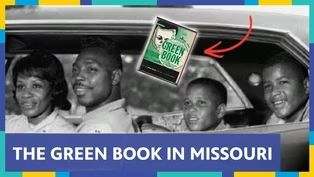
Green decided to create a similar handbook for black travelers, and with the help of his wife Alma, published the first edition of the Green Book in Harlem in 1936.
As the popularity of Route 66 and the romance of the Great American Road Trip grew over the next three decades, it would become invaluable.
The Green Book served as a tool, an instrument for Black travelers to be able to explore while also maintaining their safety.
St.
Louis had a number of businesses listed in many editions of the Green Book.
But after the May 16th tornado devastated the popular Harlem Tap Room, which had been open since 1946, there are none that remain operational today.
There is one still standing that's propped up, in part, by its impressive history.
The building, which is on North Sarah and St.
Louis Avenue, was built in 1906, not too long after the World's Fair.
In 1942, a gentleman by the name of Gustav Brinkman, he and his wife, Amelia, started the Sara-Lou Cafe.
The Brinkmans were white, but welcomed everyone into the cafe.
They also employed black workers in highly visible management positions.
And this inclusive atmosphere saw the Sara-Lou listed year after year in the Green Book.
When Gust decided to sell the restaurant in the early 1970s, it was bought by Vashon graduate and entrepreneur, Jimmy Owens.
- So the initial Sara-Lou, they were famous for their frogs, that was up on the sign.
But Jimmy Owens' Sara-Lou was famous for their shrimp.
It was said that Sara-Lou sold more shrimp than any non-chain restaurant in the Midwest.
And it wasn't just because the shrimp were delicious, Jimmy intentionally kept the cost of the famous dish affordable so that everyone could enjoy it.
The Sara-Lou had always been popular, but under his ownership, it became much more.
It was sort of a cultural center for the neighborhood.
Jimmy was sort of a godfather for a lot of the kids in the neighborhood.
He was champion of a lot of children's causes.
Over the years, he employed generations of neighborhood families in the restaurant.
So it was a special place.
Jimmy Owens closed the Sara-Lou in 2002, and the iconic sign disappeared in 2019.
But those I spoke with in the neighborhood still remember it fondly.
But since happy memories can only do so much, structural supports have been placed to preserve what is left of the building, in hopes that someday this historic site can come back to life.
Yeah, maybe one day somebody will be serving frog and shrimp there again.
By the mid-1950s, millions of green books were in circulation.
And as both the popularity of Route 66 and the green books distribution grew, so did the opportunities for black entrepreneurs.
It helped them to identify what types of services were needed in their area and to take advantage of the wide exposure that being advertised or even just listed in the green book provided.
So it's incredible to be able to have a source like this that's building business, building community and ensuring black safety.
One of the standout entrepreneurs was featured in the Missouri History Museum's Route 66 Festival, which marked the 100th year since its construction.
Elizabeth Calvin and Irv Logan were there to share the incredible story of their grandmother, Alberta Northcutt Ellis, who bought the Old City Hospital in Springfield, Missouri at an auction and turned it into an amazing destination on the Mother Road.
Her hotel was right there on Business Route 66.
The hotel had a barbershop, a beauty shop, the rumpus room, you know, for partying, the restaurant.
The Crystal Palace.
Then she had the jazz club, the Crystal Palace.
Alberta also bought a farm about 10 miles outside of Springfield, where families could pull off of Route 66 to take a rest, eat their picnic, or enjoy the fruit trees in the orchard.
She even arranged with the white farmer next door to give pony rides to the children.
Her unique complex of businesses didn't just give black travelers the necessities, it gave them the chance to enjoy their journey with a sense of freedom and community.
The only other way that African Americans in that day would have a place to stay was in someone's home as they passed through.
Graham's Ribs Station was anothe location in town that had little cabins that Mr.
Graham, who was an expert in barbecue, decided, "You know what?
People are coming here to buy a barbecue, and then they're asking me, 'Where do I stay?'"
So over time, he developed these small cabins.
So the hotel was around the corner from it.
They worked together.
Very close.
With each other.
It's like, if somebody came and there was no room in the hotel, she would send them to Graham's.
Graham's would do the same thing Alberta's Hotel also hosted a number of famous black performers who followed Route 66 from gig to gig.
Nat King Cole, Roy Hamilton, even the Harlem Globetrotters.
But all of her businesses, from the Snack Shack to the Jazz Club, were open to everyone.
She never discriminated against anyone based on color.
There were times when the soldiers who were returning from Korea would come into town from Fort Leonard in a group, and they had served in war together and seen some horrible things and been through some terrible experiences together.
And when they got a chance to relax, they wanted to do that together.
So a lot of times, you know, we'd have a mixed group of people staying there at the hotel.
Before moving to St.
Louis, Elizabeth Calvin and Irv Logan grew up in Springfield, watching their grandmother run multiple businesses while also working full-time at the Southwestern Bell Telephone Company.
Everybody in Springfield called her Miss Alberta.
She was all business.
But she was also a very loving grandmother.
I spent a lot of time working with her at the hotel.
I was the gopher.
Go for this, go for that.
Just followed around and saluted and did what I was told.
I learned a lot.
I didn't realize it was going on.
But it really served me well as I became an adult and moved on.
But on the rare occasion that she got a break, Alberta would indulge in one of her passions, traveling.
We were on old 66 all the way from Springfield to to California.
We we traveled with her as the family on the road.
And so we knew about Jim Crow.
At nighttime, we would stop along the road if we saw a vacancy sign at a motel.
Alberta was always the one to go in because she was pretty no-nonsense.
Sometimes she would be told that there was no vacancy and she would usually come back to the car and she'd say, "I told them that I'm gonna write, "I'm gonna write to AAA, I'm gonna let them know "that you denied us service."
And that was back in the early 50s.
She was pretty conscious, I think, of the way things should be and not the way things were.
In 1966, two years after the Civil Rights Act had passed, the final edition of the Green Book was published.
That same year, Alberta Northcutt Ellis passed away at the age of 56, shortly after her iconic hotel on Route 66 had closed.
The grand old building was eventually torn down, a historical marker the only indication it had ever stood there.
But Alberta's legacy lives on thanks in part to her refusal to throw anything away.
She had meticulously documented her life, her family, her business by saving every photo, record, postcard and letter.
There's a picture in the collection of me as a newborn child being held by Elijah Bidel.
Elijah Bidel Crittenden, born into slavery, was still living when Irv was born.
So the history for us is very present.
It doesn't always feel like the past.
Her grandchildren inherited this vast and precious collection and donated it to Missouri State University in Springfield for preservation.
Find out what your history is, find out who your family really was, honor your past because it is also your present.
Just the way that we also were able to live because this woman was on fire.
She was, she was really something.
The Missouri History Museum's Route 66 Green Book panel also featured Marlie and Anthony Love who discussed how the Green Book inspired their digital travel series.
Hey what's up, it's Anthony and Marlie Love.
Welcome to episode three of our Traveling While Black Across America series, volume two, Oregon Coast.
We're in the one of the most famous cities on the Oregon Coast, Cannon Beach, and we cannot wait to show you all the great things that you can experience here.
When the St.
Louis natives moved to Seattle, they embraced exploring the Pacific Northwest, but realized other black travelers might feel hesitant to do the same.
And we thought about the aspect of not really seeing a lot of other black folks up in the Pacific Northwest, not like we were used to growing up in the St.
Louis area.
Then it took my mind back to when I found an original copy of the Green Book back in Marlie's grandparents' house.
Pulling off the road and walking into our lodging, it was really refreshing to see a sister work in the front desk checking us in.
So we are giving two points for black people seen.
Of course, that added to our personal comfort level.
But not only that, walking around the town and dropping into the establishments, we encountered some friendly and welcoming people.
We rate our experiences on three criteria.
The drive or travel to a destination, how much fun we have in that destination, and then how comfortable we feel as a black traveler visiting for the first time.
We create these rating systems to help be a resource to other people, because we thought about the Green Book and how there were places that you knew you'd be comfortable at.
And we also have different type of scales for the different type of destinations we go to.
A great example is the state of Oregon.
So the state of Oregon, historically, because of the black exclusionary laws, it has a black population of less than 1% within the whole state.
But if you've ever been to the Oregon coast, it's like one of the most beautiful places in the country.
So we made its own scale to replace the criteria that we have for amount of black people seen.
This trail is pretty dope because it is a pretty easy trail that takes you to a very beautiful payoff.
Low effort but also gets you right smack in the middle of nature.
Yeah, because you know we say nature loves black people.
It was just good to be able to connect that historical context to the present and how people are still thinking about these things and how it informs the way that we today even see ourselves as travelers.
In all of our travels, we try to find a black owned business or minority owned business and encourage other people to go visit them as well.
Black owned, women owned, LGBTQ+ owned businesses that traditional tourism often overlooks.
And so that is sort of the spirit of the green book that we like to carry on.
We like to build bridges.
You know, a lot of folks, they weren't aware that there's still a need, but you know, more often than not, if it's folks outside of our community, they are willing to be allies and to help that experience be better.
♪♪ The National Museum of Transportation in Des Peres is home to all kinds of Route 66 memorabilia and artifacts, vintage cars, neon signs, and even an entire unit of a motel.
And though most people associate Route 66 with happy memories, this particular motel has a darker past.
In its heyday, there were plenty of stops on Route 66 if you were looking for family fun.
But taking the road through St.
Louis, there was an infamous place to go if you were up to no good.
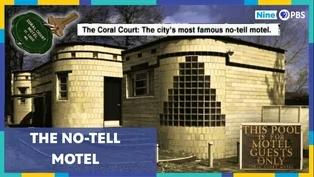
Any reason you might have to need a room for a couple hours, the No-tell Motel of the Coral Court was the perfect place for you.
That's Andrew Wonko, a public historian at the Missouri Historical Society.
By the time the Coral Court was demolished in 1995, it was associated with the mafia, prostitution, outrageous parties, and even a murder.
But the motel began with good intentions.
It was just one of many motels built on what was known as Motel Row.
So Watson's Motel Row roughly stretched between the St.
Louis City limits and Lindbergh Boulevard.
And across that area, you had more than a dozen of these motels that popped up.
Most of them were built from the 1930s to 50s.
And a few still stand today, like the Wayside and Chippewa motels.
These were the first roadside accommodations for folks who wanted something that wasn't one of the big grand hotels of downtown, something a little more family-friendly that they could get in and out of, something with a playground and a swimming pool for their kids.
The Coral Court was built in 1941 by John Carr.
He wanted the motel to stand out from the others on Watson Road.
He spent hours with local architect Adolph Strubeck coming up with plans for what this motel would look like.
And he wanted to capture that feeling of roadside aerodynamics, the sort of built for speed curves.
He went with this glazed sort of honey colored tile.
In the early days, the Coral Court was a huge success.
By 1946, John Carr has tripled its size.
He has 70 units.
He has a swimming pool, a playground, anything a family who is wanting to come through could want.
While the Coral Court has been demolished for over 30 years, an entire unit of the motel was salvaged and is currently on display at the National Museum of Transportation in Des Peres.
-Kobe Ellison, the museum curator, explains that the motel also had private garages.
-You could park your car in at night, which in the early days was considered to be, you know, a luxury.
And then as the history continued on through the '60s, when the motel kind of started to develop a seedy factor, it kind of led itself for other things.
- But even before it became known as seedy, the motel made headlines for housing a murderer.
The story begins in Kansas City.
In 1953, a couple named Carl Hall and Bonnie Hedy kidnapped six-year-old Bobby Greenlease.
- His father was a very well-known car dealer, a multimillionaire, had dealerships throughout the Midwest region and they asked for a ransom of $600,000.
And ultimately, they killed the boy before they received the ransom.
The two buried the boy's body in St.
Joseph, Missouri and fled to St.
Louis.
While here, Carl went to stay at the Coral Court for a time, where he was finally caught.
Eventually, both Hall and Hedy confessed to the crimes and were sentenced to death.
Ellison says the Greenlees case affected the motel's reputation.
Coral Court was still kind of its heyday, you know, I mean, it was still a reputable place to stay.
But you know, when something like that happens, and just the grizzliness of the crime, you know, killing a kid, I think that that really affected the relationship and the reputation of the motel.
But the biggest reason for the Coral Court's decline was the passage of the Interstate Highway System in 1956.
For places like the Coral Court, all of those families who used to go right by the doorstep were now flying by on Interstate 44 just a mile away.
The Coral Court began to cater to more local clientele.
They reduced rates.
They started offering rooms to be rented by the hour.
You could buy what was called a short, which was four hours or less for like 20 bucks.
A bunch of high school students would pool their money and they would rent a room for the night and they'd have big parties.
By then, that's when that reputation really started to kind of make the motel was known for that.
People used to joke that it was sinning in style when you would go to the Coral Court because it did have that style to it, but it was also some of the architectural features of the place.
You had this wonderful canopy of trees that was sort of, and the units were sort of pushed back from the road's edge so you could get back into this complex and nobody could see what you were doing.
You had these built-in garages, the glass block windows that were all the rage in the 1940s were perfect for sort of shielding prying eyes.
As the Coral Court's reputation became increasingly tied to stories of crime, prostitution, and other illicit activities, the motel continued to decline.
After founder John Carr died in 1983, his wife struggled to keep the business afloat, especially as developers tried to buy the property.
But by then, the motel had become a beloved local landmark, inspiring preservationists to fight for its survival.
In 1987, the Coral Court Preservation Society was formed with an attempt to try to keep this landmark.
Local historian Esli Hamilton actually got it listed on the National Register of Historic Places.
But the clock was ticking.
And by the early 1990s, a plan had come forth to repurpose the land into a suburban housing development.
In 1995, the Coral Court was demolished, but parts of the motel were preserved.
A group of county employees and museum volunteers, they took it upon themselves with guidance to save two of the units, actually one unit with the two sets of rooms.
They worked eight 10-hour days for about a little over two weeks, and fortunately, with their determination and insight, they were able to rebuild the unit that we have here.
While most of Motel Row has disappeared, the enduring fascination with the Coral Court reflects a broader desire to preserve the places and stories that once defined Route 66.
Had the Coral Court held on and actually been saved across that time, it would easily be one of the most visited landmarks in St.
Louis.
Not just Route 66 landmarks, but any sort of landmark in the city.
And would have been a huge point of pride for the city's Route 66 history that we have this storied and fascinating motel.
- And that's Living St.
Louis.
If you're looking to get more kicks on Route 66, you can go to our YouTube channel where we have even more stories, including a painter who specializes in large-scale murals and a runner who's making his way on foot across the mother road.
And as always, you can send us your story ideas to ninepbs.org/lsl.
I'm Brooke Butler, thanks for joining us.
♪♪ - Living St.
Louis is funded in part by the Betsy and Thomas Patterson Foundation and the members of Nine PBS.
The Infamous Coral Court Motel
Video has Closed Captions
Clip: S2026 Ep15 | 7m 1s | When the Coral Court was built in the 1940s, it was the perfect family-friendly stop on Route 66. (7m 1s)
Missouri's Forgotten Green Book Stops on Route 66
Video has Closed Captions
Clip: S2026 Ep15 | 14m 7s | The Sara-Lou Cafe is one of the only Green Book locations still standing in our stretch of Route 66. (14m 7s)
Vintage Car Race Across Route 66
Video has Closed Captions
Clip: S2026 Ep15 | 4m 39s | As the Great Race made its way across Route 66, drivers of pre-1962 cars stopped in Collinsville, IL (4m 39s)
Providing Support for PBS.org
Learn Moreabout PBS online sponsorship









Support for PBS provided by:
Living St. Louis is a local public television program presented by Nine PBS
Support for Living St. Louis is provided by the Betsy & Thomas Patterson Foundation.