Smart Start: A KET Special Report
Setting a Foundation for Learning
Clip: Episode 1 | 8m 47sVideo has Closed Captions
A panel of experts discuss how early education sets a foundation for learning.
A panel of experts discuss how early education sets a foundation for learning.
Problems playing video? | Closed Captioning Feedback
Problems playing video? | Closed Captioning Feedback
Smart Start: A KET Special Report is a local public television program presented by KET
Smart Start: A KET Special Report
Setting a Foundation for Learning
Clip: Episode 1 | 8m 47sVideo has Closed Captions
A panel of experts discuss how early education sets a foundation for learning.
Problems playing video? | Closed Captioning Feedback
How to Watch Smart Start: A KET Special Report
Smart Start: A KET Special Report is available to stream on pbs.org and the free PBS App, available on iPhone, Apple TV, Android TV, Android smartphones, Amazon Fire TV, Amazon Fire Tablet, Roku, Samsung Smart TV, and Vizio.
Providing Support for PBS.org
Learn Moreabout PBS online sponsorshipJoining us now is a panel of early childhood education experts and those in the field who deal with this every day.
We're glad to have with us Dr. Jennifer Porter.
She's a pediatrician from Louisville with extensive work in early childhood development.
Dr. Whitney Stephenson, director of Early childhood for Fayette County Public Schools, and Ashley Brant, director of early care and education for the Metro United Way.
Dr. Stephenson, you've been very integral in a program called First Five Lex.
And in fact, we've talked about that several times on KET.
This is where a community of educators are really dedicated to supporting children those first five years of life, hence the name, right?
And it empowers care givers, parents and guardians and others to set a foundation for learning.
How is that done?
So how.
How do we.
Communicate?
How do you communicate your family to families about that?
So we have a social media campaign.
We have a first five likes app, so we really want to go where we know families are getting information.
We work with our local hospitals to have information, you know, at well-child visits that they're giving the information out.
Just we just want to meet families where they are and provide the information.
And it it really is centers around free talk play.
So we want families like to see that, to see how we are.
I know that that's the first five legs.
And we say it's as simple as that.
But from this conversation, we know that there's so much behind read, talk, play.
But again, just making sure that families are as consumers, if they're on Facebook, if they're on Twitter, if they're, you know, we're advertising, we're going to have a, you know, ramp up our presence in the community with billboards and busses.
Again, just getting the information out, making it easy as possible for families to scan the QR code and then just go on the app and see whatever you're doing in your daily life.
You're impacting your child's development by talking with them, by playing with them, by reading them books.
Just whatever you have, wherever you are, not being an early childhood educator, we just we want you to have the information because it's those those interactions.
And what's been shared really is what's helping know build that foundation in their brain.
Because it can be overwhelming for parents, particularly new parents don't know, where do I start, where do I get the information?
So first five, Lex is doing a tremendous job of this and Fayette County.
But can you speak to how available are these types of resources in other parts of the state?
So we've fortunately been able to share our first five Lakes mission, you know, in the at conferences and with different counties across the state.
And one of the foundations that we talk about is every county has a school system.
Every county has a public library, every county has a health system, you know, United Way, Community Action Council.
And so we have shared that mission of finding who your community partners are.
And this is this is what we've done.
And, you know, we've just taken the message.
We've all we've all gotten on the same page of this.
This is what we want to communicate to families.
And as we've we've shared that message, we hear from other counties that, you know, we're doing something similar.
It's called it's called this.
But we've brought all of our community partners to the table.
And that's what it takes to have that unified, unified message.
But I do think it varies across the state.
But that's one thing that we want to empower other counties is looking at who you have right there locally, because that's who families trust.
They trust who's local and the messaging.
And so we really, you know, want to advocate and want to support other counties in this messaging as well.
And that message is very simple.
Three words don't count the conjunction, read, talk and play.
Right.
And so to make it very simple so that it doesn't seem so overwhelming for parents about this is you're already doing this.
There's just more maybe some intentionality and how you're doing it right and making the dedicated time to do that.
Absolutely.
And just like, you know, changing a diaper, you know, you're going to change diapers when your little ones, though, just take that time to just talk with them.
Talk about, you know, what they're you know, what you're doing, the color of their shirt, just having those conversations because, again, when they're little, they're not going to respond back, but they're going to get to a point, like you said, that they are.
And the more experiences they've had, it just again, it just continues to build a foundation.
So for those children who are in situations where those environments do not afford them, the babbling and the constant feedback and I call it call it a response, you call it something different, you know, how far behind could they be without that early foundation?
So because, you know, development is on a continuum and a lot of it is experiences that children have.
You know, we do we see children that do have, you know, diagnosed disabilities that, you know, play a part into the skills that they are learning and when they learn them.
But, I mean, we do see, you know, that children that don't have that experiences can you know and I hate to use the word fall behind but you know, the more that we can is they come to child care experiences and, you know, visit the doctor and provide families with those the information about providing those experiences or this is what you know, children need.
Let's start as soon as we can.
You know, some children, it may take a little bit longer, but they may eventually or hopefully will catch up with early intervention services and those experiences.
And then some, you know, if they don't.
And that's why we will look and see, you know, is there a developmental delay in that?
But we really do have to, you know, have those conversations with families about the environments that children are in and the impact that that has.
And just, you know, those three simple things we talk by the impact for the adults that are in their child's life can can really make a difference.
You've hit on something very important about, you know, diagnosing or noticing what could be a diagnosed developmental delay of some sort.
So when you're doing the read talk and play exercises and maybe you have a three year old and you think maybe Susie should be doing more of this and she's not responding in that way, what should a parent do then?
So they definitely have a conversation with their pediatrician, their, you know, health care provider.
We have so far in the school system, we serve children three and four.
And so we can refer children to be screened for special ed services, you know, at three in the school system prior to that and the early intervention system, it used to be called first steps.
But I know it's under a new a new name now, but it's the early intervention system for children birth to three.
And, you know, a family a parent can call and, you know, make a referral for their child.
A provider can call someone from the community, a child care provider, just making sure that they know that there's you know, we're all here to support.
And, you know, if you feel there's a concern, let's get it checked out.
If there's not, we can get, you know, support on moving forward.
If there is, then that will support support the family in that as well.
Now to part, I want to get your take on that, too.
If you if there is something that a parent senses right.
And when they come to you as a pediatrician say, okay, I'm just not thinking that Johnny is where he needs to be right now, what's the conversation you have with that parent?
So, first of all, you know, I always tell parents, you know, your child, bless you, spend the time with them.
I'm in the room for 20, 30 minutes.
But at every well-child check from birth til five, we ask questions that the CDC sets for milestone development.
And recently there was a change in those milestones in the last two years that 75% of children at that age should be meeting that milestone.
It used to be 50%.
So what that means is that it used to be like, well, you know, it's a 5050 kind of toss up.
Your kid could be doing that.
They could not be doing it.
So now it kind of pushes us to refer those children sooner.
It's like, no, 75% of children should be doing this.
And if your child isn't, then we're not saying that they are going to have issues forever.
It just means we need those early intervention services that she mentioned and we will refer.
One of the first things like for speech, for example, we want to make sure that they're hearing is okay, right.
And there's a newborn hearing screening, but things change in between.
So there's steps that we can take to ensure that the child has what they need.
You know, if they need speech therapy or occupational therapy or whatever may have you to get them on the right track.
And most of the time, I see those kids, you know, in my career have those things, and then they come see me from year to year and then you see I'm in third grade and they're doing just they're flourishing.
Yes, right, right.
Yeah.
And I think that's so important that you mentioned about the vision checks and the hearing checks.
Right.
Because we've done stories about kids who, you know, they were falling behind.
It's because they in these in primary school situations, but they couldn't see the chalkboard or the blackboard or whatever they call it says my age, Right?
The Smartboard.
So it's so important to think about all of those things, all those sensory abilities.
Biggest Factors for Kindergarten Readiness
Video has Closed Captions
Clip: Ep1 | 7m 32s | A panel of experts discuss the biggest factors in kindergarten readiness. (7m 32s)
The Challenges of Universal Pre-K
Video has Closed Captions
Clip: Ep1 | 9m 29s | A panel of experts discuss the challenges involved with universal pre-K. (9m 29s)
Child Care Industry's Impact on Kentucky Economy
Video has Closed Captions
Clip: Ep1 | 10m 34s | A panel of experts discuss the child care industry's impact on the Kentucky economy. (10m 34s)
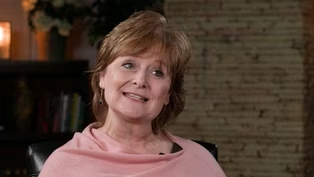
Donna Grigsby, M.D. (Full Interview)
Video has Closed Captions
Clip: Ep1 | 33m 32s | Full Interview with Chief of Division of General Academic Pediatrics. (33m 32s)
Video has Closed Captions
Clip: Ep1 | 6m 54s | A panel of experts discuss the impact of early learning. (6m 54s)
The Importance of Child Care Funding
Video has Closed Captions
Clip: Ep1 | 5m 54s | A panel of experts discuss the importance of child care funding. (5m 54s)
Video has Closed Captions
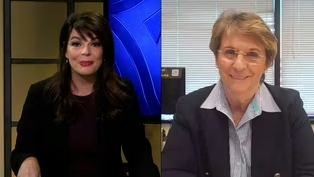
Clip: Ep1 | 27m 48s | Full Interview with Director of Early Childhood Initiative, Bipartisan Policy Center. (27m 48s)
The Need for Child Care Funding
Video has Closed Captions
Clip: Ep1 | 6m 47s | A panel of experts discuss the need for child care funding. (6m 47s)
The Status of Kentucky's Early Childhood Education Workforce
Video has Closed Captions
Clip: Ep1 | 4m 47s | A panel of experts discuss the status of Kentucky's early childhood education workforce. (4m 47s)
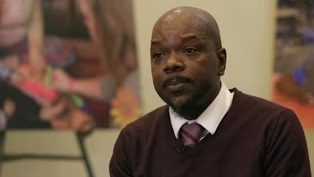
Vaughn Nebbitt (Full Interview)
Video has Closed Captions
Clip: Ep1 | 8m 27s | Full Interview with Vice President of Early Childhood Services Family & Children's Place. (8m 27s)
Providing Support for PBS.org
Learn Moreabout PBS online sponsorship

- Home and How To

Hit the road in a classic car for a tour through Great Britain with two antiques experts.












Support for PBS provided by:
Smart Start: A KET Special Report is a local public television program presented by KET