Do You Hear the Short “i” in Pick?
4/10/2023 | 58m 39sVideo has Audio Description
LET’S LEARN about transformation! Measure how much you’ve grown. See how animals change.
LET’S LEARN about transformation! Measure how much you’ve grown. See how animals grow and change. Try a dance inspired by water turning into ice and steam. Read SOUP DAY and words with short i. One-hour programs help children ages 3-7 learn in school and at home. Content provided by Flor Bromley, Memphis Zoo, National Dance Institute, and New Victory Theater.
See all videos with Audio DescriptionADProblems playing video? | Closed Captioning Feedback
Problems playing video? | Closed Captioning Feedback
Let's Learn is a local public television program presented by THIRTEEN PBS
Do You Hear the Short “i” in Pick?
4/10/2023 | 58m 39sVideo has Audio Description
LET’S LEARN about transformation! Measure how much you’ve grown. See how animals grow and change. Try a dance inspired by water turning into ice and steam. Read SOUP DAY and words with short i. One-hour programs help children ages 3-7 learn in school and at home. Content provided by Flor Bromley, Memphis Zoo, National Dance Institute, and New Victory Theater.
See all videos with Audio DescriptionADProblems playing video? | Closed Captioning Feedback
How to Watch Let's Learn
Let's Learn is available to stream on pbs.org and the free PBS App, available on iPhone, Apple TV, Android TV, Android smartphones, Amazon Fire TV, Amazon Fire Tablet, Roku, Samsung Smart TV, and Vizio.
Providing Support for PBS.org
Learn Moreabout PBS online sponsorship[upbeat music] - [Announcer] Ready to learn?
- Hi!
- Hi, friends.
- [Announcer] It's time to share a story, read and write.
- Let's take it from the beginning!
- [Announcer] Discover science, sing.
♪ Hello friends ♪ - [Announcer] Play, and so much more.
- We're exploring with light.
- [Announcer] Stay tuned for lessons and activities.
- And the keyword is?
- Apple.
- [Teacher] Awesome!
- [Announcer] Funding for this program was provided by the JPB Foundation.
- Hi, friends!
My name is Carlton, and today we'll be reading one of my favorite books, Soup Day.
The author and the illustrator of this book is named Melissa Iwai.
[upbeat music] Today is soup day.
Do you see how cold it is outside?
I see snow.
I see gloves.
I see scarves.
It looks like a really cold day.
I help Mommy pick out the vegetables.
She says it's important to choose the freshest ones with the brightest colors.
This is what we put in our basket.
One bunch of crispy green celery, two shiny yellow onions, three long orange carrots, four smooth tan potatoes, five tiny dark green zucchini, six big white mushrooms.
Oops, we almost forgot the parsley.
Back at home, we wash the vegetables.
Then Mommy chops everything into different shapes.
The celery and onions become tiny squares.
The carrots become circles.
The potatoes become cubes.
The parsley becomes confetti.
I love confetti.
I get to cut the mushrooms and zucchini with a plastic knife because they are soft.
Mommy helps my hand.
And, friends, what shape does she cook the zucchini?
It's a circle!
Good job.
We pour oil into the big soup pot and Mommy cooks the onions, celery, and carrots together.
This makes them soft.
They sizzle in the oil.
Then we fill the big pot with broth.
"Ssssssss!"
It makes a loud sound.
I help put in the rest of the vegetables.
Mommy covers a pot and we wait.
Friends, all this food is making me hungry.
Anybody else hungry?
For a while we make a city.
We read to each other.
Then we have to escape from a big monster.
Uh oh, friends, do you see the monster?
Where is the monster?
Before long, our home smells like yummy soup.
It looks like they're having a lot of fun.
There's toys everywhere!
Mommy checks the pot.
We hear the soup bubbling inside.
She tastes it.
"It needs a little something," she says.
Mommy adds some spices.
Mommy adds some of the spices in the soup.
This is gonna be some good soup, friends.
Now I get to choose which kind of pasta to add to the soup.
Angel hair, fettuccine, farfalle, pastina, rotini, elbow macaroni, alphabet, which is my favorite.
I pick alphabet because I like to eat the letters.
Sometimes they make words.
While we wait for the noodles to cook, we clean up our city.
All right, friends, it's time to clean up.
We return the books to the bookshelf.
We put the monster to sleep.
And then Daddy's home!
Now it's time to eat our soup!
Look, friends, do you see Daddy?
He's coming through the door.
Mommy lets me sprinkle the confetti parsley on top.
It looks like green snow.
Mmmm, I love soup day.
Okay, friends.
So after that story, I don't know about you, but I am hungry, so I'm gonna make my own soup, but I need your help.
Can you help me?
Okay, great.
So I need you to help me determine what is a fruit and what's a vegetable?
What vegetables can go in my soup?
Are you ready?
All right, let's do this.
Okay, so the first thing I have here is this.
Can you tell me what this is?
Yes, this is a carrot, correct!
Now, friends, is a carrot, a fruit or a vegetable?
A carrot is a vegetable.
So therefore, this can go in my soup!
Okay, great.
I'm gonna have carrots in my soup.
Perfect, okay, next one.
What is this?
Have you seen this before?
Yes, this is a banana!
And, friends, is a banana a fruit or is it a vegetable?
A banana is a fruit, so therefore this cannot go in my soup.
We don't want fruit in my soup.
All right, so we're gonna put this to the side.
All right, let's keep going.
Friends, can you tell me what this is?
What is this?
It's broccoli!
Yes, this is broccoli.
Now, is broccoli a fruit or is a vegetable?
Broccoli is vegetables, that's correct.
Awesome job, friends!
Also, this is going in my soup.
All right, great.
So we're gonna have broccoli in my soup.
All right, okay, let's go, let's move forward.
All right, what is, are you ready?
What is this?
Friends, can you tell me what this is?
Have you seen this before?
Okay, this is a dragon fruit!
Yes, it's a dragon fruit.
Now, is a dragon fruit a vegetable, or is it a fruit?
That is correct, it is a fruit!
So therefore, this cannot go in my soup.
All right, we're gonna put this to the side.
Let's do one more.
One more.
Okay, what about this one?
Have you seen this before?
This is a tangerine!
Now, is a tangerine a fruit or is it a vegetable?
That is correct, a tangerine is a fruit.
so therefore, we're not gonna be putting this in my soup.
Alright, friends, I think we're good.
I'm ready to have some soup.
It's gonna be so good.
Thank you, guys so much!
You guys were great.
I'm gonna go make some soup!
All right, bye-bye!
[upbeat music] [whimsical xylophone music] - Hi, friends!
My name is Isabel, and welcome to My Learning Corner.
Today we're going to be learning about the short sound that the letter I makes.
Do you know the short sound that the letter I makes?
- [Kids] Yeah!
- You do?
That's right, it says "ih".
Can you repeat that with me?
Ih.
Excellent!
Today we're going to be building words, reading words, and writing words, all with the short sound that the letter I makes, which is, "ih", you got it.
Are you ready to get started?
Let's go!
- [Kids] Yay!
- Our first activity of the day is a Phonemic Awareness activity.
Phonemic Awareness activities are listening activities, so before we even get started, we should warm up our ears, right?
Let's go!
[whimsical xylophone ascending] Perfect!
Today, I will say some sounds.
Then you will repeat those sounds and together we are going to say a word.
Let's try one.
SS, IH, P. Your turn.
Sip!
[inhales] Ahh, delicious!
Let's try another one.
ZZ, IH, P. Your turn.
Zip!
Zip up your coat!
Next one.
CUH, LL, IH, P. Clip!
Clip!
One more, are you ready?
SS, WUH, IH, MM.
Your turn.
SS, WUH, IH, MM.
Swim, swim!
[water flowing] Are you ready to build some words with me?
- [Kids] Yeah!
- Great, let's look at this word that I already have on my board.
BUH, IH, T. BIH, T. what's the word?
Bit, good job!
I wanna change bit to sit.
One of my favorite things to do.
What letter should I change?
Hmm, bit?
Sit.
I have to change the letter B. SS.
Oh, does this say sit?
Let's try it together.
SS, IH, T. SIH, T?
Sit, it does!
I love to sit, but I also love getting fit.
Hmm, how can I change sit to fit?
What needs to change?
Sit?
Fit.
Oh, you're right.
I should change the letter S, which says SS to?
FF, fit.
Is this right?
FF, IH, T. FIH, T?
Fit, that's right!
And when I'm getting fit, I might flit all over the place.
I go everywhere quickly.
Let's see, let's see, how do I change fit to flit?
Let's see.
Ooh, I have to add a sound.
Let's see, where's it going to go?
Flit.
FF, LL.
Ooh, right here.
What is the missing letter?
I don't know, let's check it out.
Let's see, is this the missing letter?
Let's try it!
FF, LL.
FLL, IH, T. Flit, flit!
Very good!
I think we are ready to read some words now.
Now that we've built words together, we are going to read words using those same skills.
Let's get started.
Are you ready?
- [Kids] Yeah!
Sweet!
Tin, pin, pit, lit, lid.
Good job!
Let's look at that second row.
The second row has words that all begin with blends.
When we are sounding them out, we're going to take those first two letters and say them very close together.
Let me show you what I mean.
GUH, RR, put them close together, GRUH.
GRUH, grit, good!
Grit is like a little bit of dust, dirt or sand.
Grim.
Grim is when you feel really sad.
Brim, good job!
Brim is when you fill something up to the brim, as I'm sure you do when you're drinking water, you fill that up to the brim, right?
Slip, good job.
Snip.
Snip.
Now, blends also come at the ends of words.
LL, INT, what's that word?
Lint.
Glint, it's like a sparkle in someone's eye.
CRI, ISP.
Crisp.
That's like crunchy.
CRISP, EE, crispy!
Good job!
Let's read these words together.
You'll read and I'll whisper read.
Tin, pin, pit, lit, lid.
Grit, grim, brim, slip, snip.
Lint, glint, crisp, crispy.
Excellent reading!
Now, the last thing that we're going to do is we are going to read a sentence about my favorite snack food.
I wonder if you can guess what it is.
The chip was very crispy.
And really, is there any other way to eat a chip other than crispy?
Absolutely not, you guys did a great job!
Now we're going to start our last activity of the day.
That is our Dictation activity, which means you need a paper or something to write on and a pen or pencil or something to write with.
I'll be right here waiting for you.
[upbeat music] Are you ready?
- [Kids] Yeah!
- I am.
So, in our Dictation activity, I will say a word and you will repeat the word, and then we're going to tap or sound the word out.
You guys ready?
The first word is pick.
You say it.
Let's tap out all the sounds we hear in that word.
PUH, IH, CK Okay, you write it and I'll write it.
PUH, IH, CK.
Is that what you wrote?
Great job!
Let's try another word.
The word is swim.
Ah, SS, WUH, IH, M. Swim.
Go ahead and write it.
SS, WUH, IH, M. Did you write this?
You did?
Great job!
You guys have done such a good job today.
Reading words, building words, writing words, all with the short I sound that says, "ih", you got it.
Now, today or sometime during the week, I'd love you to play this game with your friends.
It is the "ih" game.
In the "ih" game, you think of words that are action words that you like to do that use the short I sound, "ih".
For instance, I love to swim.
What do you love to do?
And do you hear the short I sound that says "ih" in it?
Until next time, friends!
[upbeat music] - Welcome to Omarion's Science Lab.
I'm, oh, well, I already said my name, Omarion.
I'm seven years old and I live in Brooklyn, New York.
Today, we're going be doing the Dancing Cranberry Experiment.
Whoa!
So, let's get started with the things we need.
We need one tablespoon of baking soda, a real spoon, one half cup of water, dried cranberries, and vinegar.
First, we're gonna put the baking soda in the half glass of water.
Whoa.
Now, we're gonna stir it.
It's dissolving.
Okay, now that it's solid, we're gonna put the cranberries.
Now we're gonna stir a little bit more.
Now, we're not gonna pour all of the beans, I mean, of the vinegar.
We're just gonna pour a little.
[mysterious music] [vinegar fizzes] Okay, that's good.
Now I'm gonna stir some more.
Now we're gonna pour a little bit more.
[vinegar fizzes] Now, we're gonna stir again.
So now we're gonna just add all of this now.
We're gonna stir up a little bit more, and then we're gonna see what happens and look, have you noticed this little like bubbles on the like raspberries?
And make sure to have fun when you're doing it with your family or with your friends, and have a great time.
I hope you loved this video.
[upbeat music] [whimsical music] - Hey there, friends at home.
Lily and I were just noticing how much she's growing.
- Yeah, can you tell?
Can you see that I'm almost as tall as Omar?
- Lily, what are you gonna do with all this new height?
- Well, I'm gonna be able to reach for the top shelf, look over the window sill, and leap almost as high as the clouds.
- Changing, growing.
It's really exciting, but it's also different, and sometimes when things are different that can make us feel uneasy.
- Hmm, yeah.
Yeah, like when I lost my first tooth, I felt scared, but then I got excited when the tooth came in.
- Yeah, look at those chompers now!
You know there's a lot on our body that always changes and also some things that always stay the same.
- Seems like a lot is changing.
What's staying the same on my body?
- Well, you'll always have your blue eyes.
- And you'll always have your brown eyes.
- Yeah, that's true.
And you will always have yourself.
You'll always have Lily.
- Yeah, but wait, except for when I play pretend and I'm someone else.
- Of course, of course, that's true.
But actually, even then, you'll still have yourself.
- All this changing, I don't have to be afraid of it, but how can I keep track of the way my body is changing and growing?
- Well, one way is we can measure how tall you've gotten.
- Hmm, well, I already know I'm as tall as George the Plant.
- [Omar] There we go, you are one George the Plant tall.
We can also measure how tall you are using smaller objects.
- How would we do that?
- I know someone who can show us.
[fast-paced music] First, we invited our friends to measure with blocks to see how tall they are.
This is Gianna.
She's three years old and lives nearby.
Gianna made a tower as tall as she is.
Let's watch.
[bell ringing] - [Lily] This is Sariah, Maya, and Marissa.
They're sisters.
They also took turns measuring each other with blocks.
First was Sariah.
[bell ringing] - I'm gonna knock it down with my head!
[Girls giggle] - [Omar] Then Maya.
- [Lily] They loved building.
Oh, it's getting pretty close to your head.
- [Omar] Pretty close.
- [Lily] Pretty close.
[bell ringing] - [Lily] And they also loved knocking down the blocks when they were done.
- [Omar] We had so much fun measuring with blocks that we decided to play Just As Tall As I Am.
It's a game where we try to find items that are just as tall as us.
As you'll see when you play, the game can be challenging on the way to find the items that are just as tall as you.
You may find many things that are taller and many things that are shorter.
[upbeat music] First, Maya and Sariah wanted to see how they could be as tall as Lily.
They thought just maybe they could pretend to be as tall as Lily by flying high on the swings.
What do you think, friends at home?
On the swings, are Maya's feet higher than Lily's head, lower, or do they reach just as high?
[bell chimes] Yeah, her feet reach higher than the top of Lily's head.
- [Lily] What about Sariah?
When Sariah is on the swing, do her feet reach higher, lower, or just as high as my head?
[bell chimes] Yeah, Sariah swung almost to the top of my head.
Her feet are just a teeny tiny bit lower.
- [Omar] Next we tried the benches.
Do you think this bench is longer than Sariah?
Shorter than Sariah?
Or just as long as Sariah?
[bell chimes] Yeah, the bench is longer than Sariah because we can see space on both sides of her.
Ooh, ooh, okay, what about the trash can?
Friends at home, what do you think?
[bell chimes] Yeah, Sariah's head is way above the trash can.
Sariah is taller than the trash can.
Let's do one more.
Let's see how they compare to the small swings.
What do you think, friends at home, are Maya and Sariah shorter than the small swings?
Taller than the small swings?
Or are just as tall?
- [Lily] Yeah, Sariah is a little shorter and Maya is almost as tall.
- [Omar] Yeah, comparing is one way to measure.
And remember, we were also measuring ourselves with blocks like Lily, when our friend Gianna use blocks to measure you.
- [Lily] Look how Gianna lined up the blocks end to end next to my body.
She lined them up so carefully making sure there was no space between the blocks.
- Three, four, five, six, seven, eight, nine, ten!
- Ten!
- [Omar] Ten, we counted the blocks to see how many we had and to see how many blocks tall Lily is.
- [Lily] Isn't it cool the way our bodies keep growing and changing?
- It's so cool.
Friends at home, how are your bodies growing and changing?
How do you know?
How do you keep track?
Are there things you can do now that you couldn't do when you were younger?
- I'm sure there are!
Friends at home, we hope you have fun growing.
- And measuring!
We'll see you later.
[upbeat music] [relaxing music] [Flor singing in Spanish] ♪ When autumn comes ♪ ♪ All the leaves fall ♪ ♪ It starts getting just a little cold ♪ [Flor speaks in Spanish] [Flor singing in Spanish] ♪ Fall fall fall all the leaves fall like this ♪ [Flor singing in Spanish] ♪ Fall fall fall all the leaves fall like this ♪ [Flor singing in Spanish] ♪ Valleys change color ♪ ♪ Fall all around us ♪ ♪ Pumpkin picking so fun at the park ♪ [Flor speaks in Spanish] [Flor singing in Spanish] ♪ Wee!
♪ ♪ Fall fall fall all the leaves fall like this ♪ ♪ Wee!
♪ [Flor singing in Spanish] ♪ Wee!
♪ ♪ Fall fall fall all the leaves fall like this ♪ ♪ Wee!
♪ [Flor singing in Spanish] ♪ Wee!
♪ ♪ Fall fall fall all the leaves fall like this ♪ ♪ Wee!
♪ [Flor singing in Spanish] ♪ Wee!
♪ [Flor singing in Spanish] [upbeat music] - Hi, my name is Ceucynth and this is my son Lucas.
We love to read together.
What's the title of the book?
- T-R-E-E-S, Trees.
- We read all kind of books, fiction and informational.
Lucas is learning so much from reading.
He loves the stories and is learning and thinking about science.
- Your lungs pull oxygen and.
- [Ceucynth] We really take time to think about and discuss the book.
Longer.
- In the space where there's a lot of space and nothing to like block the tree from growing and growing.
- When he doesn't understand something, I don't give him the answer.
He learns more if I help him to figure it out on his own.
What you breathe?
- You breathe air?
- Air.
Reading has helped Lucas develop curiosity and love of learning.
- Whoa.
[upbeat music] - Hello there and welcome to the Memphis Zoo here in the city of Memphis, Tennessee.
My name is Bella and I'm an animal interpreter here at the zoo.
As an animal interpreter, my job involves a lot of different things, but one of my favorite things about my job is getting to teach people just like you all about how important animals are.
In fact, today I wanted to share with you one of the most amazing things that both we and animals can do, transform.
Just like you and me, animals change throughout their lives.
You started out as a baby, right?
And now look at you!
Changes are happening all around us.
How does a caterpillar become a beautiful butterfly?
How do octopus change color?
Where do flamingos get their pink color from?
We'll cover that and more on our adventure today.
Let's get started.
First of all, what does it mean to transform?
Well, if you look at the word, trans means change and form means shape, so transform means to change shape.
Transformation happens when one thing becomes another.
When you were a baby, what did you look like?
You maybe had a smaller body than you do now and you can probably do more things now than you could as a baby.
As you grow older, you'll transform even more, but let's look at some other animals that take transformation to a whole different level.
Some animals go through a very big change called metamorphosis.
Metamorphosis is another word that means to transform or change shape.
Lots of animals go through metamorphosis or this special change.
Let's explore some.
Have you ever gone for a walk outside and seen a caterpillar or maybe you've seen one in a book?
Caterpillars are the larval or baby version of another animal.
Can you guess what caterpillars transform into?
Good guess!
Caterpillars actually become butterflies.
Have you ever seen a butterfly fluttering through a patch of flowers before?
They look so different from caterpillars.
Butterfly metamorphosis happens in four stages, meaning they go through four changes.
They start as an egg, like a chicken egg, but a lot smaller.
Then they hatch out of that egg and become a caterpillar.
Caterpillars have lots of legs and spend all of their time eating to grow big and strong.
Once they're big enough, they start another change and are called a pupa, which is where they sit in a chrysalis and change again.
The chrysalis is kind of like a warm cozy blanket that protects them while they change.
After they're done changing, kind of like how you might change clothes, they come out of the chrysalis blanket and are the beautiful butterflies we know and love.
Butterflies are much different from caterpillars.
Do you see any differences?
Butterflies have beautiful wings.
While caterpillars are much better at crawling around on leaves.
You also might not be able to see it, but their mouths are very different too.
As caterpillars, they have mouths like ours that are good at chewing up leaves.
When they become butterflies, their mouths turn into something called a proboscis, which is basically a straw.
It's great for slurping up plant nectar instead of chewing those leaves.
Do you remember all four stages of butterfly's life?
Let's review.
First they start as an egg.
Then they become a caterpillar.
After that, they become a pupa in their chrysalis, nice and protected before becoming an adult butterfly.
That's a lot of change for such a small creature, but it's not the only way animals transform.
In fact, I have a friend that might be able to help us see a different type of change.
This is my friend Charming and he is a toad.
Just like butterflies, toads and frogs go through a metamorphosis or big change.
Let's take a closer look.
Just like the butterfly, a toad stared as an egg.
When they hatch out of that egg, they are a baby toad called a tadpole or a polliwog.
They have a tail that helps them swim in the water and special gills, which are like lungs that breathe underwater.
Just like the caterpillar, the tadpole spends most of their time eating away.
They munch and munch and munch, and while they're munching, they grow bigger.
As they get bigger and grow more, the tadpole starts to lose their tail.
It gets smaller and eventually goes away entirely.
They also start to grow lungs like us, which helps them to breathe air instead of water.
Once their tail is gone and they can breathe air, they are an adult known as a toad, like my friend Charming.
So just like butterflies, the toad starts as an egg, then becomes a baby toad.
Do you remember what that's called?
A tadpole!
Instead of a chrysalis like a butterfly though, tadpoles just keep growing until they become an adult toad.
That's a little more like us except for the tail part.
Wouldn't it be so cool if we had tails though?
Sometimes change isn't always easy to see in animals.
Change isn't always about growing up, but it can be just as interesting.
In fact, one of my favorite animals changes every day.
They don't grow but instead, change their color.
One animal that changes color is the octopus.
They can change the color of their skin, special parts of their skin change color so that they can communicate with or talk to other octopus.
Picture this, you're feeling super happy today and you'd like to make some new friends.
Instead of asking someone to play, you paint yourself green.
Green might mean that you would like to meet someone new and everyone else knows that, so they also paint themselves green.
If you see someone else that's painted green, you know you can play with them today.
If they're painted a different color, it might mean that they don't want to play or that they need to do something else.
This is kind of what octopus are doing all the time, minus the paint.
Another animal that changes color is the flamingo, but it's not quite the same as an octopus.
While we think of flamingo as bright pink, they don't start out that way.
They're actually gray when they first hatch.
Their diet or what they eat is what helps them change color.
Flamingos eat pink colored food like shrimps so much that they turn pink.
It would be like you eating carrots every day, you'd turn orange, imagine that!
While metamorphosis and color changing are super amazing ways that animals transform, there are some other ways that animals transform that look a little bit more like how we change as we grow up.
Let's look at puppies and kittens, for example.
When puppies are born, they are small.
As they grow up and get bigger, they turn into dogs.
Kittens do the same thing, turning into cats.
The transformation might seem less exciting, but it's a transformation, to be sure.
What about an animal that looks even more like us, like an orangutan?
They start as a baby orangutan, just like a baby human.
The adult orangutan takes care of them until they grow big and strong enough to be an adult themselves.
Baby orangutans are pretty cute too, just like baby humans.
As we saw today, there are so many different ways that we can transform or change shapes.
First, we spent some time in the garden with our butterfly friends.
Do you remember what their transformation is called?
Metamorphosis.
We also looked at another animal that goes through metamorphosis, toads.
Do you remember what a baby toad is called?
A tadpole.
Other than metamorphosis, there are other changes that animals go through.
We saw how animals can change color.
Can you name one of the animals that changes color?
Octopus and flamingos are pretty good examples.
After having some fun with colors, we took a look at some animals that are a little more like us.
When we learn about animals, we realize we are just like them.
We all change throughout our lives.
How have you changed throughout your life?
I know that I've grown a whole lot taller since I was a baby and that's just one way that I've changed.
Thank you for joining me at the Memphis Zoo today and learning all about transformation.
Have a great day!
[upbeat music] [Ceucynth speaking in Spanish] - What's the title of the book?
- T-R-E-E-S, Trees.
[Ceucynth speaking in Spanish] - Your lungs pull oxygen and.
[Ceucynth speaking in Spanish] - In the space where there's a lot of space and nothing to like block the tree from growing and growing.
[Ceucynth speaking in Spanish] - What do you breathe?
- You breathe air?
- Air.
[Ceucynth speaking in Spanish] - Whoa!
[upbeat music] - [Renata] Hi, welcome!
My name is Renata Townsend.
I'm a teaching artist here at the New Victory Theater.
I am also a puppet, a puppet version of human teaching artist Renata Townsend, who is about to teach you all about paper puppets like me.
Please welcome to the stage, teaching artist extraordinaire puppeteer and real life human being, Renata Townsend!
[crowd cheers] Wow, thank you for that introduction!
I, well, we are here to talk to you today about puppets.
Puppetry is the art of bringing inanimate objects to life.
Anyone can be a puppeteer and anything can be a puppet.
A paper puppet is a flat two-dimensional puppet made out of, you guessed it, paper.
Today we are going to be making paper puppets.
Here are the materials.
Paper, of course, scissors, glue or tape, something that's sticky, something to draw with, some cardboard.
You can use the cardboard of a cereal box or an oatmeal box, but the thinner the better 'cause you can cut it, and then, a dowel or a chopstick.
This will serve as your handle for your puppet.
My paper puppet is a tiny version of me.
What kind of character do you wanna make?
A pirate, a unicorn, an astronaut, a Supreme Court Justice?
Once you've chosen your character, it's time to get creative.
Let's go.
Think about what kind of clothes you want your character to wear, and what sort of pose you might want your character to be in.
Then draw and color it.
Remember, this is your puppet.
Anything goes.
Once you've drawn your puppet on paper, cut it out and trace its outline onto a piece of cardboard.
This will make your puppet more sturdy so it doesn't flop over.
Cut out the cardboard and then glue or tape it to the back of your paper.
Add a stick, this is called your control.
You will hold the stick to manipulate your puppet and that's it.
Now it's time to get to know your puppet.
Have fun moving it around.
Can you have it enter the stage?
Can you have it move quickly?
[speaks fast gibberish] What about slowly?
[speaks slow gibberish] Can you have it exit?
Can you have it fly?
Aaah, whoa, whoa!
What about dance?
[Renata hums] What is your puppet voice sound like?
Hello!
Hi!
Hey, you, over there!
Amazing, you're giving your puppet a personality.
But be careful, puppets have been known to take on minds of their own.
[upbeat music] Aah, this is the life.
I can't wait to see the show!
Look how high I can jump!
And that's it.
You have everything you need to bring your paper puppet to life.
Have fun puppeteering!
And see you next time!
Bye!
[upbeat music] - My name is Dufftin Garcia and I'm a teaching artist and choreographer for National Dance Institute.
And this is my son!
- Hi, my name is Roman.
- Many years ago, I did a show about science, so I thought I'd teach you a dance that is influenced by something my son is learning in school now, which is the three states of matter.
And they are?
- Solid, liquid, and gas.
- Solid, liquid, and gas.
Here's a trivia question for you.
What substance can you find in all three states of matter?
- Water!
- Water, in liquid form it would be?
- [Roman] Water!
- In solid form it would be?
- Ice.
- And in gas form it would be?
- Vapor and steam!
- All right, let's get to it.
I hope you're nice and warm, let's get ready to dance.
Okay, so before we get started, let's give a shout out to our very own associate music director playing music for us today, Yakia Ben Hur.
[dramatic piano music] All right, let's get to it.
First we start with Solid.
We're gonna start with our feet together, your feet are gonna go out, your arms are gonna go out.
One, two, and then you're gonna come back.
One, two, just like that, ready?
Five, six, seven, we go.
One, two, one two, five, six, seven.
Again, go one, two, one, two.
One more time like that it goes, out and in, good.
And for five, six, seven, eight, we're just gonna clap and march [claps] five, six, seven, eight, ready?
Just like that it goes.
[claps] Five, six, seven, eight.
One more time, just like that go, [claps] five, six, seven, eight.
So now let's put that together.
Go out, come in, then march and clap at the same time, ready?
[claps] Five, six, seven, we go out, and in, and clap, clap, clap.
Just like that one more time, go!
Out and in, and [claps] clap, clap, clap, clap.
Yes, okay, moving on.
So we're here, we just finished.
Clap, clap, clap, clap, march, and you're gonna stay low.
Your arms are gonna go back to here and you're gonna march around in a circle.
A-one, two, three, four, five, six, seven, eight.
With your hands pumping, just like that, ready?
Five, six, seven, let's go, around two, three, four, five, six, seven, eight.
Got that?
One more time.
Five, six, seven, we go, around two, three, four, five, six, seven, eight.
Now let's put that together.
We're gonna go out, come in, clap six, seven, eight, and then march around for eight counts, ready?
Five, a six, a five, six, seven, we go, out and in and [claps] march five, six, seven, eight.
And march two, three, four, five, six, seven, eight.
Okay, so the next state of matter is the Liquid form.
Yes, so we're going to really move fluidly with our arms, our legs are gonna open out and we're gonna go one, two, three, four.
Ready, steady, just like that.
Go, one, two, three, four, make it fluid.
One more time, go one, two, three, four.
Five, six, seven, eight, you're gonna swim straightforward.
You're gonna go swim and swim, ready?
Five, six, try to go, and swim, and swim.
One more turn like that and ready go.
Go, swim and swim.
Now we put it together, it goes like this.
One, two, three, four, swim and swim.
Ready?
Do it with me, a five, six, seven, go.
One, two, three, four, and swim, and swim.
And one more time with me.
Here we go, six, seven, eight.
Go one, two, three, four, swim, and swim.
Yes?
Okay, so let's bookmark for the swim and now we're going to put our hands together like this.
Like it's a fish and we're gonna go straight forward and then back.
You're gonna go forward for four counts.
One, two, three, four.
And then back up, five, six, seven, eight.
Let's try that.
Five, six, seven, fish!
One, two, three, four, five, six, seven, eight.
One more time, just the fish.
Five, six, seven, you go.
One, two, three, four, five, six, seven, eight.
Okay, so let's put that together.
Now, the Liquid form, so we're gonna have flow.
One, two, three, four.
Swim, five, six, seven, eight.
Fish, one, two, three, four.
Back up, five, six, seven, eight.
Ready?
Let's try it.
Five, a six, a five, six, seven, eight, we have.
One, two, three, four.
Swim and swim, then fish two, three, four, five, six, seven, eight.
Okay, good.
So now we ready to try Solid and the Liquid back to back, starting with the Solid here.
Bop, bop, bop, walk around [speaking gibberish].
Liquid, swim and swim.
Then you do the fish forward, then you do the fish back.
Are we ready?
Let's try it, five, a six, a five, six, seven.
We have Solid.
[claps] And march two, three, four, five, six, seven, eight.
And Liquid, two, three, four.
Swim and swim.
And fish two, three, four, five, six, seven, eight.
Okay, so remember doing this, if you wanna go back and try it again, do it as many times as you need to do it so you can make sure we put that together correctly.
Let's try that one more time.
Solid and Liquid, ready?
Five, a six, a five, six, seven.
We have Solid!
[claps] And march around.
And Liquid, and swim and swim.
And fish, two, three, four, five, six, seven, eight.
Okay, so now we're gonna move onto the Gas.
The Gas, we're gonna have our legs going out like this and your arms are gonna swing as big as they possibly can going back.
So you're gonna go back and back, just like that.
Five, six, seven swinging back, swing it back.
Then, can you do four fast?
Back, back, back, back.
Ready steady, try like that.
Back, back, back, back, yes!
Now let's try two slow, four fast.
Five, six, seven, go.
Slow, slow, and fast, fast, fast, fast.
Yes, like that.
One more time, six, seven, eight.
Go slow, slow.
Go fast, fast, fast, fast.
Yes!
Okay, moving on from the Gas.
We just finished four fast arms going back.
Now you're gonna clap up high.
Choose any side you want.
We're going to do two claps to one side, [claps] one, two.
And two claps to the other side, [claps] one, two.
Then two claps down low, [claps] one, two.
And then only one in the middle, Ceucynth one!
Just like that.
Can you do [claps] two claps high, two claps high, [claps] two down low, one in the middle?
Let's try that.
Five, a six, a five, six.
Start up high.
[claps] Two, two, two, and one.
One more time just like that.
Five, six, seven, eight.
[claps] Go two, two, two, and one!
Okay, good.
Now let's put the Gas section together.
So we're gonna start with those arms swinging back.
Back and back, then four fast, back, back, back, back.
Then the claps, [claps] two up high, two to the other side, two down low, one in the middle.
Here we go.
Ready five, a six, a five, six, seven, we go.
Back, and back and fast, fast, fast, fast.
[claps] Clap and clap, and clap, and center.
Okay, let's try that again.
Yes, just the Gas part.
Slow, fast, then the claps.
When you're doing the claps you can look straight at your camera or you can look straight at your hands.
I'm looking at my hands.
Gives it some more energy.
Five, a six, ready?
Arms go back, they go, back, and back.
And fast, fast, fast, fast.
[claps] Clap, and clap, and low, and center.
Okay, so let's put those three sections together.
Solid, Liquid, then Gas.
Are you ready?
Starting here, we're gonna go slow with me.
You're gonna go out, then in, then we march, march, march, march.
Then we march round in the circle, five, six, seven.
Now Liquid.
One, two, three, four.
And swim, and swim.
Then go fish to the front and go fish to the back.
There we go, back with the Gas.
Back with the Gas, five, six, seven, eight.
Then [claps] clap up high, clap up high, clap down low, center.
Okay, I hope you got that.
Now let's try a little bit faster.
Here we go, five, a six, a five, six, seven, we go.
Out and in and, [claps] and march around and three, four, five, six, seven, eight.
And fluid, and swim and seven.
And forward two, three, four, five, six, seven, eight.
Go back and back, and five, six, seven, eight then go [claps], center.
Alright, so so far that's six counts of eight that we had together.
Two counts of eight for each state of matter.
First was the Solid, then was the Liquid, then we had the Gas.
Now, we're gonna do is we're gonna take each state of matter and we're gonna just shorten it.
So first the Solid form, we're just gonna go one, two, three, four.
That's all we're gonna do.
Five, six, seven, go.
One, two, three, four Then we're gonna do the Liquid part, also four counts.
And we're gonna go one, two, three, four.
Ready, steady, just like that, one, two, three, four.
So let's put those two together, four and four.
Count each, five, six, seven, you go.
[claps] One, two, three, four, one, two, three, four.
And then the Gas, we're gonna go, [claps] one, two, three, four, five, six, seven.
Do that whole clapping section at the end, ready?
Five, six, the Gas part then go, [claps] one, two, three, four, five, six, seven.
And that's what we're gonna finish.
Let's try that.
Four counts of the Solid, four counts of the Liquid, and then finish it off with the clapping section of the Gas.
Five, a six, a five, six, seven.
We have [claps] one, two, three, four, one, two, three, four.
And [claps] clap up high, down low, finish.
Okay, so I think we're ready.
Let's try with music all the way through.
A five, six, seven, we go.
[funky music] [Dufftin claps] [Dufftin claps] [Dufftin claps] [Dufftin claps] - [Announcer] Funding for this program was provided by the JPB Foundation.
[upbeat music] ♪ [dramatic music]
Video has Audio Description
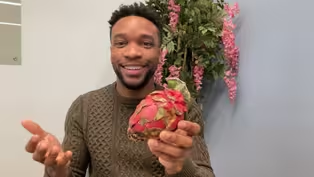
Carlton Ellen reads SOUP DAY by Melissa Iwai & shows how ingredients transform into soup. (7m 36s)
Video has Audio Description
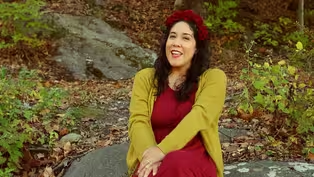
Flor Bromley sings in Spanish and English about leaves changing color in the fall. (3m 44s)
Changing States of Matter Dance
Video has Audio Description
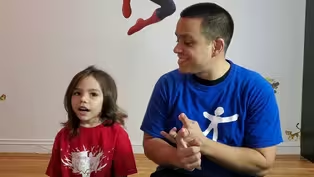
Dufftin Garcia from National Dance Institute moves like water as it changes states. (11m 24s)
Video has Audio Description
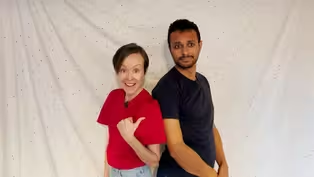
Three sisters compare their heights to objects on a playground and use blocks to measure. (7m 17s)
Omarion the Scientist Makes Cranberries Dance!
Video has Audio Description
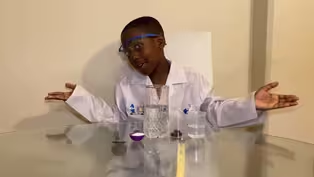
Omarion the scientist makes cranberries dance. (2m 26s)
Video has Audio Description
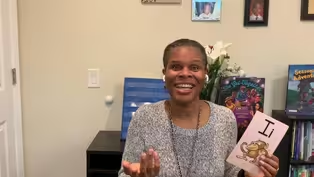
Isabel Simmons helps children build, read and write words with the short i vowel sound. (11m 9s)
Video has Audio Description
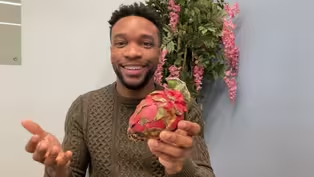
Carlton Ellen reads SOUP DAY by Melissa Iwai & shows how ingredients transform into soup. (7m 36s)
Video has Audio Description
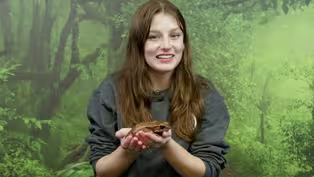
Bella Corley from the Memphis Zoo explores how animals transform. (7m 37s)
Transform Yourself into a Paper Puppet
Video has Audio Description
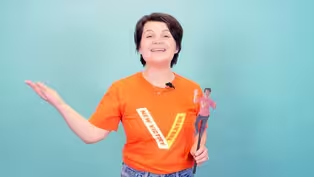
Renata Townsend from The New Victory Theater transforms her photo into a paper puppet. (3m 53s)
Providing Support for PBS.org
Learn Moreabout PBS online sponsorship













Support for PBS provided by:
Let's Learn is a local public television program presented by THIRTEEN PBS