Charlotte Cooks
Short Rib Tortelloni and Pesto | Charlotte Cooks
Season 8 Episode 6 | 26m 50sVideo has Closed Captions
Tortelloni from fresh pasta dough filled with short rib and ricotta also two kinds of pest
Chef Raffaele Patrizi of Mano Bella Artisan Foods brings a recipe straight from his native Italy. Raffaele and Chef Pamela mix fresh pasta dough to create short rib tortelloni with two kinds of pesto.
Problems playing video? | Closed Captioning Feedback
Problems playing video? | Closed Captioning Feedback
Charlotte Cooks is a local public television program presented by PBS Charlotte
Charlotte Cooks
Short Rib Tortelloni and Pesto | Charlotte Cooks
Season 8 Episode 6 | 26m 50sVideo has Closed Captions
Chef Raffaele Patrizi of Mano Bella Artisan Foods brings a recipe straight from his native Italy. Raffaele and Chef Pamela mix fresh pasta dough to create short rib tortelloni with two kinds of pesto.
Problems playing video? | Closed Captioning Feedback
How to Watch Charlotte Cooks
Charlotte Cooks is available to stream on pbs.org and the free PBS App, available on iPhone, Apple TV, Android TV, Android smartphones, Amazon Fire TV, Amazon Fire Tablet, Roku, Samsung Smart TV, and Vizio.
Providing Support for PBS.org
Learn Moreabout PBS online sponsorship(calm music) - [Narrator] This is a production 'PBS Charlotte'.
- [Narrator 2] The following episode of 'Charlotte Cooks' is brought to you by Central Piedmont Community College, and viewers like you, thank you.
(cheerful music) - Welcome to 'Charlotte Cooks', I am Chef Pamela Roberts, and I am so excited to have you with me today, because I have a very special guest, one of my very favorite people straight from Italy, we have him right here in Charlotte, Chef Rafaelle Patrizi, and I hope I said his name right.
Rafaelle, did I say your name right?
- Yeah, pretty much you say... Hi, Chef Pamela.
So, you say my name Rafaelle.
- Rafaelle.
- Patrizi.
- Patrizi.
So, we are going to be making something really special for you today, so what are we making?
- [Chef Rafaelle] So, we are making today, short ribs tortellini- - [Chef Pamela] Tortellini?
- [Chef Rafaelle] Tortellini, I'm gonna show you how you make them from scratch, how I roll the tortellini around my fingers, how you grab the short ribs braise, and then you do a filling for the tortellini, and then I gonna show you a pesto in two different ways.
- When we hear 'pesto' here in the United States, we think of basil, and we think of something green with pine nuts, or almonds, or something like that in it, but it's actually something different.
- So, we gonna start right now with the whole pasta.
- [Chef Pamela] Okay.
- So, I'm going to get my '00 flour', so the reason why I decide to use the '00', so '00 flour' is the grain, it's a summer wheat grain, so it's a soft, summer wheat.
It's much more, absorb more moist, it's elastic, so it's good to do like a pappardelle, tortellini, lasagna, better gluten develop.
- Yes, and it stretches beautifully.
- Yep.
So, I going to do a little hole in my volcano, and I'm going to get some eggs, eggs is another very interesting thing, unique thing, so egg, weigh between... And I talking about grams, so it's between 48 to 55g, so when you are going to do a pasta recipe, you need always going to count, doesn't matter how much flour you have, you always to go pretty much the weight of the flour off, it's pretty much a 2:1, we are having here 300g of flour, I'm using one egg, a full one, and a yolk.
- Just a yolk?
- Yep.
And we put right here, I'm going to mix it up, the egg.
So, many people they use a whisk, they use it differently, so I do like my grandma taught me, it's very, very easy.
So, what I'm doing now, I'm going to mix and do like a rotation movement.
- [Chef Pamela] Oh, there you go.
- [Chef Rafaelle] So, I do very gentle.
- [Chef Pamela] And you're not breaking the walls of your volcano.
- [Chef Rafaelle] No.
So, what you do, slowly, slowly you broke the eggs, and when all the eggs is broke, you are going to amalgamate very gently the flour.
This is not rush, so when you do pasta, need be time, you need plan the day, need be time-consuming, and as well you need to let the flour absorb the liquid, so you need to have a little patience.
- [Chef Pamela] I like watching your technique, it's really great to watch people who really know how to do this right, really do it, because it's so much fun.
- When it's now like this, that is more normal, you are going to clean, and very gently, always when you work on pasta, always no gloves, because the flour you need to feel how much the flour is absorbing the liquid, so very gently, we are going to put the flour on top, and just start to massage, so the movement it's always, bring towards to you, push towards to the outside, and doing this movement, you are going to give a push on the dough, so you are let it start the flour to do this gluten develop, that we want to have to let the pasta become nice and like strong on the chew when you are cooking.
- [Chef Pamela] So, this is kinda like when you're making bread, you're just doing it a little bit more gentle?
- Yep.
- Now, do you ever get to the point where you say you need to add more liquid, or more eggs?
- Yes, sometimes.
So, this as well is a beautiful question you gave to me.
So, in my kitchen, at my restaurant, I have a thermometer that tell me what is the weather outside, as soon I walk in the kitchen, I see what is the weather, and if example my original recipe is a gallon of water, example in for my batch of pasta, that morning if I see that the moist is up 50%, I go a little lower, example.
If I see that is a little more, I go, like it's a high moist, I go a little higher, so it's always you play a lot about weather really.
- And that has a lot to do with the flour absorbing moisture from the air.
- [Chef Rafaelle] Yep.
- [Chef Pamela] So, how long do you do that?
Just 'til it comes together?
- [Chef Rafaelle] Yes, so you do for about 15 minutes.
- [Chef Pamela] Okay, and you could add flavors to this too, couldn't you?
- [Chef Rafaelle] Yep.
- And how would you add flavor to this?
- So, you just grab some spinach, and just blend it up, and add to the egg.
- Do you have to cook the spinach first, or you can use it raw?
- No, you can just use raw.
- So, use that moisture with the spinach?
Okay.
- [Chef Rafaelle] So, many people when they do pasta, they make very, very, very moist, so I prefer to make a little harder.
So, what you are doing, you are working the pasta right now, you are giving the stretch, and with the hands, you are going to heat it up as well, so when here after you are wrapping up the pasta, what does the pasta?
It's going to release that heat, releasing the heat, release more moist, and it's going to be the perfect stretch that you want, softness you want.
Now, what you are gonna do, you're gonna grab the dough, and wrap it up in plastic-wrap, and just set aside, and let it rest the pasta for at least 30 minutes.
- 30 minutes?
- At least.
- [Chef Pamela] Now, we're gonna start on our short rib filling.
- [Chef Rafaelle] So, the short rib's filling is gonna be a whole short rib that we gonna braise, and I gonna show you how to braise the short rib.
Ricotta, and salt & pepper, that's it.
Very, very, very easy.
We gonna start with a cup of flour, grab about a teaspoon of dry parsley, teaspoon of smoked paprika.
- [Chef Pamela] Smoked paprika?
- Yes, ma'am.
And then, we gonna get just pinch of salt, and a pinch of black pepper.
- [Chef Pamela] Nice.
- [Chef Rafaelle] That's it.
- But also I wanna talk about your business, and what you're doing nowadays.
- We do authentic Italian food.
- [Chef Pamela] Yes, you do.
- [Chef Rafaelle] So, we make fresh pasta from scratch, we make fresh mozzarellas, we make weekly pestos, using local produce from local farmers.
So, what I gonna do now, gonna put some extra virgin olive oil in the pot, and in Italy, we use a lot of extra virgin for pretty much everything.
- [Chef Pamela] Okay.
- So, you want that the oil is going like to the smoking'ish, more or less.
- Get it really hot.
- Yep, so it need to be very, very hot.
And what we gonna do next, we are going to sear the short ribs.
- [Chef Pamela] So, we're just doing a nice braising process?
You know, and a braising process always starts with a sear, and then you add liquid, and some aromatic vegetables, and put it in the oven.
- It's very, very, very, very easy.
So now, I say we just grab the short ribs, and I start from the side, you hear?
- [Chef Pamela] Ah, so you're gonna go around the block before you lay it down flat?
So, he's gonna get all sides, all nice and seared, and golden brown.
- I'm doing this, I suggest people home don't do, I like... My hands are very, and your hands as well.
- When you cook a lot, you have a tendency not to notice temperature so much.
- Yep.
And what we are doing, (crackling drowns out speaker) just to let the short rib do it's job, don't over-burn, but don't be afraid to let it sear.
- [Chef Pamela] And guys, instead of using your hands at home, if you've got tender fingers, use your tongs, don't pierce it with a fork, use your tongs, you don't wanna pierce it, 'cause that releases moisture from the center, and you want all that moisture inside.
- I'm just going to toss down, and let it start to work on the sides, and we just grab some tongs, and you pretty much do the same thing.
Yeah, I don't wanna get burned now.
(Chef Pamela laughing) - So, your fingers do have a temperature sensitivity.
- A little bit.
- A little bit.
- Now, you can see Chef, you see?
Nice and brown, you don't wanna brown it up too much, because of what you gonna do after, we are going to shred it, so we don't want that the meat is too crispy.
So, now is my favorite part.
So, we turn this off for a little bit, set this aside.
- [Chef Pamela] Oh, look at that beautiful golden brown.
- We are going to chop a little veggie, do a 'soffritto', or how they say in French 'mirepoix'.
- 'Mirepoix'.
- But we like to say 'soffritto' in Italian.
So, we just go carrots.
- Some celery.
- We get just two ribs of celery, we're gonna get a normal onion, and how you cut this is very randomly, so it doesn't need be anything perfect, I just grab the onions, cut in an half, and then do like 1-2-3 cuts, that's it.
Grab the celery as well, and just like very 1-2-3-4, done.
Grab my carrots, same things.
You can use big carrots, I use now baby carrots, but when you do the big carrots, I like to keep the skin, because it's much more rich, much more flavorful with the skin on it, so these just cut in half.
- [Chef Pamela] And so, the reason we use carrots, onions and celery is because it has a lot of flavor, and it imparts a lot of really good, sweet, earthy flavors to whatever you're cooking, it's a really good base to start just about anything with.
- I am going to add a touch more of olive oil, and what we are going to do, we're gonna let it literally caramelize this beauteousness, and all you guys can hear, just like toss them in.
(oil sizzling) Turn down a little the fire.
And what you gonna do now, let it caramelize.
- Bringing out the sugars, and so, how do you tell when they're caramelized?
They're gonna be a little golden brown.
- So, doing this, my suggestion is do the day before.
So, the reason why you wanna do the day before is because the short ribs need to be cold enough to be mixed with the ricotta.
So, you can do this the day before- - It makes it easier to shred too, because it's not getting so hot.
- The soffritto, it takes about eight minutes more or less, how I like to use for the short ribs.
So, what I want, what I like, what I'm going to look for, literally the caramelization, how you were mentioning I want this veggie nice, and charred, that hold their flavor, hold their sugar.
All right, so what I do right now, I grab thyme, bay leaf, and two cloves of garlic.
So, we are going to put the thyme in, garlic, and the bay leaf.
So, the reason why I added the garlic right now, and not in the beginning, is because me personally when I use garlic in this scenario, I don't want that the garlic gets to burn, I wanna keep the fresh flavor of it.
Now, it's good to go, it's nice, and charred.
Right, what is next step, Chef?
You remember?
No.
- No?
Oh, we're gonna de-glaze.
- De-glaze with red wine.
A little bit, like let's grab two cups, it's fine.
So, when I cook, I use a red wine that I will go to drink, because you wanna always cook, of course if you work in a restaurant, you are not going to spend like $500 on a caste of 'Chianti', don't do that.
And what we are going to do, just like when it's seasoning, so you wanna turn up the fire back up, yeah grab the wine, and just... (wine sizzling in pot) And you just let it hold the sugar of the wine, aromatize all the vegetables, and we will let it cook all together.
Next step, we de-glaze with red wine, how you can see the wine is almost completely evaporate, and left a little bit of a liquid on the bottom, and so, what is this?
So, I do short ribs pretty much almost like semi-often for my shop, these is the leftover of my previous short ribs, all the fat, all the aroma, all the flavor of my previous short ribs, and then just going to use for my next one.
You can use a chicken stock, you can use any kinda stock you prefer.
- But this is packed with flavor.
- You just going to add to her, and just bring it to boil.
So, when it start to boiling, like to simmer, you let simmer for about 1 minute, 1½ minute, that all the flavor go to be all together, and then you just turn this fire off, grab the short ribs, and just place in here, just like a pot roast, how you were mentioning.
- [Chef Pamela] Yeah, exactly, exactly.
- Just put the parchment on top, just like this, foil up, careful it's very hot.
And just grab this- - [Chef Pamela] In the oven.
- Yep, now we are going to toss in the oven.
- And how long will it stay in there?
- This you cook I say 365°/375 for electric, for about three hours, three hours and 20 minutes, after three hours, if you see that it start to shred, it's ready.
If you wanna do something that you are going... You can even slice these, and serve like (indistinct) style, that will be about two hours and 45 minutes, and we'll reach the temperature- - But we want this to fall apart?
- Yep, we want that reach the temperature, so the fat of the meat it start to melt about 195/205, so you want that the temperature is about 195 on this, that you shred it, if you wanna slice, 165 is already good.
We gonna start preparing the whole vegetables, for the pesto, so we just grab whole lemons, pretty much one lemon per pesto.
- Okay.
- We grab 'Roma tomato', and we just going to cut them in a half.
- [Chef Pamela] Oh, are we not peeling them?
- Nope, we are just using pretty much everything of the tomato, all the tomato has his flavor, so I'm going to use from the head of the tomato, the seeds, I'm using pretty much everything of them.
- [Chef Pamela] Tomatoes taste so good anyway.
What is this onion?
- [Chef Rafaelle] So, this is name 'tropean onions', it's an onion from Calabria South Italy, so it's of course is a red onion, in Calabria they eat these like an apple, they just grab the onion, and eat like an apple.
- Are they sweet?
- Yeah, they are very sweet, very flavorful.
So, it's mostly used for fresh salads, for pestos because you don't need to blanch them, you don't need to cook them, you just eat how they are.
And there are different varieties, so this is a little bit more long, others look like a pear, but they are pretty much all the same.
So, on this, we are going to use just the red this time, so we are going just to cut like this.
Pesto is not just basil.
Pesto, so the word 'pesto', it comes from the Latin word 'p+nsM'.
So, it means like pretty much everything that you use the, how you say in English?
- [Chef Pamela] Mortar & pestle, yeah.
- [Chef Rafaelle] Yeah?
So we do seasonal pesto, so whatever is in season from local farmers, we make a pesto, so I do kale other day, I did asparagus, I did okra, people went crazy for okra as well.
- I bet that would be good.
- Yep, it's different, a little bit different style, people need to try, but when they try in the end of the day, it taste like pesto, but anyway.
The spinach is something that everybody can found very easy.
I use almonds, it's a very flavorful dry fruit, and very sweet that is going to work altogether with the pesto that we are doing.
I put one clove, and a little bit of garlic, I grab the lemon, we are using this, so is without seed, but you should pull out the seeds 100%.
So, I use about one lemon, and a little bit.
So, what is this?
It's a real Parmesan cheese, so we put the Parmesan cheese, doesn't need to be grounded, a chunk is okay the same, I don't use Pecorino, the reason is... Pecorino Romano, the reason is because Pecorino Romano is more like salty, it's a little bit more strong on flavor profile, I prefer the Parmesan, because it's much sweeter, and work better with the vegetables.
- Isn't Pecorino made with sheep's milk too?
- Yes, yes.
We just add about 50g of olive oil, again I add the little bit more, meanwhile we are blending, just to emulsify even better.
So, now it's gonna be a little loud, but we put that all in here, and just turn it on.
(food processor grinding) And now, I'm going to add a little bit more extra virgin olive oil, meanwhile that is blending up.
(food processor grinding) And now it's done, how you can see it's nice, and emulsified.
We are going to do Tropea Style Pesto.
So, how this work, we just put the tomatoes, and onions yep, pretty much two ounces, two tablespoon'ish of fresh Ricotta, we just toss in.
We are going to toss 15g of almonds, same amount of a whole Parmesan cheese, we gonna use a Ricotta, and Parmesan cheese for extra flavor, same amount of lemon juice, always don't forget to de-seed it.
And then...
So, we need a total of about 75g of extra virgin olive oil, so I put a little bit in the beginning, just to start, to let it work, and the rest, I'm going to add when it's working.
(food processor grinding) And voila.
- [Chef Pamela] We are gonna go ahead, in our short ribs, we've already braised this, you're gonna go ahead and show us how to do this, so it's done, and ready to go for a filling.
- [Chef Rafaelle] So, you just grab the short ribs, and with your hands you just break apart.
- Oh yeah, you can see that braising really works to break that up really nice.
- Mm-hmm.
So, we just shred like... Punch with your hands like this, grab the Ricotta, toss in, mix it up.
Would you mind Chef, to put a pinch of salt & pepper for me, please?
- Okay, so now that filling is ready to go.
- So now, we are going to do the pasta.
So, we gonna just press down a little bit, help a little bit like this.
- [Chef Pamela] Oh, it looks great.
- And now, we are going just to work with the machine.
So, when I do the pasta, I start with the biggest piece, fold in a half the first time, and pass again, because I let the gluten develop, go to work on the pasta.
(pasta machine rolling) So, for doing this job, you can use, a 'Kitchen Aid' work very well, I will not suggest this machine, it's good, but it's a restaurant machine, or you can go by hand how my grandma does.
- [Chef Pamela] Which is gonna really give you a good arm workout.
- [Chef Rafaelle] That's gonna be harder.
And when it's like this, we are going to flour a little bit, just very gently, and it's done.
- Look at that.
Look at that.
- So, you can use to do this work, a knife, this is name 'Bicicletas', it's mostly...
In Italian.
It's mostly used for pastry, to cut things much better.
- It's called an 'accordion cutter'.
- Yeah, thank you for the English translation.
You can like cut things in a perfect way, or you can use like, spend a little money, and buy some Italian tools with the bronze-die, but I wanna show you guys with this one, because it's much easier.
So we are going to do squares- - What's really neat about these, is you can get even strips, I mean it's just 'rizz', so easy.
And it's beautiful, nice even pasta.
- See?
So, now what we do, we are going to grab whole filling, and just put like this, you can do this with a piping bag, with your hands.
I gotta put you to work very soon Chef, are you ready?
- I am ready.
- [Chef Rafaelle] Grab the tortellone, tortellone, pull a little bit.
- [Chef Pamela] A little bit on all sides?
- Just like this on the sides, very gently, put the filling a bit more in the middle.
So, after that, grab the tortellino, and fold over, like a triangle.
Close the sides.
So, pry wide, you're gonna grab like this, so you gonna grab the sides, one on top, one on the bottom, yeah?
And then, grab both with this other hand, the side, and just pass around your finger, just like a wedding ring, it's pretty easy, no?
- Ooh, we got tortellones!
Tortellones?
- Tortellini/tortellone, so the different is how big they are, and when you get your hands, there you go.
- Help stretch it a little bit?
Okay, so then you held it over your finger.
- So, one.
- [Chef Pamela] One.
- [Chef Rafaelle] And two.
- [Chef Pamela] Two.
Whoa, pinch it.
Two.
- [Chef Rafaelle] Close.
- [Chef Pamela] Close.
- [Chef Rafaelle] And turn around.
- [Chef Pamela] There we go.
Aren't these adorable?
Authentic.
- And now I show you how to heat it up, pesto.
So pesto, you don't wanna cook that, because otherwise you are going to ruin.
So, you'll need to heat it up very gently, so I'm gonna show you how.
So, we are going to season, to salt the water.
So, we are going to get just a little salted water, and we are going to put on the bottom, because I'm gonna show you guys how to heat it up, the pesto when this is done.
Our tortellini we gonna toss in the water, just be careful, don't burn yourself, there you go, this happen.
- [Chef Pamela] Drop 'em in.
- Woo-hoo!
- Woo-hoo!
Why not?
- And so, this being that is a fresh pasta, it takes about three to four minutes to be cooked.
- [Chef Pamela] And see how they float to the top, guys?
When they float to the top, that's a sign they're almost ready.
- Almost ready, yes.
So, this is pretty much done, we are going to do now this tortellini, cooked with the two different pestos, so we are going to split a little bit in here, and we are going to put the water on the bottom, because how I was mentioning, you don't wanna cook the pesto straight on the fire, because you are going to burn the leaf, you are going to lose the flavor, pesto is a very delicate sauce.
So, what I'm doing now, I'm just finishing to heat it up the water, with the tortellini, and we need that the water, it's hot enough, in this way I can add now the pesto.
- It's not gonna burn the pesto, it's not like putting it over direct heat.
- Yeah.
So, now I'm just very gentle, we start with this, and just heat it up.
The fire is off, what I'm doing now, water very was very nice and hot, and boiling, so I'm just letting the pesto get nice, and warm.
Same thing I do with this other one.
All right, so now we are going to plate the tortellini, so what I do, I grab the tortellini first, put it right here, and put a little sauce on top.
Same thing I do with the other one.
- [Chef Pamela] Oh, look how pretty.
Look how pretty!
- [Chef Rafaelle] And the last touch, a little fresh Parmesan on top.
- [Chef Pamela] Yeah, there you go.
- Buon appetito!
- This is beautiful.
Thank you so much.
Everybody, take a look at our beautiful pasta, fresh, fresh, fresh tortellone, and we have a spinach pesto that we have with this, then we also have, you have to tell me what name is this one?
- So, that one is a Calabrian pesto.
- Thanks for joining me.
- Thank you Chef for having me.
- Oh, absolutely!
So, coming up on the next 'Charlotte Cooks' show, we have someone visiting us from the Caribbean, we are going to take you to the islands, and we're going to cook you up some 'Mahi Mahi'.
So, join us next time on 'Charlotte Cooks' and find all these fabulous Caribbean recipes.
If you have any questions, I'd be happy to answer them, send me an email at 'pamela.roberts@cpcc.edu'.
You can watch this show, and past episodes on 'PBS Charlotte Passport', or subscribe to our YouTube channel.
And we'd love to hear from you, send me an email, send me pictures of what you make, send me your comments, do you like it?
Do you hate it?
We'd love to hear from you.
So, we look forward to seeing you next time on 'Charlotte Cooks'.
(cheerful music) (upbeat music) - [Narrator] A production of 'PBS Charlotte'.
(calm music)
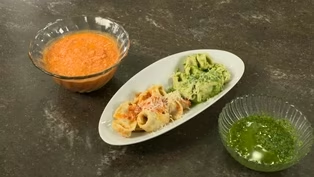
Preview: S8 Ep6 | 55s | Tortelloni from fresh pasta dough filled with short rib and ricotta with two pestos. (55s)
Providing Support for PBS.org
Learn Moreabout PBS online sponsorship

- Food
Christopher Kimball’s Milk Street Television
Transform home cooking with the editors of Christopher Kimball’s Milk Street Magazine.







Support for PBS provided by:
Charlotte Cooks is a local public television program presented by PBS Charlotte