
Shrooms, Reparations, and the City Budget/Student Reporting
Season 5 Episode 32 | 26m 46sVideo has Closed Captions
Shrooms, Reparations, and the City Budget/Student Reporting Labs | Episode 532
Detroiters will get to approve or reject 3 ballot proposals that involve decriminalizing psychedelics. Micah Martin, a senior at L’Anse Creuse High School, was chosen to be a PBS NewsHour Student Reporting Labs Gwen Ifill Legacy Fellow for 2021. Will Glover spoke with President and CEO of the Corporation for a Skilled Workforce, Larry Good. Episode 532
Problems playing video? | Closed Captioning Feedback
Problems playing video? | Closed Captioning Feedback
One Detroit is a local public television program presented by Detroit PBS
Shrooms, Reparations, and the City Budget/Student Reporting
Season 5 Episode 32 | 26m 46sVideo has Closed Captions
Detroiters will get to approve or reject 3 ballot proposals that involve decriminalizing psychedelics. Micah Martin, a senior at L’Anse Creuse High School, was chosen to be a PBS NewsHour Student Reporting Labs Gwen Ifill Legacy Fellow for 2021. Will Glover spoke with President and CEO of the Corporation for a Skilled Workforce, Larry Good. Episode 532
Problems playing video? | Closed Captioning Feedback
How to Watch One Detroit
One Detroit is available to stream on pbs.org and the free PBS App, available on iPhone, Apple TV, Android TV, Android smartphones, Amazon Fire TV, Amazon Fire Tablet, Roku, Samsung Smart TV, and Vizio.
Providing Support for PBS.org
Learn Moreabout PBS online sponsorship- Hi, I'm Christy McDonald and here's what's coming up this week on one Detroit, a PBS news hour student reporting labs project on race and inequality, the meaningful perspective and conversation from a student point of view, plus Nolan Finley and Stephen Henderson on Detroit's election next week in ballot proposals and the future of work and workforce investment with Larry Good.
It's all ahead this week on one Detroit.
- From Delta faucets to Behr paint, Masco corporation is proud to deliver products that enhance the way consumers all over the world experience and enjoy their living spaces.
Masco serving Michigan communities since 1929.
- Support for this program has provided by The Cynthia and Edsel Ford Fund for journalism at Detroit public TV.
The Kresge foundation.
Community Foundation for Southeast Michigan.
- The DTE foundation is a proud sponsor of Detroit public TV among the state's largest foundations, committed to Michigan focused giving.
We support organizations that are doing exceptional work in our state.
Visit DTEFoundation.com to learn more.
- Business leaders for Michigan dedicate to making Michigan a top 10 state for jobs, personal income, and a healthy economy also brought to you by and viewers like you.
[Upbeat Music Playing] - Hi there and welcome to one Detroit this week.
I'm Christy McDonald.
So glad that you were with me.
Coming up on the show, we're less than a week away from election day.
Our one Detroit contributors, Nolan Finley, and Stephen Henderson give us a look at the ballot proposals and races in Detroit.
Plus a project from the PBS NewsHour student reporting labs.
It's a conversation on race and inequality from a student perspective.
You will meet our Gwen Ifill legacy fellow Micah Martin, who created this project and brought her friend and stepbrother together for it.
Then the future of work, how employers have to create a quality workplace.
It's a conversation with Larry Good, the CEO of the corporation for a skilled workforce.
So ahead this week on one Detroit, and we're starting off with our one Detroit contributors, Nolan Finley, the editorial page editor of the Detroit news and Stephen Henderson from American black journal.
They got together to talk about the election in Detroit next week, city council and mayor's race and the importance of the proposals on the ballot.
- All right, Nolan.
So in addition to like new city council and having a mayor's race in November, we have some ballot proposals in the city of Detroit, three of them let's start with the one that would make people goofier in the city.
The one that would be utilized mushrooms, psychedelic mushrooms.
What do you think about that?
- I love mushrooms on my pizza, Steve, but I'm not sure about this one because it decriminalizes, but it doesn't actually make them legal.
I guess that's not within the purview of city voters.
So it decriminalizes mushrooms.
And I am all for the legalization of drugs, almost any drug, but I do think that the legalization should become with a regulatory framework to protect people, just like we do with alcohol.
This one doesn't come with any such framework.
- No, and it is a very piecemeal approach to the idea of what to do about illegal drugs.
More generally, I don't know that we should just go down the list and tick different things off and say, well, we'll decriminalize this, but not that you should have a pretty broad discussion about how we want to deal with drug enforcement in cities like Detroit.
I am not as much in favor of legalizing drugs as you are.
I think in a city like Detroit, especially given the problems we have with employment in particular that are tied to drug is something we want to think about.
It's something we really want to talk about and what it does to communities for the sales to communities.
But this one seems it was come out of left field, like someone was doing mushrooms and came up with an idea that, Hey, this shouldn't make.
- Well our efforts to criminalize drugs and keep them illegal, that hasn't worked from using them.
And I think it's time to stop and revisit that because it has, The whole criminalization process has ruined a lot of lives, apart from the drug use.
Other one on the ballot would replace our representative democracy with direct democracy or at least would risk doing that.
It would allow ballot proposals to appropriate money from the city treasury from the city budget.
And man, I think that's terrible idea.
You get a situation like California, where almost every decision is made by a ballot proposal.
We elect leaders, mayor council for a reason to make these decisions.
- Yeah.
You know, one of the things that I think people don't think about when these kinds of ideas come up is that this would be available to everybody.
It's the activist community that is pushing this because they want to have more say over how the city spends its money.
They presumably would like corporations and corporate interests to have less say, but this would just give them just as much say.
Anybody would be able to do this and convince enough voters with a campaign to allow them to do it.
It's just normal way to run a government.
This is not, it's not efficient.
It's dangerous.
There's a lot of very small interest groups who corporate or a grassroots who could, who could end up deciding how we spend big parts of the budget.
It's better to, to lobby the people that we elect and say, look, I want you to do this.
And sometimes you win.
Sometimes you lose.
- Absolutely.
And finally, a proposal to establish a reparations committee commissioned to study paying reparations for slavery and past discrimination.
What should that look like, Steve?
- I mean, I think continuing the discussion that has been started about the things that have been done by government particular, to disenfranchise African-Americans, to steal from us, to assign us to the second class, I'm all in favor of all of that in theory.
And I think it is perfectly appropriate for the city of Detroit to be part of that, that inquiry, you know, this is a continuation of an idea that was rejected as part of a massive rewrite of the city charter.
This is pulling that one idea out and saying, why don't we go ahead and talk about it?
I think it's a step we got to take.
- Well, I mean, if they're looking at creating programs to help small businesses, to improve education, scholarships, to deal with the effects of long-term racism across the spectrum.
I think that's one thing and direct checks written to individuals, I think is quite another, you'd have to be certain that racism is going to end with this generation because what are you going to do for the next generation then that suffers many of the same, same effects.
- Yeah.
Well I think, I mean, you know, the idea here is to start thinking about it, to start looking at how do you unpack, first of all, the responsibility for what's happened.
And then second of all of what you might do about it, you know, the idea of compensating people for being wrong is not new.
When it comes from Americans, we did it after the Holocaust in large measure, people were made whole for the things that happened to them.
Japanese Americans were paid recompense in, in large measure for the mistreatment during the second world war.
That's something we've got a history of African-Americans have been left out of that conversation.
I don't think that makes a lot of sense.
- In both those cases.
So they were the actual victims being compensated, not generations later.
And I think you know, it's a different approach than, and so, but a lot of cities are doing this.
A lot of studies are studying it and it's taken different forms.
So voters will have a chance to decide all of these, all of these issues next Tuesday.
- Absolutely.
- We'll make sure.
to give you the latest on the election results next week, right here on One Detroit.
And at OneDetroitPBS.org.
All right, this next story comes from the teenage perspective.
All through the pandemic.
We've been partnering with the PBS NewsHour student reporting labs.
The students from around Southeast Michigan, give us an inside look at their experiences, which helps us understand bigger issues that the younger generation faces.
Well this summer, Micah Martin, a senior at Lance Cruz high school was chosen to be a Gwen Ifill legacy fellow.
As part of the reporting labs program.
She came to intern with us here at Detroit public television at One Detroit, Micah had an idea to do a series of conversations on race and inequality.
She really wanted to bring something real to television, not just sound bites.
Her goal was to help people understand the different perspectives of her friends and for them to tell their stories.
So meet Micah, her friend, Triasure golden and her stepbrother Gleo Wade.
- Hi, my name is Micah Martin and I a 2021 PBS NewsHour student reporting labs, Gwen Ifill fellow.
I got to intern with DPTV this summer and during my internship, I wanted to produce a piece on racial inequality.
I wanted to cover this specific issue because I feel like people my age don't really get to speak on it because it's too sensitive of a topic or it can be too problematic of a topic.
I was very glad to produce this piece because racial inequality is something we don't speak on enough.
And I thought that this was my time to finally start this conversation up and bring it amongst young people like myself.
- It's difficult trying to hold your emotions in.
- I selected my stepbrother Gleo and my best friend Triasure to take part in this conversation.
I chose Gleo because he is a black male in this world.
And I know he has had quite a few issues.
He doesn't really speak about it cause he doesn't want to be seen as weak.
But I told him that this is his time to really voice his opinion.
- You get in the car, you make sure you got everything, but there's also like you go over, okay, what am I going to say, when he comes up to the window?
Like I got to make sure that every movement is right.
Cause if it's one wrong movement and he pulled that gun, that's my life.
- I chose Triasure because being a dark skinned girl, she's always had more issues since she was younger with being more insecure because she doesn't look like everyone else and simply being treated differently just because of her skin color.
She's also a very, very intelligent girl.
And I knew she would have quite a few things to say.
- Me being in honors classes AP classes as a black girl, when most of the time, I'm the only black student in those classes.
I feel like I have to go above and beyond.
I have to be better than everyone else just to be seen or just to be looked at as smart.
- What I hope that people take away from this conversation is that there's people everywhere going through these issues, no matter how old you are, no matter who your friends are, no matter who you hang around everywhere and we don't speak on it enough, we don't bring enough light to it.
And I think that it's about time that we do so.
- Now you have a sense of who Micah is and why she wanted to do this story.
This conversation between Triasure and Gleo focuses on their experiences inside the classroom and what they hope people will take away from listening to them.
- Just as being a black student athlete in a predominantly white school, a lot of the stuff that I endure is like having to withhold a certain persona around the school as if, you know, I'm just like, I got to be the best.
Top-notch.
- I feel like me being in honors classes, AP classes as a black girl, when I'm most of the time, I'm the only black student in those classes.
I feel like I have to go above and beyond.
I have to be better than everyone else just to be seen or just to, you know, be looked at as smart.
And when I tell people that everybody's always so surprised or they're so like, oh, are you sure?
You know?
And, and it's hard cause I work just as hard if not harder than every single person in those classrooms.
So to be looked at as if, oh, maybe it's a mistake that she's here.
- I feel like it's, difficult trying to hold your emotions in and, always have to worry about not being looked at as just a crazy old black man, but you know, a black student, a black kid that don't have a dad that ain't come from a good upcoming.
It doesn't have a up girl coming.
So it's like, you know, having to still be respectful, but still get off what I have to say.
And what I actually mean is it's difficult because it's like I have to just sit there and be calm and say what I have to say to you.
But really I have all these emotions built up inside of me and what I really want to say.
I can't say because I might get in trouble.
- And as far as me having to work harder than all the other white kids in my class, just to be seen, just to prove to everybody, I feel like I have to prove that I should be here.
I'm already here.
And I still have to go hard every single day to, you know, show people that I am good enough that I am smart enough, that I'm just as good.
And just as smart as these other kids.
And I feel like a lot of people don't see that they just see me as, oh, the loud black girl or oh, black girls can't do this or black girls can't do that.
And that's not the case.
- Just to piggyback off that.
I had a little situation at my school where a teacher felt like I didn't deserve the grade that I got on a test.
And you know, I ended up, I ended up getting a D the first time and I retook the test over again and got a B.
And he wanted me to retake it again.
Cause he felt like I cheated.
And I just, I felt some type of way because it's like, not only did I have to already come to you and asked you to retake the test, but you basically told me that I shouldn't get that grade because you felt like I didn't do the work.
- It was like, you wanted me to fail.
You wanted that.
- So it was, it was, it was a hard situation having to deal with that and having to still go in his class and not look at him a certain way would still have to, you know, act, you know, treat him as he is, which is my teacher.
But also on the back end, I also know that you feel some type of way about me when it's outside of this classroom.
- Of course.
- So it was dreadful, you know, having to walk in that class every day and look at him and he looked at you just, just put on that fake smile.
And it's like, I see through the smile, you know, so, and everybody else, that's my classmates see through your smile too.
And they understand what's going on, but you know, you still gotta, again, like I said, put on that persona and be respectful.
And.
- And I feel like that's hard.
I feel like I have to be somebody that I'm not.
Or just like you said, put on a front.
The one thing that I would want, the people that are watching this to take away from this is, you, you have a voice and you can speak out.
You can say how you feel and don't be afraid and don't be afraid to be put in situations where, you know, like difficult situations, don't be afraid to stand out.
Don't be afraid to just be different because at the end of the day, you know what's right and you know what's wrong.
And don't, how do I say this?
Don't try to dim your beliefs for other people.
Don't try to dim your light for other people, speak out, let everybody know how you feel and take it from there.
- What I want people to take from this is just knowing that it's all right to be who you are.
You know, who you are is important.
We all, as individuals play a part in this world, everybody's words and actions play a part and you never know what you can do.
You never know who you can help.
- Yeah.
I feel like the power of the tongue is incredible.
- Definitely.
- Thanks to Micah, Gleo and Triasure.
Thanks for letting us listen and helping us understand your perspective.
We will continue to work with the PBS NewsHour student reporting labs throughout the year and bring you their stories.
For more, just head to OneDetroitPBS.org.
All right, turning now to the future of work and what employers have to do to create a quality workplace, to attract workers.
Will Glover had a conversation with Larry Good, the president and CEO of the Ann Arbor based corporation for a skilled workforce.
- So COVID-19 was a shock to the American workforce.
Although some people can work from home.
Things still seem to be like they're opening back up on a pretty wide scale.
So my question for you is all of that stuff happened very abruptly and it seems like there's still something that's going to happen.
Is there an aftershock coming as a result of millions of people needing assistance, being, let go of their jobs.
- I think we're experiencing the beginnings of what you would call an aftershock, which is all of the shortages that let's say every restaurant and site are facing in finding workers.
Just an example, and many others in the hospitality industry, just to pick on them as an obvious example, where people are making conscious choices, not to go back and not necessarily, even to some extent may be a wage issue or a number of hours issue.
But the greater extent is safety that is keeping people away and concern of the risk of catching the virus from the large amount of customer contacts that goes into certain these jobs.
If you have to do a lot of customer contact with people that you don't work with every day and don't know every day, the risk is higher and there's just enough people that are not vaccinated.
There's all the concern about sort of when the virus and the variants penetrate the existing vaccination shields, the booster shots and need and everything else to sit in flux for people that's pretty high risk work.
And I feel like that.
So it's going to take a while for that mist to stabilize and to figure out how has that really permanently changed things.
I think the other part of that national writers are calling the great resignation of the mass resignation going on.
A range of people looked at their lives during the changes that went on last year and made different choices about priorities.
And a number of families said, can we live on one income versus two?
Can we live with a different mix of work to life than we did?
When you have that as a site, as a mostly pandemic, it really is accelerating a whole bunch of changes that were probably edging through labor market.
And they kind of all hit at once.
And so any of the forecastist who will tell you, here's exactly what it's gonna look like a year from now are making it up.
Previous data.
Doesn't give us really, we can't rely on it to predict what's going to wind right now because there's so much change going on for individuals all over the state, all over the country.
- What are, and what should employers be looking at or looking to do?
How should they be trying to adapt to accommodate this new school of thought, as you know, we're going into the future and people are being more considerate about their relationship with work, about what kind of time and compensation comes along with the work that they do.
- So a buzzword for what's needed is called quality jobs.
And that can be any kind of a job, frankly, at any pay range.
Quality job does inherently mean.
It pays the top.
Everything you can make is really do people get satisfaction in the work.
Is it organized in ways where they have flexibility, where they get to use their knowledge and skills to the greatest extent possible.
And you see huge differences, even again, back to the restaurant industry, for example, restaurants that are being incredibly flexible about that and supporting longstanding workers and giving them supports where they need it versus others that are being pretty rigid of, you know, okay, you have to go get your follow up shot on your own time or take vacation time to do it.
Places that are known for being good places to work are going to do better than places that just assume they can, you know, people will come to them because they need the job and they can keep doing it the way they always did it.
- So, what are some of the occupations that are going to be vanishing and what are some of the solutions to, you know, either shifting those people who had those skillsets or, or moving them into a, you know, just a different stead when it comes to being in the workforce.
- We've seen for a long time, but accelarate that's hit, the pandemic is looking at the automation of routine things.
And that can be in any industry, frankly.
It's not all sort of what jobs are going away, but what jobs are being reconfigured.
and then do you need fewer people to do it?
A big example, a lot of publicity about the commitment that the auto industry has made to moving, to being electrified when you, when they get batteries perfected, and that's the primary mode of auto propulsion, it takes about a third, as many people to produce a battery as it does to produce an internal combustion engine.
Well, that's a range of people who aren't going to be in those roles anymore at other plants.
Now that doesn't mean there won't be the jobs at other plants, but they're going to, that will be different work than they were doing before.
And, you know, you're seeing it in healthcare where the occupations change fairly rapidly as the technologies change within healthcare.
So part of it is the navigation going forward is going to be about your skills about your competencies and part of what we and others are urging people to get a better sense of what are you good at?
What are you able to do and demonstrate you can do.
And it matters less what job title you had or what industry you worked in because a lot of skills are transferable.
You may have learned them in let's say retail or manufacturing, but they may well be applicable in IP or in working in construction or working in healthcare.
And one example is that if you're doing work, one of the areas that there's huge demand on right now with the growth of the Amazon warehouses and many other things going on is in a logistics work.
As you look, there are major logistics, supply chain, jobs, and chemical production and mortgage loans and manufacturing and healthcare.
That if you have those skills, you can move from industry to industry.
As you need to, as demand goes up, the flexibility and the, the market power of a worker going forward is going to be how they can communicate what they know and can do, and have the context to say, okay, here's where that applies and what you're doing and smart employers are going to be moving to skills-based job descriptions and hiring.
And some are, that movement's begun.
where they can say, here's the skills we really need on it.
Can you show me you've got those skills or some of those skills, and we can see what the gap is to fill.
- For more stories on the future of work, student reporting labs, the election, everything that we're working on, just head to OneDetroitPBS.org that is going to do it for me this week.
Have a great one.
I'll see you next Thursday, take care.
You can find more at OneDetroitPBS.org or subscribe to our social media channels and sign up for our one Detroit newsletter.
- From Delta faucets to Behr paint, Masco corporation is proud to deliver products that enhance the way consumers all over the world experience and enjoy their living spaces.
Masco, serving Michigan communities since 1929.
- Support for this program has provided by The Cynthia and Edsel Ford Fund for Journalism at Detroit public TV, The Kresge foundation community foundation for Southeast Michigan.
- The DTE foundation is a proud sponsor of Detroit public TV among the state's largest foundations, committed to Michigan focused giving.
We support organizations that are doing exceptional work in our state visit DTEFoundation.com to learn more.
- Business leaders for Michigan dedicated to making Michigan a top 10 state for jobs, personal income, and a healthy economy also brought to you by and viewers like you.

Future of Work: What It Takes to Create Quality Workplaces
Video has Closed Captions
Clip: S5 Ep32 | 7m 5s | Knowing your transferable skills can help you navigate from industry to industry. (7m 5s)
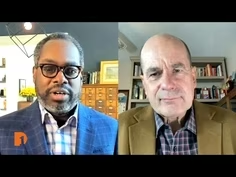
Shrooms, Reparations, and the City Budget
Video has Closed Captions
Clip: S5 Ep32 | 6m 28s | On the ballot: psychedelics, reparations, and input on the city of Detroit's spending. (6m 28s)
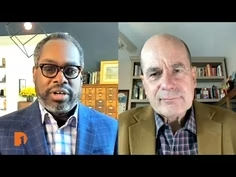
Student Reporting Labs: A Conversation on Racial Inequality
Video has Closed Captions
Clip: S5 Ep32 | 7m 47s | High school student Micah Martin produced an in-depth conversation on racial inequality. (7m 47s)
Providing Support for PBS.org
Learn Moreabout PBS online sponsorship
- News and Public Affairs

Top journalists deliver compelling original analysis of the hour's headlines.

- News and Public Affairs

FRONTLINE is investigative journalism that questions, explains and changes our world.












Support for PBS provided by:
One Detroit is a local public television program presented by Detroit PBS