
Signing with Ms. Somer - Somer Stanley - Fifth Grade
4/10/2020 | 57m 15sVideo has Closed Captions
In this lesson students will learn the basic concepts of American Sign Language.
In this lesson students will learn the basic concepts needed to explore American Sign Language. Created by NJTV in partnership with the NJEA and the NJ Department of Education, NJTV Learning Live remote learning classes are for grades 3-6, taught by NJ public school teachers. One-hour lessons include math, science, English language arts, social studies, physical education and more.
Problems playing video? | Closed Captioning Feedback
Problems playing video? | Closed Captioning Feedback
NJTV Learning Live is a local public television program presented by NJ PBS
Signing with Ms. Somer - Somer Stanley - Fifth Grade
4/10/2020 | 57m 15sVideo has Closed Captions
In this lesson students will learn the basic concepts needed to explore American Sign Language. Created by NJTV in partnership with the NJEA and the NJ Department of Education, NJTV Learning Live remote learning classes are for grades 3-6, taught by NJ public school teachers. One-hour lessons include math, science, English language arts, social studies, physical education and more.
Problems playing video? | Closed Captioning Feedback
Where to Watch NJTV Learning Live
NJTV Learning Live is available to stream on pbs.org and the PBS app.
Providing Support for PBS.org
Learn Moreabout PBS online sponsorshipMore from This Collection
NJTV Learning Live is a class for fifth graders taught by NJ public school teachers.
Galloping through Art Movements - Jason DeMaria -Fifth Grade
Video has Closed Captions
Students will identify artworks from art movements throughout the 19th and 21st centuries. (56m 24s)

National Holidays: Why Celebrate? -Jason Glezman-Fifth Grade
Video has Closed Captions
Students will explore the national holidays that are celebrated in the United States. (58m 46s)
Spoken Word Poetry - Thais Jackson - Fifth Grade
Video has Closed Captions
Students will learn the craft of writing, listening, and performing Spoken Word Poetry. (57m 27s)
Coordinate Planes with Corey Plane -Lauren Proda-Fifth Grade
Video has Closed Captions
Students will learn how to graph points on the coordinate plane to create and read maps. (57m 1s)
Design a Creature - Maria Montroni-Currais - Fifth Grade
Video has Closed Captions
Students will analyze attributes of ecosystems and then create a brand-new creature. (53m 38s)
ASL: Language & Community - Amy Andersen - Fifth Grade
Video has Closed Captions
Students will learn the three dimensions of American Sign Language. (55m 26s)
Decimal Dash! - Melissa Winters - Fifth Grade
Video has Closed Captions
Using a variety of sports statistics, students will compare, add, and subtract decimals. (56m 59s)
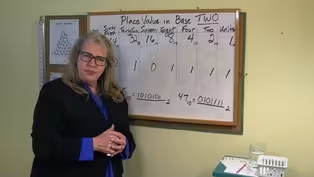
Exploring Place Value - Kristin Baker - Fifth Grade
Video has Closed Captions
Students will examine the structures of the Base Ten and Base Two place value systems. (56m 57s)
Close Reading - Tanya White - Fifth Grade
Video has Closed Captions
Students will explore how to closely analyze a text using the Close Reading method. (56m 2s)

Survival at Morristown - Christopher Kopitar - Fifth Grade
Video has Closed Captions
Students will learn about the Continental Army's survival during the American Revolution. (56m 37s)
The Elements of Drama - Maleesa Lamatina - Fifth Grade
Video has Closed Captions
The students will learn basic terms for the elements of drama. (55m 38s)
Descriptive Writing: Snacks - Christine Skalka - Fifth Grade
Video has Closed Captions
Students will learn how to write a descriptive paragraph, using their favorite snack food. (57m 57s)
Providing Support for PBS.org
Learn Moreabout PBS online sponsorship>> Hello, everyone, and welcome to my home/classroom.
My name is Somer Stanley, and today I'll be teaching you guys American Sign Language.
But first, let me tell you a little bit about myself.
I was an interpreter for many years before I started my profession of teaching.
And the reason why I started teaching ASL is because I love American Sign Language.
And I think it's important that everyone learn a little bit, at least enough to communicate with a deaf person if they met.
So, currently, I teach grades pre-K through eighth at Lakehurst Elementary and Middle School.
Yes, I teach everyone.
Today, I'll be teaching you guys a little bit of what I teach all of my wonderful students at Lakehurst.
I also teach my own children.
I have a son, age 6.
His name is Jordan.
And I have a daughter, age 2.
Her name is Journey.
And I'm sure you'll all be meeting them soon.
So, I hope you're ready.
First, I want to teach you guys some of the basic information and vocabulary that's related to deafness in American Sign Language.
So, for example, the word "deaf."
What does that mean?
Maybe you've never heard that term used before.
Well, that is the correct term to use for people who can't hear -- deaf.
Hold on.
Let me write that down for you so you can see the word.
Deaf.
Can you guys see that?
D-E-A-F.
Alright?
So, deaf refers to -- oh, we have a visitor, guys.
I told you -- one sec.
Come on over, Journey.
Would you like to say hi?
Okay.
You want to say hello?
>> Hello.
>> Hold on.
Let me pick you up.
Ready?
Say hello.
>> Hi!
>> Say good morning.
>> Good morning.
>> Alright.
Thank you.
Alright, Journey.
Go ahead.
Take your bucket.
See if you can find some things to put in there.
Alright, guys.
So, let's get back.
So, deaf.
Deaf is the term we use when we speak about someone who can't hear.
D-E-A-F.
Perfect.
The second thing I want to make sure you guys understand is American Sign Language, the abbreviation is ASL.
So, you may hear it referred to as ASL more often than people saying the full name American Sign Language.
So, if you heard it, or if you in the future hear ASL, you know that it means American Sign Language.
But hold on.
What does American Sign Language mean?
American Sign Language is a visual language used by many deaf people all over the United States.
So, we know what "deaf" means.
What do I mean by visual?
For you all, you use your ears to hear language, right?
So, if someone said something in English, you use your ears.
You can close your eyes, but you still could hear and understand what someone said.
Well, if I'm deaf, that doesn't apply to me because I can't hear.
So, I use my eyes as my ears to understand.
So, I take in information through my eyes.
That's why American Sign Language is called a visual language, because deaf people depend on their eyes to hear and understand the information.
Alright?
I hope you guys are with me.
The last part of that definition, I was very specific to say that many deaf people all over where?
The United States -- good job listening -- the United States use ASL.
Really, it's close to about 500,000 people all over the U.S.
who use ASL.
So, why am I being so specific and saying that it's used in the U.S.?
That's because ASL is not a universal language, meaning that if I traveled to a different country -- I'm going to use Germany because I lived in Germany for two years, and this really happened.
When I lived in Germany, I met two deaf people.
But we couldn't communicate with each other because I knew ASL, and they knew German sign language.
So, there's a big difference.
So, that's why it's important that you all understand that American Sign Language is not universal.
It's not used all over the world.
ASL is used in America, in the U.S.
People in Germany, they use German sign language and so on and so forth.
Regardless of which country, they have their own form of sign language that's specific to their country.
So, it's not universal.
Alright?
Are you guys with me?
So, we know what "deaf" means.
We know that the term "deaf," which is the proper term for people who can't hear.
You may have heard some other terms before, such as "deaf and dumb" or "hearing-impaired."
Those are very negative signs, and those aren't words that we use to refer to deaf people.
The correct term is "deaf."
D-E-A-F.
Again, D-E-A-F.
So, let's recap on everything we talked about.
ASL is short for American Sign Language.
ASL is a visual language used by deaf people all over the U.S.
"Deaf," D-E-A-F, is the proper term used to describe deaf people, people who can't hear.
And ASL is not universal, meaning it's not used all over the world.
Awesome.
You guys are really smart.
Now it's time to teach you guys some signs.
I know you're ready.
So, first things first.
Hold on.
Let me get my helpers to come over here and help me, because we are going to shake our hands out and get ready to sign.
Alright.
Let's shake it out, now that I have my two helpers here.
So, first things first.
Put your hands out in front of you guys and shake, shake, shake.
Shake those hands.
Shake them, shake them, shake them.
Alright.
Now stretch them all the way out, stretch up and stretch, big stretch.
Good job!
Alright.
And bring them down.
Now shoulder rolls.
Roll them forward.
One, two, three, four.
Now let's get the sillies out.
Shake it out, guys.
We are ready.
Are our hands ready to sign?
Are we ready to sign, Jordan?
Thank you for using your signs.
Are we ready to sign, Journey?
Alright, then, let's get started.
Say bye-bye.
>> Bye-bye!
>> Alright, here you go.
Alright.
Now that you guys are all loose, I hope you're feeling nice and stretched out and ready to sign.
So, in this part of our lesson, I'm going to teach you guys a variety of signs that you can use every day.
Maybe you know someone in your community, in your school, your church, or maybe you have someone who's deaf in your family.
Well, I'm going to give you some everyday signs that you can use to communicate with that person.
Alright?
So, our first sign is simple.
It's the sign for "hello."
Hello.
You take your hand, you bend your thumb in just a little bit, and you sign "hello."
It's almost like when you see a soldier salute.
But it's not as formal.
You're relaxed.
Hello.
Hello, out there.
Are you guys with me, or did you change the channel?
Knock, knock, knock.
I'm knocking on your TV screen.
Wake up.
So, here's the sign again for "hello."
The second sign I'm going to show you guys is the sign for "What's up?"
My students love this sign because they can change it to match their personality.
So, the sign for "What's up?"
Put your hands up.
I want you to push your middle finger out.
So, this is your thumb.
This is your index finger.
This is your middle finger.
Then you have your ring finger and your pinkie.
So, I want you to push your middle fingers out on both hands.
Can you guys see that?
I'm going to turn to the side.
Alright?
Now that you have those fingers out, you're going to place them on your chest, and you're just going to brush up.
What's up?
What's up?
Now, this can match your personality, again.
So, if you're a really, really perky person, you may sign, "What's up?
What's up?"
If you're a cool person, you know, some of you guys are really cool, and you walk in and you're like, "Hey, what's up?"
Or "What's up?!"
So, however you sign that sign, you can sign it to match your individual personality.
Alright?
So, for me, I generally sign it, "What's up?"
because that matches my personality.
Our third sign is going to be "How are you?
How are you?"
Maybe after you say, "What's up?"
you want to say, "Well, how are you?"
You take your hands, and you place them together as so, and you roll them forward.
"How are... How are you?"
Again.
"How are you?"
So, you place your hands.
I'm going to come a little closer.
And you roll your hands forward, and then you point to the person who you're speaking to.
So, again.
"How are you?"
"How are you?"
Perfect!
Alright, you guys are really catching on quick.
Our next sign is going to be response signs.
So, if someone asks you, "How are you?"
or if you ask someone that question, you want to understand their response.
So, here are a couple examples.
"How are you?"
Someone could respond by saying, "Fine.
Fine."
That's your five hand, like you're putting up the number five.
Place your thumb in the center of your chest.
"Fine.
Fine.
Fine."
Alright?
Another response could be, "I'm good.
I'm good."
So, you're going to place your hand out in front of you.
And I should tell you this.
Your dominant hand is the sign you typically sign with.
That is the hand that you also write with.
So, for me, I'm right-handed.
So, my dominant hand is going to be my right hand.
If you're left-handed, then your dominant hand would be your left hand.
So, again, for me, I'm right-handed, as are most people.
Right-handed, that's my dominant.
My nondominant is going to be my left hand.
So, to sign the sign for "good," you will place your nondominant hand out and in front of you.
I'm going to turn to the side.
Your nondominant hand's going to be placed in front of you.
And then you're going to take your dominant hand and place it inside that hand.
That's the sign for "good."
"Good."
Alright?
Do it in front.
Nondominant hand, dominant hand goes up to your chin and then goes out into the palm of your hand.
"Good.
Good."
Alright?
Another response, maybe you're not having a great day, but you're not doing bad, but you're not feeling, you know, your normal self.
You can say, "So-so."
You take your hand, which is a five hand, and you kind of swing it back and forth.
"I'm okay.
I'm alright."
You've probably seen people do this, anyway.
"I'm okay.
I'm fine.
I'm fine.
I'm okay."
Alright?
"I'm not great, but I'm not bad, either."
So, the three responses that I'm giving you today for the question, "How are you?"
is going to be, "Good.
Good."
"Fine.
Fine."
And "so-so."
Alright?
Our next two signs are words you guys should be using already.
I'm just going to teach you the sign to match.
These are used if you have really good manners.
So, that first sign is going to be "please, please."
So, you take your hand.
It's the same hand that you would use if you're placing it over your heart for the Pledge of Allegiance, for the Pledge.
You take your hand right here, but you're going to place it in the center of your chest.
It's a flat hand.
And you circle that hand.
And that's the sign for "please."
So, you place it in the center of your chest, and you circle it -- "please."
"Please."
My next sign is going to be "thank you," because if I'm saying please, if I get whatever I'm asking for, my next response should be, "Thank you."
Thank you is the same-shape hand that we use for "please."
But you place it on your chin.
With your dominant hand, you move it out.
"Thank you."
You place that hand on your chin, and you move it out.
"Thank you."
Again.
"Thank you."
I'll come closer.
"Thank you."
Alright?
Now, if you're really, really thankful for something, then you can use both hands.
"Thank you.
Thank you.
Thank you."
That's like, "Thank you so much.
Thank you."
So, again, you place your dominant hand on your chin, and you just move it out.
"Thank you."
Alright?
The next sign that I'm going to show you guys is going to be the sign for "help."
"Help."
You're going to take your nondominant hand and place it in front of you.
And then you take your dominant hand, and you're going to sit it right on top of that hand.
And you lift.
That's the sign for "help."
So, you place your nondominant hand right here, you place your dominant hand on top, and you lift.
"Help.
Help."
So, that's a thumbs-up.
That's how my students typically learn it.
So, you place the thumbs-up hand in your nondominant hand, and you just lift, as if you're lifting something that's really heavy.
"Oh, my hand is heavy."
"Help.
Help."
The next sign is going to be "bathroom."
This is an important sign to know for you parents but also for you students out there because maybe you're out somewhere, and you really have to use the bathroom!
And you're trying to get your parents' attention.
Or maybe, parents, you have a child who is not yet verbal.
You can teach them the sign for "bathroom."
So, that hand, you place your thumb in between your pointer finger and your middle finger and that's a "T," and then you shake that from side to side.
That means "bathroom."
Now, the faster you shake that hand or the different facial expression you make is going to determine how bad you need the bathroom.
So, if I'm like... that means I really have to go.
And that's the sign for "bathroom."
Again, you take your thumb on your dominant hand, and you place it in between your index finger and your middle finger.
"Bathroom.
Bathroom."
Alright?
Got it.
Alright, our next sign for today is going to be the sign for "I miss you.
I miss you."
I know with all of us being quarantined at home right now, we're probably missing a lot of our friends and wonderful teachers that we normally see every day, and that can be a little difficult.
So, I'm going to teach you how to say "I miss you" because maybe you can FaceTime that person, or if you see them walking outside from your window, you can sign it to them and teach them what it means.
So, first things first, you're going to sign "I."
"I" is just your index finger pointing at yourself.
I'm going to turn to the side.
"I.
I."
Very simple -- "I."
The sign for "miss" uses the same finger, and it's placed on your chin.
It's placed on your chin right here.
And that's the sign for "miss."
"Miss."
So, we have "I...miss."
And then you point to the person who you're referring to.
So, "I miss you."
So, the next sign I want to show you guys is going to be "I love you."
That kind of goes hand in hand with "I miss you."
So, the cool thing about the "I love you" sign is it's one hand.
So, you put your hand up, and my kids like to call this the Spider-man web-slinging hand because it's like... Now, the sign itself actually, if you turn that hand around, if you're familiar with Spider-man, if you turn your web-slinging hand around, it becomes "I love you."
So, if you place your hand up, you're going to leave your thumb up, your index finger up, but your middle finger and your ring finger are going to come down, and your pinkie remains up, and it's "I love you."
Can you do that?
Let's try it again.
So, you put your whole hand up.
Your thumb remains up, your index finger stays up, but your middle finger and your ring finger comes down, and it's "I love you."
"I love you."
That's the full sign for "I love you."
So, you don't have to do "I" with this one.
It's directional.
So, you can push this sign towards who you mean it to.
So, if I'm saying, "I love you," then I'm going to point at you.
If I'm saying, "I love all of you," I'm going to wave the sign.
If I put "I love myself," or I point it up, it's referring to whoever you're talking to, wherever your direction is going with this sign.
Alright?
So, that's the sign for "I love you."
One sign that we missed was after you sign "Thank you," how do you say, "You're welcome"?
I missed that sign.
Sorry.
So, the sign for "welcome" is the same as "thank you."
It's the same sign.
So, if you say, "Thank you, your response is, "You're welcome."
"Thank you."
"You're welcome."
It's the same sign.
Our next sign is actually "sorry."
So, you take your hand, and you put it into a "A" hand shape, like "ASL," when we did that earlier.
That "A" hand is going to be placed right in the center of your chest, and you're just going to circle it.
"Sorry.
Sorry."
Okay?
"Sorry."
So, again, that's your hand closed like a fist or "A" hand shape.
Your dominant hand is what you're using.
And you're going to place it on your chest and sign, "Sorry."
"Sorry."
Alright?
The next sign is going to be "more, more."
So, you take two hands.
It's kind of like a flat "O" hand shape -- "more."
"More."
That sign used to be my daughter's favorite sign, her favorite sign when she was younger.
I mean, she's only two now, but when she was learning how to sign and how to talk, her favorite sign was "more" because she ate a lot.
And so, when she would be sitting down, eating her food, I would cut up bananas, and she would say, "More, more."
So, that was her favorite sign.
Might be your favorite sign, too.
"More.
More."
The next sign is "finish, finish."
So, you take your both five hands, and they're palm in, facing your chest, and then you just turn them palm out.
So, palm in, then palm out.
So, "finished."
"Finished."
Let's do that again.
"Finished."
I'm going to do it a little slower.
"Finished."
Alright?
This is also the sign you can use for "complete, all done."
So, it can be used in a number of ways.
So, "finish" -- "I'm finished eating."
"I'm finished with my work."
"I'm all done," ready for whatever is next, okay?
So, "finish."
The next sign for you guys and the last two signs, actually, is the signs for "yes" and "no."
"Yes"... and "no."
"Yes."
"Yes" uses your "S" hand.
So, your thumb is going to come around the front of your fingers on your dominant hand, and it's just going to go up and down.
You'll use your head in coordination with that sign.
"Yes.
Yes."
The sign for "no" uses your thumb, your pointer finger, and your ring finger, and it's brought together.
"No."
"No."
"No."
You're going to use your head, "No," to match the sign once again.
We call that "negation."
"No.
No."
Alright?
So, we have "yes."
And "no."
So, let's back up because I just gave you guys a lot of information.
I know your brains are like psshhu!
right now.
But I want to review those signs, and then I'm going to test your knowledge, okay?
So, first we learned the sign for "hello."
"Hello."
Then we learned the sign for "What's up?
What's up?"
"How are you?"
"How are you?"
"How are you?"
We learned the sign for "fine."
"Fine."
"Good."
"Good."
"So-so."
We learned the signs for "please."
"Please."
"Thank you."
"Thank you."
"You're welcome."
Remember, it's the same time.
"Thank you" and "You're welcome."
We learned the signs for "more."
"More."
"Finished."
"Finished" or "All done."
"All done.
Finish."
We learned the signs for "stop."
"Stop."
We learned the sign for "bathroom."
"Bathroom," shaking from side to side.
"Bathroom."
Remember, depending on how you sign this sign will match the urgency of the sign.
So, "bathroom" versus "bathroom."
We also learned the signs for "I."
"I miss you."
Point to yourself, "I... miss...
you."
And we learned the signs for "I love you."
"I love you," which is the full hand.
"I love you."
Alright?
So, now I'm going to test your knowledge.
I want to see if you guys have learned all of those signs.
So, I'm going to test you.
Here's what's going to happen.
We're going to play "Guess that Sign."
And when we're done playing, I am going to surprise my family with a test and see if they get them all right or not.
So, don't tell them, okay?
We're going to review first.
So, I'm going to sign the sign, and I want you to tell me what that sign is, okay?
If you get it right, you should give yourself a pat on the back, because this is not easy at all.
It took me years of learning.
So, if you guys have learned all the signs I've taught you today, you're pretty awesome.
So, let's start.
Our first sign is... What sign is that, guys?
Alright.
If you said "help," you are correct!
Whoo!
Good job.
Wait.
You know what?
I have some fun thinking music for this game.
Wait, wait, wait.
Wait, wait, wait.
Let me find it.
Hold on.
I know I have it.
Let's see.
Bear with me, guys.
This is a brief intermission.
Take a minute and grab a cup of water or something.
I'll play some elevator music.
[ Humming ] ♪♪ ♪♪ Alrighty, then, we are back now, and I have found my question music.
Okay, now we're ready.
Are you ready?
Are you guys ready out there?
Alright, let's do this again.
Start over.
My rewind sign again.
So, my first sign is... What sign is that, guys?
♪♪ If you said "help," you are correct.
Great job!
Our next sign... ♪♪ Alright.
If you said that was the sign for "What's up?"
you are absolutely correct.
You guys are brilliant out there.
Let's try this.
Let me give you a hard one.
Hmm... Let me find a hard one to give you guys.
I know what I'm going to do.
Alright.
What about... ♪♪ "How are you?"
Correct.
That was the sign for "how are you?"
Alright, let me see here.
What about this sign?
♪♪ That was the sign for "more, more."
Good job.
Hmm... What about this sign?
♪♪ Oh, I played the music.
Hold on.
So, that's more than one sign.
It's like a whole phrase.
What is that?
♪♪ "I miss you."
Good job.
Alright, let's do a couple more.
Let's go a couple more.
What about -- hmm... Oh, I got one.
What about this one?
What sign is that?
♪♪ If you said "finish," you are absolutely correct.
Great job, guys!
Alright, hmm... Let's see.
Let's see.
What about this sign?
♪♪ That's right.
That is the sign for "please."
"Please."
Alright?
What about this sign?
What sign is that?
♪♪ Nope, I tricked you.
If you say yes, you are not right.
The sign was "No, no, no."
That was the sign for "no."
Alright?
What's the sign for "yes"?
Think about it.
I'm not going to sign it.
You guys think about it.
"Yes."
That's right.
This is the sign for "yes."
Y-E-S, yes.
What about this sign?
My karate chop.
What?
What sign is that?
♪♪ You are right.
That is the sign for "stop" -- S-T-O-P, stop.
We only got a couple more left.
Let's see.
Let's see.
What about this sign?
♪♪ That's right.
"Thank you."
"Thank you."
I think my daughter ran off with one of my signs.
I'm just going to show you guys.
What sign is this?
Alright.
If you say "good," you are absolutely correct.
I think she ran off with my sign, but that is the sign for "good."
You guys are really smart, and I'm so proud of you.
Now let's test their knowledge.
Let's see how much they know.
Hello, and welcome back.
It's time for "Guess that Sign."
How many of you guys are excited to play?
[ Applause ] I know, I know.
I am your host, Ms.
Stanley.
Here we have Mr.
Stanley all the way from the upstairs bedroom.
Give him a hand, guys!
[ Applause ] That's enough, that's enough.
This is my show.
Alright.
Second, we have Jordan, all the way from his bedroom.
Nope.
You're just coming from your bedroom, right?
I can't remember.
>> Nope.
>> You're not?
Okay.
All the way from the garage, give it up for Jordan.
[ Applause ] Whoo!
>> Thank you.
Thank you so much.
>> Okay, okay, okay.
It is time to play "Guess that Sign."
How this works is I'm going to sign the first sign, and they have to pick one of these little, makeshift signs to show what I sign.
So, for example, if I signed... and he picked up this sign, he would get a big... No.
Because we know the correct sign was... yes.
It was "no."
That's right.
This is correct.
Alright, so, we're going to start.
First sign.
Alright.
They picked up "please."
Is that correct, guys?
That is correct.
>> Me and dad picked it.
>> They both got it correct.
So, we got that one.
Applause!
>> Our second sign -- hmm... ♪♪ Is that correct, guys?
Yes, it is.
The second sign was "What's up?"
[ Applause ] Alright.
We need to make this a little challenging.
Let's make this the bonus round.
Alright.
For your chance to pick dinner tonight, show us which phrase is... ♪♪ Oh, sorry, Mr.
Stanley, that was the sign for what, boys and girls?
That is right.
It was, "How are you?"
"How are you?"
"How are you?"
Looks like I'll be picking dinner tonight.
And our last question, double or nothing.
Are you ready, guys?
Are you ready?
>> Yes.
>> Alright.
♪♪ Is that right, guys?
"Finish."
Yes, it is.
Whoo!
Good job, guys.
Alright, let's do a couple of more.
Let's see.
Let's test their knowledge of sign language.
I mean, I've only been teaching this one his whole life and teaching this one for about ten years.
We'll see what happens.
Alright, next.
The sign is... ♪♪ Alright.
What's your guess?
Say it.
>> Help.
>> "Help."
Is that correct, guys?
Yes, it is.
Good job.
>> I guess I'll be picking this dinner.
>> Nope, you'll just eat it.
Alright, moving on.
Alright.
Hmm...I have another one.
It's pretty hard.
The question, the sign is... ♪♪ >> I couldn't reach it.
>> And what does that say?
>> "I miss you."
>> "I miss you."
Is that correct, guys?
Did he get it right?
Yay!
[ Applause ] Alright, guys.
Give it up for my great contestants.
Give it up for them.
[ Applause ] Alright.
Welcome back.
So, how do you guys think they did with that game?
Yeah, they did alright.
But I know you all out there did much better.
So, we have some time left, and I was thinking I would love to teach you guys how to sign your colors.
So, that's what I'm going to do.
I'm going to teach you guys how to sign all of your favorite colors.
But I'm also going to teach you how to sign my favorite color.
So, the first sign is pretty simple.
You guys are so smart.
I know this is a walk in the park.
"My" uses the same hand shape as "please."
And, again, remember, you're using your dominant hand.
And your dominant hand is what hand?
The hand that you write with.
Absolutely correct.
So, you take your dominant hand, and you place it in the center of your chest, and it stays there.
So, "my."
"My."
Okay?
"My favorite."
"Favorite" uses the same hand shape as, "What's up?!"
But you're only going to use one hand, and the location is different.
So, "what's up" was on your chest.
Now you're going to use that one hand and that same hand shape, and you're going to place it on your chin and pull cord.
"Favorite, favorite."
So, put your hand up.
Push down that finger, that middle finger.
Put it on your chin and pull out.
Can you see that?
Perfect.
So, let's put those two together.
"My favorite."
"My favorite."
"Favorite."
The last part of that is "color."
"Color."
So, "my favorite."
You take your dominant hand in front of your lips, and you just wiggle your fingers.
It's kind of a fun sign.
"My favorite color."
"Color."
So, my favorite color is yellow.
I absolutely love the color yellow.
You know why?
Because it's such a happy color.
Regardless of how you're feeling, if you see that beautiful color, it just changes your entire attitude -- at least for me it does.
So, my favorite color is yellow.
The next color I'm going to show you is blue.
You put your hand up the same way that we did yellow, which uses your "Y" hand, yellow.
But this time you're using your "B" hand.
And the reason I'm saying, like, "A" hand, "B" hand is because once you guys learn the alphabet in sign language, you'll understand the hand shapes.
So, this is called a "B" hand because it's the letter "B."
And it's the sign that you're going to use the sign "blue."
So, you put your hand like this, and you wave it from side to side, the same way we did yellow.
"Blue, blue."
That's actually my husband and my son's favorite color.
"Blue.
Blue."
"Blue."
The next color is going to be green.
Green is done with a "G" hand.
You hold it like this, and you shake it.
"Green."
It's almost like you're using the gesture for a little bit more, please.
"G" hand, "green."
And shake it.
"Green."
The next sign is purple, purple.
So, purple uses the "P" hand, but for you all out there who may not be familiar because you don't know the alphabet just yet, you use your peace hand and turn it upside down.
So, peace hand, turn it upside down, and you shake it, and you get the sign "purple."
"Purple."
Our next sign that I'm going to show you is the sign for orange.
Orange is done with an "O" in front of your mouth, and you squeeze.
"Orange."
"Orange."
That's also the sign for the fruit orange.
But it's the sign for the color, as well.
"Orange."
"Orange."
Next up, we have red, like my shirt, red.
You take your index finger on your dominant hand, and you place it right on your chin, and you just rub it down like that.
So, it's literally the same location, hand shape as "miss you," but the movement is different.
That's important.
We know this is the sign for "miss," but if you rub it, that becomes the color red.
"Red."
The next color is pink, which is probably my second-favorite color.
Pink uses the same hand shape as purple, that "P" hand or or that peace hand upside down.
But this time you're going to use your middle finger to rub on your chin in the same location that you did red, red.
So, "red."
"Pink."
Again, pink is going to use that middle finger.
Exactly.
Good job, guys.
"Pink."
Our next colors are going to be brown.
Brown again uses that "B" hand, just like blue, and you rub it along the side of your face.
"Brown, brown."
Then we have black.
The sign for "black" uses that same index finger, and this time you're going to just go across your forehead right above your eyebrows.
"Black.
Black."
And lastly, we have white.
You place your hand on your chest, like a five hand, and you pull forward.
So, you place your hand on your chest, an open five hand, and then you pull forward.
That's the color white.
"White."
Alright?
So, in sign language, we have this thing called "the five parameters," okay?
I'm not going to get into a lot of detail about that today.
But for you guys to fully understand the terminology that I'm using when it relates to your colors, I want you guys to know those.
These are like the holy grail for ASL, American Sign Language.
Hand shape, location, movement, palm orientation, which means which way your palm is facing.
And then, lastly, your nonmanual markers -- your facial expressions, your body language that goes with the signs.
And the reason I'm saying this now is because when I tell you it's the same location but a different movement, that's really important, alright?
So, let's say for the color red, I showed you where it's the same location, same hand shape as "miss," but it's a different movement.
That's pretty important.
So, that's why I'm using that terminology.
So, I hope I didn't throw you guys off.
So, let's practice a little bit.
I'm going to show you a color.
And I want you guys to try to sign it.
Now, I know we just learned it, so no pressure.
First up, red.
Red.
That's a red heart.
Do you remember the sign for red?
That's right.
"Red, red."
Good job.
Next up, we have an orange heart, orange heart.
What's the for orange?
That's right.
Good job, guys.
You place your "O" hand in front of your mouth and squeeze.
"Orange, orange."
Alright?
Next, we have a green heart, a green heart.
What is the sign for green?
Yep, you use that hand that shows a little bit, which is also your "G" hand shape, and you shake it.
"Green.
Green."
Good job.
Alright, let's see.
Next up, oh, we have my favorite color, my favorite color.
A yellow star.
And what's the sign for yellow?
That's right.
"Yellow, yellow."
Mellow yellow.
Alright, let's see.
Hmm...let me give you guys a tricky one.
What about a pink square?
What's the sign for pink?
That's right.
You take that "P" hand or peace hand, and you rub it right there on your chin.
"Pink."
Good job.
You guys are so, so smart out there.
Hmm...let me see.
I got to find a hard one.
What about blue?
What is the sign for blue?
Oh, that's an easy one.
I see guys out there.
You're probably already signing it.
That's right.
"Blue.
Blue."
Good job, guys.
And let's see here.
Hmm... Purple.
Purple.
That peace hand turned upside down, and you get purple.
Alright.
So, again, our other three colors were brown, white, and black.
So, now that you know all of your colors, what's your favorite?
I want you guys to practice saying, "My favorite color."
And then put your favorite color in.
So, if your favorite color is blue, you would say, "My favorite color is blue."
Good job.
You guys are so smart.
I'm very proud of you guys, and I thank you so much for allowing me to hang with you today.
I truly enjoyed teaching you guys, and I hope you enjoy learning from me.
Until next time, I really encourage you all to continue practicing your sign language.
Continue practicing with your family members, with your friends, or even by yourself.
When life goes back to normal, I would encourage you guys to go out to your local library or your school library and pick out books that are related to sign language.
Most libraries have resources about ASL and deafness.
So, you can pick out a book and continue learning on your own.
So, before I leave, I do want to do a quick review with you guys.
I'm going all the way back.
We learned what American Sign Language meant, and we know that it means that it's a visual language that many deaf people use in the United States.
We know that the abbreviation for American Sign Language is ASL.
We know that deaf people depend on their eyes to understand the way that we depend on our ears.
We also know that deaf people can do anything in the world they want to do the same as you and I. The only difference is they can't hear.
So, they have to apply a little bit of difference to get it done.
But they can do everything that we can do.
That's the only difference.
We also learned that ASL is not universal, and that means what?
That if we wanted to travel all around the world, visiting different countries, that we could not use ASL to communicate with people who are deaf in other countries.
So, we learned that it's not universal.
We also learned everyday signs to communicate, such as "please" and "thank you."
"You're welcome."
We learned how to say "I miss you."
We learned how to say "I love you" using one hand.
And if you didn't know before, we learned how to become web-slinging spider people.
We also learned how to sign "help."
"Help."
And you can try putting some of these signs together.
For example, "Help, please."
"Help, please."
We learned how to sign "bathroom."
We learned how to sign "How are you?"
We learned how to sign "What's up?"
And "hello."
We learned how to sign "good."
"So-so."
We learned how to sign "fine."
"Fine," as in "I'm fine."
We learned how to sign "yes" and "no."
We learned how to sign "more" and "finish."
And you guys are so smart.
I know you will continue to practice all of these signs that I taught you.
We also finished up our lesson today by learning our... What sign is that?
Colors -- great job.
So, we know the color blue... green... purple... Let's see, blue, green, purple, yellow.
Can't forget my favorite color.
We learned how to sign red.
And pink.
We learned the sign for orange, brown... black... and white.
And we also learned the five parameters for ASL.
We learned that ASL uses these five parameters to show the signs correctly.
And those five parameters were hand shape, which is how you position your hand.
If your hand is an "A" hand or a "B" hand, if it's a "C" hand, you learn the hand shape.
You learned the movement is really important when signing.
You also learned that location is extremely important, as well as palm orientation and nonmanual markers, which is your body language and your facial expressions that matches the sign.
Remember, we talked about that, when even though we didn't use nonmanual markers, when we talked about showing "bathroom" and the urgency versus "I just need the bathroom," that's what your nonmanual markers are, your facial expressions and your body language that matches that sign.
Maybe next time I'll go into more detail about those for you guys, who are just really motivated to learn everything about American Sign Language.
So, until next time, you guys take care.
Be safe.
Wash your hands.
And I hope you guys stay safe and healthy.
Bye-bye!
Hey, guys, it's Mrs.
Stanley again.
Take a moment and look at this chart.
This chart shows you the American Sign Language alphabet.
See if you can work your way through all of the signs.
Start with "A" and move all the way down to "Z."
Remember, take your time.
It's not about speed.
It's about clarity and accuracy.
So, give it a try.


- Home and How To

Hit the road in a classic car for a tour through Great Britain with two antiques experts.


 New Episode








Support for PBS provided by:
NJTV Learning Live is a local public television program presented by NJ PBS