
Reflections on John S. Williams
Clip: Season 1 | 4m 46sVideo has Closed Captions
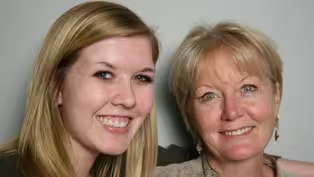
Descendant Susan Burnore talks about learning the history of her great-grandfather.
Descendant Susan Burnore talks with her cousin Kate about learning the history of her great-grandfather John S. Williams.
Problems playing video? | Closed Captioning Feedback
Problems playing video? | Closed Captioning Feedback
Major funding for Slavery by Another Name is provided by the National Endowment for the Humanities, W.K. Kellogg Foundation, The Coca-Cola Company and the CPB/PBS Diversity and Innovation Fund. Additional...
Reflections on John S. Williams
Clip: Season 1 | 4m 46sVideo has Closed Captions
Descendant Susan Burnore talks with her cousin Kate about learning the history of her great-grandfather John S. Williams.
Problems playing video? | Closed Captioning Feedback
Where to Watch Slavery by Another Name
Slavery by Another Name is available to stream on pbs.org and the PBS app.
Buy Now
Providing Support for PBS.org
Learn Moreabout PBS online sponsorship- So, when did you first hear the story about John S. Williams?
I know it was brought up again with these books, but was, was it something that you had heard your whole life growing up?
- Actually, yes.
I had heard it my whole life, but of course, a completely different version from what turned out to be the truth.
It's kind of a pun that it was a whitewash that my grandmother and my mother and father had all told me just a little bit about him, because of course he had died long before I was born.
But when I ask about my great-grandfather and any of those people, they told the story that he had been one of many wealthy white landowners back at the turn of the century, through the twenties and that they worked prisoners on the farm And that it was a very common practice that it was a way for prisoners to earn some money for when they got out of prison.
And they told the story that one night, a lot of the prisoners tried to escape and that he, and a lot of the other plantation owners got together and went to catch them.
And while they were tracking them down, some of them were murdered or some of them were killed.
They wouldn't have said that it was murder.
- Right.
- Even though a lot of the, the men in that rural Jasper and Newton county were responsible.
John S. Williams had taken the blame for it because he had a lot of sons that could continue to take care of the farm if he went to jail.
So it was painted like he was almost a hero that he did something that, of course he was just tracking these men down because they were escapees.
But somehow the story got mixed up and someone had to be a scapegoat for these men's deaths.
What really did happen is that there were quite a few basically slaves on the plantation.
He working with his black foreman who was under his control, murdered 11 of them, because there was a hint of an investigation by what became the FBI into Peonage.
And I think you had made that point.
He was more afraid of.
- The local government.
Because murder was a state crime, whereas Peonage was a federal crime.
And he was such a, he was wealthy.
He was well known in the community.
He was a leader and he wasn't afraid of the local law enforcement.
He, he would rather commit murder than a federal because once the FBI showed up, that's when he started getting worried.
Whereas, he eventually ended up a life in prison.
- And from a society standpoint, it's shocking that peonage, which is slavery.
It carried a penalty of two to $5,000 still.
He was sure that, that he wouldn't get convicted of murder because it was a white man's word against a black man.
- It was historically the first time a white man was convicted of murder of a black man.
And more importantly, his jury was a jury of his peers.
You know, his neighbors, his friends, and they were all white.
And they believed the testimony of Clyde Manning, a black man who was his overseer, who assisted in many of the murders.
- Even though it was a really big case.
It was covered by the New York times.
And the governor was involved.
The governor of Georgia was involved and even the president to a certain extent, but still the incidents of Peonage did continue to happen.
It seems like that that would have been so shocking that everyone would have changed on a family basis on an individual basis.
The Williams family really did pay hugely for this particular incident, especially for the murders and ultimately for the slavery itself, because they lost everything.
They lost the plantation, all of their holdings.
John S. Williams had 12 children, all of them, except my grandmother left the state of Georgia.
It totally destroyed all of their lives.
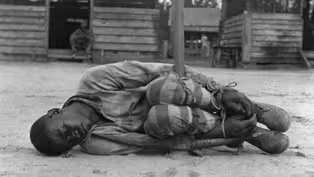
Slavery by Another Name Preview
Video has Closed Captions
Preview: S1 | 30s | Learn how post-Civil War practices and laws created a new form of slavery in the South. (30s)
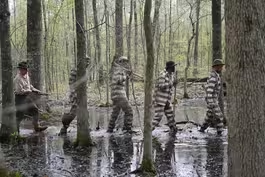
Video has Closed Captions
Preview: S1 | 1m 16s | Learn how a de facto slavery system persisted for Black Southerners after the Civil War. (1m 16s)
Video has Closed Captions
Clip: S1 | 1m 48s | Audible clip from book (1m 48s)
Video has Closed Captions
Clip: S1 | 2m 10s | Historian James Grossman talks about the legacy of supremacy. (2m 10s)
Video has Closed Captions
Clip: S1 | 2m 56s | Historian James Grossman explains why black Southerners left the South. (2m 56s)

Video has Closed Captions
Clip: S1 | 1m 50s | Douglas A. Blackmon and historian Khalil Muhammad explain the Southern economy. (1m 50s)
White Supremacists and Government
Video has Closed Captions
Clip: S1 | 2m 3s | Historian Mary Ellen Curtin explains positions of power and white supremacists. (2m 3s)
Video has Closed Captions
Clip: S1 | 1m 33s | Historian Khalil Muhammad explains the convict leasing period. (1m 33s)
Video has Closed Captions
Clip: S1 | 2m 25s | Historian Pete Daniel breaks down peonage and debt servitude. (2m 25s)
What are the Reconstruction Amendments?
Video has Closed Captions
Clip: S1 | 1m 16s | Historian Risa Goluboff explains the thirteenth, fourteenth & fifteenth amendments. (1m 16s)
Video has Closed Captions
Clip: S1 | 2m 7s | Historian Mary Ellen Curtin breaks down the emergence of sharecropping. (2m 7s)
The Significance of the Ku Klux Klan
Video has Closed Captions
Clip: S1 | 1m 39s | Historian Mary Ellen Curtin explains the significance of the Klan. (1m 39s)
The Significance of the Chain Gang
Video has Closed Captions
Clip: S1 | 1m 38s | Historian Talitha LeFlouria explains the chain gang systems significance in the South. (1m 38s)

Video has Closed Captions
Clip: S1 | 2m 3s | Author Douglas A. Blackmon explains the sharecropping and how it was a form of slavery. (2m 3s)

Video has Closed Captions
Clip: S1 | 1m 55s | Douglas A. Blackmon describes the crushing effects of Plessy v. Ferguson. (1m 55s)

Video has Closed Captions
Clip: S1 | 2m 1s | Author Douglas A. Blackmon tells the ruling of Judge Jones and the panic it caused. (2m 1s)
Video has Closed Captions
Clip: S1 | 2m 4s | Historian Risa Goluboff describes the rise of political progressivism. (2m 4s)

The Rise and Fall of Reconstruction
Video has Closed Captions
Clip: S1 | 2m 37s | Historian Risa Goluboff talks about the rise and fall of Reconstruction. (2m 37s)
Video has Closed Captions
Clip: S1 | 1m 13s | Historian Khalil Muhammad explains race relations and slavery after Reconstruction. (1m 13s)
Video has Closed Captions
Clip: S1 | 2m 24s | Douglas A. Blackmon's daughter Colette asks for advice to becoming a writer. (2m 24s)
Reflections on White Supremacy
Video has Closed Captions
Clip: S1 | 7s | Descendant Barbara Belisle shares stories of racism and the KKK she experienced. (7s)
Video has Closed Captions
Clip: S1 | 1m 28s | Descendant Rod Frazer talks about how his ancestor W.D. McCurdy. (1m 28s)
Reflections on the Ku Klux Klan
Video has Closed Captions
Clip: S1 | 1m 27s | Descendant Barbara Belisle remembers visits from the KKK from her childhood. (1m 27s)
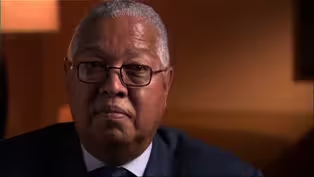
Reflections on the Great Migration
Video has Closed Captions
Clip: S1 | 1m 32s | Descendant Bernard Kinsey talks about his pride at being part of the Great Migration. (1m 32s)
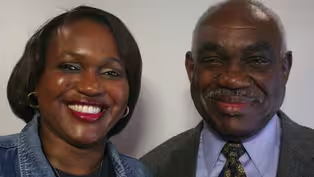
Reflections on the Company Town of Westfield
Video has Closed Captions
Clip: S1 | 3m 9s | UW Clemons explains the company town built by US Steel in the 1900s for its workers. (3m 9s)
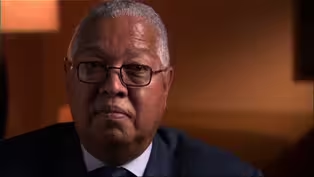
Reflections on the Chain Gang System
Video has Closed Captions
Clip: S1 | 1m 21s | Descendant Bernard Kinsey expresses his reactions to the chain gang system and its effect. (1m 21s)
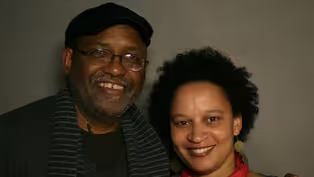
Video has Closed Captions
Clip: S1 | 4m 27s | Sam Pollard talks about the importance of storytelling and the influence it's had on him. (4m 27s)
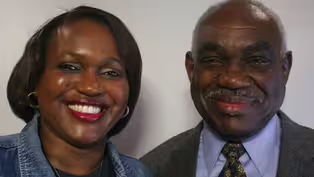
Video has Closed Captions
Clip: S1 | 2m 18s | U.W. Clemons talked about his grandparents and parents and their lives of sharecropping. (2m 18s)
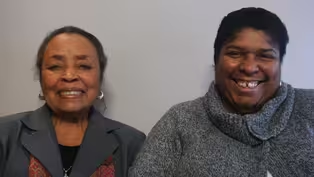
Video has Closed Captions
Clip: S1 | 1m 49s | Vanessa Cottenham shares her memories of segregation in Montevallo, AL. (1m 49s)
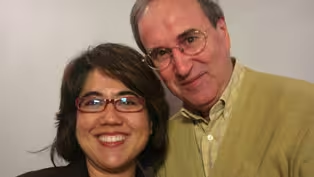
Reflections on Robert Franklin
Video has Closed Captions
Clip: S1 | 5m 4s | Descendant Dr. Robert Corley reacts to his ancestor Robert Franklin arresting John Davis. (5m 4s)
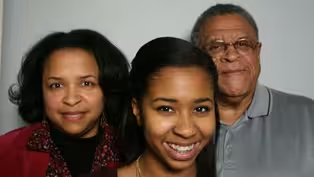
Video has Closed Captions
Clip: S1 | 1m 46s | Descendant Tonya Groomes reflects on how this re-enslavement has effected so many people. (1m 46s)
Video has Closed Captions
Clip: S1 | 2m 17s | Descendant Dr. Robert Corley on his interest in race relations a convict leasing. (2m 17s)
Video has Closed Captions
Clip: S1 | 1m 26s | Descendant Kate Willis describes peonage and how it worked. (1m 26s)
Reflections on Learning Family History
Video has Closed Captions
Clip: S1 | 1m 2s | Descendant Cristina Comber on why she thinks her family doesn't talk about their history. (1m 2s)
Reflections on Learning About Family Legacies
Video has Closed Captions
Clip: S1 | 4m 46s | Descendant Kate Willis talks about why exploring family stories is important. (4m 46s)
Video has Closed Captions
Clip: S1 | 2m 48s | Descendant Rod Frazer remembers the types of labor on WD McCurdy's plantation. (2m 48s)
 Now Playing
Reflections on John S. Williams
Video has Closed Captions
Clip: S1 | 4m 46s | Descendant Susan Burnore talks about learning the history of her great-grandfather. (4m 46s)
Video has Closed Captions
Clip: S1 | 3m 6s | Descendant Tonya Groomes talks to her dad about his experiences growing up in the South. (3m 6s)
Video has Closed Captions
Clip: S1 | 4m 8s | Sharon Malone talks about her sister Vivian Malone integrating the University of Alabama. (4m 8s)
Video has Closed Captions
Clip: S1 | 2m 46s | Descendant Rod Frazer reacts to his ancestor's role in convict leasing. (2m 46s)
Video has Closed Captions
Clip: S1 | 2m 23s | Descendant Dr. Robert Corley talks about the hidden history of forced labor. (2m 23s)
Video has Closed Captions
Clip: S1 | 4m 36s | Douglas A. Blackmon's son Michael asks what got him interested in this topic. (4m 36s)
Video has Closed Captions
Clip: S1 | 1m 2s | Descendant Tonya Groomes talks about her role as family historian. (1m 2s)
Video has Closed Captions
Clip: S1 | 1m 2s | Descendant Cristina Comer explains her family's history. (1m 2s)
Video has Closed Captions
Clip: S1 | 1m 27s | Descendant Tonya Groomes reflects on how slaves must have felt at the end of the Civil War (1m 27s)

Video has Closed Captions
Clip: S1 | 2m 25s | Sam Pollard discusses his dream project: exploring different cultures through their music. (2m 25s)
Reflections on Convict Leasing
Video has Closed Captions
Clip: S1 | 1m 2s | Descendant Bernard Kinsey reacts to convict labor. (1m 2s)
Video has Closed Captions
Clip: S1 | 3m 20s | Descendant Dr. Robert Corley describes convict leasing is part of Birmingham’s history. (3m 20s)
Providing Support for PBS.org
Learn Moreabout PBS online sponsorship











Support for PBS provided by:
Major funding for Slavery by Another Name is provided by the National Endowment for the Humanities, W.K. Kellogg Foundation, The Coca-Cola Company and the CPB/PBS Diversity and Innovation Fund. Additional...