
South Carolina Peach Farmers
Clip: 6/15/2026 | 6m 25sVideo has Closed Captions
Meet a South Carolina family that’s been raising prize-winning peaches for nearly a century.
Meet a South Carolina family that’s been raising prize-winning peaches for nearly a century.
Problems playing video? | Closed Captioning Feedback
Problems playing video? | Closed Captioning Feedback
America's Heartland is presented by your local public television station.
Funding for America’s Heartland is provided by US Soy, Sustainable Agriculture Research and Education, Rural Development Partners, and a Specialty Crop Grant from the California Department of Food and Agriculture.
South Carolina Peach Farmers
Clip: 6/15/2026 | 6m 25sVideo has Closed Captions
Meet a South Carolina family that’s been raising prize-winning peaches for nearly a century.
Problems playing video? | Closed Captioning Feedback
Where to Watch America's Heartland
America's Heartland is available to stream on pbs.org and the PBS app.
Providing Support for PBS.org
Learn Moreabout PBS online sponsorshipWe all know that fruits and vegetables are important to a healthy diet.
And it makes it easier to stick to that diet if our choices include something that tastes good.
Well the good news is that whether you're picking up fruit at the farmers market, traveling to a you-pick farm, or reaching for peaches, plums, or pears at the supermarket, we're all eating more fruit than we did a generation back.
The Department of Agriculture says that fresh fruit consumption, in particular, is up by more than 25 percent alone, and that figure could grow.
Increasing numbers of Farm to School programs and nationwide farm to table efforts are delivering more fresh fruits and vegetables directly to homes and schools This is all good news to growers in the heartland whose farms and orchards are working to meet that demand.
One of those farms is centered in the heart of South Carolina's peach country, run by a family that's been picking the sweet fruit for almost a century.
♪♪ It's the busiest week of the year at McLeod Farms in McBee, South Carolina.
It's the height of the harvest and there are ripe peaches everywhere you turn!
♪♪ Kemp McLeod calls these peaches 'Mac's pride,' and on this mid-July day, they're perfect for the picking!
>>We'll pick 'em five times over about, about, yeah, five to six times.
And we'll probably pick 'em over the next ten days.
We're trying to pick every peach that's ready and because we got so many orchards to go over.
>>The McLeod fruit trees spread across miles of the Carolina countryside.
650 acres with workers picking each piece of fruit by hand.
>>I know what variety gets ready, I know what characteristics.
And these fellows here have been with me twenty years, he knows what to look for.
So I, everybody out here, they're- they're tuned in on what we need to do.
>>The McLeods grow more than 20 varieties of peaches.
Kemp says the Winblo is the most popular peach in the South.
>>About behind the man right there.
>>The picking and packing to keep fruit on the shelf demands coordination in growing and harvesting.
>>OK watch the top, that's what we're looking for, that, this guy's doing a good job.
A peach cannot be stored, so what we do is we grow different varieties to fit different ripening so we have a continuous flow of peaches.
>>I see... >>So we try to pick a peach that will crop, y'know, consistently has good shelf life that can work.
>>Off the tree, containers of the peaches will roll down the road to the McLeod packing house.
The peaches will be sent through a cold water bath to cool them from the field heat.
They'll be sorted by shape and size, then packed and shipped.
How many peaches can move through here in a day?
>>Roughly about seven hundred bins can be picked a day and we also can pack about ten thousand boxes per day.
And that's half a million peaches.
>>Kemp's son, Spencer, returned to the farm after college and oversees the packing house operations.
Much of the fruit will go from field to consumer in less than 24 hours.
Spencer, why did you pull this one out of the batch?
>>This one's ready to eat; it's ripe.
It has a- it's a little bit soft.
That's the way I like to eat my peaches.
Sometimes the peaches can be firm when they're at the grocery store.
You want to give that a chance to ripen up and that's when I like to either set it out, don't put it in the refrigerator.
>>South Carolina is the number one state for peach production in the South.
The McLeod peaches will ship all across the country and even into Canada.
They are ripe and ready to go.
>>Yes, sir.
These are ripe peaches, Winblos, and they're ready to eat right now.
We're gonna take these straight to our store, put 'em on the shelf, ready for people to make a pie or eat fresh.
>>What do people say to you about why they keep coming back for this?
>>Well, you gotta have a good peach.
You gotta make a good product.
If it looks pretty... and that'll sell it the first time.
But if it tastes good, everybody's gonna come back.
>>Those peaches, headed for the McLeod retail outlet, are popular with customers from all across the region.
They show up here to purchase peaches, peach cobbler, peach pie, peach ice cream.
You've tasted them from other places.
>>Georgia.
>>From Georgia.
>>Of course, the Georgia peach is supposed to be the best peach, but we would have to say, these peaches, they're better.
>>What is the appeal?
Why come, for some people far, to eat this?
>>It's fresh and it's home grown, and y'know it's in Chesterfield County, we love it.
>>Mmhmm... does home grown matter to you Susie?
>>Yes.
>>Why?
>>Because it supports our state, and our local businesses, those sorts of things.
>>So it's more than just good flavor for you, it's knowing that you're supporting your roots.
>>The roots and the businesses, and the families and all that participate in it.
>>Alright, well taste it!
>>Taste it, have you had any?
>>Not unless you're sharin'.
>>Get you a spoon.
>>Alright, let's just... I'm goin' have a bite of yours.
May I?
>>Mmhmm.
>>Mmm, I see why you drive all the way over here.
>>[laughs] >>Nice to see you!
[laughing] That fresh picked flavor is part of the pride for the McLeods.
Pride in a product that has deep roots in these fields and this community.
Kemp is the fourth generation of McLeod famers young Spencer, the fifth.
I look at your hat and it says, Mac's Pride.
>>Right, right.
>>What is that pride to you?
>>Well, I mean, it's more like... it's our family life.
Y'know, it's our family.
It's- the farm is our family and our family is our farm.
>>You think your daddy would be proud?
>>I think Dad would be- would be very proud.
♪♪ >>South Carolina grows more than just peaches.
The Palmetto State is home to one of the few tea plantations in the U.S.
Farmers here also grow gingko, a popular medicinal herb.
And if you like okra, you'll want to stop by Irma, South Carolina for their annual Okra strut festival.
Video has Closed Captions
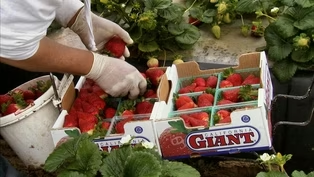
See how California farmers find new overseas markets for their bright red strawberries. (4m 57s)
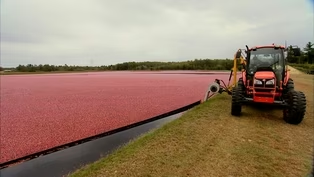
Massachusetts Cranberry Harvest
Video has Closed Captions
Discover the hard work involved in bringing in the harvest in the cranberry bogs of Massachusetts. (5m 39s)
Video has Closed Captions
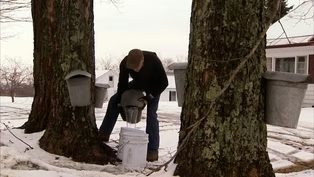
Tap into the successful operation of maple sugaring in Vermont. (5m 46s)
Providing Support for PBS.org
Learn Moreabout PBS online sponsorship

- Food
Christopher Kimball’s Milk Street Television
Transform home cooking with the editors of Christopher Kimball’s Milk Street Magazine.











Support for PBS provided by:
America's Heartland is presented by your local public television station.
Funding for America’s Heartland is provided by US Soy, Sustainable Agriculture Research and Education, Rural Development Partners, and a Specialty Crop Grant from the California Department of Food and Agriculture.