
Vermont Maple Syrup Trees
Clip: 6/15/2026 | 5m 46sVideo has Closed Captions
Tap into the successful operation of maple sugaring in Vermont.
Tap into the successful operation of maple sugaring in Vermont.
Problems playing video? | Closed Captioning Feedback
Problems playing video? | Closed Captioning Feedback
America's Heartland is presented by your local public television station.
Funding for America’s Heartland is provided by US Soy, Sustainable Agriculture Research and Education, Rural Development Partners, and a Specialty Crop Grant from the California Department of Food and Agriculture.
Vermont Maple Syrup Trees
Clip: 6/15/2026 | 5m 46sVideo has Closed Captions
Tap into the successful operation of maple sugaring in Vermont.
Problems playing video? | Closed Captioning Feedback
Where to Watch America's Heartland
America's Heartland is available to stream on pbs.org and the PBS app.
Providing Support for PBS.org
Learn Moreabout PBS online sponsorship>>We picked some sweet, juicy peaches earlier.
Let's serve up another sweet farm product that comes from a tree.
Now this is not something that you pick like an apple or an orange.
Like the cranberry, it has a place in American history and it's definitely something you'll want on your breakfast table if pancakes or waffles are coming your way.
♪♪ It's a late winter ritual older than America itself as these snow-covered New England mountains begin to thaw.
>>Ah man, nice and full.
>>The farmstead hills and valleys of Vermont come alive with the annual sound of maple syrup being made.
♪♪ It is tree-tapping time and within seconds, the sap is flowing.
>>That sound there is music to a sugar maker's ear, that drip, drip, drip.
[motor starting] >>Arnold Coombs' family has been sugar making, as they call it, for 7 generations.
Today he's tapping a tree that was planted decades before the Declaration of Independence.
[chink of hammer tapping spile] >>Well this is the method that's been used for well over 100 years.
Where you drill a hole into the tree, it's a little bit bigger than the plastic one, drive a metal spout into the tree, and just hang a bucket on it with a cover.
>>This sugar house is where Arnold's cousins boil the sap down into maple syrup.
It's a slow process as water in the sap evaporates over a wood burning fire.
As outside temperatures warm, maple sap will flow for several weeks.
It takes about ten gallons of sap to make just one quart of syrup.
Wow... how long did this take to fill up?
>>On a perfect day, you can fill it in one day.
That's 4 gallons of sap.
>>Four gallons... okay.
>>So that would be 40% of your crop in one day.
>>Wow.
>>But seldom do you get that.
>>Just across the Vermont border in New Hampshire, syrup runs in the family for Bruce Bascom as well.
>>My great-grandfather moved to... to part of this property in 1853.
He was tapping maybe 500 trees- probably in wooden buckets.
>>But times have changed and maple means money.
Bascom maple farms is one of the biggest producers of maple syrup in the world.
They take a more modern approach.
So these trees were here when you were a little kid, huh?
>>They were about 4 inches- 4 inches in diameter when I was in grammar school.
>>Well come in here and show me how this works, because it looks really, really cool.
Everywhere you look there is a sea of taps and tubes.
Today they are filled with flowing sap.
>>You see the bubbles moving?
And what it does, is you're using up about half a dozen of these hooked together into a larger pipe.
See, sap is flowing right now.
>>Bruce has 24 hundred acres, 63 thousand trees, woven together by a plastic tubing system, that makes Maple Mountain farming high tech.
>>And you can see with the newer technology and the plastic tubing you can consolidate it all into one spot so one person can actually obtain sap from trees that are in remote hill sides, like there, you'd never gather buckets with a pail, it'd be almost impossible on that slope.
>>Right across from the crop, Bruce can boil 4,000 gallons of sap an hour, thanks to a reverse osmosis machine, which quickly removes water from sap for processing.
Bottle after bottle, barrel after barrel, and box after box, is filled with syrup, and shipped for sale worldwide.
The push for this product is on.
>>What's happened is the demand in Asia, like Japan, Korea, China, all through Europe, demand in the United States, is way up, and so there's- it's a specialty crop that they can't make in the other countries.
>>Translation, a cash crop.
The beginning of the 21st century brought a rise in price per gallon.
The sweet success has us in the mood for some tasting!
>>You have to drink it all the way down, you know.
Whatever's left we'll let him eat >>Mmm... man that is delicious.
Bruce grades each barrel with this device he calls his color comparator.
But Bruce can even walk into a room and smell the grade of syrup!
I imagine you've had quite a few sugar highs.
[laughing] >>Well you can taste several hundred barrels in a day but you don't want to break for lunch.
It works good to sit down after about 15 minutes, have a glass of water, have a pickle, something that's sour >>There is nothing sour about this booming maple industry that is branching out across New England and Canada with liquid gold.
But it all began with a tree, something Arnold Coombs never forgets.
As a sugar maker, do you feel a connection with these trees?
>>Oh I do, especially there's a older tree out back and every time I tap it I just kind of give it a pat, you know, and every time I gather, it's like- thank you.
[laughing] You know they're giving up some sap for us, so I do appreciate that.
♪♪ >>Although maple trees grow in Europe, Europeans were unaware of the potential uses of the sweet sap until colonists learned how to tap the trees from Native Americans.
When Britain imposed heavy taxes on sugar the maple sweetener became even more popular.
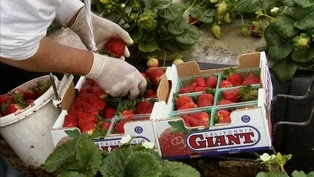
Video has Closed Captions
See how California farmers find new overseas markets for their bright red strawberries. (4m 57s)
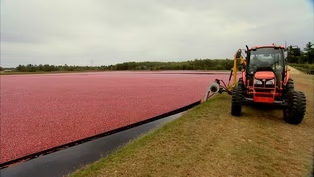
Massachusetts Cranberry Harvest
Video has Closed Captions
Discover the hard work involved in bringing in the harvest in the cranberry bogs of Massachusetts. (5m 39s)
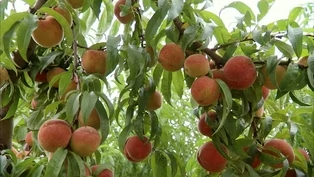
Video has Closed Captions
Meet a South Carolina family that’s been raising prize-winning peaches for nearly a century. (6m 25s)
Providing Support for PBS.org
Learn Moreabout PBS online sponsorship

- Food
Christopher Kimball’s Milk Street Television
Transform home cooking with the editors of Christopher Kimball’s Milk Street Magazine.












Support for PBS provided by:
America's Heartland is presented by your local public television station.
Funding for America’s Heartland is provided by US Soy, Sustainable Agriculture Research and Education, Rural Development Partners, and a Specialty Crop Grant from the California Department of Food and Agriculture.