
Spice Road | Inside Chicago's First Michelin-Starred Indian Restaurant | S2 E1
Special | 16m 44sVideo has Closed Captions
What does it take for an Indian restaurant to earn a Michelin star—for the first time in Chicago?
Rupak Ginn steps inside Indienne, the groundbreaking restaurant that is changing perceptions of what Indian food can be, thanks to visionary chef Sujan Sarkar. He is joined by Chef Chrissy Camba (Top Chef, The Grocery List Show) to explore how Indian cuisine and fine dining are being redefined in America.
Problems playing video? | Closed Captioning Feedback
Problems playing video? | Closed Captioning Feedback
Spice Road | Inside Chicago's First Michelin-Starred Indian Restaurant | S2 E1
Special | 16m 44sVideo has Closed Captions
Rupak Ginn steps inside Indienne, the groundbreaking restaurant that is changing perceptions of what Indian food can be, thanks to visionary chef Sujan Sarkar. He is joined by Chef Chrissy Camba (Top Chef, The Grocery List Show) to explore how Indian cuisine and fine dining are being redefined in America.
Problems playing video? | Closed Captioning Feedback
Where to Watch Independent Lens
Independent Lens is available to stream on pbs.org and the PBS app.
Aesthetics and Unraveling the AI Hype
Ghost in the Machine seeks to unravel the AI hype to find the untold origins of “artificial intelligence.”Providing Support for PBS.org
Learn Moreabout PBS online sponsorshipMore from This Collection
Films exploring the people, culture, and traditions of food.
Spice Road | What Indians REALLY Eat for Breakfast | S2 E7
Video has Closed Captions
Forget toast and cereal—this is how India does breakfast. (4m 37s)
Spice Road | Can She Identify Indian Bread Blindfolded? | S2 E6
Video has Closed Captions
Can you tell naan from chapati from puri… without seeing them? (4m 56s)
Spice Road | Which Butter Chicken Wins? | S2 E5
Video has Closed Captions
Which store-bought butter chicken is actually the best? (4m 19s)
Spice Road | What Happens When Indian Spices Meet Mexican Classics? | S2 E4
Video has Closed Captions
Try scrumptious Indian-Mexican dishes as South Asian flavors become more popular in America. (6m 25s)
Spice Road | This Bangladeshi Pizza Joint Was Ranked One of the Best in America | S2 E3
Video has Closed Captions
One of the best pizzas in America, according to The New York Times. (15m 12s)
Spice Road | You’ve Never Had Indian Food Like This| S2 E2
Video has Closed Captions
Kerala cuisine might be India’s best-kept secret—and most Americans have never tried it. (16m 49s)
The Grocery List Show | Latino Grocery Store in Brooklyn | Ep 5
Video has Closed Captions
A food blogger cooks up his family's garnachas recipe after a jaunt to a Latin American grocery. (12m 21s)
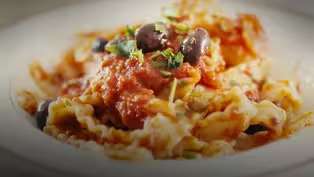
The Grocery List Show | Family-Run Italian Market in New Jersey | Ep 4
Video has Closed Captions
A family-run grocery in New Jersey brings people from all over for delectable treats from Italy. (10m 31s)
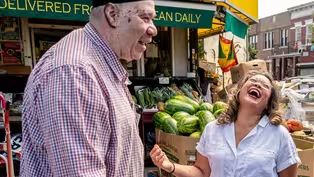
The Grocery List Show | A Little Caribbean Market in Brooklyn | Ep 3
Video has Closed Captions
At a Caribbean grocery in Brooklyn, the "island vibe" infuses the spirit of the neighborhood. (10m 31s)
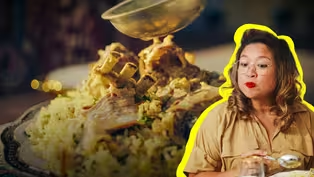
The Grocery List Show | Halal Grocery in Brooklyn | Ep 2
Video has Closed Captions
The family behind a Middle Eastern Brooklyn grocery makes a hearty mansaf meal. (12m 7s)
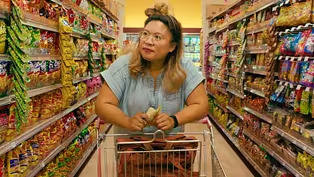
The Grocery List Show | Seafood City in Chicago | Ep 1
Video has Closed Captions
Filipino food galore at Seafood City in Chicago is followed by the making of a crab torta feast. (12m 39s)
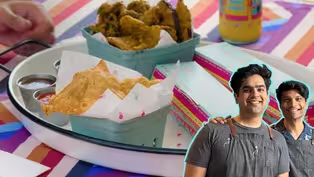
LA Street Food, South Asian Style | Spice Road, Episode 4
Video has Closed Captions
Rupak Ginna goes home to LA for Desi street delicacies and grocery store comfort food. (16m 31s)
Providing Support for PBS.org
Learn Moreabout PBS online sponsorship♪♪ - Growing up, fine dining to me was the exclusive province of Western cuisine.
The words "Indian restaurant" meant all-you-can-eat lunch buffets, which, don't get me wrong, were cherished meals full of good memories, but never did I imagine an Indian restaurant with a waitlist, and people paying $300 a meal.
That's why I'm in Chicago, to meet the chef who's challenging our ideas of what Indian food can be.
This is "Spice Road".
Let's go.
A native of West Bengal, Sujan Sarkar runs Indienne, Chicago's first Michelin-starred Indian restaurant.
He's also launched NADU, celebrating regional specialties, and Swadesi Cafe, a chic, Indian-inspired take on the modern coffee shop.
I'm excited to try Sujan's food and learn how he's built one of the most acclaimed Indian restaurants in the world.
First up is Swadesi Cafe, where the Indian chai stall collides with French pastry in sleek, modern style.
In a big city like Chicago, an upscale Desi cafe like this isn't just serving chai and pastries, it's making a bold, spice-infused statement about the future of the American Cafe.
So great to meet you!
- How are you?
Nice to meet you.
- Everything looks so delicious.
Of course, I gotta have the Swadesi masala chai.
What should I order in terms of the food?
- Our butter chicken croissant, samosa chaat croissants, and a chicken tikka toastie.
And then, if you're gonna have like, need a little bit of sweet tooth, go for our gulab jamun cheesecake croissant, - Gulab jamun cheesecake croissant?
- When the French people see I'm putting a gulab jamun in a croissant, - Sacré bleu!
Time for a "Spice Road" rewind.
- [Friend] Yeah.
Let's do the gulab jamun, yeah.
- Alright.
Now, you ordered this.
Try and describe it.
- A fried dough ball?
- Fried dough ball.
Love it.
- But like, a delicious fried dough, because fried dough ball does not sound appetizing.
- And I'm just gonna enjoy this thing.
(friend laughs) We're gonna get the chicken tikka toastie, the butter chicken croissant, and the gulab jamun - [Both] cheesecake croissant!
Yes!
(chill music) (inhales aroma) - Grilled cheese?
Move over.
The chicken tikka toastie is in town.
It just looks great, too.
I like that.
I like when a dish looks great.
All these dishes are beautiful in terms of their aesthetic.
The gulab jamun cheesecake croissant.
Wow!
That was unexpectedly amazing.
I mean, croissant, already great.
Cheesecake, yes.
Gulab jamun, oh my gosh.
I mean, it's like taking that cheese danish and upping it 10x in awesomeness.
I'm gonna wash it down with some delicious Swadesi masala chai.
And 30 seconds on chai.
(upbeat music) The word chai simply means tea.
But across the street corners and kitchens of South Asia, it's a daily ritual and a cultural anchor.
After water, tea is the most popular beverage in the world.
In South Asia, tea's growth was fueled by British imperialists who established vast plantations to break China's monopoly and export Indian tea to the empire.
But as if in a quiet culinary rebellion, Desi vendors and households began adding ginger, cardamom, cloves, cinnamon, and black pepper, drawing on centuries old traditions of spiced drinks.
Milk and sugar joined the mix, creating a brew that wasn't just about taste, but also warmth and belonging.
Swadesi Cafe channels that same spirit, re-imagining the chai stall through a modern, global lens.
I'm gonna meet the great Sujan Sarkar, the master chef, the maestro behind all of these establishments that I'm checking out.
I'm very excited to see the brains behind all this.
I'm now headed to NADU.
It's the first of Sujan's two Indian restaurants I'll be dining at here in Chicago.
What makes NADU so unique is its devotion to regional Indian cuisine.
Rather than leaning on the familiar greatest hits like butter chicken or tikka masala, NADU explores dishes rooted in specific states, cities, and family traditions.
It's yet another way in which Sujan is moving the needle forward and elevating the conversation on Indian cuisine in the West.
Ah!
Sujan!
- Hello.
- How does a kid from Kalyani get inspired to become a chef, and then come all the way to the United States and come to the highest level of chefs?
- I always wanted to be a designer.
- Fashion?
- Yeah.
I was trying to get in the top fashion school.
That didn't happen, so this was more like a career alternative.
I said, "Okay, just get into the cooking school, and let's see what happens."
But when I got in after one year, and then I realized that, you know, it's not bad.
- What makes NADU stand out as an Indian restaurant?
- NADU means homeland.
Why I picked the name, because the food, it should be as close to what we get in India.
And if we can achieve that, then it's a big win.
- I want to talk about Indienne as well, because that's quite an accomplishment.
You got a Michelin star.
There are only three Indian restaurants in all North America that have a Michelin star.
Why is that?
- I think it doesn't matter what I think.
It's about what a Michelin inspector, they think, you know that?
But, you know that we have to understand progressive Indian folk movement in America started quite late.
It's not UK or it's not, you know, middle East or Southeast Asia, which are closer to India.
People, they're just getting into the flavors.
They want to explore more about Indian food.
It's gaining popularity day by day, and it'll be huge in coming days.
- Maybe now's a good time to talk about the progressive Indian food movement that Sujan mentioned in our chat.
(upbeat music) To quote Sujan, "It isn't about fusion, It's about evolution."
Re-imagining centuries old traditions and flavors with modern techniques and presentation.
Chicago itself is a fertile ground for this evolution.
The metro area is home to more than 200,000 South Asians with vibrant enclaves like Devon Avenue and a generation of diners eager for a new twist on Desi classics.
The moment finally met the man when Indienne became Chicago's first Indian restaurant to earn a Michelin star.
It wasn't just a personal triumph, it was a signal to the world that Indian cuisine in all its complexity and beauty belongs at the highest table in global gastronomy.
Following as sumptuous dose of benne dosa, Sujan whisked me off to the kitchen to learn how to make it for myself.
- He will now show you how to do real benne dosa.
- Dosa is an iconic dish from South India, and benne dosa is a buttery variation from the state of Karnataka, where benne means butter.
So you think anybody should know how to cook a dosa at home?
- Something that you won't mind eating on everyday basis.
In India, dosa can be a breakfast, a lunch, a dinner.
It can be every part of the meal.
- A snack.
- A snack.
A snack.
This is our benne dosa's major ingredients.
So that's dosa rice, which we get from south, urad dal, very typical to a dosa.
So once we grind it, you get a beautiful, fluffy batter.
- This batter is fermented now.
- Yeah, that's our portion here.
Unlike most of the dosa that you see, is very paper thin, this needs to be a little fluffier so that the edges don't round.
- Now should I try one on the other side?
- Why not?
Why not?
- A little batter.
We're gonna go slow.
We're gonna take it.
- Yeah, just pull it all out.
Yep.
- All right.
All at once.
- Just think of making a crêpe.
The way we move it, we try to even it out.
That's quite good, actually.
- First starter.
Second job, coming up.
- This is a potato of aloo palya.
- So what's in that?
- Potatoes.
Smash it.
A little bit of shallot, mustard seed, curry leaves, ginger, and turmeric.
I put the butter inside to give it a nice, rich buttery flavor.
That's the white butter that we use here.
So this is the dosa that I did.
- [Rupak] Okay.
This is the Dosa.
This is the final product.
- Yeah.
- [Rupak] Wow.
- So you'll get a nice color.
- Mine didn't turn out so bad after all because you helped.
Yeah, it was good.
Now, what are you putting on it here?
- So that's gunpowder.
(loud boom) Dry powder seasoning.
Because like, India was a colony of Britain.
British, when they had podi, they found it so fiery and spicy.
- [Rupak] They called it gunpowder!
- They called it gunpowder.
- That's so interesting.
Professional, amateur.
Look how beautiful that is.
And now for the pièce de résistance, I make my way to Indienne.
What's really cool about what I'm about to experience, just in concept that it's the first Indian Michelin star restaurant in Chicago, where you can have an Indian restaurant in America getting a Michelin star.
I mean, that's a testament to so many things.
How Indian food has evolved in America.
It's a testament to Americans and who we are as Americans, that we can embrace this food at the highest level.
(soft, relaxed instrumental music) It's so gorgeous.
I mean, these colors, this artwork.
- This used to be a printing press.
Then we started working on it, how we can turn this into restaurant with Indian accent.
And then we kept it very simple and straightforward.
- It's gorgeous.
I am dying to see the kitchen.
Can I get a peek?
- Absolutely.
Come on in.
♪♪ - Look at this.
We got so much activity.
I got gentlemen chopping here.
We got some kind of frying going there.
Some kind of something.
I don't even know!
Okay.
- Here, everything is very precise.
Everything is well-measured, everything has to be perfect.
We have another section of the kitchen where we do all the delicate work, all the pastry work, all the canapes, all the small bites, and all this stuff.
- He's doing such a great job that he's getting featured in this magazine right here!
- Their skill level is one of the best there.
We can do it, too!
Alright!
I gotta eat!
- Absolutely!
-Hey.
- Hey, what's up?
- Of course, the only thing better than having a great meal is sharing it with a friend.
So I invited Chrissy Camba to join me.
She's a Filipino American chef who's run restaurants, cooked for Cirque de Soleil, competed on "Top Chef", and is now the awesome host of PBS's "The Grocery List Show".
I am pumped to have a real chef here - Ooh.
- to enjoy this Michelin-starred meal.
- I'm excited to have great company.
Celebrating friendship.
- That's right.
- Hello.
- Hello!
- Welcome to Indienne.
So we are starting with Indian Street food.
This is pani puri.
You get anywhere and everywhere in India or in different version and form.
We are doing that with bean guava.
Please take that one go.
- One go.
- One go.
- Mmm!
- Hmm!
- What's your experience with pani puri?
- Is it the one with the... And then... it's hollow... Yes.
- The little puri.
It's how you make a little hole.
- Yeah.
And you put stuff in it.
- Time for another serving of "Spice Road" rewind.
Oh my gosh.
This is golgappa or pani puri, right?
- Pani puri.
Yeah.
We're gonna have the burst of flavors.
- That is so good!
This food sort of revolution in Indian food, much of it is being led out of Chicago.
What do you think it is about Chicago, the food scene here, that makes it unique?
- We are a people of substance here in Chicago.
- Yes... Yeah.
- I think you get a lot of people with a lot different backgrounds, and different experiences.
It's like all hearts.
- It's all heart, and it's real.
- There's something humble.
- Say it.
Preach it, girl!
(Chrissy laughs) I gotta interject here to point out just how fast Chicago's Desi food scene has evolved.
It's actually wild to think that, for much of the 20th century, few South Asians even settled here or any other US city on account of government policies aimed at restricting immigration from the Eastern hemisphere.
But that all changed with the Immigration and Nationality Act of 1965, opening the doors to a new wave of Desi professionals, entrepreneurs, and, you guessed it, restaurateurs.
I just love that the dishes keep coming.
- So this one, we call it yogurt chaat, but we got different layers to it.
Savory yogurt, panna cotta.
Then you have yogurt mousse, three different chutneys, and this disc made out of sweet potato.
So you have to just break it down, dig deep, and just enjoy.
- How do you come up with a concept of something like this?
- We always say that the food has to be exciting.
It looks something different, but the idea remains the same.
You can say different version of Indian food, which is progressive.
- [Chrissy] Break it.
- [Rupak] Oh, Break it.
Yeah.
- [Chrissy] It's like a crème brûlée.
- Oh.
And it's got some flower petals underneath.
- So it's like secret beauty.
- Now, you've had chaat.
- Mmhm.
- How does this compare to the chaat you're used to?
- So different, but similar.
Flavor.
Like what he said, flavors are very similar, but they're a little more refined.
You can tell it's so well thought out, but you can tell there are memories from past that are being put into this dish.
- I'm beginning to get the picture of what Michelin star means.
The level of attention to detail, branching into the future of what food might or could be, channeling the imagination.
- Yeah.
- But taking flavors you know, but pairing it with that imagination.
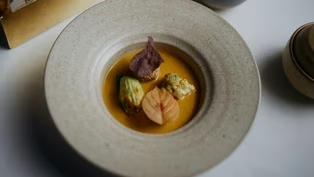
- Here we have lamb loin crusted with pistachio, and next to that is lamb ribs braised.
This is the nihari sauce.
You have a little bit of romanesco which is cooked in tandoor, You have courgette, the baby squash flower, stuffed with paneer.
Jackfruit kofta.
That's the round things on top.
On top of the jackfruit kofta, you have black rice papadam.
- Hmm!
The taste of the lamb loin with the crust and this reminds me of walking into an Indian restaurant.
- It might be the nihari.
Nihari is like, a classic, like, meat dish.
- Okay.
-It's like, a very saucy dish.
- It's so powerful.
- You're the host of a fantastic show called "The Grocery List Show".
I think it's super cool that you're highlighting that community.
- Yeah.
I noticed that like, the grocery stores are located within a community of like, people who need these specific items because they're either Palestinian, or Grenadian, or Caribbean.
But I think it kind of fans out, and then gets more people interested in that culture, so I think it's like an educational thing with other customs, with different foods that like, normally you wouldn't see, but also like, showing the friendliness of like the community.
I feel like that's what cooking is.
Not reviews, like, people being mean.
I think it's like, people enjoying something that like, is being given to them from your heart.
(uplifting music) - How do I even begin to describe the meal I just had?
Every dish exploded with originality, emotion, and whimsy.
Course after course, they built like a culinary concerto with Sujan as the maestro.
- Indistinct dialog.
- Yes.
- It was visceral, too, like being on an immersive ride through an Indian food theme park, powered by a chef's palpable passion to create something unforgettable.
And for me, it came with a deep sense of pride.
Kid Rupak would've had his mind blown that an Indian chef would one day use dishes like chaat, bhapa doi, and dhokla to redefine fine dining in America.
Sujan may speak humbly, but his food has the swagger of someone who's rewriting the rules.
I've read about the progressive Indian food movement, but this evening, I experienced it.
Cheers.
- Cheers.
(chuckles) - It's transformed what I thought was possible during the "Spice Road" journey, and has me craving even more.
There's a revolution simmering in Chicago's Desi food scene, and I feel like I'm only getting started.
The word is, there's a must-eat spot for authentic cuisine from the South Indian state of Kerala, so that's exactly where I'm headed next on "Spice Road".
(uplifting music continues)
Video has Closed Captions
Preview: Special | 29s | It’s not just about what’s on the plate—it’s about the journeys behind it. (29s)
Providing Support for PBS.org
Learn Moreabout PBS online sponsorship










Support for PBS provided by: