KSPS Public Television
SPOKANE CITY COUNCIL-DIST. 2 | Barrientos v Tellis Debate
Season 20 Episode 1 | 28mVideo has Closed Captions
Alejandro Barrientos and Kate Tellis address homelessness and public safety concerns in Oct 8 debate
Two newcomers are hoping to earn a spot on the Spokane City Council from Southside voters. Alejandro Barrientos and Kate Tellis address homelessness and public safety concerns during this debate recorded on October 8 at KSPS PBS.
Problems playing video? | Closed Captioning Feedback
Problems playing video? | Closed Captioning Feedback
KSPS Public Television is a local public television program presented by KSPS PBS
KSPS Public Television
SPOKANE CITY COUNCIL-DIST. 2 | Barrientos v Tellis Debate
Season 20 Episode 1 | 28mVideo has Closed Captions
Two newcomers are hoping to earn a spot on the Spokane City Council from Southside voters. Alejandro Barrientos and Kate Tellis address homelessness and public safety concerns during this debate recorded on October 8 at KSPS PBS.
Problems playing video? | Closed Captioning Feedback
How to Watch KSPS Public Television
KSPS Public Television is available to stream on pbs.org and the free PBS App, available on iPhone, Apple TV, Android TV, Android smartphones, Amazon Fire TV, Amazon Fire Tablet, Roku, Samsung Smart TV, and Vizio.
Providing Support for PBS.org
Learn Moreabout PBS online sponsorship- [Announcer] This is a KSPS PBS election special.
A debate featuring candidates for Spokane City Council.
- Hello, and thank you for joining us, I'm Dana Haynes.
We are pleased to bring you this debate featuring the candidates running for Spokane City Council in District 2.
District 2 covers the South Hill as well as part of East Central Spokane and areas to the west along Highway 195 and near Spokane International Airport.
There is no incumbent in this race, so let's meet the candidates.
We're gonna start with Alejandro.
- Yeah, my name is Alejandro Barrientos.
I'm running for City Council in District 2.
I am not a career politician.
I'm a father, neighbor, somebody that cares deeply about Spokane.
I moved here 17 years ago from Medellín, Colombia, went to Gonzaga University, go Zags, and I finally felt ready and had the courage to step up and give back to the community that's given me so much in the last 17 years.
- [Dana] All right, thank you.
Moving on to Kate.
- Hi, my name is Kate Telis.
I have spent my career and most of my life giving back to my community.
In the past six years since moving back to the area, I have been an active community volunteer working with many different organizations here in Spokane.
I have also been a former prosecutor working with victims of domestic violence felonies, helping them stand up to their abusers and seek justice.
And I have also worked with the nonprofit world, helping homeless families find much needed stability.
I'm excited to get to work.
- [Dana] All right, thank you and welcome to you both.
For this debate, the candidates will answer questions from two Spokane journalists: Emry Dinman from the Spokesman-Review and Erin Sellers from RANGE Media.
Thank you both for joining us.
- Thank you.
- And before we begin, we wanna take a quick look at debate rules.
The panel can ask the same question to both candidates or can direct the question to just one.
The panelists may request a follow-up to an answer, and candidates will have one minute for answers and are allowed two rebuttals for the entire debate.
Rebuttal length is limited to just 30 seconds.
So let's begin.
A coin flip determined that Alejandro will take the first question, and that will come from Erin.
- The Spokane City Council has previously issued two moratoriums on new development in Latah Valley, totaling 18 months, with the last one expiring in May.
Are there circumstances in which you'd support another moratorium?
And what specific infrastructure projects are you willing to commit to accomplishing during your term?
- Yeah, thank you for the question, Erin.
I think the 12- or the 18-month moratorium that we put in place, when I talk to neighbors in the Latah neighborhood, is that they don't feel like we've actually addressed the challenges and issues on why we put these moratoriums.
Obviously, the moratoriums are done, but we still have infrastructure road issues and challenges that are facing in those areas.
And so for me is: if we are going to work on another moratorium, is we need to give clear guidelines on what we're gonna do as city council members.
What we feel and the people in Latah Valley is we just kick the can down the road.
Some of these issues have not been addressed.
And so if we are going to contemplate another moratorium, we need to have a plan in action, kind of have milestones or metrics that we need to follow and communicate with the people in Latah Valley.
And if we do that and we uphold to those guidelines, then I am in favor of doing a moratorium and how we can address those challenges.
- Do you have any ideas for what some of those metrics or milestones could be?
- Well, we need to partner with the developers and the community.
And, you know, the infrastructure roads that we have, the issues of infrastructure and roads, like the Sunset Bridge, which is one of the key areas for the evacuation route in case of a fire, that's something that we need around $60 million to fix.
And so that's an area that, if we're going to take on those challenges, we need to find the funding for it and then put clear guidelines on what that looks like.
So we can do a moratorium for a month, two months, 90 days, but then kind of have clear communication with the neighbors on what is it that we're achieving during that moratorium and how we're gonna address those challenges.
So roads, infrastructure, and clear communication with the people.
But it needs to be a partnership between developers, neighborhoods, and our city.
- Kate, same question to you.
- Yeah, the west side of our district has long felt ignored.
There are many infrastructure needs that we have.
We see them in Latah Valley, we see them in Eagle Ridge, we see them in Grandview/Thorpe.
So something desperately needs to be done.
Right now, there's a single-family house that's been turned into a fire station of sorts where there is not a full-size engine because we don't have the storage capacity to put a full-size engine in a single-family house.
So that means that, because of severe cold and severe heat, we have what they call a baby fire truck that is offering the wildfire prevention for a huge area.
If you look out, it's right in the urban-wilderness interface, and, for lack of a better word, sometimes looks like kindling.
So we need to address this.
I think we need to balance the needs of potentially a moratorium and liabilities that we could be sued by developers with the liabilities of our residents, making sure that we have the safety that they need.
- I mean, I'm gonna ask you the same follow-up: can you give me any specific milestones that would need to be met to put a new moratorium in place?
- Well, for one thing, we would actually need to have a fire station, I think, in order to get that going.
We also just need to make sure that people have roads and evacuations in all areas.
And so I would want to see both of those things done if we were to enact a moratorium.
But, again, we have to balance that with threat of lawsuit from developers.
- Emry?
- Kate, it's been three months since the city passed a homeless camping ban to replace Proposition 1.
The council is now going back to the drawing board after police have said that that law was unenforceable and did not connect people to services.
What changes do you believe should be made to that law, and what is your opinion on the city taking another stab on it so soon?
- First of all, I'm very happy that the city is taking a stab on it so soon.
I would've liked to see this addressed even earlier than 60 days from when it was admitted or when it was put into law.
The most important thing: I'm very frustrated with the results in the article that came out in the Spokesman-Review yesterday.
But the one thing that I will say is it further highlights things that I have already advocated for.
We need to have service providers doing the outreach.
Chief Hall agrees with me on this.
And we also need to make sure that we are listening to all stakeholders downtown, whether it be service providers, police officers.
The people doing the actual work need to be in the room to talk about what is enforceable and what isn't.
And then I think, once we have everybody in the room, we can collaborate, ask the tough questions, and find lasting solutions.
But we're not gonna do it without everybody there.
- [Emry] Alejandro?
- Yeah, so to me what's disappointing is that we had a Proposition 1 that passed with 75% approval, and we're getting the same results that we did with that Prop 1.
I think what we needed to do to regain trust with our constituents is go with what they asked for, which was 75% approval.
I don't think I've seen 75% approval in business or local politics.
And so to me is what we need to do is, if that's what the people voted for, is find a way to communicate with the people on what works and what doesn't.
And it's been two years since we passed Prop 1, and I don't think we've ever had that communication.
And I know the home ordinance is something that we adapted, and I'm hoping that we actually have communication with stakeholders and people and see what can be done to enforce and have a compassionate aspect of getting people the path forward that they need.
- Yeah, I would just say that the will of the people is one thing, but we need to make sure that we are adequately representing the will of the people by talking to the people doing the work.
In the past 60 days, there have been zero citations issued for that ordinance.
There has been zero offers of help for services that people who are unhoused have taken officers up on.
So we need to be talking specifically to police and specifically to service providers doing the actual work on the streets every day in order to figure out how we go forward.
- Would you like to use your... - Yeah, when she said zero, I believe what she meant to say is that zero people actually took service providers or services that they need.
And I think that's where we're losing the help that people need.
One thing that I saw in Boise is: people are actually given the options, right?
They said, "Hey, you cannot be here.
"Either we can take you to a mental health provider, "housing, or we can take you to a shelter."
And that's not what we're doing.
- [Dana] All right, great.
- Alejandro, was the city's handling of the anti-ICE protests on June 11th appropriate?
And would you characterize any moment of that protest as violent?
- So I actually was there, I was there in support.
I ended up leaving when things kind of escalated.
I witnessed firsthand people taking pub... Or not public, or park property like benches, lime scooters, things like that to block entrances.
And it was getting a little bit out of hand.
And so at first, you know, people were there to support, and that's when I decided to leave because I have kids at home and I am running for public office.
And so I was there to show... Because it's important for us to have a voice and be able to kind of express our voice.
But I know that at some point it got a little bit too hectic for me.
So I left.
I actually heard about what happened afterwards, and I think that in leadership we made the right decisions to deescalate the situation.
But there's always learning experiences from this on what we can and shouldn't do.
- Kate?
- Yeah, just to go back real quick to Boise, and then I'll address your question.
I think when we compare Boise to Spokane, we're forgetting the fact that Boise has one constitution and one set of laws, or Idaho specifically has one set of constitutions, one set of laws.
Washington has another.
The personal freedoms that we provide in Washington are much higher, excuse me, than the ones we provide in Idaho.
So we cannot compare them apples to apples.
As to your question, I think we need to balance the right to protest with the right to have a safe and secure community.
Everything that I saw, and I was not there, I actually had back-to-back campaign events happening at the same time.
I got home and was asked if I was safe because people assumed that I was there and I was not.
But everything that I saw from videos, from actually your footage, Erin, it looked like it was peaceful until it was escalated by people in uniform.
And that, I think, is a disservice to our community.
We are in times now where we are having constitutional crises, and the ability for our people to rise up and protest when we need to is paramount.
- The relationship between the city and the county has been rocky.
What, if anything, do you believe the city should do differently to repair that relationship?
Do you feel the county has been an equal partner in efforts to improve the region?
This question is to Kate.
- I'm really happy to have relationships with two county commissioners already: Chris Jordan and Amber Waldref.
I've been talking with them repeatedly on this campaign about where we move forward as far as jail and the homelessness regional collaboration.
These issues that we are facing are not confined to city limits, and so we cannot best address them unless we are collaborating regionally.
If I win this election, I have plans to reach out to other county commissioners.
But I really think we're going to have to all get together and collaborate.
I cannot speak to why collaboration was not working beforehand, but if it was just a matter of personalities, I think we owe it to ourselves and to the public as elected officials to move past that and do whatever we can to collaborate and solve the problems that we're all facing.
- [Emry] Alejandro?
- So, to me, I've actually met Chris, Amber Waldref.
I also met Al French.
I think one of the key things is that what we're doing is: we continue to attack each other, right?
And collaboration is key to a plan, but we need to have a plan in motion of what we're actually trying to achieve.
One thing that I've been attacked is affiliations with Al French.
But we have to understand that this is an elected official.
This is somebody that has power here in Spokane.
And until we're able to actually put our political bias aside or our political understanding aside and actually work with people on common ground to find solutions, we're never going to find solutions.
And collaboration is key, like I said, but collaboration without a plan is only talking about the issue and not actually putting actions in plan.
And I've heard my opponent attack the people that I've worked with closely.
And, to me, I'm here to serve, and I'm here to work with anybody to really find solutions here in Spokane.
- Would you like to use your second rebuttal?
- Yes, I would.
So speaking of divisiveness, both of us have been talking about collaboration, both of us have been talking about getting people in the same room.
What we are forgetting and what we need the voters to know about: please go to the Public Disclosure Commission because you can follow the money there.
My opponent's boss created the Spokane Business Association.
It is a conservative lobbying group that is actually funding money into the Spokane Government Alliance, which is funding all of the attack ads against myself, against Zack Zappone, against Sarah Dixit.
That is the divisiveness that we are seeing, and we need to call it out.
- All right, time's up.
And that is just a reminder: that was your second rebuttal.
Erin?
- I'm gonna use my rebuttal.
- [Dana] Okay.
- I haven't witnessed any attacks.
700 of our leading businesses here in Spokane participated at the SBA dinner.
These are organizations that want to see better for Spokane and our community.
They're not advocating for... They're not actually donating.
So I think she might be misunderstanding of some of the organizations that are funding some of these initiatives.
But I've been to the SBA dinners, I've been to SBA meetings, and they're business owners that want to see a better Spokane.
- All right, time's up.
Rebuttals are now complete for the debate.
- Great, this is kind of a long question: Alejandro, at earlier candidate forums, you could only name one member of city council staff, you didn't understand the difference between a resolution and an ordinance, and you didn't know a council member could recuse themself if there was a conflict of interest on a vote.
Kate, in interviews you have said you were unfamiliar with the details of important ongoing city debates, like about the regional emergency dispatch service or the regional homeless coalition, because you haven't been in the room.
Neither of you are regular city council attendees.
Why should voters trust that you are going to be informed enough to act on their behalf?
We can start with you, Alejandro.
- Yeah, I mean, not knowing the staff members in our city council: I know that it might be important right now, but, to me, as I'm running a campaign, I'm learning as I go.
And I will know every staff member and every council member that's there.
I actually know all the council members, but I didn't know the staff.
And the important part of it is: just because you don't know staff members or some of the resolutions, ordinances, doesn't necessarily mean you cannot do the job.
I have leadership skills that have proven that I can bring people to the table on common ground and find solutions for Spokane, and that's what I wanna bring to the table.
I'm somebody that's multicultural, multilingual, somebody that's worked in operations, finding solutions to the challenges that we face.
And we need bold, practical solutions to the issues here.
These are not red or blue issues, these are local issues.
And until we find a way to work together and find solutions for Spokane, we're gonna be in the same rhetoric of pointing the finger and saying it's somebody else's problem.
- [Dana] Kate?
- Yeah, so with regards to not attending city council meetings, I actually attend every, well, I virtually attend every single one of them.
I have found, and you can ask me about last Monday.
I'd be more than happy to talk about what was addressed last Monday.
But I have found that being in the audience as a city council candidate is distracting, and I find it much easier to take notes and follow along online.
I did attend one city council, which was the protest city council meeting.
That was the same one that lasted until 1:00 p.m.
So I'm well aware of what's going on with city council.
As far as regional collaboration, we just need to have more transparency in government, and that's something that I'm advocating for.
I have not been able to address and speak to the specifics of the derailed conversations with SREC or the Homeless Coalition because there isn't that transparency.
And, if elected, that's what I would like to bring to office.
- All right, Emry?
- We're gonna go back to a topic that you guys both touched on earlier: involuntary treatment.
We are increasingly seeing proposals for policies and reforms to existing law to allow more people to be placed in treatment services against their will.
Councilman Jonathan Bingle has recently suggested that if somebody is overdosing and emergency personnel use Narcan to reverse that overdose, it should result in mandatory substance abuse treatment or jail.
Would you advocate for more involuntary treatment and commitment, and, if so, under what conditions?
- As far as involuntary treatment, the law is very clear: people can be involuntarily treated and held against their will if they are a serious danger to themself or to others.
If someone is stepping out in front of traffic, that would qualify.
If someone has overdosed two times a day, that would qualify.
I do think we have people on our streets who would fall into those categories.
I know that from speaking with lead medical providers.
But what we do not have right now is levels... We do not have a way to address that in every specific level of court.
For example, we need to make sure that community court has those availabilities, to say, "You know what, this person, "we're dismissing this case because of incompetence."
But that shouldn't be the end of it.
If they truly are incompetent to the point where they're a danger to themselves or others, then I believe the judge who would control community court has an obligation to flag that and proceed.
- [Emry] Alejandro?
- What I've said before is: if people are a risk to themselves or others, there should be involuntary treatment.
I think what we need to say is no to open drug use, no to camping, and yes to the resources and services that we can provide.
I think right now, unfortunately, we're not attracting people for the resources that we have, but we're attracting people for the fact that we're not enforcing some of these laws.
I mean, the home ordinance showed that there was no citations and no people that took on the services that we're providing.
And we need to have clear guidelines on, you know, giving people the options, saying, "You cannot be here, you cannot do open drug use, "but we have mental health resources, we have detox centers, "and we have housing for you."
Because when I think about my son or daughter, I would do anything in my hands to get 'em off the street and into the services that they need or require.
And I think that's what we need of a community.
We need to enforce some of that.
- All right, Erin?
- Great.
Alejandro, if you get elected, what goals or milestones will the city need to hit by the end of your term for you to feel like you were an effective city council member?
Please be as specific as possible about those milestones.
- Sure.
So I've thought about this quite a bit, and I don't think there's necessarily milestones or things that need to be done.
I'm here to serve the people of Spokane, and leadership is not about being agreeable or being liked.
It's about making tough decisions that better serve the people here in Spokane.
And I think what we need to do is focus on the top priority of our local government, which is public safety.
I think public safety is something that, you know, I hear a lot about perception, but, to me, is perspective.
You know, we have family members in communities that do not feel safe in their own home, in their neighborhoods, and we need to fix that.
Our city council needs to focus on some of those things.
And so to me is: if we can change the lives of people in a positive way, people here in Spokane, then I would feel like I've done myself and my family and other families proud here in Spokane.
But I think my top priority would be public safety, our unhoused population, specifically on street level, and housing.
Those are my three priorities.
- [Erin] Kate?
- Well, first of all, we need to deal with our affordable housing crisis.
The issues that we're seeing downtown actually relate to the fact that we have 30,000 more... We have a need for 30,000 more entry-level units for housing than we currently have available.
This actually goes also to whether or not we should penalize people for camping.
Right now, we do not have enough low-barrier shelters to tell somebody, "You cannot be here, "but here is a legal place you can be."
Right now, we do not have that space, and so we need to address that first.
I would like to see, first of all, for us to be able to have low-barrier shelters and availability for housing for anyone who is on the streets.
That's goal number one.
Because that's when people actually start working on addiction and mental health and finally start finding stability.
Not related to downtown: we need to make sure that we have adequate infrastructure in Latah Valley, Eagle Ridge, Grandview/Thorpe.
We need to make sure that we have a fire station that will actually protect our residents in case of wildfire and adequate roads for evacuation.
- All right, it is time for our final question.
We wanna remind the candidates: because of time, your answers need to be kept to 30 seconds each on this final question.
- [Emry] Oh, really?
- Yes, just for this final question.
- Well, and it's gonna be a bit difficult with this one.
Kate, how should the city find funding for permanent and reliable treatment services given that state and federal funding is so unreliable in this moment?
- We're gonna have to think outside the box.
State and federal funding is unreliable.
Therefore, we're gonna need to work with our community partners.
We're gonna need to talk to nonprofits, we're gonna need to talk to faith-based communities.
It's going to require thinking outside the box to get people the services that they need.
I have great relationships with state legislatures.
I have great relationships with county commissioners.
As much as possible, I would work on regional collaboration to make sure: if there is money, we can get it to those people.
But more than anything, we're gonna have to think about ways to do more with less.
- New taxes?
- I would consider them if they were appropriate and if the voters felt like it was warranted.
- [Emry] Alejandro?
- So very similar to Kate.
I think it's a collaboration issue, right?
It's something that we need to work with our county commissioners, city council, our city administration, nonprofit organizations, and then the private sector, right?
This is gonna help us really find initiatives and find resources to actually do built housing and resources that people need.
I think one of the things that we're missing is, we talk about collaboration, but we're actually not doing anything about it.
And when it comes to taxes, because I'm assuming your follow-up is gonna be on taxes: people here in Spokane did vote for a public safety tax.
So people are willing to provide resources to come with the issues.
We just need to make sure that we're actually utilizing the most effective as possible.
- All right, thank you.
It's time now for closing statements, and, Alejandro, we're gonna go to you first.
- Sure.
I'm not running for a title: I'm running to serve.
I'm a father, a neighbor, and a leader who knows how to get results.
Spokane is at a crossroads right now, and if you like how the city's being run and how we address the challenges, I am not your candidate.
I'm not here to represent the status quo: I'm here for change.
I've said this throughout my campaign trail: if you want to know more about my campaign, please reach out to me.
I would love to speak with to you about my vision, my values, and what I care about.
And, more importantly, get to know your candidates and vote on Election Day, November 4th.
Thank you.
- Kate?
- If I liked the status quo, I would not be running.
There are major issues that we need to address, both with our public safety system as well as our affordability for housing as well as our sustainability.
The river ran dry: we need to start thinking about climate change and how we're going to address that.
I'm also not a career politician, but I am somebody who has been actively communicating and working within Spokane for six years to talk with people in organizations and changemakers and figure out, problem solve, what is best needed for our city.
There are many challenges, but there are also many opportunities.
We are better when we collaborate together, and that is why I'm running.
Because I believe in a better future.
I believe in a future where these issues should not be non-partisan... Or should be non-partisan because what they really need to do is just address all issues, address all stakeholders' needs, and think of lasting solutions that will actually get the job done.
I'd be honored to have your vote.
- All right.
That's gonna do it for our debate for city council.
Our thanks to the District 2 candidates: Alejandro Barrientos and Kate Telis.
As well as our journalists: Emry Dinman and Erin Sellers.
This and other KSPS debates are available for viewing any time at ksps.org.
For all of us here at KSPS PBS, thank you for watching.
(dramatic music)
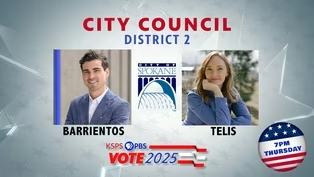
Spokane City Council Debate - Dist 2
Video has Closed Captions
Preview: S20 Ep1 | 20s | Alejandro Barrientos and Kate Tellis address homelessness and public safety concerns in Oct 8 debate (20s)
Providing Support for PBS.org
Learn Moreabout PBS online sponsorship















Support for PBS provided by:
KSPS Public Television is a local public television program presented by KSPS PBS