
Political Breakdown
Steve Hilton’s Strategy to Win Over California
9/4/2026 | 28m 26sVideo has Closed Captions
Steve Hilton discusses his plan to change California politics and win the governor’s race in 2026.
California Republican gubernatorial candidate Steve Hilton joins Marisa Lagos to discuss his plan to break Democratic control over California. Hilton shares his views on the state’s ruling class, taxes, AI regulation, data centers, election integrity and abortion, and explains why he believes he can win in 2026
Problems playing video? | Closed Captioning Feedback
Problems playing video? | Closed Captioning Feedback
Political Breakdown is a local public television program presented by KQED
Political Breakdown
Steve Hilton’s Strategy to Win Over California
9/4/2026 | 28m 26sVideo has Closed Captions
California Republican gubernatorial candidate Steve Hilton joins Marisa Lagos to discuss his plan to break Democratic control over California. Hilton shares his views on the state’s ruling class, taxes, AI regulation, data centers, election integrity and abortion, and explains why he believes he can win in 2026
Problems playing video? | Closed Captioning Feedback
Where to Watch Political Breakdown
Political Breakdown is available to stream on pbs.org and the PBS app.
Providing Support for PBS.org
Learn Moreabout PBS online sponsorship- You rail against the elites and you're a fair amount.
- I do.
- Who do you think are the elites?
- Well, in California, it's the, it's the ruling class.
I think we clearly have a ruling class in Sacramento.
Every time I go there, it's very evident that you've got a very insular group of people, certainly the politicians are there, but actually mainly they're not driving it.
It's the interest groups that control politics in Sacramento.
And I fear that too often the politicians there are just puppets of these interests.
And that's why nothing really changes even as the politicians keep running for elections say, "We're going to do something about this."
I mean, how many times have we heard that they're going to do something about housing costs, for example, but nothing seems to get better.
- Hey everyone.
From KQED in San Francisco, this is Political Breakdown.
I'm Marisa Lagos.
Today on The Breakdown, Republican candidate for governor Steve Hilton is here as he campaigns to break Democrats' ironclad grip on state governance.
It is a steep challenge.
No GOP candidate has won statewide office in 20 years, but Hilton remains bullish that his message of change can win over enough independent and democratic voters.
While his conservative credentials and endorsement by President Donald Trump will keep Republicans on his side, it is quite the needle to thread.
We are thrilled to have him back in studio to chat about his life and make the case that he's making to voters.
Steve Hilton, welcome back.
- Fantastic to be with you.
Great to be back.
- Well for those who maybe didn't tune in for some of our earlier interviews - And why not?
I know.
What is wrong with people?
They probably can pick up by your accent.
Yeah.
You were born in the UK.
Yes.
You, your parents were Hungarian refugees, raised by your mother and stepfather.
You went on to Oxford University and then you worked in politics there for the prime minister at the time, David Cameron.
And reading back, you were kind of known as this like quirky guy who would bike around and not wear your shoes and talk about climate change at a time where that was not, you know, a part of conservative politics.
I know you broke with Cameron later over Brexit, but I wonder like when you think back, what were you most proud of of that chapter of your work life?
- I think that the, well, there's one specific thing I think of actually, and it's something I'd like to see happen here.
It's not like some big broad policy thing, but it's one of those things where you can really trace back like your role in making it happen.
And it was something that we called National Citizen Service.
And going back years before David Cameron became prime minister, actually it originated after the London bombings.
There were these terrible bombings on the underground and in buses.
And one of the really striking things was that the terrorist, the terrorists who did that were not as we saw, and we're about to have the anniversary of nine eleven, - The - 25th anniversary.
These were not people from other countries in the, in the UK - Case.
They were homegrown.
- They were homegrown.
And there was a lot of soul searching, like what is going on that we've become so, we've created this society where anyone could do something like that.
And as part of that conversation, we, we, I remember, you know, developing our response to that, a security response, a foreign policy response, all those things.
But we also felt we needed to do something to bring the country together to actually heal some of the torn social fabric.
And so that led to an idea for what we started off calling non-military national service.
And the idea was to have a common experience for young people where they, they just do something positive and constructive with others from different backgrounds away from their communities so people just get a sense of - - Sounds like AmeriCorps, some of these programs we put here.
Yes, exactly.
But, - And just as here in the UK at the time, there were lots of things that went on, but typically it tended to be the, the kind of more middle class, you know, more wealthy people had, were able to take advantage of it.
And it certainly wasn't universal.
So the goal was to produce something that everybody did without making it compulsory.
It was kind of fine line to tread.
Yeah, that's interesting.
So we spent a long time developing that.
So that, and actually prototyping it before we be - we got into government so that we had a model ready to go.
And, and that's something that I kind of shepherded from idea stage to actual implementation with hundreds of thousands of young people doing it.
Look - At that.
This is a nice nonpartisan.
- Okay, - There you go.
Good, good, good thing everybody can agree with.
All right.
Well, I want to, you know, come forward to now you are running for governor.
I wonder how would you describe your politics now in this moment?
- Pragmatic.
I think that's the number one word, which is and I say this all the time, I'm not an ideologue.
I've never been an ideologue.
I've never been tribal.
Of course it's true.
I'm running as a Republican.
I've worked for a conservative prime minister.
But remember, and we've talked about this before, that government where I served in, in the UK as senior advisor of the prime minister, it was actually a coalition government.
He was a conservative prime minister.
It was with another party, the liberal Democrats.
We worked together.
I helped negotiate the coalition agreement, shared an office with my opposite number from another party right there in 10 Downing Street next to the cabinet room.
Every day we try and figure it out.
And so that's what I think we need here, especially let's be honest given the fact that, and as, as you, as you, as you mentioned, I think I can win this election.
I know it's an uphill battle.
I think we need some balance and some change in California, but it's very likely it'll be a Democrat controlled legislature with a super majority.
So we're going to have to - Work together.
Yeah.
But it's fascinating to me that you describe yourself as a pragmatic because you used to say you were a populist.
I wonder if that, that, that label is, is a pragmatic choice.
I mean - Well, I - Used to say, here's the thing.
I used to say, I know it's a little bit of a mouthful, especially in my accent.
My running mate for Lieutenant Governor Gloria Romero teases me about it.
I used to call myself, I used to say it's positive populism.
What I mean by that is problem solving rather than just railing against whoever it may be.
You know, that's a tip.
One of the things that you, you have had with populism over the years in history is a legitimate grievance, whether that's, you know, stagnant wages or lack of opportunity or whatever or poverty, but then it's directed towards you know, a negativity towards the other or something else.
And it could be the elites or it could be immigrants or whatever.
- I mean, you, you rail against the elites and your fair amount.
- I do, - But I also - Try and put forward solutions, - Right?
How do we actually solve the problems that have given rise to this sense of grievance?
- Who do you think are the elites?
- Well, in California, it's the, it's the ruling class.
I think we clearly have a ruling class in Sacramento.
Every time I go there, it's very evident that you've got a very insular group of people and it's some combination of the certainly the politicians that are, but actually mainly they're not driving it.
It's the, it's the interest groups that control politics in Sacramento.
That is a combination of the unions, the trial attorneys.
That's a huge force that we don't talk about enough.
Climate activists, big business, lobbying, you know, all, this is what goes on.
And, and I fear that too often the politicians there are just puppets of these interests.
And that's why nothing really changes even as the politicians keep running for elections say we're going to do something about this.
I mean, how many times have we heard that they're going to do something about housing costs, for example, but nothing seems to get better.
- I wonder, like, I've heard you talk about socialism as a huge threat to America.
What about inequality?
Is that widening gap a threat?
- So I've always had a particular view on inequality, which is that it's less the gap that's the problem.
What's the real, the real problem is a sense that you can't climb the ladder and, and make it to the top of whatever the scale is.
As long as people have a sense that, yeah, there's people much richer than me, but I could get there because why not me?
And that's what America has done so fantastically well compared to any other place in the world that this, you know, anyone from anywhere can become anything.
That's the sort of idea of America.
And so I think that for a long time, you didn't have this kind of resentment of, of the people who are rich.
I may be a little bit, but not as a pervasive thing - Because people felt - Well, the gap has grown exponentially and the people, I mean, there weren't billionaires when I was growing up that didn't even exist.
- Yeah no, fair enough.
Fair enough.
- As a class, right?
And the difference between a millionaire and billionaire, if you want to listen to yesterday's podcast or this week's podcast about the Prop 40 we talked about Stanford economist.
Anyway, well let's move on.
I mean, you were running in a state where Democrats outnumber Republicans nearly two to one.
And as I said earlier, you received the endorsement this spring of President Trump.
What is your pitch to those center, center right, independent voters who you're trying to win over?
- Well, we've had 16 years of one party running everything and the results are just obviously disappointing.
We've got the highest cost of living in the country housing costs, gas prices, electric bills, and we don't need to sort of name it.
We all experience it.
On top of that, you know, less obvious but very serious problems like the highest unemployment rate of all 50 states, the highest poverty rate, not to mention the very visible you know, homelessness and, and those sorts of things and the kind of degradation of our public spaces.
I think that as I travel around the state, I'm really shocked by the fact that we're the richest country, richest state in the richest country on earth.
And yet there's a sense of public squalors in MacArthur Park yesterday in Los Angeles.
It's just so shocking that we have this going on in such a rich state, in such a rich country.
So I think that clearly there's a case for change.
A majority of Californians agree.
Every poll shows that, that it's above 50% that people say we're going in the wrong direction and it's time for change.
And my pitch is to say, look you know, I, I ran ads, you know, right at the beginning of the general election phase of the campaign after the primary say, look, can you be anti-Trump and still vote for me?
Someone who's endorsed by Trump.
- Well, let me ask you like about a specific - - And the answer is yes, because you, whatever you think about Trump and the federal government and Iran and all these things, right, I'm focused on practical things to make your life better here.
$3 gas, your first 150 gand tax free.
- How do we get to some of those things when you do have a president doing some of the things he's doing?
I want to give you a specific example.
Yeah.
We could talk about Iran and gas if you want, but you are running on a smaller government agenda.
You talk a lot about waste, fraud, and abuse, about, you know, the fact that we have a, not a revenue problem, but a spending problem.
- Yep.
- How do you grade Doge and what they did at the federal level then?
- So I don't think that that, I, I, I, my sense is that it was a bit of bull in a china shop to use it.
For, you know, and now I do know that there are some serious reforms still going on that we don't hear about.
You know, for example you know, one of the, one of the things kind of interesting for us here from San Francisco, Joe Gebbia, who was one of the founders of Airbnb, actually doing really interesting work in terms of the design of government services and websites and so on.
So there's all, and that started through that.
So there's definitely things that are going on that I may not be aware of and I'm pretty close to it.
But I think that in terms of the stated goal of saving money and making the government more efficient, I think there's no question that, that, that certainly is not apparent to people.
And so what we, I mean, the focus now for me is on the budget in California.
And so we've announced a plan.
In fact, when we last met, the plan was your first $100,000 tax free, no state income tax.
And actually I got a lot of feedback in the primary that that level was pretty low.
There's a lot of people remember in many counties in California, the official level for low income is 100,000.
And so a lot of people saying, look, we're making 120, 130 and it's a real struggle.
And so we've raised it to 150 grand tax-free, no state income tax.
And the cost of that is about $25 billion.
So for me, it's a very pragmatic focus.
Where can you save $25 billion in the budget to pay for that?
And so we're calling that Operation Zero Waste.
It's not some general, let's kind of rethink the whole thing.
It's like how do we find the money?
Because you have to, you can't just cut tax, you've got to cut the spending.
- I want to talk about this November's election because there's been a lot of move at the federal level to try to, I mean, critics would say interfere.
And here in California, we've seen a court case play out because your GOP rival from the primary, Riverside County Sheriff Chad Bianco seized 650,000 ballots earlier this spring related to the statewide election prop 50 last year.
He claimed irregularities in the number of votes that were cast versus counted.
What's your take on this?
Do you support that investigation?
Do you think he had the right to seize those ballots?
- I've really not followed it.
- Okay.
- I just don't know.
I'm of course aware of it.
And I've just read a few press reports.
I haven't spoken to Chad about it or I haven't spoken to him about anything.
And so I truly don't know whether there's something there.
Look, I've got to have good faith that he meant, he saw something that needed investigation.
That's why he did it.
But as to where that's got to, I think also there's a sense of knee jerk shutting down this kind of thing because of a defensiveness on the posture of the people in charge right now.
- I think there's also concerns by election experts that when you interrupt the chain of custody on ballots, that in itself can undermine an election, right?
And that is a fear.
We're seeing the president move to give the postal service more power over federal elections, talking about sending ICE to polls.
Are you supportive of those moves?
Are you concerned about federal intervention?
How do you view that?
- Look, I was very supportive of the move specifically on the seven days after voting.
To limit when ballots can arise.
So the theory is that since we have universal mail-in voting, people vote by mail, it should be the same as if you were voting in person.
So if you may - Well sure but - The President doesn't want us to have mail-in voting at all.
I mean, he signed an executive order to end it.
- Well, I don't agree with that.
- I mean it's clearly popular.
I mean the fact that so many people use it.
- Among Republicans as well.
- And I say every time I get asked about this stuff all the time on the campaign trail and I say, look, this is the system.
We may not love the system, but we've got to win votes using this system.
And actually, truly early voting, I mean I used to say, I don't like this early voting.
I like voting on election day and the civic ritual of going to vote.
And I used to say that's truly what I thought.
Honestly, I've come around to it.
I can see that it's more convenient for people.
It's actually helpful to campaigns because you can see who's voted and so there's a point there.
And yeah, of course we need to encourage as many people to vote as possible.
So I don't agree with that.
The specific thing about the seven days was the idea is, well, if you vote by mail, it should be treated the same as if you're voting on election day.
So if you mail it in on election day, we got to give you seven days.
But there's all sorts of ridiculous rules amongst in that which is.. - I mean, interestingly though, the data shows that the biggest sort of delay in the vote count is actually all those ballots that arrive on election day, not after election day.
- Right.
- So the seven day thing I think has become a bit of a red herring for a bigger conversation.
By the way, it's moot - Now because the Supreme Court didn't change it.
They lost that case.
And I just want to say that the New York Times wrote a very powerful editorial specifically about California's election system, which I agreed pretty much with all of it.
They were against the seven days.
- They left the way in on California.
- Yeah.
- Do you have any concerns about this November's election moving forward in a free and fair manner?
- No.
No.
I mean, I say that to every audience.
- And you're going to accept the results, whatever they are.
Yeah.
I mean, - Look, I just think it's very simple.
This is the system.
It's our job, if we want to win, to just get more votes than the other guy using this system.
Now, all these rules that we may or may not agree with ballot harvesting and so on, whatever, that's the rule.
- Yeah.
Right.
- So let's use it properly.
Let's make sure we are playing by the same rules instead of just, you know, sulking and saying we don't like it.
- Yeah.
I want to move on and talk a little bit about AI and tech.
This is such a huge area.
And your wife is actually a very successful tech executive.
She worked at Google, Uber, Facebook, Netflix.
Now she's an AI startup, I believe.
Yes.
How has her career affected how you view the industry?
- Well, if you asked her, she'd say, "Not really."
Because for example, for a while I hosted a show on Fox News, The Next Revolution on Sunday nights.
And I regularly would rail against, you know, certain.
But look, let's be honest.
I'm broadly very supportive of this incredible industry that's transformed the world in so many ways.
It's fantastic.
And it's a huge part of our economy and I'm right behind it.
However, there are certain things that along the way I've said, "Well, I don't agree with that.
I don't agree with that."
And so it's a, it's a kind of narrow set of things where I would say, "Sure, you're doing, this is a fantastic industry, but come on, let's look at this."
And over the years, I've not been shy of pointing that out, including about companies where she actually worked at the time.
So, you know, it's been - So spicy at dinner table conversation at the Hilton House.
- But broadly well, first of all, I'm incredibly proud of her and her career.
She's amazing.
And and that's the reason we're here in California remember.
That why we moved here.
Yeah, no, that's so - Brought you're here.
All right.
So I want to ask you about how the state should be approaching AI and tech.
You've had a couple of plans you've rolled out.
One to bar tech companies from selling AI products to schools if they're also involved in curriculum, a pledge you want parents to take to not give their kids smartphones until high school.
But a lot of the debate we saw this year in the state legislature is around AI regulation.
Should California be in the business of regulating AI companies and how they operate?
- Yes, definitely.
But in, in a, in a more focused way than I think that we're seeing now.
So broadly the, I think the foundational point for me on a lot of this is actually a book that I wrote in 2015, 11 years ago, called More Human: Designing a World Where People Come First.
And that's where, for example, I first floated the idea of, I was warning about smartphones and kids and kids shouldn't have smartphones.
Maybe we'll get into that in a second.
But I do have, you know, generally a skepticism, honestly, towards the, an overpowering role of technology in our lives.
That's where I start from.
But I'm also very much interested as the theme of my campaign is like reviving our economy.
And I, and tech is clearly a massively important part of our economy, not least because of the revenue that it generates.
I mean, it's kind of keeping the state afloat right now.
I think when you come to specifically on AI what I made a speech to the commonwealth club a couple of weeks ago and I, I suggested that we're both over and un - there's a risk of both over and under regulating it.
Over regulating it because actually the people who are writing a lot of this legislation and regulation really don't understand what they're talking about.
Unlike previous waves of tech, there is actually a lot of competition in AI right now.
That's a good thing.
And that, that tends to you know, work out some of the, the problems that, that regulators try and solve.
But we're under regulating in two particular areas with, in respect of children and actually creative, the creative protest art process, artists, musicians.
- Like protecting.
- Copyright and so on.
So with children, that's where I get to the point about schools.
I think it is way too early to just wholeheartedly embrace AI for schools until we've had a proper evaluation of it.
That's why I, I published a policy paper this week, Get Big Tech out of the classroom.
And that is two things.
It's there's a, there's a non-AI part of it, which is that over the last few years, many years actually, you've seen some of these companies really get involved in shaping the curriculum as part of what you really could just call a marketing process.
And I'm not saying that there's no role for it, but they shouldn't be shaping the academic standards curriculum and all the rest of it.
And that's just been well documented in a recent book, for example, that's been published called Coding Kits.
The second part is on AI is, I've specifically said let's have a pause on the rollout of AI in schools, not forever.
I've said just till the summer of 2027 while we really look at where it can add value because if it's replacing the thought, the development of, of a student's ability to think, that is not helping education, that's actually getting in the way of it.
- Yeah.
What about data centers?
This has become sort of this flashpoint and I almost wonder if there, it's a proxy fight over the larger anxiety we have over this massive technology change that could be the end of human civilization to your point about overstating it or the savior of human civilization to the other side of overstating it.
Should the state be looking at things like we've seen like limiting water use at these places, limiting where they can go, giving communities more power, the electrical grid.
These are all questions that are, some of them are on Newsom's desk right now.
- Yeah.
I mean, first of all, just quick point.
I think one of the main drivers of the backlash has actually been two of the leaders of these companies right here in San Francisco, Dario and, and Sam Altman.
Dario and - - OpenAI and Anthropic.
Yeah.
- It's they're the ones that have been pushing this, you know, dystopian doom laden scenario more than anybody else.
And now they're turning around saying, oh, why does everyone - Know - Don't worry about it.
- Well, you know, it's because you've been telling us that you're going to destroy the world.
But that's just an aside.
- But the data centers are something people feel like they have control over, right?
But I think in a way - I think that's why they become a proxy.
- Exactly.
But I think in a way, I mean, I don't mean this too flippantly.
It sound a little bit flippant, but it's almost, if only we had that problem in California, the real problem is no one really wants to build anything in California.
There's a few data centers going up, but mostly it's in other states because everything is so expensive and impossible to build in California.
So the real point here for me is what I want to see, the, the biggest point I want to see change in relation to this whole area is that we should in California be looking to have the full stack, as a technologist would put it, of AI jobs, which is not just the, the, the, the development of the software and the, and the, the high end part of it and the, and the real value creation, but also the job creation.
Most of the actual investment in building out this AI infrastructure and future, whether that's high end manufacturing chips and semiconductors and all the rest, it's going to other states.
Last year NVIDIA, half a trillion dollar investment and none of it came to California in America.
- One of our billionaires is their CEO.
Yeah.
Well, - You know, you've got Anthropic the same.
They have massive investment.
Most of it went to other states, Texas, Nevada, Arizona, wherever.
- So you want to see more stuff happen here.
Yes.
But would you sign bills to say limit data center water use or electrical use.
- Well, I think one of them, I think the, the most important point and the, and the, and the most legitimate criticism is where a data center is so close to residential neighborhood, it's directly affecting people who live there in a day-to-day way.
For example, there's horrible reports of noise and so on and we can't have that.
That's just completely unacceptable.
And I think that actually some of the more enlightened versions of data centers now are taking that into account.
They're going further from residential areas.
They may create parks and make the Buildings look nice, all that.
On electric and water, which are the two sort of drivers of this, again, my approach is we should be having abundant electricity and water in California anyway, as part of my energy policy and water policy that we wouldn't be as concerned about that because we'd be generating abundant electricity using all the means at our disposal, not just what we have now, which is wind and solar.
We'd be using hydro, geothermal eventually nuclear, and also natural gas to generate electricity.
That way we could have abundant, reliable, affordable electricity and the data center consumption would be less of an issue.
- All right.
I got to move on.
In the spring, you told us that you would have agreed to extradite a California doctor who provided abortion pills to a woman in Louisiana.
You said that despite state laws protecting the doctor, California shouldn't impose its will on other states.
In July, you said your position changed.
- Yes.
- What is it now and why?
- So I, I changed my position actually by looking in detail at the law and perhaps it's a good, good lesson in, you know, maybe not answering a question where you haven't done that.
I really responded to you and Scott on the, on the basis of the principle that I, I still think is absolutely right, which is that states should make their own decisions wherever possible.
I believe in the decentralization of power.
That was actually one of the main arguments in that book I mentioned More Human.
However when you actually look into the law this, this person did not break California law.
And so actually the more, the more I looked at it and I, I talked to, I got legal advice on it and so on.
And of course we have the shield law that's been passed on California.
Whatever you think about these things, that is the law.
And as governor, you have to follow the law.
And so yes, I changed my position on that.
- All right.
Final question.
As we spelled out, it's an uphill battle to get into the governor's office as a Republican.
You think you can do it.
But I wonder even if you don't, is there a victory in having run this race?
Do you think you've changed the conversation or that maybe you represent a new path for the party beyond the sort of MAGA era?
- Well, I'm, I'm running because I genuinely believe that I can win the election and then do a good job, put a good team together, start to make these practical changes.
So I don't think about it like that at all.
I just want to emphasize why I think I can win.
I mean, you've even seen in the, in the course of the last two months as I've been campaigning hard and, and my opponent hasn't at all, the gap's closing.
I mean, we're still behind and, but it's come down.
If you look at the results of the primary, you have, it's me and the other Republican.
I got 25%, he got 10, that's 35%.
You add up all the Democrats, 65, that's a 30 point gap.
The first poll that came out, PPIC, 25 point gap.
The Berkeley poll, eight.
Not that I'm following the polls to go, but you see what I mean?
There's a trend here, 18 points.
There's another one, there's 14 points.
Now the poll, yes, we commissioned it, but we didn't want to cook the numbers.
We wanted to know where we stood.
This was last week.
The gap was eight points.
So there's a trend there.
And I think that the other part of this story that's really true is that there's a majority who want change.
And I think that as we get closer to the election, I really believe California will say, look, it's, you know, we need some balance in our politics.
16 years, one party running everything, it's not working.
And so I think that it's truly a winnable race.
I understand that that is not the consensus in Sacramento or in the media, certainly not in the part of Xavier Becerra who seems like he thinks he's already elected.
- Yeah, we'd love to have you guys debate.
We're working on that.
- But no, I, I honestly, I don't really think about it that way in terms of making a point or, or, or, or leading the.
I don't really see it like that.
I'm running for a particular job at a particular time.
And yeah, I mean, if I don't, if I don't win, that what, you know, I, I don't know what I'm going to do, but I'm intending to win.
- All right.
Steve Hilton, Republican candidate for governor.
Thank you very much.
Thank you so much for your time today.
- Of course.
Good to be with - You.
You too.
And that is a wrap for today's Political Breakdown.
We are a production of KQED.
Our engineer today is Jim Bennett.
Our producer is Izzy Bloom.
Our video team includes Jim McKee, Rick Santangelo, Derek Lartaud, Kate Lowpensky, and Vivian Morales.
I'm Marisa Lagos.
We'll see you next time.
 New Season
- Drama
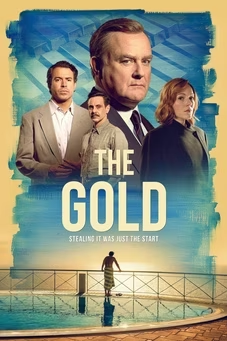
Hugh Bonneville stars in a crime drama inspired by one of the largest robberies in British history.
 New Episode
- News and Public Affairs

Top journalists deliver compelling original analysis of the hour's headlines.

 New Season
 New Episode
 New Episode

 New Episode


Support for PBS provided by:
Political Breakdown is a local public television program presented by KQED