Call The Doctor
Strokes: Get Help Fast
Season 33 Episode 15 | 25mVideo has Closed Captions
Stroke is the 5th leading cause of death in the US with nearly 800,000 cases
Stroke is the fifth leading cause of death in the United States with nearly 800,000 cases diagnosed each year. Having a stroke is considered a medical emergency and the patient should be treated as soon as possible to reduce brain damage. The good news is that fewer Americans die of a stroke because of the effective treatments available.
Problems playing video? | Closed Captioning Feedback
Problems playing video? | Closed Captioning Feedback
Call The Doctor is a local public television program presented by WVIA
Call The Doctor
Strokes: Get Help Fast
Season 33 Episode 15 | 25mVideo has Closed Captions
Stroke is the fifth leading cause of death in the United States with nearly 800,000 cases diagnosed each year. Having a stroke is considered a medical emergency and the patient should be treated as soon as possible to reduce brain damage. The good news is that fewer Americans die of a stroke because of the effective treatments available.
Problems playing video? | Closed Captioning Feedback
How to Watch Call The Doctor
Call The Doctor is available to stream on pbs.org and the free PBS App, available on iPhone, Apple TV, Android TV, Android smartphones, Amazon Fire TV, Amazon Fire Tablet, Roku, Samsung Smart TV, and Vizio.
Providing Support for PBS.org
Learn Moreabout PBS online sponsorship- Stroke: Get Help Fast, coming up next on "Call The Doctor."
(upbeat music) - [Announcer] The region's premier medical information program, "Call The Doctor."
(upbeat music) - Stroke is the fifth leading cause of death in the United States with nearly 800,000 cases diagnosed each year.
One of the most common types of stroke is ischemic stroke.
It occurs when the brain's blood vessels become narrowed or blocked due to a blood clot or fatty deposits that have traveled through the bloodstream and lodged in the blood vessels in the brain.
Risk factors include being obese, high blood pressure, heart disease, or having a COVID-19 infection.
The other type of stroke is a hemorrhagic stroke caused by blood leaking into the brain.
Having a stroke is considered a medical emergency and the patient should be treated as soon as possible to reduce brain damage.
Treatment begins with taking drugs that break down clots and prevent others from forming.
Symptoms of a stroke include trouble speaking, paralysis or numbness in the face, and problem seeing in one or both eyes.
Good news is fewer Americans die of stroke because of the effective treatments available.
Stroke: Get Help Fast, now on "Call The Doctor."
(upbeat music) Welcome to "Call The Doctor" here on WVIA, I'm Paola Giangiacomo.
Tonight our topic is stroke.
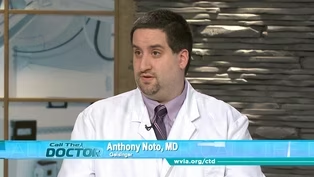
Joining us on the panel, Dr. Anthony Noto.
He is a Medical Stroke Director and Vascular Neurologist at Geisinger.
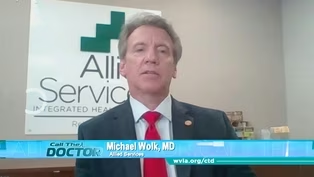
Dr. Michael Wolk is the Medical Director of Allied Services Rehabilitation Hospital, and Medical Director for the Stroke Rehabilitation Program.
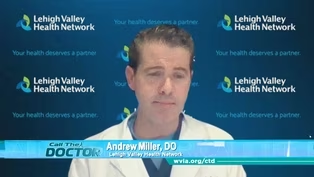
And Dr. Andrew Miller.
He is Chief Division of Emergency Medicine at Lehigh Valley Health Network.
Thank you all for joining us.
I would like to remind our viewers that you can participate in the conversation at wvia.org/ctd.
You can also submit your questions for future shows by emailing ctd@wvia.org or using the hashtag wviactd.
And be sure to check our website for a listing of future programs and watch "Call The Doctor" episodes any time on the WVIA app.
And now we'll begin our discussion.
Dr. Noto, I'll begin with you.
We heard a little bit about what a stroke is in the open, but can you tell us what happens in a person's body, in their brain when a stroke is going on.
- Sure.
A stroke starves the brain of oxygen in certain cases or causes bleeding in the brain, both of those damage the brain and cause it not to function normally.
And so most people develop symptoms including weakness on one side of the body, difficulty with their balance, double vision in certain cases, trouble speaking, drooping of the face.
This is why we talk about BE-FAST, that mnemonic that the American Heart Association put out, balance eyes, face, arm, and then time to get the patient the hospital as quickly as possible.
- Right, the acronym FAST.
- That's right.
- You want to make sure you don't have any face drooping, that's what the F is for?
- That's what the F is for.
A is for arm and S is for speech.
And we actually added two more letters at the beginning, B and E for BE-FAST.
B being balance and E for eyes, because we wanted to make sure that people are aware that strokes can even happen in the back part of the brain, in the balance center and affect their ability to walk and their ability to see.
So trouble with their vision or even double vision.
- Okay.
And Dr. Miller, you work in emergency.
So why is time of the essence when it comes to stroke?
- Well, there's no doubt that the faster that a patient comes in from when they start having symptoms until we can actually initiate treatment, will help the brain, because time is brain cells.
And so every minute and second that there's less blood flow to the brain, will result in death to the brain, which means you're not gonna recover from the stroke.
So we've put protocols in place.
When patients come into the ER, we try to evaluate them quickly, do a quick CAT scan, get them to the stroke neurologist and get them the medication to bust those clots if we can or do any other interventions to kinda open up those arteries and restore the flow to the brain.
- So when a stroke victim comes in, how do you know where the clot is, whether it's in their brain or, what's the first step in diagnosing that patient?
- Well, generally we do three things right away.
Right when the patient comes in, we check their blood sugar, we check their vitals, and we check to see if they're having stroke symptoms.
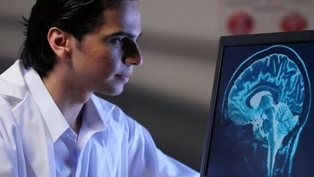
And then frankly, we get them right to a CAT scanner because you can't really tell exactly if they're have a bleeding stroke or a stroke that has no blood flow, both of those are treated very differently and you really need that CAT scan as quick as possible so you can really identify what's going on and where it is in the brain itself.
We know if the symptoms are on one side, like the right side, then the brain is probably affected on the left, it's usually opposite depending on the scenario.
But right away, you have to get them to a CAT scan.
And so it's really important to go to a hospital that has that set up, those processes set up.
So, a stroke center like at Lehigh Valley Hospital, we're able to do that rapidly and get that stroke within minutes of arrival, and that's really important.
- And Dr. Wolk, there are different types of stroke, correct?
- Correct.
As you said in the intro, there's the bleeding type of stroke, and then there's the type where you have a lack of blood flow because a blood vessel is blocked.
- Okay.
And are strokes more common in women than in men, and what would the signs be, Dr. Wolk?
- Well, the signs are similar to what we had said in the introduction with regards to the FAST or BE-FAST.
And, again, it is critical that individuals get to the hospital as soon as possible because it's very time sensitive.
There are certain things that could be done in the emergency room if you get there soon enough.
And the same thing is true with some of the newer techniques that I'm sure Dr. Noto will speak about with regards to being able to actually go in and retrieve the clot and get it out of there.
- Yes.
Is there any new technology?
Because you were saying earlier before we started taping that the new technology that's available can make recovery more successful.
Can you talk a little bit about that?
- Yeah, absolutely.
So in the past few years, we've started sending patients to larger stroke centers when we've identified one of those blood clots in the arteries, because our neurosurgeons and neuroradiologists can go in with a catheter from the groin all the way up to the brain, or from the wrist to the brain, and actually remove that clot.
And they're successful a significant portion of the time.
And if they can restore blood flow to the brain early enough, then we can prevent any further damage from occurring and even reverse some of the damage that's already occurred.
And so the faster that we can do that, the better their chances for recovery.
And, in fact, we only have to do that to three patients to have in certain circumstances to get a really good outcome back to the community, back to work, back to their families at home.
We're talking about the most serious strokes and the really advanced treatment to get that blood vessel open.
- And Dr. Miller, are 87% of strokes ischemic strokes, and what is that exactly?
- Yeah, so ischemic strokes.
Basically, there's a low blood flow.
The artery gets blocked, the vein gets blocked, and there's no blood flow to the brain, the certain areas of the brain.
And that's the most common stroke in adults that we see.
So it's not the bleeding type, like you think an aneurysm blows, that's the bleeding type, or if there's trauma and there's bleeding.
This type of stroke is no blood flow and there's a clot that's blocking the artery.
And so stopping that is really, or opening that blood vessel up is really important.
- So what would cause a stroke, Dr. Wolk?
- What would cause a stroke?
So there's certain things that are tied to stroke, tobacco, high blood pressure, diabetes, family history.
I always say there are certain things that are associated with stroke that you have no control over, and there are certain things that are associated with increased risk for stroke that you do have control over.
- So what would you have control over?
- So, tobacco is an example, monitoring your blood pressure.
Then if you do have high blood pressure, taking appropriate medication.
Monitoring and controlling your blood sugar for diabetes, and much of this also has to do with your diet as well as the amount of exercise that you're doing.
- So if your cardiologist tells you have atherosclerosis, plaque on the arteries, hardening of the arteries, or atrial fibrillation, and that makes you at risk for stroke, would that patient be on blood thinners to help that patient to prevent a stroke, Dr. Noto?
- Yeah, in certain circumstances blood thinners can help.
As the other doctors mentioned, these other types of strokes, these blood clots can come from the heart, they can build up in the arteries as plaques, and they can even affect the tiny arteries in the brain due to things like long-standing high blood pressure.
One, high blood pressure reading is not gonna cause a stroke, but if you have long chronic high blood pressure that's untreated, those arteries thicken over time and then can block off.
And so depending on what risk factors you have, and whether you have plaque in the artery, sometimes that's even treated with surgery to prevent strokes if it gets severe enough.
Or things like aspirin or Plavix can be used to try to make sure that the sticky parts of the blood, the platelets can flow through those arteries well in these tiny arteries in the brain.
And then, yeah, of course, if you have atrial fibrillation and your cardiologist or your primary doctor recommend that you go on a blood thinner because your risk for stroke is so high, that can certainly lower your risk for stroke.
- So what if these medications or these remedies to thin your blood to prevent stroke, let's say they cause side effects.
Would you still recommend these medications to prevent stroke if the side effects are risky?
- Well, a lot of these medications, there are some of the safer medications that we have.
And I think you have to balance those risks and benefits with your doctor.
And, ultimately, I think there are a lot of these side effects that are less severe than having a stroke.
So I think you need to think about that when you talk with your doctor.
- All right, talk with your doctor and get your doctor's advice.
Now, Dr. Wolk, have there been any COVID related strokes since the pandemic started?
- Yes.
Unfortunately, COVID has affected almost every part of the human body, and stroke is an example of something that can occur.
We have seen patients who had COVID, and unfortunately because the COVID infection can increase inflammation as well as increase the chance for blood clotting, we've actually seen individuals who get strokes.
- Have you seen that in the hospital, Dr. Miller, COVID related strokes?
- Yeah, absolutely.
Absolutely, and it's really fascinating how COVID has really affected things.
One of the bigger problems though from a COVID perspective that I see is that people are scared to come into the ER at all.
So they're at home, they're having the facial drooping or they have some weakness, and they're actually scared to come into the ER because of COVID or whatever reason.
And then things are delayed.
So I definitely wanna kind of hit that point home, that don't delay in getting care, don't be worried about COVID.
Come in if you have any of those symptoms.
- That's a very good point, you don't wanna delay getting treatment.
How well should you know your personal health history, Dr. Noto, when it comes to preventing stroke?
- Yeah, it's really important to get checkups to make sure that your cholesterol and your A1C, which is that number that we track for diabetes as well as your blood pressure are under control and we know what those numbers are.
And when you come into the hospital, it's really helpful if you have a list of your medications with you or there's someone who can communicate for you those medications and what you're taking.
Because a lot of the time, if patients are already on blood thinner or sometimes they're not a candidate, for some of these clot busting medication sometimes they're a candidate for other treatments, and the faster we know that, and we don't have to look through the record or try to call family to figure out what people are taking, the faster they can be treated.
So, really important to know what your medications are and what your risk factors are.
- So, Dr. Miller, let's say someone has a stroke, what would the effects be of having a stroke after they leave your emergency room?
- Well, because of the different types of stroke, I guess it depends.
But if a patient comes in and they have that ischemic stroke we've been talking mostly about, if a patient comes in in the right amount of time and they qualify to receive this clot busting medication, then sometimes their symptoms will resolve right in the ER within minutes or an hour.
Oftentimes, what'll happen depending, and Dr. Noto mentioned this, if we wanna send a patient to kind of a major stroke center, because not only the IV medication that we can give, there's these clot retrieval and they go in and actually pick out the clots or do other things to try to resolve some of these symptoms.
- Well, some of the symptoms, what are some of the symptoms of a stroke Dr. Wolk?
- Sure.
- Some of the effects that you see in your rehab.
- So the effects can be very mild and reversible and patients can go home.
Others could be much more profound.
And so you can have anywhere from speech difficulties, swallow difficulties, weakness affecting one side of the body or another.
It can affect therefore your ability to walk.
It can affect your ability to perform what we call activities of daily living, which includes eating, grooming, bathing, dressing, even just being able to stand up.
It can affect bowel and bladder control.
It can affect vision, it can affect balance, and it can have cognitive difficulties as well.
So there's a whole array of different types of syndromes that can result from different types of strokes.
- It's very serious and can alter your life drastically.
And that's why, Dr. Wolk, you're a big proponent of demanding inpatient rehabilitation.
- Yeah, so it's still despite...
Listen, there've been some great advances in the care of stroke patients, from clot busters in the emergency room to the thrombectomies or the retrieval of those blood clots, but it is still the leading cause of long-term disability of any other diagnosis.
And so there are still individuals who still require rehabilitation after getting a stroke.
The greatest window of opportunity is that first one to three months after having a stroke, that's when you have this period of what's called neuroplasticity or where we could really affect changes in the brain.
And the medical literature has shown, the American Heart Association, American Stroke Association even came out with guidelines in 2016 which were even adopted by the VA, including other medical societies that after having a stroke, if you need rehabilitation, inpatient rehabilitation such as that at Allie John Heinz is the place to go at least in our area.
- Why do some people recover with rehab and others don't?
- Well, that's a big question there.
It depends on the severity of the stroke.
It depends upon other comorbidities.
It can certainly depend on the type of stroke program that an individual is getting.
It depends upon the delay in which they got to the hospital.
And there's some people who get there late, or people who don't qualify for getting the clot busters, or who don't qualify for getting the thrombectomy.
So there's a whole host of factors that can lead towards why some people can recover quickly and other people don't.
- And you don't have to leave this area for quality stroke care, right, Dr. Noto?
- Yeah, that's right.
The Geisinger system has two comprehensive stroke centers, one in Wilksbear and one in Danville.
And we have a primary stroke center in Scranton.
And really because we're a system, all of our hospitals are linked by us, by the vascular neurology team so that we can take care of you whatever door you enter and get you to the appropriate center or keep you closer to home if that's appropriate, making sure that you get those clot busters.
And then whatever hospital you are admitted to after your stroke, I think the gear shift a little bit to try and figure out why that stroke happened so that we can put you on the right medication to prevent a stroke from happening.
Around 200,000 of those 800,000 strokes are actually recurrent strokes or a second stroke after the first one, and that's what we really need to cut down on.
Because when you've already shown that you can have a stroke, we got to figure out why so that we can put you on the right treatment to make sure you don't have another one.
- And then there's also a mini stroke, correct, Dr. Miller, what's that?
- Yeah, that's exactly right.
So a patient would come in and they would have a symptom of a stroke and then the symptoms would resolve within an hour.
And then we do MRIs or CAT scans and we don't really see maybe evidence of brain damage, but there are chances, Dr. Noto mentioned, to have another stroke, like a major stroke can happen especially within that first year.
And so trying to identify if they have a blockage in their neck that was causing the stroke, or if they're in the atrial fibrillation, that abnormal heartbeat.
If we can find that cause, we could prevent a major stroke.
And so even if you're at home and you have symptoms for two minutes, five minutes, of what could be a stroke, definitely come into the ER to get checked out because we wanna do a workup.
Even if you're better by the time you get there, this is really important to kind of identify those mini strokes we call them.
- Is there an instance where someone may not know they're having a stroke?
I mean, could that happen, Dr. Noto?
- It could happen.
We have patients unfortunately who don't recognize the signs and symptoms of stroke like we've discussed.
Sometimes family recognizes that something's different, maybe they're walking a little differently or they're not thinking the same way as they were before.
Those can be subtle signs of stroke and certainly a reason to be checked out.
- And in terms of rehab, Dr. Wolk, Allied offers a lot of technology and high end apparatus type equipment to help people recover, isn't that right?
- Yes, there's a lot of factors involved with quality rehabilitation.
The first obviously is the medical care that you can get.
There are certain medications now that can be used depending upon the type of stroke that you have, whether or not you qualify to enhance that recovery.
There's the nursing care.
There's 24 hour RN rehab nursing care.
And then there's the therapy component.
And there's the expertise and experience of the therapists that treat stroke patients.
It's a dedicated stroke program.
And then there is the technology, and there's things where we use functional electric stimulation.
We can use body weight support, gait training where we have a harness on the ceiling.
And it really helps the therapist to help the patient walk.
It's like if you wanna be a better swimmer, the way to be a better swimmer is to swim a lot.
So the way to be a better walker is to be able to walk.
So sometimes if it typically takes three or four people to be able to get somebody to stand up and walk, using a system like this allows them the ability to only have one therapist that's able to walk the individual.
We use virtual reality, we use metronome therapy, there's all kinds of different therapies and techniques that can be used depending on how the patient presents.
- Would the takeaway be from this is that if there's anything you can do to improve your health, now is the time, Dr. Noto?
- Yeah, absolutely, it's not too late.
It's not too late to change your lifestyle.
It's not too late to see your primary doctor or get a primary doctor.
You'd be surprised how many patients come in and they feel healthy, they think they're healthy.
Hypertension or high blood pressure is a silent killer because you don't often have symptoms.
People don't get those headaches or vision changes until the blood pressure has been too high for too long.
And so, yeah, it's not too late.
Go see your primary doctor.
Don't be that person who comes into the emergency room thinking they're healthy and then says, I haven't seen a doctor in 20 years.
You don't know until you go get that checkup and get that lab work and get that blood pressure taken.
So, absolutely go do that today if you haven't.
- And Dr. Miller, how important is diet and exercise?
- Oh, 100% important.
I can't tell you how many times people come in.
And like we were saying, they come in and they haven't seen a doctor, or they've been on medicine and unfortunately their insurance lapses and they haven't taken their medication.
So it's just so important to stay healthy and exercise because the best way to have rehab from a stroke is not to have a stroke in the first place.
And so doing what you can to prevent it is key for sure.
- And in terms of, Dr. Wolk, with therapy, it's not just speech therapy, cognitive therapy, physical therapy, but a severe stroke can leave you having to relearn almost everything, isn't that right?
- Yes.
You take somebody who was a right-handed individual, if they had a stroke on the left side of their brain and affected their right side, yes, we're trying to rehabilitate the right side, but we may have to teach them compensatory techniques on how to be able to use the left side more.
- Because the stroke is really your brain cells have been killed, they're basically destroyed, that's what a stroke does to your brain cells, right, Dr. Noto?
- That's right.
A stroke injures your brain cells.
So think of all the things that we do in our daily lives, all the motions we don't think about when we're talking here or moving, strokes take those away by destroying the brain cells that allow us to communicate and allow us to move around and see and understand when people are talking with us.
Anything the brain does, a stroke can take away.
- Well, I'd like to thank you all for joining us to discuss strokes.
May is Stroke Awareness Month.
So this definitely is bringing awareness to the severity of stroke.
So once again, I'd like to thank our panelists for participating in our discussion on stroke.
For more information and resources on this topic, visit wvia.org/ctd.
I'm Paola Giangiacomo for "Call The Doctor."
Thank you for watching.
(upbeat music) We appreciated.
Are we still on?
- What's up?
- Are we still on?
- No, we're good - Okay.
- Yeah.
- Thank you guys.
- Okay, thank you.
- Thanks.
- Thanks Paola.
- Appreciated.
- Hey, that's pretty high.
- What?
- I can see your ear piece, it's high.
So I'm not sure why you were not coming in.
Strokes: Get Help Fast - Preview
Preview: S33 Ep15 | 30s | Watch Wednesday, May 5th at 7pm on WVIA TV (30s)
Providing Support for PBS.org
Learn Moreabout PBS online sponsorship
- Science and Nature

Explore scientific discoveries on television's most acclaimed science documentary series.

- Science and Nature

Capturing the splendor of the natural world, from the African plains to the Antarctic ice.











Support for PBS provided by:
Call The Doctor is a local public television program presented by WVIA