
Surfridge: The Beachside Neighborhood Erased by LAX
Clip: Season 9 Episode 1 | 9m 8sVideo has Closed Captions
A lost coastal neighborhood erased by the expansion of Los Angeles airport.
Surfridge was once a thriving coastal neighborhood near Los Angeles International Airport. As LAX expanded, the community was gradually erased, leaving behind empty streets and foundations. This segment explores the history of Surfridge and the impact of development and displacement on Los Angeles communities.
Problems playing video? | Closed Captioning Feedback
Problems playing video? | Closed Captioning Feedback
Lost LA is a local public television program presented by PBS SoCal
Surfridge: The Beachside Neighborhood Erased by LAX
Clip: Season 9 Episode 1 | 9m 8sVideo has Closed Captions
Surfridge was once a thriving coastal neighborhood near Los Angeles International Airport. As LAX expanded, the community was gradually erased, leaving behind empty streets and foundations. This segment explores the history of Surfridge and the impact of development and displacement on Los Angeles communities.
Problems playing video? | Closed Captioning Feedback
Where to Watch Lost LA
Lost LA is available to stream on pbs.org and the PBS app.
Providing Support for PBS.org
Learn Moreabout PBS online sponsorship-That's Dockweiler Beach down there.
I've been running down there, and it's really fun with the airplanes coming overhead.
-It's amazing.
-I can imagine that if you lived here, you wouldn't be praising the airplanes.
-Yes.
Having to think about stopping every couple of minutes while the dishes rattle and the conversation stops, yes.
[airplane sounds] -This was part of a larger development called Palisades del Rey that extends all the way up to present-day Playa del Rey.
This was where in what was called Surfridge Estates.
Back when this was developed in the 1920s, Mines Field, which is what is today LAX, was at least a mile out there.
It was a small airport, propeller-driven craft.
That was way out in the countryside on bean and barley fields.
Didn't look like it was going to ever encroach on any suburban development.
-Moving from those propeller planes to the jet age, by the time the '50s and the '60s and the '70s hit, transportation mechanisms had changed.
The lakes got bigger and bigger and bigger.
The runways needed to get bigger and bigger and bigger, and they got closer and closer and closer.
-This is an interesting case study in eminent domain because we usually talk about eminent domain being used against communities that you would call maybe marginalized or disenfranchised.
Right here, this was a middle-class/relatively wealthy neighborhood right on the beach.
-Right on the beach.
It's very hard to put it into that classic story about eminent domain.
-Transportation is obviously something that makes the modern metropolis possible.
It helps you get around the city, connects LA with other cities, but it has costs.
-I think when the neighborhood was first established, I don't think they had any idea at the scale of what was going to become this international, global connection and hub.
I think it's important to put this in the context of a larger LA story, thinking about the ways that transportation has been used both to move the city forward as a bigger metropolis, but also the consequences and the displacement of the people who actually lived in the neighborhoods that get chosen as the sites for these hubs.
We can obviously start with Union Station and the displacement of the Chinese community.
We can think about freeway expansions and cutting through neighborhoods.
Then LAX, I think, offers a long line in the continuum of thinking about how does LA connect both locally and globally.
What I've been thinking more about lately is Vandenberg Air Force Base and the rockets that are now launching.
There are new neighborhoods that are in the path of this big transportation.
It's intergalactic, it's local, it's domestic, it's international.
It's all part of that story.
-Courtesy of the Center for Land Use Interpretation, we do have these amazing real estate listings from the '60s.
I think we could probably find some of these houses.
-I'd love to.
-You want to go check it out?
-Absolutely.
-Let's go take a look.
One of the ironies of this place is that when it was being developed, the developers, they used a few things as a starting point.
They donated land from Loyola University, they built a beach club, and then they also pointed out the proximity to the brand new Mines Field LA Airport.
-That's totally not surprising, right?
I mean, proximity to freeways, proximity to airports.
I think that was part of this.
You could go anywhere.
-Here we are.
Here, let's take a look at this.
We are at 9126 Trask Avenue, and this is the house right here.
-Oh, and it's so beautiful.
I think what we're looking at right now is a driveway.
You can imagine- -Here's the [?]
right here.
--pulling the huge car in.
-[laughs] Right.
-I think one of the things that it's really exciting as a historian is to have these records that can live on, even though the physical has been demolished.
It enables us to do exactly this, to stand in a place where something once existed.
These archives are amazing.
-I mean, this is a real estate listing, just like what you're trying on Zillow today, but it tells a story.
-On to the next one?
-It goes down this way, right?
-Yes.
Perfect.
-Surfridge is unlike any neighborhood I've ever visited.
Walking its once suburban streets today, you find yourself longing for the most mundane sounds of Southern California life.
A lawnmower, a sprinkler, even a gas-powered leaf blower, but all you get is the roar of jet engines and the hiss of blowing sand.
Four or five decades after the houses came down here, nature really is taking over.
It's not just the plants.
I mean, we're walking on top of sand dunes, right?
That's actually what you really see, is the sand is reclaiming this neighborhood.
-You're looking at what's here, and it's really beach.
-When they started building this back in the '20s, there was a scarcity of coastal land that wasn't already occupied by amusement concerns.
One of the rules here is that nobody could build a pier or an amusement park or anything else because Venice, Santa Monica, the coastline was all taken up.
This was some rare residential coastal property.
This is where we are right here.
We're at 255 Jacquelin Street.
Three bed, one bath.
It's going for $34,950.
-Sounds about a good price.
-Yes, I know.
-For how long was it standing from that point on?
-Yes.
The eviction process, or at least the expansion that set the eviction process in place, that started in '68.
This house might have been here for 20 more years, right?
-Exactly.
That is one of the interesting things, I think, about this, is it was such a long, drawn-out, slow decay of a particular neighborhood as one family left after the other.
-The best line here is property will go up in price as this section of Playa del Rey is excellent.
They wrote that after the introduction of jets here.
This was a few years before this area was condemned.
-I think we're looking at real estate language, historic real estate language.
Some things never change, right?
This is due to go up in value.
-One other interesting wrinkle is that at the same time the airport was eyeing this land for whatever use, there were residents on the other side in Inglewood who were encouraging the airport to extend the runways all the way to the ocean so they would have a higher approach.
There were homeowners in one area who were in conflict with homeowners on the other side of the airport.
-Yes.
That, in and of itself, is the true definition of the challenges of regional planning is that we have set up a system where so many small municipalities, especially LA with multiple jurisdictions, it pits people against each other.
It's a big regional network with lots of different implications.
-Now we can hear the waves crashing.
-I know.
That sea breeze really is strong here.
-You're somebody who has a background in both history but also urban planning.
What lessons can you take away from the story of Surfridge as LA continues to evolve into the future?
-Thinking as an urban planner first.
We have an obligation to plan regionally.
We really do have to think about LA as part of a larger ecosystem of transportation, of wildlife, of communities.
We have an obligation to the people who live here to plan effectively so that people can make decisions.
I also think history really does matter because it gives us the opportunity to think about how we didn't do it quite right and how we could do it better in the future.
-Now LAX, maybe not everybody's favorite airport, but we really couldn't do without it either.
-Absolutely.
-Every time somebody gets on a plane and flies out of LAX, they can look down and see this neighborhood.
What should people think as they fly over Surfridge?
-I know that I won't see this neighborhood in quite the same way.
There was a community here.
Children grew up here.
Skateboards and surfboards and hula hoops and all of those things that make Southern California what it is, they were here.
It's a good reminder of the choices that we make in order to serve the larger region.
-Those are the human lives that give a place meaning.
You can't see that 35,000 feet up.
-You can't see that.
-You have to walk through the neighborhood.
-Exactly.
That's why I'm a planning historian.
I believe in urban planning.
I believe in planning for the future, but I also believe in understanding decisions that were made in the past because I think that actually gives us the capacity to make better decisions.
This is an example that we should learn from.
[music] [airplane sounds]
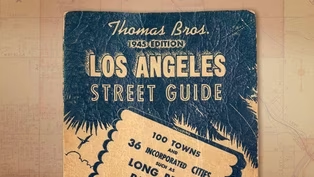
How the Thomas Guide Reveals a Changing Los Angeles
Video has Closed Captions
Clip: S9 Ep1 | 8m 50s | The street atlas that defined how Southern Californian's navigated their city. (8m 50s)
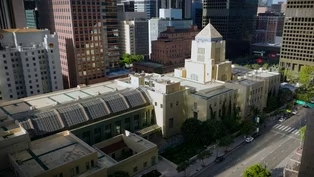
Surfridge, Tehachapi & Thomas Guide: How Southern California Moves (Preview)
Video has Closed Captions
Preview: S9 Ep1 | 30s | Nathan visits Surfridge, the Tehachapi Loop and the largest collection of Thomas Guides. (30s)
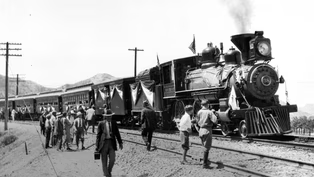
The Tehachapi Railroad Loop Still Powers California Trade
Video has Closed Captions
Clip: S9 Ep1 | 8m 40s | The railroad loop that transformed California trade. (8m 40s)
Providing Support for PBS.org
Learn Moreabout PBS online sponsorship













Support for PBS provided by:
Lost LA is a local public television program presented by PBS SoCal