
The American Southwest
7/8/2026 | 55m 4sVideo has Closed Captions
An unforgettable journey of the majestic Colorado River and the urgent fight to protect its future.
From the Rockies to scorching deserts and iconic landscapes, the mighty Colorado River sustains wildlife and communities. Uncover the region’s deep cultural history and the urgent fight to protect its future. Narrated by Quannah Chasinghorse.
Problems playing video? | Closed Captioning Feedback
Problems playing video? | Closed Captioning Feedback
The American Southwest
7/8/2026 | 55m 4sVideo has Closed Captions
From the Rockies to scorching deserts and iconic landscapes, the mighty Colorado River sustains wildlife and communities. Uncover the region’s deep cultural history and the urgent fight to protect its future. Narrated by Quannah Chasinghorse.
Problems playing video? | Closed Captioning Feedback
Where to Watch The American Southwest
The American Southwest is available to stream on pbs.org and the PBS app.
Providing Support for PBS.org
Learn Moreabout PBS online sponsorshipThe Never Summer Mountains headwaters of the mighty Colorado River.
Fueled by snowmelt from the Rockies, the river and its tributaries grow with each confluence and nourish valley floors and cottonwood galleries downstream.
♪ Along its nearly 1500 mile journey, the Colorado connects the Rocky Mountains to the Gulf of California and nurtures landscapes that are bursting with wildlife.
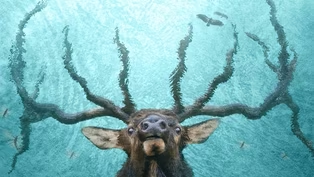
[elk bugle] ♪ [growls] Water is the divine force in this unforgiving landscape, it is the most essential and precious resource that has supported humanity for millennia.
This story follows the Colorado on its journey to sustain society and the natural world through a rapidly changing landscape.
♪ [bugles] Vast herds of elk and other wildlife have roamed the Southwest for millennia.
They supported wolves, grizzlies, mountain lions and jaguars and were an important source of food and clothing for indigenous people.
As the Southwest was colonized much of the wildlife was commercially hunted for meat, hides and for sport.
The slaughter was so extensive that within mere decades, the mountains fell silent.
[thunder] As the last bugles faded, a bold group of early environmentalists and conservation-minded hunters resolved to protect the animals that remained and to begin their recovery.
They led states to regulate hunting, which allowed the herds to regrow and they reintroduced elk and other species across their historic range.
The ongoing recovery efforts have been so successful that elk numbers in the Southwest have increased from a few small herds in the early 1900's to nearly half a million today.
[elk bugles] [elk bugles] The song of the Rockies is a reminder of our ability to both destroy and recover the natural world.
[wind blowing] As autumn gives way to winter, the mountains are enveloped under a deep blanket of snow.
Snowpack is the heartbeat of the Southwest.
It stores and releases water and pumps life into rivers, cities, and ecosystems downstream.
♪ Each spring, the snowpack begins to thaw and the watershed awakens.
[cracking of ice] [water trickling] [water flowing] Thousands of streams from across the Rockies join together in a torrent towards the sea.
[roaring of rapids] [water falling] The peak of the snowmelt, which usually occurs in late May to early June, presents a challenge to one of nature's most ambitious engineers.
♪ The Beaver.
♪ Beavers can weigh more than 60 pounds and their diet consists of grasses, forbs, and tree bark.
A lot of tree bark.
In a traditional beaver family, there is a patriarch and a matriarch.
Their relationships are often longer than the average American marriage.
A beaver couple's dream is to have a pond of their own with a big spacious lodge.
A place to raise a family in peace.
[underwater sounds] ♪ Beaver mothers give birth in the springtime, and on average, they have four very hungry mouths to feed.
Still living in the lodge are her nearly grown kids from last year who help raise the newborns and teach them the family trades of woodwork, hydrology, and construction, which can be very competitive fields.
When they're two years old young beavers leave their parents' lodge to find a partner and build a life of their own.
They seek out an ideal home site, a place with flowing water and plenty of timber and mud for construction materials.
Once located, they begin to chew out a living.
♪ [loud gnawing] [wood creaking] [creaking continues] [creaking stops] [silence] [sigh] [gnawing] [wood creaking] [wood breaking] ♪ Through hard work, determination, and several months of pulling all-nighters, these young couples can build the foundation for their family's success and achieve their great beaver dream.
♪ In pursuit of their ambitions, beavers transform their immediate surroundings, and as a species, they engineer a wetland ecosystem.
By building dams, beavers spread water across valley floors and create a web of channels and ponds called a beaver meadow complex.
Their porous dams filter streams and purify water and their ponds collect sediment and prevent erosion.
Like a sponge, the wetland soaks up water during floods and spring runoff and slowly releases it through the dry summer and fall.
Acting as both a natural reservoir and serving as a fire break.
The impact of beavers is so great that streams with beaver complexes can hold water year-round compared to similar watersheds without beavers.
And although riparian habitats are only found on 2% of the landscape, they contain 80% of the biodiversity in the West.
Beavers make landscapes wetter cooler, and more resilient.
As creeks and rivers flow down from the mountains, their water is often diverted for human use.
By the late 1800s, large canals had been dug along many fertile valleys to spread the power of water across the landscape.
In 1922, the Colorado River Compact was created to legally divide the water between the states.
The Compact split the watershed in half.
The upper basin was allotted seven and a half million acre-feet, as was the lower basin.
Mexico was later granted one and a half million acre-feet.
The Compact gave no water rights to the Sovereign Tribal Nations or to the river itself.
To regulate the water's flow dams were constructed over many rivers and streams.
[humming machinery] Dams impound water and create reservoirs that store it for human use.
The release of water is carefully managed to generate electricity, provide irrigation and fulfill downstream water commitments.
They've helped grow the human population that depends on the Colorado from 2 million people in the year 1900 to over 40 million today.
But the dams and altering the river have come with consequences.
The released water is unnaturally cold.
The water quality is diminished and the altered flows disrupt natural processes.
The disruptions are so extensive that an iconic species of the West now only survives in a small fraction of its historic waters.
This is the largest aquatic insect in North America, the giant salmonfly.
They spend three to five years feeding on vegetation in the boulders and traveling with the river's current.
[rushing water] ♪ [whooshing] ♪ Their constant downstream motion presents a challenge.
How will they travel back upriver to lay their eggs for their offspring to live and grow in the same home waters?
Such a feat requires a metamorphosis.
[distant coyote howls] [crickets chirping] Under the cover of darkness in early summer, the mature salmonflies begin to emerge.
♪ This is their first time to leave the river.
An instinct propels them upwards in search of a safe place to shed their exoskeleton.
[creaking] [more creaking] ♪ After half an hour of struggle they reveal their new adult form.
Four wings will give them the power of flight and the ability to travel upstream to lay their eggs.
By morning, thousands of salmonflies cover the willows, each in search of a partner.
After mating, they wait for dry and sunny conditions with little wind to take flight.
[soaring orchestral score] Rising together, the salmonflies create a swarm that travels up the canyon walls and begins their journey upstream.
♪ The swarm can fly for several miles before the females return back to the water to release their eggs.
Their offspring will now have a chance at life in the same home waters.
It is their final act.
[splashing] [splashing] The salmonfly hatch is a massive transfer of nutrients from the river to the surrounding ecosystem.
[water rushing] As the Colorado and its many tributaries leave the Rocky Mountains behind, they begin to carve their way through the Colorado Plateau.
Water and soil from faraway watersheds converge at each confluence, nourishing fertile valleys and cottonwood forests.
This remote four corners region has been called home for thousands of years.
♪ In Bears Ears National Monument alone, there are more than 100,000 cultural and archaeological sites.
[sombre flute melody] These canyon walls have witnessed the laughter of children and the dreams of their parents for longer than 1,000 human generations.
♪ This individual was part of a community that lived in a multi-room dwelling overlooking the river.
They played games, made music, raised children, and passed down their stories and wisdom to future generations.
♪ Sadly, our understanding of these cultures and their ancient wisdom is incomplete because a genocidal war was waged against their descendants.
And almost all of the archaeological sites have been looted.
[silence] Many panels have been vandalized, and some of humanity's oldest artwork has been used for target practice and is riddled with bullet holes.
This cultural desecration from vandalism is salt in the wound to the partial drowning of their ancestral homes.
[mournful flute] Buried beneath the surface of Lake Powell are more than 3,000 known archaeological sites and Glen Canyon, a canyon whose arches, grottos, and spires are so beautiful, it is often remembered as America's Lost National Park.
When the reservoir is low, its rocky cathedrals are partially revealed, providing a glimpse of the submerged wonders.
[somber strings] Lake Powell was formed by the Glen Canyon Dam in 1963, making Powell the second largest reservoir in North America.
The largest reservoir is 300 miles downstream, Lake Mead.
In total, there are 15 major dams and diversions on the main stem of the Colorado, and dozens more along its tributaries.
The reservoirs expose water to the sun, and over 10% of the Colorado's water is lost to evaporation.
In the hundred years since the Colorado River Compact was created, the annual river flow has diminished from 16.5 million acre-feet to only 13 million acre-feet.
Water is projected to decrease even further, as climate change makes the Southwest hotter and drier.
[silence] These dams and the Colorado's water management system were designed with values that are over a century old for an amount of water that no longer exists.
[electric humming and eerie wind] Hope for revival can be found beneath Vermilion Cliffs along the Navajo Nation.
These canyons are home to one of the planet's most rare and endangered birds, the California condor.
Fewer than 100 condors exist in Arizona and Utah.
[soaring orchestral score] Condors often soar over 100 miles a day and fulfill the important role of scavengers.
This couple has defied the odds and laid hope for the future.
Their precious hatchling will become known as Condor Eleven Hundred and Fifty.
♪ [playful flute] Condor Eleven-Fifty is now five months old and almost fully grown.
He spends his days exercising his wings and exploring the ledges around the nest.
Like all youngsters, he's fascinated with the world around him.
[crumbling rock] [suspenseful strings] [shattering rock] Gravity.
He'll have to overcome that.
[playful orchestral] But for now, Mom has brought home the groceries.
♪ His favorite.
Leftover roadkill.
♪ His parents have chosen a nest location that is 500 feet above a vertical cliff face.
As he grows, his parents must bring back more and more food, which requires them to be gone for days at a time, leaving him alone and unsupervised.
[foreboding orchestral] His only chance to leave the confines of the nest and be with his parents is to fly.
For that, he'll need to keep exercising his wings and practicing.
♪ [flapping] [scrabbling] [descending chaotic strings] [suspenseful music] [silence] Eleven-Fifty survived the fall but he doesn't have the strength or skills to fly back to the nest.
His only hope of returning is to attempt a first ascent.
He begins to climb home.
He's able to find enough holds to climb up the vertical distance and make his way to the same elevation as the nest.
But he still faces the crux of the climb, the gap separating him from the nest.
The gap he originally fell from.
[tense music] Like the condors before him, Eleven-Fifty overcame the odds and returned home.
A few weeks later, with more confidence in his abilities, Eleven-Fifty spread his wings.
[proud, soaring orchestral score] With luck, he will soar for the next 50 years and help increase the endangered condor population, where they will soar over one of Earth's most iconic landscapes: the Grand Canyon.
♪ ♪ The landscapes of the Southwest have inspired some of the greatest conservation efforts in the history of the world.
They led to the creation of national parks and monuments, and to the world's first designated wilderness.
In total, 60% of the Southwest is public land.
They are a beacon of hope for wildlife, and an opportunity for every American to experience wild places and have a stake in the stewardship of our environment.
♪ Downstream of the Grand Canyon, the Colorado flows into the Mojave Desert, a scorching landscape in the rain shadow of the Sierra Nevadas.
Earth's hottest surface temperature, 134 degrees Fahrenheit, was recorded in the Mojave's Death Valley.
The namesake of this desert produces two types of venom, a hematoxin that destroys tissue, and a neurotoxin that attacks the nervous system.
[rattling] [hypnotic drumming] The Mojave rattlesnake.
[enchanting, sinister strings] This female has released pheromones to summon males.
She wants snakelets.
A potential suitor approaches but is he worthy?
She responds to his advances by slapping him repeatedly.
He seems committed, but he'll need to prove himself.
[hypnotic music] His fitness and determination meet her standards, and she coils around him.
She seizes what she needs and drags him by his reproductive organs.
She will keep him locked for the next 12 hours until his usefulness has expired.
[silence] A few months later, she descends into a burrow.
♪ [biological rumbling] [louder rumbling] [squirming] ♪ This mother sacrificed 40% of her body weight and most of her water to deliver life to her 13 offspring.
Such extreme measures are needed for the harsh conditions above.
[silence] Some parts of the desert receive mere inches of annual rain, but inspiration for water efficiency can be found in the Sonoran Desert of Arizona and northern Mexico.
♪ The Saguaro Cactus is legendary for saving water and distributing it to their community.
[thunder] [rain falling] Saguaros funnel water down to their base and soak it up through shallow roots that extend as wide as the cactus is tall.
They store their water in their trunks and arms, which expand during wet times and can hold over 1,000 gallons.
When it's dry, they contract.
Saguaros protect the precious liquid inside, like their lives depend on it.
Their thick, waxy skin shields their water from the sun and nearly eliminates evaporation.
While their rows of needle-sharp spines defend it from any predators.
Their water-saving strategies are so efficient, that saguaros can live over two centuries and can survive years without rain.
During the scorching conditions of early summer they prepare an annual gift for their desert community.
♪ For only one night and day, the flowers bloom and reveal their nectar.
♪ The sweet aroma drifts through the desert air and attracts a variety of pollinators.
[birds chirping] In exchange for the nectar's sugar and moisture, birds, bats, and bees transfer the flower's pollen to other saguaros.
A few weeks later, the flowers mature into a succulent red fruit.
It is a life-saving gift of food and water during the hottest and driest time of year.
The Sonoran Desert's plants and animals have evolved over millions of years to survive and thrive in one of the most arid and unforgiving landscapes on Earth.
In contrast, our water management system is in the early stages of adapting to a desert environment.
[humming turbines] At the Imperial Dam, the Colorado is diverted into the largest canal in the world, the All-American Canal, which transports nearly one quarter of the entire river basin's water to Southern California's Imperial Valley.
In total, the Colorado irrigates over five million acres of farmland.
25% of the Colorado's water used by humans is municipal, commercial, and industrial.
28% is used to irrigate crops for human consumption.
47% is used to grow alfalfa and hay to feed livestock for meat and dairy products.
[mournful orchestral score] The most commonly grown crop in the Imperial Valley is alfalfa.
Around a third of its alfalfa, grown with Colorado River water is exported overseas to feed livestock in foreign countries.
The largest opportunity to save water in the Colorado River system is to transition to more water-efficient agriculture.
[hissing water] By the time the river flows past the border wall, the Colorado is so exhausted, all that remains is the amount of water that is owed to Mexico under the river's compact.
After crossing the border, the river is dammed and diverted for its final time.
Only a small trickle seeps into the river's natural channel.
[somber music] At this location, the mighty Colorado, which carved the Grand Canyon and has journeyed to the sea for 6 million years, ceases to flow completely.
[silence] Less than one lifetime ago, the river spread across a 2 million acre delta, nourishing forests and wetlands that teemed with waterfowl, fish, and jaguars.
This is the delta now, an entirely man-made wasteland.
[silence] This ecological collapse is spreading as the southwest becomes hotter and drier.
It is a symptom of policies and values that ignore the health of the earth.
The same strenuous efforts to conquer the river are now needed to recover it.
On the east side of the delta, a small amount of agricultural runoff seeps into the historic wetland, and has created the Cienega de Santa Clara.
[birds singing] This is a small taste of what the delta once looked like and could look like again, if a portion of the Colorado River is allowed to fulfill its ancient journey and flow to the sea.
[majestic score builds] Restoring the river can be achieved by saving water at every opportunity, and by giving the river the legal right to flow.
[water flowing] The Colorado is the artery that connects landscapes and life.
There isn't a shortage of water in the southwest.
There is an opportunity to better steward this magnificent landscape and its most essential resource.
♪ ♪
Video has Closed Captions
An unforgettable journey of the majestic Colorado River and the urgent fight to protect its future. (30s)
Providing Support for PBS.org
Learn Moreabout PBS online sponsorship New Episode
- Science and Nature

Explore scientific discoveries on television's most acclaimed science documentary series.
 From My Station

 New Season
 New Season





Support for PBS provided by: