
The Black Church in Detroit series and “Caregiving Conversations”
Season 54 Episode 21 | 26m 46sVideo has Closed Captions
The mental health struggles of young African Americans and the challenges and rewards of caregiving.
For Mental Health Awareness Month, our "Black Church in Detroit" series examines the mental health struggles of young African Americans. Host Stephen Henderson sits down with three guests to talk about the church's role in supporting the well-being of young people and how it can partner with mental health professionals. Plus, we’ll hear about the challenges and rewards of caregiving.
Problems playing video? | Closed Captioning Feedback
Problems playing video? | Closed Captioning Feedback
American Black Journal is a local public television program presented by Detroit PBS
The Black Church in Detroit series and “Caregiving Conversations”
Season 54 Episode 21 | 26m 46sVideo has Closed Captions
For Mental Health Awareness Month, our "Black Church in Detroit" series examines the mental health struggles of young African Americans. Host Stephen Henderson sits down with three guests to talk about the church's role in supporting the well-being of young people and how it can partner with mental health professionals. Plus, we’ll hear about the challenges and rewards of caregiving.
Problems playing video? | Closed Captioning Feedback
Where to Watch American Black Journal
American Black Journal is available to stream on pbs.org and the PBS app.
Providing Support for PBS.org
Learn Moreabout PBS online sponsorship- Coming up on "American Black Journal," our "Black Church in Detroit" series examines the mental health struggles of young African Americans.
We'll talk about how the church can partner with mental health professionals to support the wellbeing of our young people.
Plus, we'll hear about the challenges and rewards of caregiving.
Stay where you are, "American Black Journal" starts right now.
(upbeat music) - [Announcer] Across our Masco family of companies, our goal is to deliver better living possibilities and make positive changes in the neighborhoods where we live, work and do business.
Masco, a Michigan company since 1929.
Support also provided by the Cynthia & Edsel Ford Fund for Journalism at Detroit PBS.
- [Announcer] The DTE Foundation is a proud sponsor of Detroit PBS.
Through our giving, we are committed to meeting the needs of the communities we serve statewide to help ensure a bright and thriving future for all.
Learn more at dtefoundation.com.
- [Announcer] Also brought to you by Nissan Foundation, and viewers like you.
Thank you.
(upbeat music) - Welcome to "American Black Journal."
I'm your host, Stephen Henderson.
Today we are continuing our series on "he Black Church in Detroit," which is produced in partnership with the Ecumenical Theological Seminary and the Charles H. Wright Museum of African American History.
May is Mental Health Awareness Month, and the Office of Minority Health says the number of Black youth who are experiencing anxiety, depression and suicide attempts is going up.
The church is often the first responder to this youth mental health crisis, as families turn to pastors and faith leaders before seeking professional help.
Here to talk about a collaboration between spiritual care and clinical care are James White, who's president and CEO of Detroit Wayne Integrated Health Network, Erica Cravens, a board certified behavior analyst and member of Fellowship Chapel.
And the Reverend JB Fields, youth pastor at Hartford Memorial Baptist Church.
Welcome, welcome, all three of you- - Thank you for having us.
- to "American Black Journal."
It's gonna be hard for me to resist calling you Chief.
(everybody laughing) But you're not the chief anymore, but you're the chief of Wayne Integrated Health, (laughing) so that matters.
- Yes, sir.
- I can still use that name.
I wanna talk first about the vision that you have of this crisis, the sight that you have on this crisis at your organization.
I think, for a lot of people, this is outta sight, right?
It's somewhere else, it's hidden.
It's not for you.
- No, it's not for me at all, and it's not for our organization.
So our motto is, "There's no wrong door at DWIHN."
If you can reach us, if you can reach out to us, you come to our facility 24 hours a day, seven days a week, we're gonna provide service.
But to your point, we're seeing a significant uptick in youth behavioral crisis and a significant uptick in the need for youth services.
And we're very focused on it by way of a number of different entry points to DWIHN.
But the issue is here, and it's real.
I'm very happy to be here to really talk about something that needs to be talked about.
- Yeah.
Working with churches, and the Black church in particular, that makes a lot of, I think, intuitive sense in a city like Detroit.
But talk about why now this makes sense for Wayne Integrated Health, and I guess what you hope to enhance about what you can do through the church.
- Yeah, we've had a presence in the church.
We've increased it significantly recently with our faith-based initiative and our programming.
We're also looking at implementation of chaplains in our work, and we don't think there's any better place to be than in the church, in the Black church in particular, in a community like Detroit, where there's such a significant presence with the Black church in our community.
And this is an area where, as you've indicated, they're the first responder.
They're getting these messages, they're getting these asks and these questions that, "What do we do?
We have children that are in need of services.
We have children now that are exposed to things that 20, 25 years ago we didn't see."
You're looking at a computer in all of our pockets called a cell phone, right?
(Stephen laughing) Which gives you immediate access to information, and some good, some not so good.
And now this AI, you know, the implementation of AI, and unfortunately now people are using it to answer questions from a behavioral health standpoint, which they should not be doing.
(Stephen laughing) - It's a little dangerous, right?
- It's a little dangerous.
And they're being guided by this unknown entity.
And so being at the church right now is timely, now's the right time, and to certainly, you know, be in a position where we can provide services and connectivity from the church, and really reducing the stigma around behavioral health issues, because we know in our community- - Still, yeah.
- you know, it still has that stigma of weakness when, quite frankly, the messaging around it should be someone who seeks services is actually a strength, that that's actually something that should be awarded and rewarded by giving you those services.
- Yeah, yeah.
Erica, you are on a different- - Yes.
(laughing) - part of the front lines with this, in the church.
Give us a sense of what this looks like at places like Fellowship.
- So I am a Girl Scout leader for that 10-to-13-year-old group- - Oh, wow.
- and a mentor for high schoolers.
- So you're seeing a lot of it.
(laughing) - So I do get to see quite a bit of it.
I have my own 13-year-old at home, so I also get to get firsthand experience- - Yes.
(laughing) - through conversations and sleepovers that give me insight into the psyche of the adolescent at this point in time.
And it's disturbing, because we have these computers in our pockets, they are seeking out information and they don't know what to do with said information.
They're seeking out information from their friends who are also getting it from this computer situation.
And so you have to be mindful that while it is an advantage, there's several disadvantages.
Adolescents' brains have not fully formed.
They don't necessarily have that social emotional regulation because they've not had the necessary life experiences to kind of know how to navigate.
And a lot of times, they are not necessarily forthcoming with their parents, who sometimes also don't know what to do because they're dealing with their own mental health issues.
And to kind of echo Chief.
(Stephen laughing) Not Chief White anymore though.
You know, there is still that stigma, that what goes on in the home stays in the home.
And while the church is present, so we are facilitating those doors to be opened for you to have dialogue with those who've been exposed to this, those that have experience with this, there's still that foundational belief that, again, it stays in the home.
Now, I think that within Fellowship, we've done a nice job in navigating the older adults, however, young, so that 35 to 50-year-old age group, where they can come into the church, they can work with the youth, they have the experience, but they still have that connection, because while it was some time ago, it wasn't too long ago that they too had certain situations, and while not to the extent that our youth today, with all of the instant information with the social media, we did not have that, we didn't have to face that.
So there's kind of like that fuel to the fire of mental health already.
There's comparison, there's cyber bullying, there's misinformation.
And so if you don't know how to navigate that and you already have a vulnerable psyche, then you're more inclined to go down that hole and you're gonna experience anxiety, depression, and you're going to attempt possibly suicide or possibly be successful.
There are several kids around my child who have discussed suicide- - Is that right?
- who have talked about doing that.
And so now I have to have those hard conversations with their parents, "Hey, you might wanna have them talk to someone.
It's okay for them to talk to someone since they're not talking to you."
- Yeah, What's the role that the church can play here that's different from mental health professionals or other sources?
Like at Fellowship, what is it about that community that stands out?
- I think it's a sense of we recognize that we're fallible, right?
We're all human, we're all privy to whatever experiences are out there amongst everyone.
So we experience anxiety, we experience depression, we experience those senses of a loneliness, even when you're not alone and you have such a large church group in a faith-based organization.
So I think that we definitely put forth that open-door policy.
We make sure that your youth can see someone such as myself.
Someone that's in the youth choir, someone that might be a youth minister, but just two years ago was just getting out of a divorce, or having to navigate that depression-type thing.
So we make sure that our young people know that they are valued, that they are needed and they are worthy of helping.
- Yeah, yeah.
Reverend Fields, give us a sense of how this plays out at Hartford.
And same question, what is it about that community that makes it a first responder and what does that response look like and how is it different from other places?
- Definitely.
I think the first thing is that we all must understand the importance of there being a number of loving adults in any given child's life.
So to have a community where when you bring your child, it's more than just, "Okay, yeah, they're on their way to teen church or to youth church," but no, "How are you?
How are your grades?
Let me get a look at you.
Come on and hug my neck."
(Stephen laughing) You know, like having that real personal communication and connection definitely makes a difference.
Then also there's the opportunity for us to tell our truths, "Yes, I am missing my nana.
Yes, she passed away 26 years ago, but I'm still dealing with that grief," so that we can help them to see that, yes, we are healing and we will always be in the process of healing.
You know, don't ever pretend like you're already there.
Then also just being able to say, "Hey, I'm in therapy myself."
I have two therapists.
I say it often.
(Stephen laughing) Not only do I have a mental health therapist, but I also have a spiritual director.
And not being afraid to mention I did have suicidal ideation when I was in high school.
But now I'm on the other side.
Now I see the difference.
And now after whatever amount of training, I can encourage students to check in on other students, to remind them that when you ask about suicidal ideation, you're not putting the thought in their minds.
But just to let people know, "We care about you, we love you."
And we mentioned the cell phones before, let's take a step back and let's remind ourselves that we are humans first.
Before we're students, before we're workers, before we're clergy, we're people.
- So let's go back to this time that you're in high school and struggling with some of these feelings.
What was it about what was around you at the time that lifted you out of that place?
What were some of the things that you would say were touchstones then?
- I would say, number one, my friends, you know?
It is that moment in life where our friends are more important than our family- - Than everything, yeah.
- Yes, exactly.
(Stephen laughing) Than everything, than breathing.
- Fun times.
- But being able to have those moments of relaxation, of joy, of adventure, but then also to understand, "If I'm going through something, maybe they should not be my very first choice."
So I am grateful.
I tell everyone that has a second and a half to listen that the very first time that I knew I heard from God was when I was going through a very difficult season and was actually on my way to enact a plan to harm myself.
And I heard God say, "Call your father."
And I remember thinking like, "We're not that close."
(Erica laughing) "Right now, I don't care what he has to say."
(Stephen laughing) But he knew exactly what to say.
Yeah, and I'm just grateful, grateful for that opportunity.
And whether it's our birth fathers or our adoptive fathers- - Or uncle, whoever.
- adoptive uncles or whomever.
It doesn't need to be our youth pastor.
It could be such-and-such Unc, maybe you don't remember their name, but you actually have their telephone number.
Maybe it's their wife that's always asking you, "Hey, how's everything?"
You know, reach out for whatever.
And just remembering we have so many more lifelines than we can ever imagine.
- Yeah, yeah.
- Absolutely.
Chief, I'm gonna talk a little about your time as chief here in Detroit, chief of police.
You did a lot of work then to integrate more mental health awareness and response into that work.
I really wonder, in your new role, what you're seeing sort of as different, how is this different from that, or are there things that you learned while doing that in a policing context that really help now that you're outside of that?
- Wow, what a question.
The answer's yes, right, (laughing) to all of that.
But it's very different.
The system, the behavioral health system is what I'm focused on now.
You know, I thought I knew the system.
I'm a behavioral health therapist, licensed therapist.
And so in the police department, when we were implementing cold response, because we recognize, you can't arrest your way out of behavioral health crisis, right?
And when people are getting police officers and they need a doctor, the system's broken.
And so my focus in the police department was to integrate a cold response model that really is a best practice.
And my role currently in working with the current chief, Todd Bettison, we've talked about expanding that, taking it to a 24-hour, seven-day-a-week program.
And we're right now in the process of doing that, because we know that folks that are suffering from, you know, dysregulation and an inability to manage what we would necessarily see as a critical issue, but simple conflict, right, where people are feeling, you know, insulted and disrespected.
Some of that really lives in a behavioral health place where they have either not had it treated, or is in current treatment, or need treatment.
And one of the things that I saw in the police department was this notion of folks getting treatment and then not being where they need it to be, and oftentimes sitting in emergency rooms for hours and hours, when they should be in a behavioral health facility, and sometimes long term, not just for an hour, or two, or three hours, but a long-term facility.
So, you know, in my new role, we're looking at all of that.
You know, we've done some amazing things in terms of opening facilities.
We're getting ready to open another facility on Northwest side of Detroit, on Seven Mile, late this summer, early fall.
It's gonna be helpful.
But long term is outcomes for folks, right?
Folks who are in crisis, folks who are having violent episodes, folks who are engaging folks in conflict, people who are self-medicating.
You know, I'm very concerned, was concerned as chief, also concerned as COD with this marijuana.
And I'm not trying to, you know, look, I know what it does, I know that it's a gateway to bigger problems, but I also know that the way it's being represented now is very dangerous, particularly as it relates to recreational use of gummies and things.
- And for young people.
- And for young people.
You just cannot have that.
And when you have people who are altering their reality daily and constantly, whether it be through substance use disorder, whether it be through drugs and alcohol, gummies, all of that, the outcome is predictable, right?
You're gonna constantly have situations.
- It makes things harder though.
- It makes things harder.
So great question.
A lot of work to be done, and I'm very happy to hear what I'm hearing today.
- Yeah, yeah, we've got a few minutes left.
I wanna have both of our church folk here talk about what you would say to church communities that are struggling with the idea of trying to address this?
We talked about how in our community in particular this is a difficult thing to surface.
And I imagine that there are church communities that are having a hard time with that.
What would you say from Fellowship to some of those places about how to get past that and get into the space of working on this?
- I would say, honestly, to be open-minded, right?
If it's not working, there's nothing wrong with trying something else, right?
- Trying something else.
Yeah.
- Currently, I always ask, "How's that working for you?"
(Stephen laughing) "If it's not working for you, then why not try and take a different path?"
So my background is behavioral, literally looking at behaviors and their functions.
So I do try and approach people from that standpoint so that it's not so aversive, because a lot of times, when you hear mental health, "They're crazy.
They're not strong enough.
I don't understand why they can't just suck it up and walk it off."
Well, here, let me give you the behavioral aspect.
They're looking for attention.
They're looking to escape from something.
They're looking for access to something, right?
And when you reframe it, you can get a wider audience, because it's not within that mental health realm, even though it is.
So I think Fellowship does a great job of allowing us to reframe things so that it's more digestible.
You don't wanna give someone a plate of food and they're allergic to everything on the plate, right?
- (laughing) Right.
- So you have to make sure that you are giving them bite-sized pieces that they can handle, that they're not allergic to, and that they're more open to receive.
- Yeah, yeah.
Reverend Fields?
- Definitely, there are two things that come to mind.
First, it has to do with our heart posture, with our humility, with our overwhelming urge to love and forgive.
If someone were to walk into the church smelling like all outdoors, let's just call it that.
(Stephen laughing) (JB laughing) I like that term.
All outdoors.
- I mean, it could be temporary relaxation, it could be extra work.
You know, do we love on them?
Do we hug them?
We need more hugs.
Let's start there.
Also, let's think about trauma-informed care.
And I don't think that we need so many more lessons, so much more training.
One short YouTube video can make a world of difference.
Understanding the trauma, understanding that adverse childhood experiences, such as neglect, abuse, discrimination and violence, these are explanations for behavior, they're not excuses.
But, okay, you are yelling in this moment.
(Stephen laughing) So instead of me taking it personally, how do I take a second and a half - Oh, that's great.
- to calm down so that I can reengage and show you the pure love of God, as pure as I can manage?
- Okay.
All three of you, great to have you here and great conversation about this.
Thanks for joining us on "American Black Journal."
- Thank you.
- Thanks for having us.
- As part of our ongoing coverage on caregiving, Detroit PBS has produced a series of conversations with local caregivers.
We captured their personal stories about the challenges and rewards of caregiving.
Here are some of those stories.
(bright music) - My first experience was with my mother.
My mother, she passed away, she was 77, and she needed care.
And somebody said they wanted her to go to a nursing home.
And I said, "No, I'll take care of her."
And so I did.
And then it goes all the way down to my mother, my father, my oldest sister, Pocie, Pocahontas, my brother, Thomas.
And then I had my oldest son, Joseph, was diagnosed with AIDS.
So I was his caregiver until he passed away.
And then my husband, the best husband in the world, he became ill with lymphoma, and he kept saying, "Frank, put me in the nursing home."
And I said, "No."
So for almost 10 years he stayed right at home.
But I know that if I were in that position, he would've done the same for me.
And so it's been a long ride, but a satisfying one.
The physical part of caring for them, sometimes it was difficult.
It's my job and it's my choice.
I was chosen to be a caregiver, by God, I guess, because it's like, as soon as one person is taken care of, another one needs me, and I'm here.
I feel proud that I had a chance to serve the people I love.
And my son is taking care of me now, and he's bossy, but I still say, "Wait a minute, I'm still your mama."
So it's still a mixed feeling, a mixed experience, but it's all good.
(bright music) - When I was finishing graduate school, my mother was trying to take care of my grandmother who was diagnosed with terminal cancer.
So as a only child with a mother who's a professional and probably not having a lot of caregiving skills, 'cause my grandmother used to be the one taking care of everyone, I really wanted to come home and help my family.
So just seeing the struggle of my mom trying to balance her career and her work with taking care of my grandmother, and then my grandfather always being the one that was being taken care of and seeing him struggle and decline, watching his wife decline, that was my first experience.
I have a research background.
And so I was like, "Okay, I can come and give back to my community just for a little while," and I was saying that.
Turned into 27 years of being here at St.
Patrick's Senior Center.
And I think just my caregiving experience made me more empathetic to what caregivers and older adults have to encounter.
So here at St.
Patrick's, we try to fill in the gap.
I'm always looking for money for caregiving resources.
I'm asking seniors to volunteer to help my staff, volunteers to help.
We try to find other programs that we can provide that may free up some money, or provide supplies, or get them access to other friends, you know, other senior members who may check on their friend, or they go over and do some things for 'em, or they pick them up, or they take 'em to the store, or they take them a meal to help out.
Sometimes I have to step into a different space from just being executive director, knowing that for many of the older adults that I serve, they don't have anyone.
And so my experience and just who I am makes me say that, you know, I'm their family.
Sometimes people don't know that there's resources available if you're not in that space.
You know, coming to a community center, having instances where outreach can be conducted and you can be a part of that makes you aware of resources.
But when I was a caregiver, I'm a caregiver now actually for my mother.
But when I was a caregiver for my grandmother, we didn't know.
Advice I would give someone who's having difficulties being a caregiver is that to know that you're not alone.
Seek community.
You know, there's resources out there, you just have to know where to look, which is hard, so reach out to your local area agency on aging, reach out to your local senior center, 'cause there are resources and we're here to help you.
Just as much as I give to the seniors they give to me, and they've helped me grow, taught me a lot, using their wisdom and experience to make a difference in my life and make me a better person.
- And you can see more "Caregiving Conversations" at detroitpbs.org.
That is gonna do it for us this week.
You can find out more about our guests at americanblackjournal.org and you can connect with us anytime on social media.
Take care, and we'll see you next time.
(upbeat music) - [Announcer] Brought to you in part by Impart Alliance, Ralph C. Wilson, Jr.
Foundation, and by... Across our Masco Family of Companies, our goal is to deliver better living possibilities and make positive changes in the neighborhoods where we live, work and do business.
Masco, a Michigan company since 1929.
Support also provided by the Cynthia & Edsel Ford Fund for Journalism at Detroit PBS.
- [Announcer] The DTE Foundation is a proud sponsor of Detroit PBS.
Through our giving, we are committed to meeting the needs of the communities we serve statewide, to help ensure a bright and thriving future for all.
Learn more at dtefoundation.com.
- [Announcer] Also brought to you by Nissan Foundation, and viewers like you.
Thank you.
(bright music)
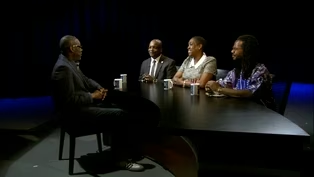
The Black Church in Detroit series examines the church’s role in supporting youth mental health
Video has Closed Captions
Clip: S54 Ep21 | 18m 41s | A look at the connection between spiritual care and mental health care for young African Americans. (18m 41s)
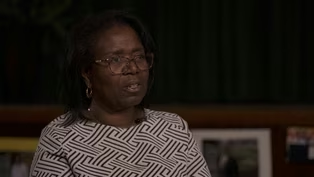
“Caregiving Conversations” highlights caregivers and their stories
Video has Closed Captions
Clip: S54 Ep21 | 5m 22s | As part of our ongoing caregiving coverage, Detroit PBS presents the stories of local caregivers. (5m 22s)
Providing Support for PBS.org
Learn Moreabout PBS online sponsorship New Episode
- News and Public Affairs

Top journalists deliver compelling original analysis of the hour's headlines.

- News and Public Affairs

Today's top journalists discuss Washington's current political events and public affairs.

 New Episode

 New Episode


 New Episode

 New Episode
Support for PBS provided by:
American Black Journal is a local public television program presented by Detroit PBS