
The Black Church in Detroit's One-Year Anniversary
Season 50 Episode 8 | 56m 46sVideo has Closed Captions
The Black Church in Detroit's One-Year Anniversary Celebration | Episode 5008
American Black Journal celebrates The Black Church in Detroit's one-year anniversary in collaboration with the Ecumenical Theological Seminary and the Charles H. Wright Museum of African American History with a special hour-long episode. Host Stephen Henderson explores the impact of the series and the importance of the church in the Black community. Episode 5008
Problems playing video? | Closed Captioning Feedback
Problems playing video? | Closed Captioning Feedback
American Black Journal is a local public television program presented by Detroit PBS
The Black Church in Detroit's One-Year Anniversary
Season 50 Episode 8 | 56m 46sVideo has Closed Captions
American Black Journal celebrates The Black Church in Detroit's one-year anniversary in collaboration with the Ecumenical Theological Seminary and the Charles H. Wright Museum of African American History with a special hour-long episode. Host Stephen Henderson explores the impact of the series and the importance of the church in the Black community. Episode 5008
Problems playing video? | Closed Captioning Feedback
How to Watch American Black Journal
American Black Journal is available to stream on pbs.org and the free PBS App, available on iPhone, Apple TV, Android TV, Android smartphones, Amazon Fire TV, Amazon Fire Tablet, Roku, Samsung Smart TV, and Vizio.
Providing Support for PBS.org
Learn Moreabout PBS online sponsorship>>Just ahead on a special edition of "American Black Journal," we are celebrating "The Black Church in Detroit."
Over the next hour, we are gonna share some of the interesting discussions that we've had on the impact of the church in the African American community, plus a conversation with Detroit's Bishop J.
Drew Sheard and First Lady Karen Clark-Sheard, and a powerful musical performance by Bishop Charles Ellis.
You don't wanna miss this special show.
"American Black Journal" starts right now.
>>From Delta Faucets to Behr paint, Masco Corporation is proud to deliver products that enhance the way consumers all over the world experience and enjoy their living spaces.
Masco, serving Michigan communities since 1929.
>>Support also provided by the Cynthia and Edsel Ford Fund for Journalism at Detroit Public TV.
>>The DTE Foundation proudly supports 50 years of "American Black Journal" in covering African American history, culture and politics.
The DTE Foundation and "American Black Journal" partners in presenting African American perspectives about our communities and in our world.
>>Also brought to you by AAA, Nissan Foundation, and viewers like you.
Thank you.
(upbeat jazz music) >>Welcome to "American Black Journal."
I'm Stephen Henderson.
One year ago, we launched a series of shows on "The Black Church in Detroit."
It's produced in partnership with the Ecumenical Theological Seminary and the Charles H. Wright Museum of African American history.
Today, we're recognizing that anniversary with a special hour-long show on the black church.
Coming up, we'll look back at some of the topics we've covered, including women in the church, how millennials feel about spirituality, the impact of COVID-19 on faith leaders, and ministry beyond the walls of the church, plus BridgeDetroit's Orlando Bailey sits down with Bishop J.
Drew Sheard and Karen Clark-Sheard to talk about his leadership in the Church Of God In Christ, and her role as First Lady and award-winning gospel artist.
And speaking of gospel music, you can't talk about "The Black Church in Detroit" without giving praise to the music.
Stick around for a rousing performance by Bishop Charles Ellis III.
♪ Lose my shackles and he set me free ♪ ♪ I just got to tell you what the Lord has done for me ♪ Help me, choir.
>>Let's start with the PBS documentary that served as the inspiration for our local project.
The four-hour series by Dr. Henry Louis Gates, Jr. is called "The Black Church, This is Our Story, "This is Our Song."
The program traces the 400-year history and culture of the black church.
I sat down with the documentary's producer and director, Stacey Holman, to talk about the impact of the black church.
So let's start with how you came up with the idea for this series, "The Black Church."
In some ways, it's a very obvious part of African American life, but it's something that I think we kinda take for granted.
It's always there.
It's part of our lives from birth (laughs) in our community.
>>Yes, yes.
>>We don't often stop to think about the history and why it's important, and how it's become so important.
>>Well, this is the brainchild of Henry Louis Gates, who I will probably intermittently call "Skip."
I go between those two.
And he had written the treatment, had this idea of doing a series on the black church.
And I had the privilege of being brought on as a series producer and as well as a director for the series.
And it was my role to really help steer his vision into a four-hour program to really talk about the breadth and the width of the black church, particularly in the continent of America specifically.
Because we know that the religion and black church can kind of extend across the borders, but we really wanted to focus on what the institution was here built by black people.
>>I wanna talk a little about the arc of the narrative here with regard to the black church.
Of course, it plays a very pivotal role in early America.
And for African Americans, it plays a very particular role then.
I think it changes over time, of course, because history changes over time.
But talk about the telling that story and making sure that you could be faithful to the idea that even though these things change, and even though it looks different today than it did 200 years ago or 400 years ago, that there's this kinda continuity, I guess, in the role that it plays, and the importance that it has for us as a community.
>>I mean, what you said at the top of the interview is very true.
We all have a root in the black church.
Whether we continue to have that grow in our life, that's told over time.
And I think that's just the ongoing thread and the connective tissue of the story, whether it was our grandmothers or our grandfathers forcin' us to go to church, or whether it was just our friends whose parent was a pastor.
And so we knew we had to go to church in order we could hang out that Sunday afternoon.
So I think, for us, and I hope I'm kinda answering your question, is that just really finding that personal element and pulling on that, so that we can then just really develop that story and show the emotional as well as some of the hard stuff.
I mean, it's not a complete all everything-is-rosy story.
The black church is complicated.
There's still a lot of stuff that we're still struggling with today that necessarily wasn't at the forefront back then, but that also shows the evolution of it and just how it's willing to grow and willing to just take on some of those conversations.
>>Yeah, I'm curious also about the reaction and feedback that you've gotten from people about this portrayal of such an important part of African American life.
>>Overall, it's been very positive, which we're very thankful for.
A lot of people had not been at the church or in the church, it really triggered them and just jogged some really pleasant memories.
For other people, it was just like confirmation of just like, yep, that was my experience; that's what I knew, that's what I understood.
Of course, not everything is perfect, as I said, and we did have, one of the things is we should have covered this.
And that's always a challenge that you have in telling a story.
It's 400 years, you know, (laughs) essentially, 400 years in four hours.
And we also, too, got a little bit of pushback from a lot of black Catholics because they felt, certain individuals, I won't say they as a whole, but individuals felt that that was one story we didn't tell.
I joke with my colleague, the other director, Shayla Harris, who's actually from Detroit.
She was our resident black Catholic, 'cause she did grow up Catholic.
So I was like, well, we didn't really cover the story due to time, but also, too, due to the fact that we were focused on black churches and institutions that were independent of whites.
>>Well, it is amazing work and I think we're all really grateful that you did it.
Stacey Holman, thanks so much for joining us on "American Black Journal."
>>Thank you so much, Stephen.
And I just wanna do a quick plug if people still wanna- >>Sure.
>>Continue to watch it, it's on demand, and also streaming services on Amazon.
And you can, of course, get the DVD, so.
But thank you so much; it was a pleasure.
>>We kicked off our "Black Church in Detroit" series with a show about the historic role of the church in the fight for racial and social justice.
And later, we continue the conversation by focusing on the church as a center for change in the community.
Take a look.
>>Reverend Williams, I'm gonna start with you.
Activism is, I think, for you hand in hand with the pastorship of your church.
And so much of what you do, so many of the reasons that people know you, not just here in Detroit but around the country, are about activism.
So I'm gonna start with you talking about that marriage between the church, the black church in particular, and activism that's focused on social and racial justice.
>>Yeah, you know, look, the black church birthed Black Lives Matter, birthed activism.
It has been the mantra that we have held since we organized the African Methodist Episcopal Church.
Further, since we organized our resources, the First Baptist Church of Savannah, Georgia; oldest institutions that blacks have ever owned, not only in the sense that we were protesting or picketing, but we, at that time, we were providing.
At that time we were opening up our churches for underground railroad.
This is what the fabric of what we've been for black people since the inception of the black church, the historic black church, and it's what we plan to continue to be.
>>Yeah, yeah.
Pastor Barry, I know from your church that that activism takes on a very specific role in your community, and takes on a very specific role with young people in your community.
Talk about what that looks like.
>>Well, one of the reasons why the church has been so successful is because we combine your purpose and your activism with your spirituality.
One of the things that have been quite successful is the fact that we let everybody know that on so many different levels, Jesus Christ and his disciples, and a lot of people in the Bible, were actually activists.
They were standing up for what was right.
They were standing up against the status quo.
They were standing up in the face of evil, and they were lettin' people know that, with God, all things are possible.
And we, as the people of God, we have a role to play in manifesting that in this world.
So we have a particular role.
So our young people in particular, they look for their purpose in life.
And part of that is to stand up for the right thing.
We give them the opportunity to be able to do that.
>>Yeah.
Reverend Simon, what does this look like at Fellowship?
>>You know, when I thought about activism, I had to take it from an academic standpoint, of course.
I am at Fellowship Chapel, which is a very active church.
ETS is ecumenical, but social justice-oriented.
So when I looked at activism and when I teach it in my African American Black Religious Studies course, I talk about it from a historical perspective.
We came from Africa, and I don't mean we came, you were enslaved.
We come to America, and even within that transition, we have held on to what has been activism.
I see activism holistically in that all of our things that we do in terms of the black church is not just the religion.
It's not just understanding the Bible.
It's dealing with every phase of every black person's need.
So even when the slaves would leave the master's church and go to the Hush Harbor, and remember, they did not take that black Bible, there's a black Bible.
I don't know if you've ever heard about it, the slave Bible.
They didn't take that.
They sat down and they talked about how they were going to be active in terms of helping everybody that was part of that slave group through songs, 'cause they sang in the field to let people know they were going to be actively leaving for freedom.
They preached, they talked about the things that people need.
And historically, that has been the activism in black church.
>>What role are you called to play these days?
Bishop Ellis, I'll start with you.
>>Well, you know, I'm carrying on a, 25 years now, legacy from my father who pastored for 34 years.
And he was the first to move beyond the walls of the church in terms of a daycare center, and then a Christian school that went from kindergarten to the eighth grade, and then apartments, so duplexes that allowed people to live in affordable housing.
And then the credit union, federal credit union, federally chartered credit union.
And that was like, wow, we're a bank now, you know?
And so he was the one to see beyond the walls of the church and to see that people had more than spiritual needs, but they had natural needs.
And it kinda was a transition because, before he passed, I was the one that wrote the grant that received $5.3 million from HUD to build Ellis Manor that is here on the new site.
So it was kinda like a transition in the two years after we moved the first residents in, in '94, my father passed, made his transition.
And of course, five years later in 2002, we moved into this facility, six years later, I should say.
So I'm just carrying on that legacy.
And I used to brag here, in a good way, that we did more ministry here at our present site, outside of the church during the summer months than we did inside of the church.
And now we're pretty much doing almost everything outside of the church.
>>Reverend Adams?
>>Yes, and it's really divine providence that we would be on the show together, Bishop Ellis and myself, because his father and my father were contemporaries and colleagues, and very good friends.
And they did a lot of the same work, housing we developed.
Bishop Ellis was a forerunner to that in a lot of housing development around the church.
And we also continued that tradition, and we just completed a senior village right adjacent almost to Northwest Activities Center, $16.5 million project cooperatively with Presbyterian Villages of Michigan, providing apartment-style housing and cottage-style housing right there.
For those who did not want to live in the suburbs, they get to have quality housing in the city of Detroit.
Also, we have tried to ignite employment opportunities through economic development because of our forerunners.
They laid the foundation.
It's an ethos that we are walking in, almost like the scripture that says we live, move, and have our being in God, we live, move and have our being in this idea that church goes beyond Sunday morning.
>>Orlando Bailey, great to see you here on "American Black Journal."
We've been at this for a year now talking about "The Black Church in Detroit" and its importance to people in Detroit, and to the culture in Detroit.
I really wonder what your favorite moment, though, was in that last year.
>>Oh, man, it's been a tremendous year.
And the thing that stands out for me is the opportunity to sit across from, in a socially distanced way, the Bishop Edgar Vann of Second Ebenezer Church, an amazing Detroiter, and one whom I will call "Detroit's Pastor," right, with that amazing voice.
And we had the opportunity to talk about just how he sees the role of the black church in the progression and upliftment of black folks in the past and in the present.
And it was a really palpable, relevant, real, and open and honest conversation.
Talking to Bishop Edgar Vann, that was monumental.
>>And in so many ways, you're right.
He does symbolize not just the church and the congregation he leads here in Detroit, but he symbolizes the relationship between clergy and culture, clergy and politics, clergy and civic duty here in Detroit in a way that most other people don't.
I think that was kind of a pivotal part of this series, was getting to the essence of somebody like that and the role that they're playing.
>>Yeah, and how he has been able for decades now to navigate all of those roles, pastor, dad, husband; one time a police commissioner, and appointee to this board and that task force.
I mean, he's a polymath, and he's still at it, and it was an honor to be able to sit across from him.
It wasn't a Zoom interview.
It was in person across from him and having that conversation.
My grandfather was one of his mentors, and so it was- >>Oh.
>>A full circle moment, yeah.
>>Wow, wow.
So we're not done with "The Black Church in Detroit."
How could we ever be done with a subject like that, but certainly not after a year.
And we've got lots of new material for viewers.
Tell me about what you have coming up.
>>I am so excited about this.
I had the opportunity to interview Bishop J.
Drew Sheard and Lady Karen Clark-Sheard.
I say Karen "The Clark" Sheard.
I mean, she is a legend in her own right.
And Bishop Sheard, within the last year, ascended to the Chief Apostle leadership role of the Church Of God In Christ, which is the largest African American Pentecostal denomination in the world.
And I wanted to ask him how significant it is for the leader of that denomination to be based in the largest majority black city in the United States of America, and what that means for black America, and what that means for the city of Detroit.
We had a really open and honest conversation about the journey, his ascent, the ups and downs.
While he was coming to power, he lost both of his parents to COVID complications.
And so there's some exuberant moments there, but there's also a pinch of sadness that he still carries and that he's working through.
But it was an amazing conversation.
And his wife, Karen Clark-Sheard, First Lady, multiplatinum-selling gospel artist, legendary just in her own right, talking about the ever-evolving role of First Lady.
It was an amazing conversation.
>>Yeah, all right, let's take a look.
>>So Bishop Sheard, I wanna start with you.
You are the leader of America's, of the world's largest African American denomination.
>>Wow.
>>The Church Of God In Christ, right?
How does a J.
Drew from Sorrento on the West side of Detroit rise to be the presiding Bishop of the COGIC Church?
>>Well, I had great parents.
I mean, they instilled in me this godliness, form of godliness, and I've always, from the time I was in the fifth grade, always aspired for leadership.
And I worked at it to be a effective leader in my school while I was going through school.
And had an encounter with God as a very young child.
And I was always very sincere about God and the church.
I love church.
I'm the kid that would gather everybody when we didn't have nothin' to do, and make everybody have church, and I would preach.
>>(laughs) You would play church.
>>Yeah, oh, yeah, oh, man, yeah.
I love church.
And so just to be involved in church was my heart's desire.
And so I'm excited about what God has done in my life and my aspirations to be in leadership, and not only in secular leadership, but in the church leadership.
And God favored me, 'cause he knows my heart.
>>Yeah, talk about your journey to this position, I mean- >>Well, it hasn't been an easy journey- >>Yeah.
>>Of course.
We have had some setbacks, some major setbacks in our personal lives, and we've had some challenges as we fast-forwarded in our church life.
We've had some real heartbreakers.
But nevertheless, we never lost our faith in God.
And that is so critical when you're doing the work of the Lord, because the scripture says, "And we know that all things work together "for the good of them that love the Lord, "and who are the called, according to his purpose."
So the bad things, the ugly things, the good things, the sweet things, the bitter things, they all work for our ultimate good.
And we've had some real challenges.
You know, Orlando, we've had some, fought, we had to fight some hard battles when the enemy thought he was destroying us.
We've had some challenges with my wife and her health and whatnot, but God saw us through.
>>Lady Karen, I gotta ask you.
This man said since the fifth grade, he knew he wanted to be in leadership.
And I heard y'all grew up down the street from each other.
Talk about, 'cause I heard his story, I wanna hear your version of the story.
Talk about where you guys met, all the way to "I do," and what is now.
Did you envision that it would be this?
>>Well, first of all, the greatest decision I could have ever made in my life was saying "yes" and "I do" to this man of God.
Of course, the beginning of our journey, well, as he stated, he was friends with Twinky, and of course, she was like a big sister to him.
And so to make a long story short, Twinky came to me and said, "You have an admirer."
And I'm like, "Oh, Lord, who is this?"
>>(laughs) Twinky was your wingman?
>>That was my partner.
Twinky was my partner.
(laughs) >>And when she told me who it was, when she said it was him, I said, "Oh, no, no, no, no, not him."
Because I saw him being such a gentleman that loved God and the church, and I just saw those great attributes.
And I said, "Wow," I said, "Wow, that," I said.
And I felt that, to be honest, I just felt I wasn't there yet.
>>Yeah.
>>I don't feel that.
Because of what I saw in him, I gave him that respect then.
Even when we were younger, I just saw it in him.
And as we went on, and when he asked me to marry him, we had our ups and downs, when he asked me to marry- >>No, no, I saw your mind go right to it.
(Orlando laughing) He wants to know some of those downs, I thought.
>>I'll leave you alone, Bishop.
(laughs) >>Well, we had those down moments of, I realized, wow.
I, of course, was in the singing group, the Clark Sisters, and I felt, oh, I'm an artist then.
And then when I found out he was doing his trial sermon to be a minister, I'm like, oh, that's a whole different hat that I'm gonna have to wear if he becomes pastor.
Then, as we began to grow together, and I said yes, and he became a pastor, and I'm like, wow, here's another hat; I'm a pastor's wife, you know.
So it's just so many things that I had to, I wanna put it right, because I don't want anybody to misinterpret this.
But a lotta things that I knew that, as a artist, you couldn't do, which was nothing bad, but as a pastor's wife, you had to, you know what I'm saying?
>>There's an added layer there.
>>It's a whole nother thing.
So I'm glad I had a relationship with God to tell me it's not that hard.
Just respect the anointing on his life and I'll bless you, you'll be rewarded for it.
And I've been rewarded ever since I said yes- >>Wow.
>>To this gentleman, I have.
And as you were asking, how was this journey?
It was a great journey.
Even during our moments of when I got sick, he still was there.
He was a pastor then, but he still honored me as his wife.
He didn't step away from being the pastor, but the human side came in, and he was there for me when the doctors gave up on me, gave me 2% chance, and when- >>My God.
>>We got closer.
>>Yeah.
>>Even after I went through my coma.
And when I was in my coma, I came out.
When I found out all of what he began to explain to me what had actually happened, and I'm like, I took you through all of that?
And it's just the human side of him being a great leader, but yet step out of that and become a great husband.
>>To be your husband.
>>Oh, my goodness.
It just took our relationship, made it stronger, and it took our relationship to a whole nother level.
I'm sorry.
>>No.
>>I mean, even dealing with our children, I was glad that he was able to portray him being that godly man, even in front of my son.
Because sometimes that's all they have to look at.
And I hear them now saying, wow, when my mother was sick, it was amazing to watch my father not be so involved in the church, and then taking away from what he's supposed to do at home.
And he just portrayed a great, being a great man of God.
>>Let's talk about your leadership role with the largest African American Pentecostal denomination in the world, the Church Of God In Christ.
>>Yeah.
>>How significant is it for the leadership of the COGIC church to reside in America's largest majority black city?
How significant and historic is it for the leadership to be headquartered right here in the city of Detroit?
>>Well, I'm gonna be honest with you.
I never thought about that until you asked me that, but it is key, because I've always said that Detroit is a "church city."
>>I've said the same thing.
>>Okay?
So me and you touchin' and agreein'?
>>Yes, we are.
>>Okay.
So Detroit is a church city.
There's a couple of cities around the nation that you classify as "church city," but Detroit is among the top, if not the top.
Okay, so- >>Preachin', singin', all of it.
>>Do you see what I'm saying?
>>Yes.
>>And so you got, we're a church city.
I'm a churchman, I love church.
I had, before this pandemic, and I'm lookin' forward to going back to it, we had Bible study Wednesday, Friday night service.
I had two Sunday morning service and a Sunday night service.
So I'm looking forward to that.
>>Lady Karen, you wanted to talk a little bit more about the role of the First Lady.
Say more about that.
>>Thank you, Orlando.
I just want to make a point that they see me singing as an artist all the time.
And, as you stated, I do teach and speak the Word as well.
But our ministry, my husband as the leader of our ministry, is totally built off of the Word of God.
And my point I wanna make is that singing soothes the soul, but preaching frees the soul.
>>Pshew.
>>That's all I wanted to say.
>>Oh, wow.
>>Not surprisingly, the Sheards had a lot more to say, and you can see Orlando's entire interview with them at americanblackjournal.org.
Now we're pleased to share a musical performance, courtesy of the Greater Emanuel Institutional Church Of God In Christ.
(classical piano music) (upbeat gospel music) ♪ Order my steps in your word, dear Lord ♪ ♪ Lead me, guide me every day ♪ ♪ Send your anointing, Father, I pray ♪ ♪ Order my steps in your word ♪ ♪ Please order my steps in your word ♪ ♪ Order my steps in your word, dear Lord ♪ ♪ Lead me, guide me every day ♪ ♪ Send your anointing, Father, I pray ♪ ♪ Order my steps in your word ♪ ♪ Please order my steps in your word ♪ ♪ Humbly I ask you teach me your will ♪ ♪ While you are working, help me be still ♪ ♪ 'Cause Satan is busy, God is real ♪ ♪ Order my steps in your word ♪ ♪ Please order my steps in your word ♪ ♪ Bridle my tongue, let my words edify ♪ ♪ Let the words of my mouth be acceptable in thy sight ♪ ♪ Lord, guide my thoughts both day and night ♪ ♪ Please order my steps in your word ♪ ♪ Please order my steps in your word ♪ ♪ Order my steps in your word, dear Lord ♪ ♪ Lead me, guide me every day ♪ ♪ Send your anointing, Father, I pray ♪ ♪ Order my steps in your word ♪ ♪ Please order my steps in your word ♪ ♪ I want to walk worthy ♪ ♪ I want to walk worthy ♪ ♪ My calling to fulfill ♪ ♪ Please order my steps, Lord ♪ ♪ Oh, to your perfect will ♪ ♪ And I'll do your blessed will ♪ ♪ The world is ever changing ♪ ♪ The world is ever changing ♪ ♪ But I know that God still remains the same ♪ ♪ But you are still the same ♪ ♪ Please order my steps ♪ ♪ Please order my steps ♪ ♪ I'll praise your name ♪ ♪ I want to walk worthy ♪ ♪ My calling to fulfill ♪ >>Over the past year, we looked at the contribution of women in the black church.
We've talked about faith, religion, and gender equality in the ministry, as well as the role of the church's First Lady.
Here are some excerpts from two of those conversations.
It seems to me that when you talk about the idea of the role of black women and black women leadership in the church, you're, by definition, talking about change.
You're, by definition, talking about transition, that this is a role that has changed a number of times across history and is changing even now.
How does that look from your chair?
>>Oh, absolutely, it's transforming ministry with women, particularly black women who are in ministry.
My observation has been that most black women in ministry have been mentored by other black women in ministry.
My mother was a minister in AME Church, Greater Community AME.
I'm fifth generation AME.
My mentor in the Unity Church was Reverend Dr. Ruth M. Moseley, who founded West Side Unity, the church I pastor, more than 56 years ago.
And she also founded the Unity Urban Ministerial School, the theological seminary I graduated from.
So women, you know, Reverend Irma Henderson, many people don't know she was not only a political leader, she was also an ordained minister who was a great mentor to me, as well as Martha Jean McQueen, who was not only a broadcaster, she was also an ordained minister.
So I've been very blessed to have been surrounded by women of faith.
>>So I have been in ministry for 21 years now.
And in that 21 years, I've seen a lot and experienced a lot.
I have been discriminated against.
I have been outright dismissed because of my gender.
I've been told to my face that women should not be pastors or should not preach.
And so I've certainly experienced it both within the church and externally as well.
I've had members who would not open up to a female leader.
But I must say it has not all been bad.
I have been mentored by both men and women.
I'm someone who grew up in a family of men.
I have five brothers, and both of my parents raised us, so it was my mother and I with six men in the household.
And what I did not realize until about a year ago when I was being interviewed, is that that really helped prepare me for leadership in a male-dominated society.
So I've had the challenges, but I've also had really good experiences.
I'm the first female pastor of a church that is 100 years old.
>>Across the church, the American church, people are thinking about, asking the question what does it mean to be the church, right.
And how does that look in terms of the ways in which we do mission and how do we address the needs of those that are in our communities.
And so I think for me, being a millennial, if you will, (laughs) that even with ministry, my ministry looks different.
You know, I started off as denominational staff of a very old, the oldest denomination, Protestant denomination, in the country, in the Reformed Church in America, and started off as denominational staff working in multiracial issues and social justice.
So I was outside of the local church, but was empowering other churches across the U.S. and Canada to meet needs through community-based development sort of work.
And so that was ministry in that context.
And then I found myself migrating to the local church, and I did work there for a few years.
Now, I'm still doing that work here in the city of Detroit, but then I got called to actually go out and to do work in the community development arena.
So part of my ministry is being a Chief Operating Officer for a neighborhood place-based organization called Jefferson East on the East side of Detroit, servicing five neighborhoods, and doing work around housing and economic development, and keeping the community clean and safe.
And that's part of my ministry, too.
>>So I wanna start kind of at the beginning and go back to the place where the two of you had to prepare for these dual roles, these dual responsibilities, and just have you talk about the things that came to your mind, the things that you had to think about, and the way that the two of you wanted to frame this.
Reverend Sheila Vann, I'm actually gonna start with you.
>>Okay, well, we started the journey very, very early.
We'd known each other since we were 12 years old.
I was 12; he was a little bit older than I.
And we were in music together and then started dating.
And then he was called to a church a year before we married.
So the preparation role was, at that time, it's kinda you chart it as you go.
You kinda have to figure it all out.
So Bishop's father was a pastor and been the pastor for years, so he kinda had a guideline.
And, for myself, I kinda had to figure it out as I go.
I had a very role model, though.
My First Lady was a wonderful, wonderful woman, a woman I gleaned from, not even knowing that I would be a First Lady.
And so charting the course is really, 'cause every church is different, and you really kinda have to gauge the people that God had given you, and see what their needs are, and base that course on the need.
Because ministry is about meeting needs.
And so we kinda had to figure it out as we went along.
What you think, Bishop?
>>Well, we were extremely young, and again, we got our start in music.
I was a musician and she was a choir director, and that's how all of the magic got started.
And we learned how to work together from there.
And the role playing really ends up being getting the job done, whatever it takes to get the job done.
And we learned that very, very early, not knowing again, that these skills would be so basic for what I would do and what she would do for the rest of our careers.
And it sort of gave us preparation, again, with some good role models.
It helped us to arrive at a place of competence in terms of working with people and leadership, of course, but also the hard work and the sacrifice that is necessary in order to be successful.
>>Now, let's turn to millennials and their spirituality.
A recent study by the Pew Research Center revealed that young black adults are less religious and less engaged in black churches than older generations.
We spoke with two millennial ministers and one of their mentors about faith among young African Americans.
>>You're a minister in one of the blackest cities, in the blackest city in America.
Tell us what you are seeing.
>>So I definitely am seeing a lotta people that look like me in church.
Now, I'll be honest.
There are people that look like me that are leaving church, but I do wanna come in and highlight those that are sticking to church, those that are comin' to church.
And I think the biggest thing behind it is the community that the church is creating, to make sure that people that come from different ethnic backgrounds or minorities are able to come in, and are able to be able to be themselves, not only with communities that look like us, but communities that are developing diversity as well.
So I think that that's really important.
Just being able to establish healthy communities for people to be a part of when they come to church.
>>What's your level of faith in the ability and even the interest of young African Americans to continue this history and legacy in our community?
>>Well, I have lots of faith in that, because one of the things about it is that I remember so well being that young person, you know, (laughs) and coming along.
And you want opportunity, you want freedom, you want a chance to come into your own.
And so I feel that many of the young people who are coming along now are in the same position.
And had not someone handed it off to me and bidded me forward, who knows where we would be.
So I think that that's what it's about.
The whole cycle is very, very important.
And to have someone of the caliber of Pastor Pressley that we could partner with in ministry, was just dynamic in and of itself.
And so I have plenty of hopes for a bright, bright future for the church in general, but for the ministry that we have been a part of for such a long time in particular.
>>Upon becoming lead pastor here at Third New Hope Baptist Church, I pastored for 10 weeks before we entered into a global pandemic that forced all ministries to kinda engage with technology and a digital platform in order to do meaningful ministry.
And, in that way, really leaning upon our youth and our young adults to be able to lead that charge has been invaluable.
And so as we continue to move forward, I think that that is yet the function and the focus of our ministry is to ensure that we are mission-driven, that we give people an opportunity to make a meaningful difference, and not only in their personal lives individually, but in the communities in which we serve.
And I think that that really is the level that millennials and Gen Zers are looking for.
They want to be able to see a meaningful and significant difference in the communities in which these churches reside, so that we know that we are making a impact in the lives of real individuals.
And so as we move forward, I think one of the things that I have to continue to remind myself of is I'm a pastor who's a millennial, but I don't lead a millennial church.
Because the large majority of our membership is much older than I am.
But that is one of the challenges of ministry, is that as a organization, we have to deal with many demographics and be able to hold them all at the same time.
>>For the past two years, faith leaders have comforted church members as COVID-19 disproportionately affected communities of color.
In some instances, the religious leaders are dealing with their own personal loss and grief as well.
Producer Marcus Green has that story.
>>Faith is the thing I always reflect on, like what the Apostle Paul talks about this weight of glory that is like on the inside.
I feel like that has been the thing, which is really faith, the faith that we have in terms of greater is he that's in us, right?
That that has been the thing that really has allowed me to put one foot in front of the other ever since April 9, which was the day that my mom passed away.
>>I preached the funeral for the daughter of one of my neighbors at a local church.
The funeral was packed.
And at that time, we were told by the White House, and other authorities, wash your hands, don't touch your face, and that was it.
Somewhere along that line, I caught COVID, and wasn't quite sure what it was.
But what happened was my wife, who was caring for me, she also caught it.
And on April 9th of last year, she died from it.
My daughter and I were not able to attend my wife's funeral.
So when my wife was taken by ambulance to Saint Ignace Hospital, I never saw her again.
She left the house, I was sick, I crawled to the window to see the ambulance taking her away, and I never saw her again, never talked to her again.
>>You know, when you minister to other people when they go through challenges, when they've lost family members, well, this time around, I was that person in that seat.
And so I still am.
But even during those times, those months after my mom passed, there was still a congregation that we had to minister to.
And yet we were still grieving.
>>When you preach faith for 40 years, and you encourage families who have lost loved ones, you encourage families through tragedy, you encourage families through their difficulties, in the black church, the "Gospel" and the "Good News," and the comfort of the Word of God and the comfort of the Holy Spirit, you use that as a pastor, as a shepherd.
When it hits you, like it hit me last year, it really pushes a reset button that will determine the fact that my life will never be the same.
You know, what I went through, what my wife probably went through, and the days that I couldn't move, the days I couldn't eat, the days that I was totally helpless, you know?
When I think about this, I get kind of emotional, because I think about what we have gone through.
I cannot describe the, I hate to, as a Christian, call it a nightmare, but a year removed from all of that, now I am revisiting all of that.
>>There's still so many people who suffered, from COVID, major losses.
I know, especially in the black church, there were many leaders that we lost.
There were many black families who lost family members in the church.
>>I'm preaching "The Gospel," I'm president of a seminary training, and this hits me and my family?
Why me?
And the Lord allows us to ask those questions.
But he'll also answer those questions, too.
It's because you're mine.
And I'm trying to say something to the world through people like you, that I'm a God who, even when a tragedy hits your life, I'm doing it for your good, so that you might lift up my name and let the world know about a faith that looks on the bright side.
I'm sad but, and I'm not blaming God, because she belonged to him, and she's where she wants to be.
And he left me here because he has a purpose for me.
And so through all of this, all this pain and agony, and so on and so forth, my faith is greater than it has ever been.
But that also comes out of the crucible of suffering that is traditional in the black church.
And so we have to, we are the light of the world, we're the salt of the earth.
And so this pandemic gives an opportunity for the Lord to showcase his grace and his mercy, and his power of love in a very, very dark time.
>>We wanna thank our "Black Church in Detroit" advisory panel for their incredible guidance during this project.
And of course, we look forward to bringing you more thought-provoking episodes this year.
Meanwhile, you can see the entire "Black Church" series at americanblackjournal.org.
We are gonna leave you now with a musical performance by Bishop Charles Ellis III of Greater Grace Temple, and gospel artist, Paul Porter.
Bishop Ellis wrote, produced and arranged this song, which is titled "Done for Me."
Take care, and we'll see you next time.
(drums beating) (congregation cheers) (big band gospel music) ♪ What he's done for me, what he's done for me ♪ ♪ I just got to tell you, the Lord has done for me ♪ ♪ He loosed my shackles and he set me free ♪ ♪ I just got to tell you what the Lord has done for me ♪ Help me, choir.
♪ What he's done for me ♪ ♪ What he's done for me ♪ ♪ Oh, what he's done for me ♪ ♪ I just got to tell you ♪ ♪ I just got to tell you ♪ ♪ What the Lord has done ♪ ♪ What he's done for me ♪ ♪ Lose my shackles ♪ ♪ Lose my shackles ♪ ♪ He set me free ♪ ♪ And he set me free ♪ ♪ I just got to tell you ♪ ♪ I just got to tell you ♪ ♪ What the Lord has done ♪ ♪ What he's done for me ♪ Let me tell you what he did.
♪ When sin had me out, Jesus took me in ♪ ♪ When I felt all alone, he became my best friend ♪ ♪ And now he's right here with me ♪ ♪ Through the thick and the thin ♪ ♪ I just got to tell you what the Lord has done for me ♪ ♪ He lifted me up when I was feeling low ♪ ♪ And I heard them joy bells ring down in my soul ♪ ♪ I just wanna tell everybody ♪ ♪ And the whole wide world to know ♪ ♪ I just got to tell you what the Lord has done for me ♪ I brought Paul Porter to share in this.
Talk to me, Paul.
>>Bishop.
♪ He brought me out in my reclaim ♪ ♪ And he set my feet on fire on the stage ♪ ♪ And he put a song in my soul today ♪ ♪ And I just got to tell you what the Lord has done for me ♪ ♪ Oh, whoa, what he's done ♪ ♪ What he's done for me ♪ ♪ I just got to tell you ♪ ♪ I just got to tell you ♪ ♪ What he's done for me ♪ ♪ What he's done for me ♪ ♪ Loosed my shackles ♪ ♪ Loosed my shackles ♪ ♪ Set me free ♪ ♪ And he set me free ♪ ♪ Ah, ooh ♪ ♪ I just got to tell you ♪ ♪ I got to tell you ♪ ♪ I just got to tell you ♪ ♪ I just got to tell ♪ ♪ I just got to tell ♪ ♪ Hey, hey, hey, wow ♪ >>Come on and put them hands together.
You can clap your hands.
♪ Ooh, yeah ♪ >>If you in an office complex, find you a private space.
Maybe you're in your home, but give God some praise.
Look back and see where he brought you from.
The choir's gonna do somethin'.
Y'all gotta give 'em a little somethin'.
♪ You gotta tell it ♪ ♪ Done for me ♪ >>Come on, play it.
♪ You gotta tell it ♪ ♪ You gotta tell it ♪ ♪ Done for me ♪ ♪ You gotta tell it ♪ ♪ I got to tell it ♪ ♪ Done for me ♪ ♪ You gotta tell it ♪ ♪ I've got to tell it ♪ ♪ Done for me ♪ ♪ For me now ♪ ♪ You gotta tell it ♪ ♪ I gotta tell it ♪ ♪ Done for me ♪ ♪ You got to tell it ♪ ♪ You got to tell it ♪ ♪ You can't tell it for me ♪ ♪ You gotta tell it ♪ ♪ I've got to tell it ♪ ♪ I've got to tell it for myself ♪ ♪ You've got to tell it ♪ ♪ I've got to tell it ♪ ♪ Done for me ♪ ♪ He blessed me once ♪ ♪ Done for me ♪ ♪ He blessed me twice ♪ ♪ Done for me ♪ ♪ The Lord be blessin' me ♪ ♪ Done for me ♪ ♪ Every day of my life ♪ ♪ Done for me ♪ ♪ When you were down ♪ ♪ Done for me ♪ ♪ To your last dime ♪ ♪ Done for me ♪ ♪ Then God will show up ♪ ♪ Done for me ♪ ♪ Just in the nick of time ♪ ♪ Done for me ♪ ♪ He surprised me and helped ♪ ♪ Done for me ♪ ♪ In the time of trouble ♪ ♪ Done for me ♪ ♪ You can count on him ♪ >>From Delta Faucets to Behr paint, Masco Corporation is proud to deliver products that enhance the way consumers all over the world experience and enjoy their living spaces.
Masco, serving Michigan communities since 1929.
>>Support also provided by the Cynthia and Edsel Ford Fund for Journalism at Detroit Public TV.
>>The DTE Foundation proudly supports 50 years of "American Black Journal" in covering African American history, culture and politics.
The DTE Foundation and "American Black Journal" partners in presenting African American perspectives about our communities and in our world.
>>Also brought to you by AAA, Nissan Foundation, and viewers like you.
Thank you.
(piano notes outro)
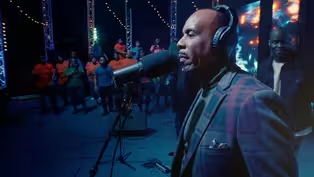
Bishop Charles Ellis III, Paul Porter Perform “Done For Me”
Video has Closed Captions
Clip: S50 Ep8 | 4m 3s | Bishop Charles Ellis III, Paul Porter Perform Original Gospel Song “Done For Me” (4m 3s)
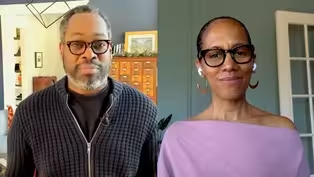
The Importance of the Church in the Black Community
Video has Closed Captions
Clip: S50 Ep8 | 12m 59s | The Importance of the Church in the Black Community (12m 59s)
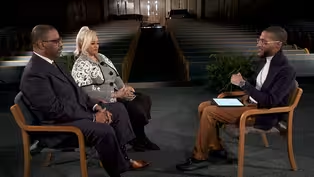
Sheard Family Talks C.O.G.I.C. Church Roles
Video has Closed Captions
Clip: S50 Ep8 | 14m 13s | Sheard Family Talks C.O.G.I.C. Church Roles and The Clark Sisters (14m 13s)
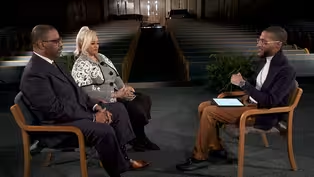
Sheard Family Talks C.O.G.I.C. Church Roles (Extended)
Clip: S50 Ep8 | 38m 25s | Sheard Family Talks C.O.G.I.C. Church Roles and The Clark Sisters (Extended Interview) (38m 25s)
Providing Support for PBS.org
Learn Moreabout PBS online sponsorship
- News and Public Affairs

Top journalists deliver compelling original analysis of the hour's headlines.

- News and Public Affairs

FRONTLINE is investigative journalism that questions, explains and changes our world.












Support for PBS provided by:
American Black Journal is a local public television program presented by Detroit PBS