Smart Start: A KET Special Report
The Challenges of Universal Pre-K
Clip: Episode 1 | 9m 29sVideo has Closed Captions
A panel of experts discuss the challenges involved with universal pre-K.
A panel of experts discuss the challenges involved with universal pre-K.
Problems playing video? | Closed Captioning Feedback
Problems playing video? | Closed Captioning Feedback
Smart Start: A KET Special Report is a local public television program presented by KET
Smart Start: A KET Special Report
The Challenges of Universal Pre-K
Clip: Episode 1 | 9m 29sVideo has Closed Captions
A panel of experts discuss the challenges involved with universal pre-K.
Problems playing video? | Closed Captioning Feedback
How to Watch Smart Start: A KET Special Report
Smart Start: A KET Special Report is available to stream on pbs.org and the free PBS App, available on iPhone, Apple TV, Android TV, Android smartphones, Amazon Fire TV, Amazon Fire Tablet, Roku, Samsung Smart TV, and Vizio.
Providing Support for PBS.org
Learn Moreabout PBS online sponsorshipWe have a great panel assembled to talk about child care, workforce issues.
And joining us in our Lexington studios are Mike Hammonds, vice president of Advocacy and Learning Grove and Northern Kentucky.
Sarah Vanover policy and research director at the Kentucky Youth Advocates.
And Kate Shanks, senior vice president of public affairs with the Kentucky Chamber.
Good to have you all.
Thank you for being here.
Well, Mr. Hammond, we're glad, too, to engage you in this conversation because it kind of blends to the next topic about there's been a lot of conversation about universal pre-K, and we've heard more about that in the last year or so.
And it seems to be perhaps that those who had questions about it are now maybe leaning toward embracing this idea more.
Is this a good option for Kentucky?
And what would be the biggest obstacle other than the cost, do you think, for not pursuing this?
Oh, good question.
I think when the state should start covering the full cost of kindergarten, that freed up local school dollars that local districts have begun to use to expand their preschool options.
So, yeah, you are seeing some expansion of the program.
And we've also had a grant program available for about eight years, I think, Sara, that had money or grants available for schools that would partner with a private charter because the problem for child care with universal preschool is that it draws three and four year olds out of the child care system and three and four year olds subsidize the cost of infants and toddlers.
Sarah was talking about the the staffing ratio for an infant.
It's a lot more expensive.
And typically those cost for cost aren't passed on to parents.
And it I would say that the state doesn't cover that full cost either when reimbursement for the Child care systems program.
So it could be a challenge.
Now, if, you know, if it is to go forward, you know, it's important that it be a mixed delivery approach where schools would take apply the experience that they've had from these grants and working with local Headstart and private childcare providers to expand options.
Now, you know, for schools that are pressed for space, that's an ideal option.
And for parents at one an all day program, it's an it's a much better option.
So but at the same time, we have to be careful that this system doesn't shut down child care because we're already desperate to maintain enough slots for all of the worker working parents that need it.
Yeah, some would say we're already there, aren't we?
That there were at that desperate point.
Now, But.
That would make it much.
Worse.
That would make it much worse.
Do you agree with that, Dr. Vanover?
I would agree.
And we've seen other states that have tried to implement universal pre-K. And when they have tried to do it strictly through the public school system, it collapsed the child care industry and made it so that there was no infant todd And and there are other factors to think about, too, like, is the public school system going to offer full day preschool?
And Kentucky right now, we see half day in almost all settings.
And working parents don't need 3 hours of care.
They need an extended daytime.
They need care for their children during the summers and during winter break and things like that.
So it those partnership between the public preschool and private child care can allow families the support that they need.
But also the public school has things that private child care doesn't like.
Special education support.
And that's huge for children in private childcare, where teachers might not be specifically trained on that.
So really pooling those resources and working together brings about the best case scenario.
You can get state dollars that help infuse into child care programs and make them stronger.
You can have public schools who don't have to run capital campaigns and build new buildings to house all of these children, as well as find staff to to teach all of them.
It's already there.
The resources are already out there with private childcare.
So if we look at moving forward, finding ways to create those partnerships and the public school system, helping to strengthen and infuse those resources into private child care can make a huge, huge success.
What does the Chamber come down on this?
You know, we want an early childhood education system that works.
And I think making sure that we have lots of options so that different communities with different needs can meet the needs of their citizens and of their economy.
I think that's where we're going to be focused on.
We need a system that works.
And I think the points that have already been raised about, you know, do we have the capacity in the schools, what happens to the younger age children in the child care centers when you don't have 14 kids to a teacher and you've got five, you know, five infants to an adult in a room?
And those are real issues that we have to talk about.
And we're dealing with a problem that's that significant, like this one.
If we're going to narrow the path, you know, we have to watch out for those unintended consequences.
So we want an early childhood education system that works because, one, we are preparing our future, our future leaders, our future work, future workers.
And two, we're addressing a current immediate workforce challenge that we have with access to childcare.
And so that might be students in the school system in the three and four year old preschool classes and it might be private childcare center, it might be a family childcare center in a home.
But I do want to touch on something Dr. Vanover said about Kentucky being a model for how we're providing these subsidies to the workforce, childcare workforce.
I think you're starting to see the General Assembly take on workforce issues.
They've been doing it broadly, but I think you're going to start seeing them looking at sectors in different types of workforce problems and trying to find unique solutions for that.
One particular situation.
And that is a very unique solution to handling the workforce challenge that we face in the childcare sector.
Like can we get these people the benefits that they might be eligible for through income, but maybe not so that they'll continue to work in those centers?
And the other thing that we did was test before 99 the Employee Childcare Assistance Assistance Partnership, and that has been a model that's been picked up by other states.
And so it's really interesting to see people looking at Kentucky for the workforce programing that we're doing with the childcare workforce, as well as this new partnership model where employers have skin in the game and they're providing a benefit to their workers as well as the state providing funds.
There were some funds appropriated for that and other states are starting to pay attention.
And I think the reason this matters so much is that, you know, there's a road map for a lot of the work that we do at the chamber.
Here's what I want you to do on taxes.
Here's what I want you to do on infrastructure.
We need to build up our signature industries.
But when it comes to child care, some of these things are rather new and I won't call them experimental because they're data driven and we're really focused on making sure they're successful.
But we're trying some different things and it's starting to work.
And with the Employee Childcare Assistance Partnership, we want to make sure there's a runway for it.
We want to make sure that there's sustainability and that employers know, okay, we're going to continue to do this so we can start this new program.
And that particular program is interesting because it was mentioned that we have benefit cliffs, which we talk about a lot whenever we have public benefits.
And and so if you're someone who's eligible for the child care assistance program, if you make more money and you are no longer eligible, you effectively lose the entire subsidy.
And so having something else you can step down to like a benefit that your employer provides through the Employee Childcare Assistance Partnership can smooth that cliff, so to speak, in a way that you can move into that higher paying job.
That's the right job for your career path without being left, without that support that you used to have.
And so some really interesting, unique things happening in Kentucky on child care.
And you know, we're eager to continue some of that work policy wise in the coming session.
Is that Child Care Assistance, partnership or program, is it being utilized at optimal levels?
That was $50 million that came from the Kentucky General Assembly.
And we had heard over the course since that has become law that people just don't know about it.
Is that still the case?
That is still the case.
It has been up and running for a few months and that is the reason why we need a longer runway on this.
And there is a need to market the program.
Absolutely.
And one of things we found is as families started enrolling in it, they discovered they were actually eligible for the child care assistance subsidy, which pays the full childcare costs.
Well, their costs, the families cost.
And so then they went into that program.
So even a program that's been around a little bit longer, you're still learning.
People are still learning that they're eligible.
Also working with businesses, making sure they know about it, answering their questions.
It's a new program.
You know, you're always going to have those businesses are like, yeah, we're going to hit the ground running on this.
This is important.
And then there's a few that are going to hang back and watch, see what they do, what they learn.
So we're going to keep at it, but definitely promoting it, marketing it, making sure it's a seamless application process, all those things is something we're going to be focused on.
Biggest Factors for Kindergarten Readiness
Video has Closed Captions
Clip: Ep1 | 7m 32s | A panel of experts discuss the biggest factors in kindergarten readiness. (7m 32s)
Child Care Industry's Impact on Kentucky Economy
Video has Closed Captions
Clip: Ep1 | 10m 34s | A panel of experts discuss the child care industry's impact on the Kentucky economy. (10m 34s)
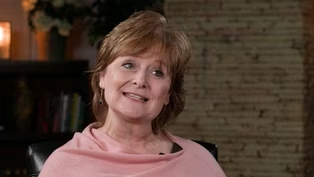
Donna Grigsby, M.D. (Full Interview)
Video has Closed Captions
Clip: Ep1 | 33m 32s | Full Interview with Chief of Division of General Academic Pediatrics. (33m 32s)
Video has Closed Captions
Clip: Ep1 | 6m 54s | A panel of experts discuss the impact of early learning. (6m 54s)
The Importance of Child Care Funding
Video has Closed Captions
Clip: Ep1 | 5m 54s | A panel of experts discuss the importance of child care funding. (5m 54s)
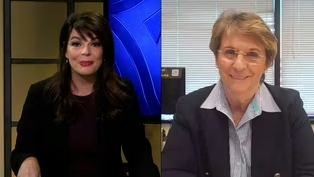
Video has Closed Captions
Clip: Ep1 | 27m 48s | Full Interview with Director of Early Childhood Initiative, Bipartisan Policy Center. (27m 48s)
The Need for Child Care Funding
Video has Closed Captions
Clip: Ep1 | 6m 47s | A panel of experts discuss the need for child care funding. (6m 47s)

Setting a Foundation for Learning
Video has Closed Captions
Clip: Ep1 | 8m 47s | A panel of experts discuss how early education sets a foundation for learning. (8m 47s)
The Status of Kentucky's Early Childhood Education Workforce
Video has Closed Captions
Clip: Ep1 | 4m 47s | A panel of experts discuss the status of Kentucky's early childhood education workforce. (4m 47s)
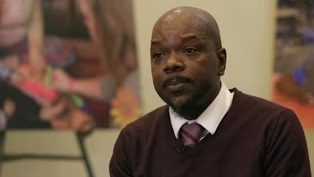
Vaughn Nebbitt (Full Interview)
Video has Closed Captions
Clip: Ep1 | 8m 27s | Full Interview with Vice President of Early Childhood Services Family & Children's Place. (8m 27s)
Providing Support for PBS.org
Learn Moreabout PBS online sponsorship

- Home and How To

Hit the road in a classic car for a tour through Great Britain with two antiques experts.












Support for PBS provided by:
Smart Start: A KET Special Report is a local public television program presented by KET