
The Dowser's Path
Clip: Season 17 Episode 2 | 9m 7sVideo has Closed Captions
Dowsing rods reveal a buried past.
In Nebraska, Bill Bolte walks old cattle trails and quiet graveyards with a pair of bent rods and a gift he can’t explain. What began as a childhood lesson has become a lifelong practice, using dowsing to uncover forgotten histories, lost graves, and 19th-century trails long vanished from the map. Alongside his neighbor, Kyla Greving, Bill demonstrates how centuries-old technique.
Problems playing video? | Closed Captioning Feedback
Problems playing video? | Closed Captioning Feedback
Nebraska Stories is a local public television program presented by Nebraska Public Media
The Dowser's Path
Clip: Season 17 Episode 2 | 9m 7sVideo has Closed Captions
In Nebraska, Bill Bolte walks old cattle trails and quiet graveyards with a pair of bent rods and a gift he can’t explain. What began as a childhood lesson has become a lifelong practice, using dowsing to uncover forgotten histories, lost graves, and 19th-century trails long vanished from the map. Alongside his neighbor, Kyla Greving, Bill demonstrates how centuries-old technique.
Problems playing video? | Closed Captioning Feedback
How to Watch Nebraska Stories
Nebraska Stories is available to stream on pbs.org and the free PBS App, available on iPhone, Apple TV, Android TV, Android smartphones, Amazon Fire TV, Amazon Fire Tablet, Roku, Samsung Smart TV, and Vizio.
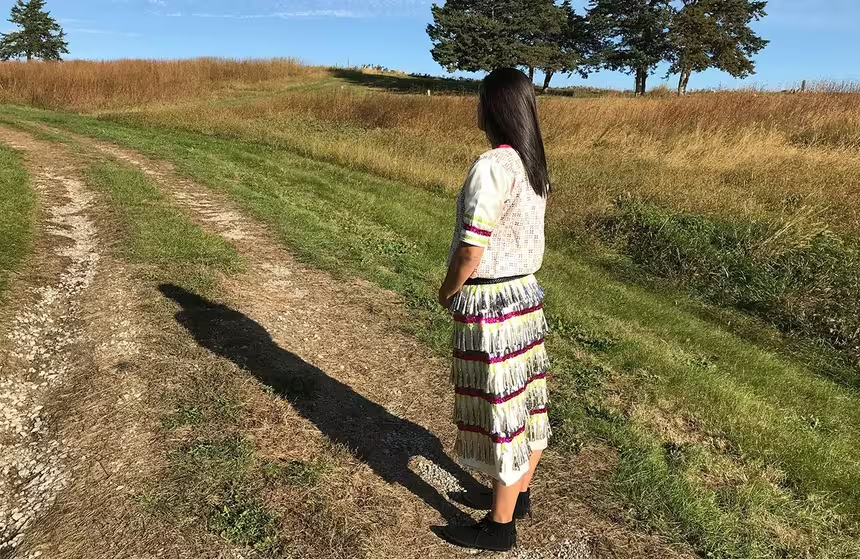
Do you have a Nebraska Story?
Do you have a story that you think should be told on Nebraska Stories? Send an email with your story idea, your name, your city and an email address and/or phone number to nebraskastories@nebraskapublicmedia.org. Or, click the link below and submit your information on nebraskastories.org.Providing Support for PBS.org
Learn Moreabout PBS online sponsorship(gentle music) -[Bill] I think it's just a gift that some people have.
Some don't.
(gentle music) It's unexplainable to what it is, how it works.
I do not know.
I just know that when I cross a trail, they will cross.
If I cross a body in the cemetery, they cross.
(gentle music) To me, it's got something to do with magnetics.
(gentle music) I know it's not proven scientifically.
A lot of people do not believe in it.
(gentle music) I don't know how to explain it otherwise.
(gentle music) It works for me.
(gentle music) -[Narrator] Out here, they say the past leaves a mark.
If you know where to look and how to read the land.
(gentle music) Today, Bill Bolte is searching for what time has nearly erased.
Trailheads from the 1800s.
(gentle music) That once carried herds north from Texas, bound for Railheads, military posts and tribal lands.
(gentle music) -[Bill] This is a map of Cherry County, 1885, and it shows the Ogalala cattle trail crossing (gentle music) the Fort Kearney trail right here, going to the west, and then crosses the North Loop River about a half mile north of where we're standing today.
And they're taking the cattle on up towards Valentine.
(gentle music) -[Narrator] Dowsing has taken Bill across Nebraska, Kansas and Oklahoma, (grass crunching) and the ancestral trails once walked by the Pawnee, Ponca, and Sioux.
(grass crunching) - And this would be the south side of the North Loop River.
And this would be where the cattle would have crossed.
Going north here.
You can see the indentation in the side of the bank where they would caved it off or trampled enough that it still shows up today.
And then I get on the trail here, and as we come down the bank, as they would have you hit the water.
When they got to the water why, it wouldn't magnetize or de-dowse anymore than the rods to open up.
This would have been where the edge of the river bank was at the time they came through here.
(birds chirping) -[Narrator] Bill first learned to dowse as a boy taught by a well man.
At the age of seven, he rediscovered the practice decades later while locating underground utility lines for the public power district.
(gentle music) -[Bill] Before that, we did not have Digger's hotline to do it for us, so we used dowsing rods to find underground lines, telephone, gas, anything like that that we might hit with an auger, trencher or whatever.
(gentle music) (car door clanking) (engine reving) (gentle music) I was led to dowse graves by Sexton.
(gentle music) Somebody wanted to purchase the lot, and he was cautious about somebody being buried there.
We decided if there is somebody buried in this grave so he wouldn't sell that lot.
-[Narrator] In places where markers vanish and records fade.
Dowsing is a quiet way to protect history, ensuring graves remain undisturbed.
(gentle music) -[Bill] Now we're on the back side of the headstones.
And this is where the body will be.
(gentle music) There's one.
Here's the second one.
(gentle music) And then there's the third one.
(gentle music) -[Narrator] For Bill and his neighbor, Kyla Greving, finding forgotten resting places of loved ones is nothing unusual.
- I started dowsing probably about three years ago.
Bill was actually the one who got me into it.
I honestly don't know why or how it works.
(gentle music) I do believe that it might be a little hereditary.
I know my grandfather used to dowse for a lot of people, and I have recently tested a theory with my own father and my uncle.
(gentle music) They can do it as well.
I know that, like my ability to tell the gender is a little bit more powerful compared to theirs to determine the gender.
If it sways north south, it's a male, and if it's east west, it's a female.
This one is marked and it says mother.
(birds chirping) We sway east west.
(grass crunching) (birds chirping) There's the mother.
(grass crunching) (birds chirping) Father.
-[Bill] Now we're on the unmarked one.
(grass crunching) (birds chirping) -[Kyla] I don't think that there's a scientific explanation.
I think either you believe you can do it or you can't.
I do know that there are several people who are unable to dowse, so I don't know.
I don't really know how to explain it and why it works.
If they haven't tried it, how do you know if it's a superstition or if it's an actual art?
(birds chirping) I guess over the years, dowsing has just taught me that there are things in life that is unexplained.
(gentle music) There isn't always an explanation.
(gentle music) -[Bill] There is a starting point in any point somewhere.
(gentle music) And when I find a trail, it's 100 years old.
It's like touching the past.
(gentle music) Here we come across to the Ogallala cattle trail.
(gentle music) And if I back up, get off of it (gentle music) so my rods aren't crossed.
I come over here and they cross over here.
And this would be the Fort Kearney trail that they used.
(gentle music) It would have been a freighting trail going to the Black Hills or to one of the Indian reservations.
This would be the corner of the intersection where the flag is at right now.
(gentle music) We know that this was a cattle trail because oral history tells us so.
Also because of the map of the 1885 that the surveyors marked it on.
When the surveyor first came through here, they were asked to mark any unusual, and this would have been one of the things that were unusual to mark, especially trails.
(gentle music) I think, you know, match what was on the 1885 map.
(gentle music) -[Narrator] Critics call it superstition, others a lost art.
But Bill has his proof trails confirmed by maps and landforms, graves verified by families and records, and old village sites later validated by archeologists.
(gentle music) -[Bill] Some of the places I have walked, I wonder how they did it 8, 10 miles and set up camp weather conditions.
Any time of the year, practically, except bitter cold.
It's a good feeling to know that I can walk where these people used to walk.
(gentle music)
Video has Closed Captions
Clip: S17 Ep2 | 4m 25s | This Nebraska farmer is growing a crop of followers (4m 25s)
Providing Support for PBS.org
Learn Moreabout PBS online sponsorship















Support for PBS provided by:
Nebraska Stories is a local public television program presented by Nebraska Public Media